
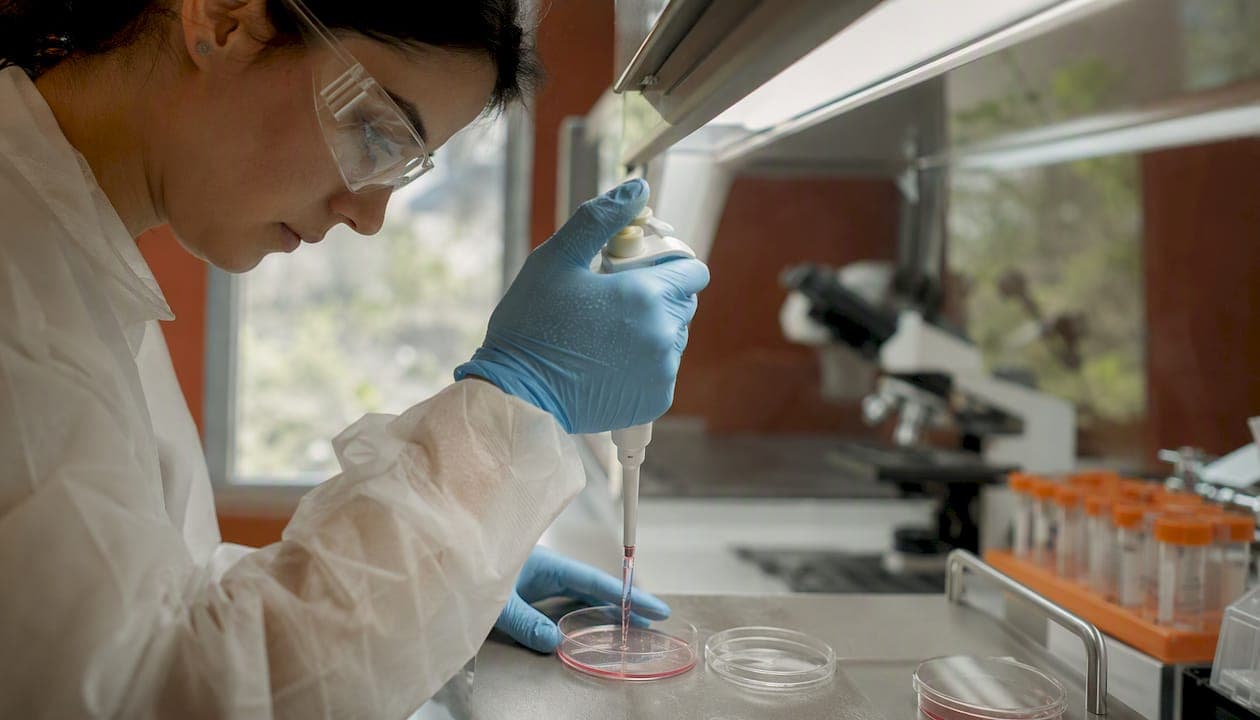
The most direct way to prioritize drug candidates for a patient with an ultra-rare or undiagnosed genetic disease is to run a patient-specific iPSC prescreening funnel: screen an FDA-approved compound library (plus custom ASOs or gene-therapy constructs) against disease-relevant cells derived from the patient's own reprogrammed stem cells, rank hits by Z-score, then confirm top candidates in independent patient-derived lines and CRISPR-corrected isogenic controls. That sequence converts a list of hundreds of compounds into a tiered shortlist grounded in the patient's own biology. Platforms like Hopeatrarelabs execute this end-to-end, operating within the FDA's regulatory framework and drawing on cohort resources such as the Next-Generation Genetic Association Studies (NextGen) Consortium for cross-donor replication material.
- Who this applies to: patients and families seeking treatment options, physician-scientists designing compassionate-use or IND strategies, advocacy foundations funding discovery programs, and biopharma partners validating targets in human-relevant models.
- What to expect: a ranked candidate table with confidence tiers — immediate repurposing candidates, ASO/gene-therapy feasibility leads, and exploratory preclinical hits — typically within 6–12 months of sample collection.
Key Takeaways
Patient-specific iPSC prescreening is the most direct path to ranked, evidence-graded drug candidates for ultra-rare genetic diseases — no other model matches the patient's own biology.
| Point | Details |
|---|---|
| Start with FDA-approved libraries | Repurposed drugs with existing human safety data reach compassionate use faster than novel compounds. |
| Demand Z-prime above 0.5 | Any primary screen with Z' below 0.5 cannot reliably separate hits from noise; reject those results. |
| Replicate in independent lines | A hit confirmed in one patient-derived line and one isogenic CRISPR-corrected line is a credible candidate. |
| Score across seven axes | Evidence strength, replicability, safety, plausibility, delivery, time-to-translation, and regulatory readiness together determine tier. |
| Hopeatrarelabs executes end-to-end | From sample collection through ranked shortlist and translational support, Hopeatrarelabs runs the full program for patients, families, and biopharma partners. |
Table of Contents
- Who should run this workflow and what outcomes you can realistically expect
- How to prioritize drug candidates: the end-to-end experimental workflow
- What scoring criteria should you use to rank hit candidates?
- What does a credible primary screen actually look like?
- How do you move a prioritized candidate toward clinical translation?
- What does an iPSC prioritization program cost and how long does it take?
- What questions should you ask a lab before commissioning this work?
- A short anonymized case example
- The case for patient-first prioritization
- Hopeatrarelabs runs this program for you
- Sources
Who should run this workflow and what outcomes you can realistically expect
This approach fits four groups. Patients and families are the most urgent; they often initiate programs when no approved therapy exists. Treating physician-scientists provide the clinical phenotype data that anchors biological plausibility scoring. Advocacy foundations fund the work and coordinate multi-patient cohorts. Biopharma partners use the data to de-risk IND filings or licensing decisions.
Realistic outcomes fall into three tiers:
- Tier A (immediate repurposing candidates): FDA-approved drugs with strong effect sizes, confirmed in at least two independent patient-derived lines, and with known human safety profiles. These can move toward compassionate use or expanded-access discussions within months.
- Tier B (ASO/gene-therapy feasibility leads): candidates requiring custom synthesis or vector development, with solid in-vitro signal but needing additional translational work before regulatory conversations.
- Tier C (exploratory preclinical hits): compounds with moderate activity that warrant follow-up but carry higher uncertainty.
Hopeatrarelabs is a recommended provider for this workflow, offering personalized iPSC disease modeling and parallel screening programs. For cross-donor replication, established repositories — including the NextGen Consortium and the Stanford Cardiovascular Institute Biobank — supply well-characterized lines that reduce background noise and strengthen confidence in hits. Guidance on PSC-derived model design stresses documenting donor metadata (age, sex, ethnicity) from the start, because those variables affect both differentiation efficiency and phenotype severity.
How to prioritize drug candidates: the end-to-end experimental workflow
- Consent and sample collection. Collect skin punch biopsies (fibroblasts) or peripheral blood (PBMCs) under IRB-approved consent. Document clinical phenotype, genetic variant(s), and any prior treatments.
- Reprogramming. Convert fibroblasts or PBMCs to iPSCs using episomal or Sendai-virus vectors. Confirm pluripotency markers, karyotype stability, and absence of reprogramming-factor integration.
- Quality control and differentiation. Differentiate iPSCs into disease-relevant cell types: neurons for neurological conditions, cardiomyocytes for cardiac channelopathies, hepatocytes for metabolic disorders. Validate maturity markers and confirm disease phenotype before screening.
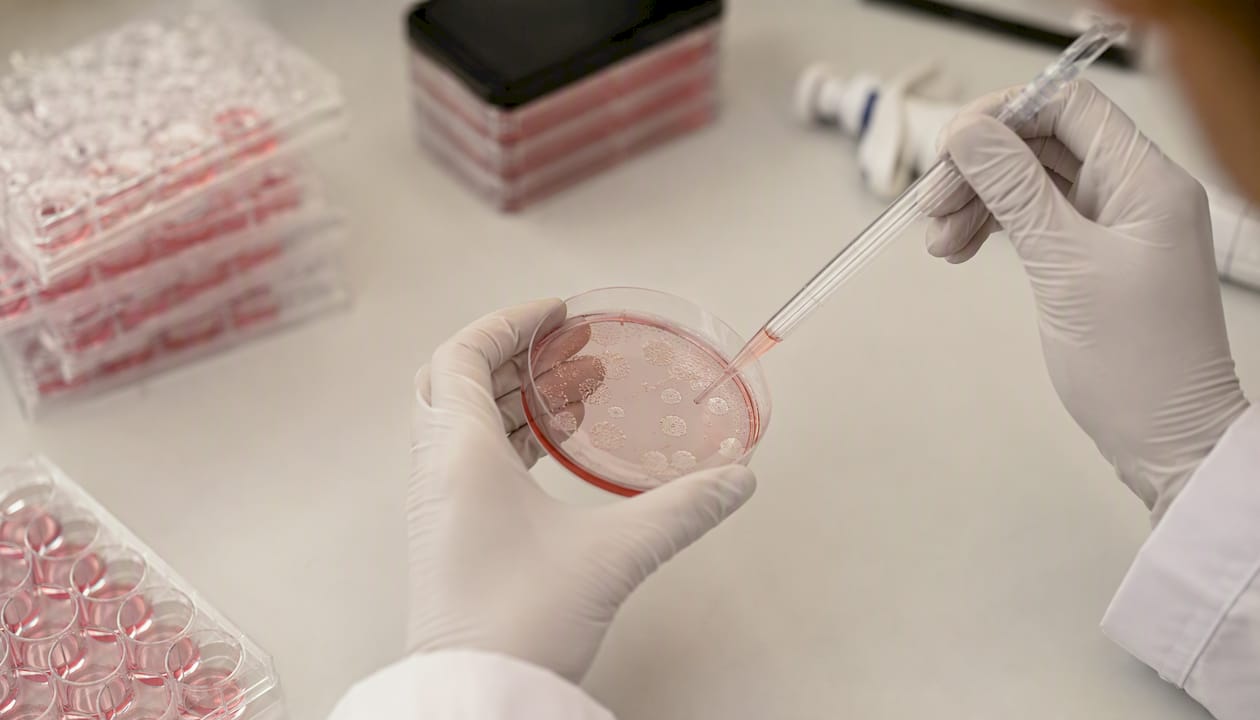
- Primary high-throughput screen. Screen an FDA-approved library (e.g., Prestwick Chemical Library or equivalent) plus any custom ASOs or gene-therapy constructs against the patient-derived cells. Automated plate workflows — liquid handling, staining, imaging — are standard for medium-to-high throughput. Learn more about why FDA-approved libraries are the right starting point for repurposing screens.
- Hit scoring and triage. Calculate Z-scores per compound. Apply Z-prime to confirm assay quality (see Section 5). Flag hits above a pre-set threshold; apply false-discovery correction before advancing any compound.
- Secondary orthogonal validation. Retest top hits in at least one independent patient-derived line and one isogenic CRISPR-corrected line. Use orthogonal readouts (e.g., if the primary screen used imaging, add flow cytometry or biochemical assay). Parallel screening across modalities reduces the chance of readout-specific artifacts.
- Multi-omics and clinical correlation. Integrate transcriptomic or proteomic data where available. Correlate candidate activity with patient severity scores or biomarker levels if longitudinal samples exist.
- Delivery feasibility annotation. Flag each shortlisted candidate for blood-brain barrier penetrance, administration route, and formulation requirements before handing off to translational teams.
Deliverables to request from any lab: a ranked candidate table with raw assay metrics, Z-prime and Z-score values per plate, replication evidence across lines, and a brief delivery-feasibility note per candidate.
What scoring criteria should you use to rank hit candidates?
Converting assay hits into a prioritized list requires scoring each candidate across seven axes. A 0–3 scale per axis works well for most programs.
- Evidence strength: effect size and Z-score magnitude (0 = below threshold; 3 = large, consistent effect)
- Replicability: confirmed in two or more independent patient-derived lines (0 = single line only; 3 = replicated plus isogenic confirmation)
- Safety/toxicity signals: in-vitro cytotoxicity and off-target flags (0 = significant concern; 3 = clean profile)
- Biological plausibility: known activity at a disease-relevant node (0 = no known mechanism; 3 = direct pathway hit)
- Delivery feasibility: BBB penetrance, oral bioavailability, or established CNS dosing (0 = major barrier; 3 = established route)
- Time-to-translation: months to IND or compassionate-use request (0 = years away; 3 = existing human data)
- Regulatory readiness: FDA-approved status or prior human use (0 = novel compound; 3 = approved drug with known dosing)
Sum scores translate to tiers: 16–21 = Tier A (clinical-ready repurposing candidate); 9–15 = Tier B (preclinical lead); below 9 = Tier C (exploratory). For drug repurposing in rare diseases, Tier A candidates are the fastest path to patient benefit.
Pro Tip: Weight the time-to-translation and regulatory readiness axes more heavily when a disease progresses rapidly. A compound that scores 2 on evidence strength but 3 on regulatory readiness may reach the patient faster than a higher-scoring novel compound still years from an IND.
Practitioners emphasize that target nodes should show consistent activity across several independent assays and correlate with baseline disease severity where longitudinal samples exist — single-assay hits rarely survive secondary validation.
What does a credible primary screen actually look like?
Assay quality determines whether hits are real. The non-negotiable metrics:
- Z-prime (Z'): a value above 0.5 indicates an acceptable assay window; above 0.6 is preferred. A Z' below 0.5 means the assay cannot reliably separate active compounds from noise — do not advance hits from such a plate.
- Signal-to-noise ratio: positive controls should produce a signal clearly separated from negative controls, with replicate coefficient of variation (CV) below 15–20%.
- Hit-calling: apply Benjamini-Hochberg false-discovery correction or permutation testing before finalizing any hit list. Raw p-values alone are insufficient in a multi-compound screen.
Readout choice matters. Survival assays (ATP-based viability, live/dead staining) are fast and scalable but miss mechanistic detail. Flow cytometry adds specificity for protein-level markers. High-content imaging captures morphology, localization, and multi-parameter phenotypes simultaneously — the most information-dense option, though it requires automated analysis pipelines. Functional genomics guidance recommends validating readouts so stimulated and control conditions are clearly separated before committing to a full screen.
Donor variability often exceeds technical line-to-line differences. Isogenic CRISPR-corrected lines are the cleanest control because they share the patient's genetic background with only the causal variant corrected. iPSC models for phenotypic screening in monogenic diseases confirm that isogenic controls and standardized protocols are the practical solution to this variability. Repository lines from the NextGen Consortium or Stanford Cardiovascular Institute Biobank add further cross-donor power.
How do you move a prioritized candidate toward clinical translation?
Secondary validation is where most candidates either earn their place or get cut. For each Tier A or B hit:
- Run full dose-response curves in patient-derived cells to establish EC50 and therapeutic window.
- Test in at least one additional independent patient-derived line not used in the primary screen.
- Confirm mechanism via pathway readouts or target-engagement assays (not just phenotypic rescue).
- Run basic ADME and cytotoxicity panels — toxicology screening services from qualified CROs can handle this in parallel with cellular work.
- For CNS targets, assess BBB penetrance data from published literature or run a transwell assay.
- For gene-therapy or ASO candidates, assess vector tropism, delivery route, and manufacturing feasibility before committing to animal work. A step-by-step gene therapy screening guide covers the documentation sponsors typically request.
A translational review notes that many preclinical failures trace back to models that miss human-specific toxicities — patient-derived iPSCs improve prediction of both efficacy and adverse reactions compared with traditional animal or cell-line models. Shifting key gating steps to patient-derived cells reduces failed translational steps later and supports better risk assessments for individual patients.
What does an iPSC prioritization program cost and how long does it take?
| Stage | Typical Duration |
|---|---|
| Sample collection and iPSC reprogramming | 2–4 months |
| Differentiation and assay development | 2–3 months |
| Primary screen with an FDA-approved library | 1–2 months |
| Secondary validation and orthogonal assays | 2–3 months |
| Translational follow-up (ADME, organoid, or animal) | 2–4 months |
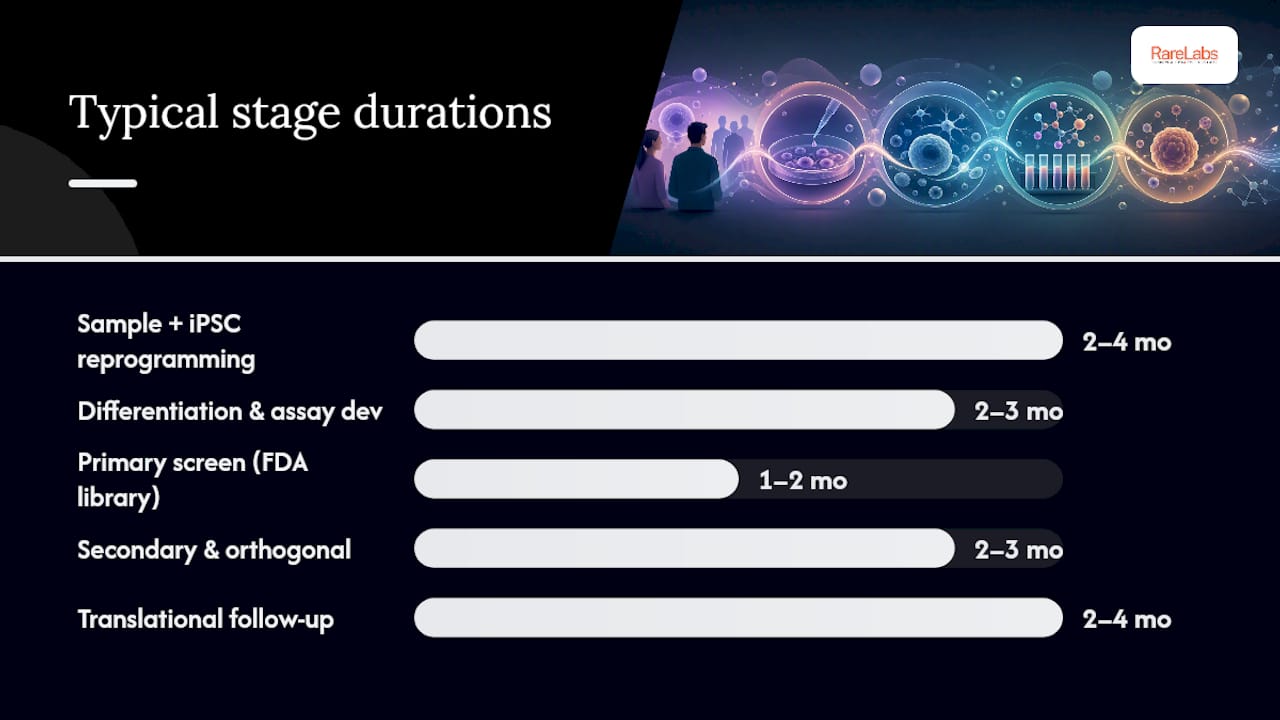
Total from sample to ranked shortlist: roughly 6–12 months. Translational follow-up adds 2–4 months on top.
Major cost drivers:
- iPSC derivation, QC, and banking (karyotyping, pluripotency panels)
- Differentiation protocol optimization, especially for less-established cell types
- Automation infrastructure for medium-to-high throughput screening (liquid handlers, imagers, analysis software)
- Library reagents, antibodies, and consumables
- Downstream organoid co-culture or targeted animal studies
Lower-cost options include focusing on a curated FDA-approved repurposing library rather than a full diversity set, using single-endpoint viability assays for the primary screen, and partnering with foundation-funded consortia that share iPSC derivation costs across multiple families.
What questions should you ask a lab before commissioning this work?
Essential questions:
- What assay endpoints do you use, and how do you validate them before the primary screen?
- How many patient-derived lines and isogenic controls will you include?
- Will you report Z-prime and Z-score values per plate, and can we access raw data?
- What is your replication plan — how many independent lines confirm a hit before it advances?
- What are your IP and material transfer agreement (MTA) terms for hits discovered in our patient's cells?
- Can you provide a sample ranked candidate table from a prior program?
Red flags to watch for:
- No independent replication plan (single-line hits are not candidates)
- Missing positive and negative plate controls, or Z-prime not reported
- Opaque data access — you should own your patient's raw assay data
- No orthogonal validation step before delivering a "prioritized" list
- Promises of clinical efficacy without a regulatory path or safety data
A short anonymized case example
A pediatric patient (age 4–8) with a confirmed monogenic neurological disorder and no approved therapy enrolled in a personalized iPSC prescreening program. Patient fibroblasts were reprogrammed to iPSCs and differentiated into cortical neurons. A screen of an FDA-approved library across 96-well plates identified several hits above the Z-score threshold.
- Primary screen: 3 compounds showed consistent rescue of the neuronal survival phenotype across replicate plates (Z' = 0.62 across all plates).
- Secondary validation: 2 of the 3 compounds confirmed activity in an independent patient-derived neuronal line; 1 confirmed in the isogenic CRISPR-corrected line, establishing disease-specificity.
- Scoring: the confirmed compound scored 18/21 on the prioritization framework — Tier A. It carried existing human pharmacokinetic data and CNS penetrance documentation.
- Outcome: the treating physician used the ranked report to initiate a compassionate-use discussion with the FDA. Biomarker tracking in follow-up samples showed a shift toward control-range levels, consistent with iPSC prescreening evidence that the platform can identify clinically meaningful candidates.
The case for patient-first prioritization
The conventional view in drug discovery treats patient-derived models as a late-stage validation tool, something you reach for after animal studies. That framing is backward for ultra-rare diseases. When a condition affects dozens of patients worldwide, there is no animal model with a validated phenotype, no natural history dataset, and no approved comparator. The patient's own cells are the most human-relevant model available — and often the only one.
hiPSC-derived assays now map across every major discovery module: target identification, lead identification, and biomarker development. The technology has moved from niche to mainstream precisely because it closes the translational gap that kills most rare-disease programs. Hopeatrarelabs is built on this premise: rigorous, transparent, patient-first screening with full data access and direct communication with treating clinicians. Consent, data sharing, and clinical coordination are part of every program. Consult your treating physician before acting on any screening result.
Hopeatrarelabs runs this program for you
For families and physician-scientists who need this work executed rather than described, Hopeatrarelabs offers the complete iPSC-based prioritization program: patient-derived disease modeling, parallel repurposing screens against FDA-approved libraries, custom ASO and gene-therapy feasibility testing, orthogonal validation, and translational support through to IND-ready documentation.
Programs are contracted directly by patients, families, foundations, advocacy groups, or biopharma partners. Foundation and consortium funding models are available. To request a project estimate or a sample ranked candidate table from a prior program, contact Hopeatrarelabs and describe your patient's phenotype and genetic variant. The team will outline a program scope, timeline, and deliverables within days.
Sources
- Development of iPSC-based clinical trial selection platform for patients with ultrarare diseases
- Cardiac glycosides restore autophagy flux in an iPSC-derived neuronal model of WDR45 deficiency
- Functional genomics in stem cell models: considerations and applications
- Annual Review perspective on translational gaps and human-specific preclinical models
- Patient-derived Induced Pluripotent Stem Cell Models for Phenotypic Screening in the Neuronal Ceroid Lipofuscinoses
- Perspective on hiPSC technology integration into drug discovery (ScienceDirect)
This article is general information, not a substitute for advice from a qualified doctor. Consult a qualified healthcare professional about your own circumstances before acting on anything here.