

What does personalized treatment actually mean for ultra-rare diseases?
For patients with ultra-rare or undiagnosed genetic diseases, a personalized treatment guide is not a customized version of a standard protocol. It is a fundamentally different process. When no approved therapy exists and no clinical trial is enrolling, physicians cannot simply consult a guideline. Instead, they build a treatment strategy from scratch, using the patient's own biology as the starting point.
Personalized medicine goes beyond stratifying patients into groups. True individualized care means testing therapies directly against a patient's own cells, integrating genetic findings with medical history, and making decisions that reflect that specific person's molecular profile. For ultra-rare diseases, this distinction is not academic. It is often the only path forward.
Key elements that define this approach:
- Biomarker identification through blood, saliva, or tissue biopsy to map the patient's molecular profile
- Functional testing of FDA-approved drugs against patient-derived cell models
- Genetic analysis including whole-genome or whole-exome sequencing
- Integration of clinical history, lifestyle, and family context
- Physician-governed interpretation of all findings before any therapeutic decision
Hopeatrarelabs specializes in exactly this process, building patient-specific disease models and running parallel drug screens for families and physicians who have run out of standard options.
How diagnostic testing and biomarkers guide your treatment choices
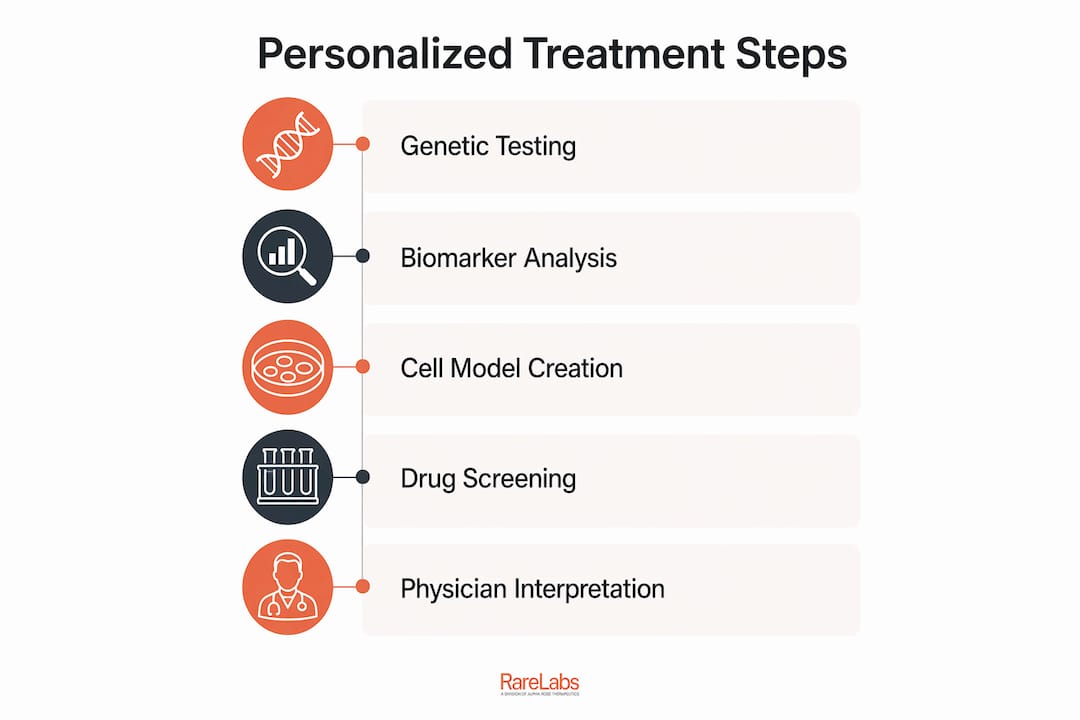
Diagnostic testing is where every tailored treatment plan begins. A blood draw, saliva sample, or tissue biopsy gives the lab the raw material to identify biomarkers, the biological signals that reveal how a disease behaves at the molecular level and which therapies are most likely to work.
Biomarkers come in several forms:
- Genomic markers: mutations, copy number variants, or splice defects identified through DNA sequencing
- Protein markers: abnormal expression levels detected via proteomics or immunohistochemistry
- Metabolic markers: unusual metabolite patterns found in blood or urine panels
- Functional markers: how a patient's cells respond to stress or drug exposure in a lab setting
The practical payoff is real. In HIV treatment, for example, DNA analysis for the HLA-B*5701 gene now screens patients before prescribing abacavir, preventing life-threatening reactions that occur in roughly 5 out of 100 carriers. For ultra-rare diseases, where no such precedent exists, biomarker profiling becomes the foundation for building one.
How patient-derived cell models test therapies before you take them
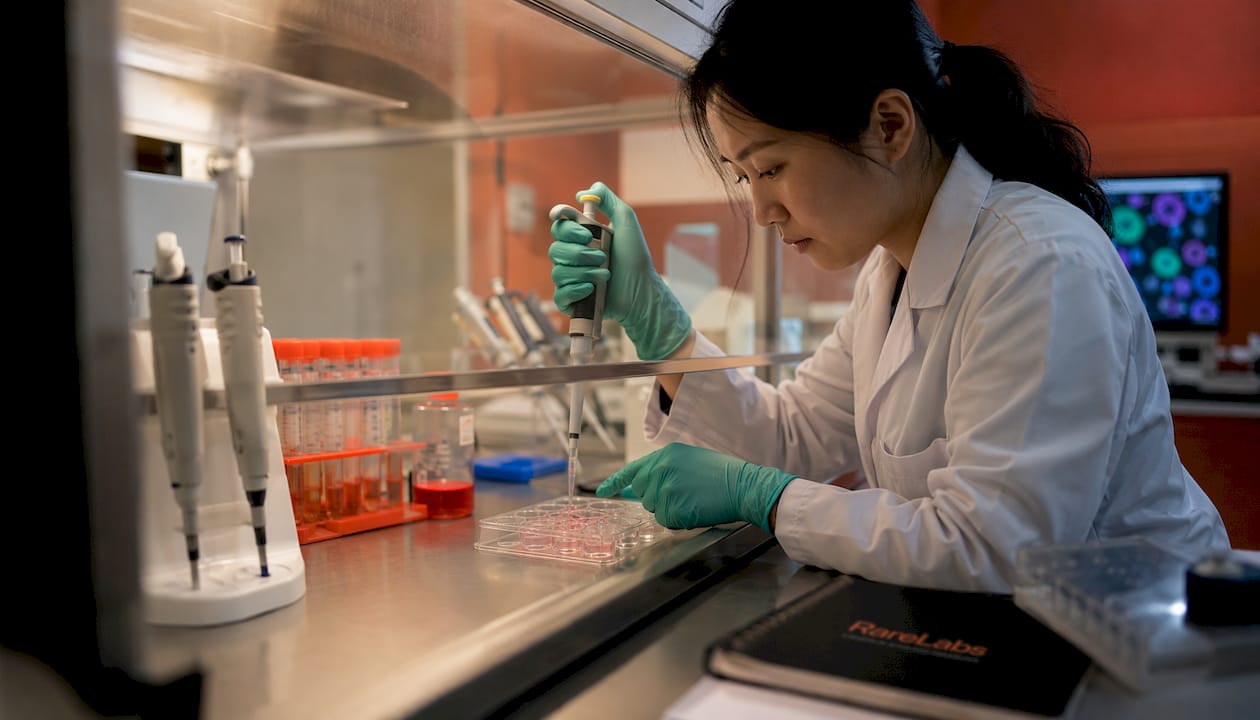
Functional precision medicine (FPM) is the practice of exposing tissues derived directly from a patient to candidate drugs in the lab, then measuring which ones work. It bypasses the guesswork of population-level data entirely.
The process at Hopeatrarelabs uses two technologies that make this possible even for diseases with no existing cell lines:
- Induced pluripotent stem cells (iPSCs): A patient's skin or blood cells are reprogrammed into stem cells, then differentiated into the specific cell type affected by the disease, such as neurons, cardiac cells, or liver cells.
- CRISPR gene editing: Used to introduce or correct specific mutations in cell models, allowing researchers to confirm that a mutation causes the observed disease behavior and to test correction strategies.
Once the model is built, thousands of FDA-approved drugs are screened in parallel. This matters because repurposing an already-approved drug is faster and safer than developing a new compound. Custom antisense oligonucleotides (ASOs) and gene therapy vectors can also be evaluated in the same platform.
Statistic callout: Personalized treatment approaches can improve therapeutic effectiveness by up to 30% and reduce adverse reactions, particularly in chronic and rare disease management.
FPM bridges molecular subtyping and clinical application, giving physicians actual drug-response data rather than probabilistic predictions. For a child with an undiagnosed metabolic disorder, that difference can be the difference between a treatment trial and continued decline.
Why genetics alone is not enough: integrating the full clinical picture
Genetic data is powerful, but it does not tell the whole story. A mutation that causes severe disease in one patient may produce mild symptoms in another, because environment, medical history, and lifestyle all shape how genes express themselves.
Personalized treatment integrates genetic profiles with medical history, environmental exposures, lifestyle factors, and treatment preferences to enable shared decision-making. For rare disease families, this means the care team needs to understand not just the variant but the patient's organ function, nutritional status, prior medication responses, and family history of related conditions.
Supporting tools that make this integration possible:
- Electronic health records (EHRs) that consolidate longitudinal clinical data across providers
- Big data analytics applied to omics datasets to surface patterns across rare disease cohorts
- Healthcare data systems that connect genomic findings to clinical outcomes at scale
- Shared decision-making frameworks that incorporate patient and family values into the final plan
The goal is a personal health roadmap that reflects the whole person, not just the variant on chromosome 17.
The physician's role in interpreting models and making the final call
No model, however sophisticated, replaces the physician. Clinical decision-making balances computational insights with the physician's direct knowledge of the patient, including factors that never appear in a dataset.
Physicians govern the process at every critical junction:
- Validating model results: confirming that in vitro drug responses are biologically plausible and clinically relevant
- Applying regulatory frameworks: FDA-approved drugs used in screening carry known safety profiles, but off-label use requires careful clinical judgment
- Obtaining informed consent: patients and families must understand what the testing involves, what the results can and cannot predict, and what the therapeutic options mean in practice
- Managing ethical complexity: informed consent and regulatory compliance are non-negotiable in personalized treatment development
AI-augmented recommendation systems can support therapy selection, but they face real challenges around interpretability, data privacy, and clinical adoption. The physician remains the accountable decision-maker. A drug screen that identifies a promising candidate is the beginning of a clinical conversation, not the end of one.
Treatment decisions for ultra-rare diseases also typically involve a multidisciplinary team: medical geneticists, metabolic specialists, neurologists, and sometimes international experts who have seen one or two similar cases. Multidisciplinary review can confirm the diagnosis and treatment strategy in ways that no single specialist can achieve alone.
Why personalized testing matters most when no approved treatment exists
Ultra-rare diseases present a specific problem: the patient population is too small to run conventional clinical trials, so approved treatments rarely exist. Physicians treating these patients have no guideline to follow and no trial to enroll their patient in.
This is precisely where patient-specific models fill the gap:
- No approved therapy: FPM screens existing drugs for unexpected efficacy, often finding candidates that were developed for unrelated conditions
- No clinical data: patient-derived models generate the first disease-relevant data that physicians have ever had for that specific mutation
- Rapid iteration: custom ASOs targeting a patient's exact mutation can be designed and tested in weeks, not years
- Gene therapy evaluation: viral vectors and gene correction strategies can be assessed in iPSC-derived cells before any human exposure
Pro Tip: When navigating emerging therapies like ASOs or gene therapy for an ultra-rare disease, ask your physician specifically whether a patient-derived cell model has been used to test the approach. A positive in vitro result does not guarantee clinical success, but it provides far stronger evidence than a theoretical mechanism alone.
The rare disease therapy field is moving fast. Advances in long-read sequencing, spatial transcriptomics, and organoid technology are expanding what is testable in a lab model. For families who have waited years for any answer, these tools represent a genuine shift in what is possible.
Hopeatrarelabs gives patients and physicians a real starting point
For families facing an ultra-rare or undiagnosed genetic disease, the hardest part is often not the science. It is knowing where to begin when no standard path exists.
Hopeatrarelabs was built for exactly that situation. The team takes a patient's own cells, builds a disease model using iPSCs and CRISPR, and runs a parallel screen of thousands of FDA-approved drugs alongside custom ASOs and gene therapy options. Every step is transparent, scientifically rigorous, and governed by physicians who specialize in rare disease translation. The result is not a generic report. It is a ranked list of therapeutic candidates grounded in that patient's actual biology, ready to inform a clinical conversation with the treating physician.
If you are a patient, family member, or physician facing a disease with no approved treatment, start with Hopeatrarelabs to request a consultation and learn what patient-specific modeling can show for your case.
Key Takeaways
Personalized treatment for ultra-rare genetic diseases requires patient-derived cell models, biomarker-guided testing, and physician oversight to identify viable therapies where none are approved.
| Point | Details |
|---|---|
| Biomarkers drive therapy selection | Blood, saliva, or tissue biopsy identifies molecular markers that guide which drugs are worth testing. |
| FPM tests real drug responses | Functional precision medicine screens thousands of FDA-approved drugs against patient-derived cells, not population averages. |
| Better outcomes | Personalized treatment approaches can improve therapeutic effectiveness compared to standard approaches. |
| Physician oversight is required | AI tools and drug screens support decisions, but the physician validates results, manages consent, and owns the final call. |
| Hopeatrarelabs builds patient-specific models | Using iPSCs and CRISPR, Hopeatrarelabs screens FDA-approved drugs and custom ASOs for patients with no approved treatment options. |