
Over 7,000 rare diseases exist, yet fewer than 5% have an FDA-approved therapy. For researchers, clinicians, and families confronting this reality, the drug repurposing for rare diseases guide has become one of the most searched frameworks in modern biomedical research. Repurposing medications for rare diseases offers a faster, more affordable path than building a new drug from scratch. By leveraging existing safety data and known pharmacology, repurposing can compress development timelines significantly. This guide covers every stage of that process, from scientific groundwork through regulatory strategy and real-world validation.
Table of Contents
- Key Takeaways
- Understanding drug repurposing for rare diseases
- Preparing the scientific and regulatory groundwork
- Executing a drug repurposing program step by step
- Verifying safety, efficacy, and real-world access
- My perspective on what actually moves the needle
- How Hopeatrarelabs supports your repurposing search
- FAQ
Key Takeaways
| Point | Details |
|---|---|
| Repurposing cuts development time | The average repurposing timeline is 7.2 years, notably shorter than traditional new drug development. |
| AI accelerates candidate discovery | Tools like TxGNN identify candidates across thousands of diseases, but predictions require rigorous wet-lab validation before clinical use. |
| Regulatory incentives matter | Orphan Drug Designation provides seven years of U.S. market exclusivity plus tax credits, making rare disease repurposing economically viable. |
| Nonprofits drive real results | Rare disease nonprofit organizations have achieved a measurable success rate in repurposing projects by facilitating trial enrollment and patient networks. |
| Validation cannot be skipped | Real-world evidence from electronic health records and preclinical models must confirm safety before any clinical trial begins. |
Understanding drug repurposing for rare diseases
Drug repurposing, also called drug repositioning or reprofiling, is the process of identifying new therapeutic indications for drugs that are already approved, investigational, or shelved. Instead of synthesizing a new molecular entity, you start with a compound whose safety profile in humans is already documented. That head start matters enormously when the patient population for a given rare disease may number only in the hundreds.
The core rationale is biological. Many diseases share overlapping molecular mechanisms, receptor pathways, or gene expression signatures. A drug that modulates a particular protein in one disease context may produce meaningful benefit in a seemingly unrelated condition. Shared mechanisms across autoimmune diseases, for example, allow researchers to repurpose compounds by reversing gene expression patterns using validated cross-disease pipelines.
Several repurposed drugs have become milestones in rare disease treatment:
- Thalidomide, once withdrawn due to teratogenicity, is now FDA-approved for erythema nodosum leprosum and multiple myeloma.
- Sildenafil, developed for angina, gained approval for pulmonary arterial hypertension.
- Metformin is actively investigated for several rare metabolic and mitochondrial conditions.
The economics reinforce the scientific case. Repurposing programs for rare diseases typically cost between $30 million and $80 million, a fraction of the $1 billion-plus price tag attached to a first-in-class drug. Regulatory incentives compound this advantage. The Orphan Drug Act provides seven years of U.S. market exclusivity plus a 25% clinical trial tax credit, meaningfully improving the return-on-investment calculation for small biotechs and academic spinouts alike.
Preparing the scientific and regulatory groundwork
Before committing resources to a repurposing program, a structured preparation phase separates successful programs from expensive dead ends. This phase covers four interconnected areas.
Identifying the right candidate drug
The first task is generating a credible short list of candidates. The three main approaches are data mining of public genomic and proteomic databases, systematic literature review of published case reports and observational studies, and AI-based prediction models. FDA leadership has urged researchers to pair AI predictions with clear presentation of case reports and observational data, treating them as complementary rather than competing forms of evidence. The agency is actively developing a new repurposing framework, with public comments accepted through June 11, 2026, specifically focused on rare and underserved diseases.
Building the mechanistic case
A candidate drug means nothing without a plausible target-disease connection. You need to understand the disease mechanism at the pathway level, identify relevant biomarkers, and confirm that the drug's known mechanism of action intersects that pathway. This work draws on existing pharmacology literature, proteomics data, and increasingly on patient-derived cell models.

Navigating intellectual property
Patent landscapes in repurposing are complex. The original drug may be off-patent, creating freedom to operate, but formulation patents, method-of-use patents, or manufacturing trade secrets may still block commercial development. An IP audit early in preparation prevents costly surprises later. For families and patient advocates driving investigator-initiated studies, academic use exemptions often provide more flexibility than commercial development paths.
Regulatory frameworks worth knowing
- Orphan Drug Designation (ODD): Grants fee waivers, accelerated review, and seven-year exclusivity for diseases affecting fewer than 200,000 people in the U.S. Read the detailed breakdown of Orphan Drug Designation requirements before filing.
- Accelerated Approval: Allows approval based on a surrogate endpoint reasonably likely to predict clinical benefit, with confirmatory trials required post-approval.
- Expanded Access (Compassionate Use): Provides pre-approval access for serious conditions when no comparable alternative exists.
- NCATS (National Center for Advancing Translational Sciences): Offers repurposing resources, compound libraries, and collaborative agreements that significantly lower entry costs.
Pro Tip: Submit an Orphan Drug Designation application before beginning expensive preclinical studies. The fee waiver alone can save hundreds of thousands of dollars, and the designation signals regulatory commitment that attracts academic and philanthropic co-funders.
Executing a drug repurposing program step by step
With preparation complete, execution demands a clear sequence. Skipping steps here is the single most common reason repurposing programs fail in late-stage clinical trials.
Step 1: Use AI tools for hypothesis generation, not final decisions. Platforms leveraging knowledge graphs now cover candidate identification for over 17,000 diseases, including thousands of ultra-rare conditions with minimal published literature. TxGNN specifically delivers a 35% accuracy improvement in predicting drug contraindications, a safety-critical factor that generic screening tools miss. Use these outputs as ranked candidate lists, not approved therapy recommendations.
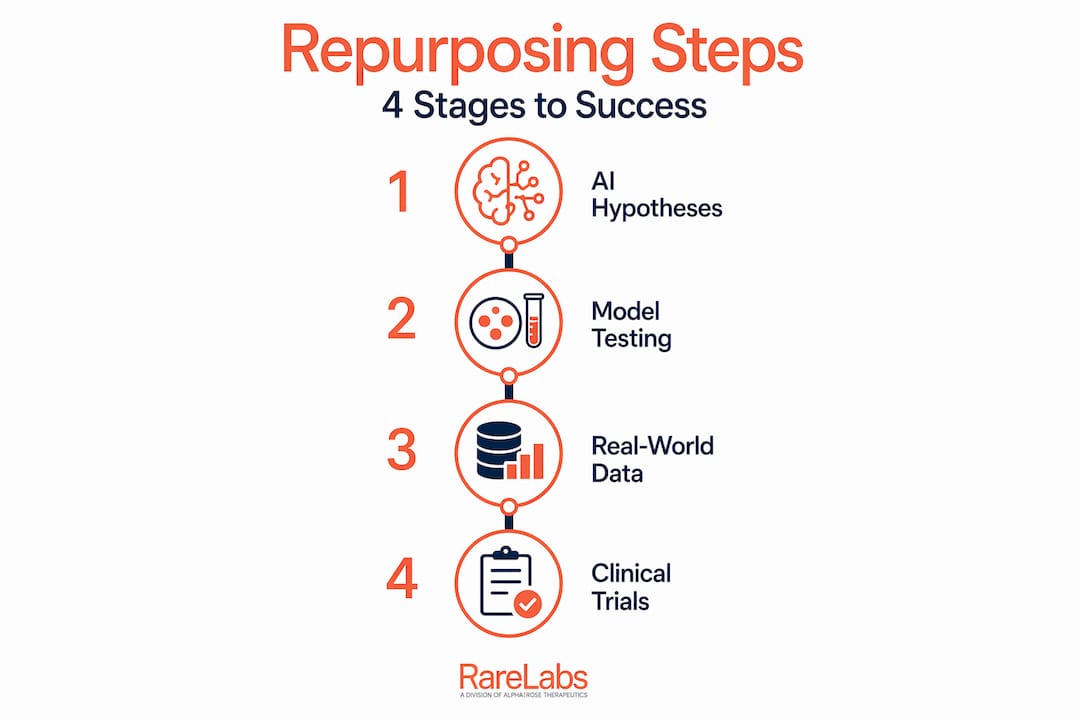
Step 2: Validate computationally predicted candidates in patient-derived disease models. This means moving from in silico to in vitro work using relevant cell lines or, preferably, patient-specific iPSC-derived cells that replicate the disease phenotype. Validation must confirm both target engagement and phenotypic rescue before any in vivo work begins.
Step 3: Generate retrospective real-world evidence. Electronic health record data provides a shortcut for human validation. If patients incidentally received a candidate drug for another indication, their outcomes offer real-world signals that support or undermine the hypothesis. This approach does not replace prospective trials, but it dramatically strengthens an IND application.
Step 4: Design a rare-disease-optimized clinical trial. Standard trial designs built for common diseases often fail in rare disease contexts due to small patient populations and variable phenotypes. Adaptive trial designs, basket trials, and master protocols allow efficacy signals to emerge from smaller cohorts. Surrogate endpoints approved by the FDA reduce the time and patient burden required to reach approval. For practical guidance on current best practices, the 2026 trial design resource from Hopeatrarelabs covers the latest adaptive approaches.
Step 5: Build a multi-stakeholder coalition before Phase II. Programs led by rare disease nonprofits have achieved a 24.5% success rate in completed repurposing projects, primarily because these organizations solve two execution problems simultaneously: they accelerate patient recruitment through established networks, and they provide credibility with regulators and payers. Academic medical centers, patient advocacy groups, and biopharma partners all play distinct roles that a single institution cannot replicate alone.
Key partnership types to pursue in parallel:
- Patient registries: Provide pre-identified trial candidates and longitudinal natural history data.
- Academic collaborators: Contribute disease-specific expertise and GMP-qualified laboratory infrastructure.
- Rare disease foundations: Fund investigator-initiated studies and sponsor compassionate use programs.
- Biotech partners: Supply GMP drug material, regulatory affairs expertise, and commercial development capability. Researchers can explore how global biotech sourcing affects supply decisions for rare disease programs.
Pro Tip: Register your trial on ClinicalTrials.gov before enrolling the first patient, even for investigator-initiated studies. Payers and patient advocacy groups increasingly use registry data to track evidence generation, and early registration builds the credibility trail that supports eventual coverage decisions.
Verifying safety, efficacy, and real-world access
Generating positive clinical trial data is not the finish line. Verification means confirming that the drug works in the real world, that the label reflects the new indication, and that patients can actually access the treatment.
Real-world safety monitoring is particularly important for repurposed drugs because the approved dose, route, or patient population may differ materially from what was studied in the new indication. Long-term registry studies and post-market surveillance programs provide the safety data that regulators and payers require to maintain confidence in a repurposed drug.
Several specific challenges deserve attention:
- Label updating: FDA has limited authority to compel manufacturers to update labels for repurposed indications, particularly when a drug goes generic. Off-label prescribing becomes the default, which creates reimbursement friction.
- Payer coverage: Without an on-label indication, formulary inclusion is inconsistent. Building a payer dossier using health economic modeling and real-world evidence data increases coverage probability.
- Confirmatory trials: Drugs approved through Accelerated Approval must complete confirmatory efficacy trials. Planning and funding these at the outset prevents the post-approval gaps that have stalled several rare disease programs.
- Patient advocacy adoption: Families and patient communities are often the final arbiters of whether a repurposed therapy achieves meaningful uptake. Early engagement, transparent data sharing, and involvement in trial design build the trust that drives adoption.
- Exclusivity and accessibility tension: Seven-year orphan exclusivity protects investment but can limit generic competition and keep prices high. This tension is real and worth acknowledging when building a repurposing strategy.
My perspective on what actually moves the needle
I have watched enough repurposing programs stall in the execution phase to form some strong opinions on what actually matters versus what merely sounds rigorous on a grant application.
The most common mistake I see is treating AI candidate prediction as the hard part and validation as a formality. It is precisely the reverse. Running TxGNN or a similar knowledge-graph model and generating a candidate list takes weeks. Confirming that the predicted mechanism actually translates in a patient-specific disease model takes months to years, and that confirmation is what keeps patients safe. Skipping or shortcutting validation is not a time-saver. It is a program-killer.
The second thing I have learned is that nonprofit rare disease organizations punch far above their weight. A 24.5% project success rate, documented in JAMA Network Open, is not an accident. These organizations understand their patient populations, control access to rare biosamples, and carry credibility with regulators that no academic lab or startup can manufacture quickly. If you are a researcher or family driving a repurposing effort, your time is better spent building a coalition with a disease-specific foundation than optimizing your statistical analysis plan.
Finally, I think the regulatory environment in 2026 is genuinely more supportive than it has ever been for rare disease repurposing. The FDA's active solicitation of public input on a new repurposing framework signals institutional will. The tools at Hopeatrarelabs, which combine iPSC disease modeling with parallel drug screening across thousands of approved compounds, represent exactly the kind of validation infrastructure that converts AI hypotheses into clinically credible candidates. The strategies to accelerate rare disease therapy are no longer theoretical. They are operational.
— John
How Hopeatrarelabs supports your repurposing search
Knowing the repurposing process and executing it are two different things. Hopeatrarelabs built its platform specifically for researchers, clinicians, and families who need more than a literature review.
The RareLabs Knowledge platform aggregates curated data on repurposed drug candidates, active clinical trials, and patient-derived model results across hundreds of ultra-rare conditions. It is updated continuously and designed for the reality that families and researchers often work together under serious time pressure. Whether you are evaluating FDA-approved drugs for a new indication or searching for an ongoing trial relevant to a specific genetic disease, the platform gives you a structured starting point grounded in real scientific evidence. Explore the knowledge base today and connect your search to the most current repurposing findings available in 2026.
FAQ
What is drug repurposing and how does it work?
Drug repurposing identifies new therapeutic uses for existing approved or investigational compounds, leveraging known safety data to reduce development risk and timeline. The process moves from computational candidate identification through preclinical validation, real-world evidence review, and clinical trial testing.
How long does a drug repurposing program take for a rare disease?
The average repurposing timeline is approximately 7.2 years, shorter than traditional de novo drug development but still dependent on clinical trial design, regulatory review, and IP resolution.
What regulatory incentives exist for repurposing drugs for rare diseases?
The Orphan Drug Act provides seven years of U.S. market exclusivity, a 25% tax credit on clinical trial costs, and FDA user fee waivers for drugs targeting diseases affecting fewer than 200,000 Americans.
Can AI replace wet-lab validation in drug repurposing?
No. AI tools generate ranked candidate lists and improve contraindication prediction accuracy, but in vitro and in vivo validation in patient-relevant disease models is required before any clinical trial proceeds.
How do patient advocacy groups improve repurposing outcomes?
Rare disease nonprofit organizations facilitate patient recruitment, provide access to biosamples, and build regulatory credibility. Projects led by these organizations have documented a 24.5% success rate across completed repurposing programs.