

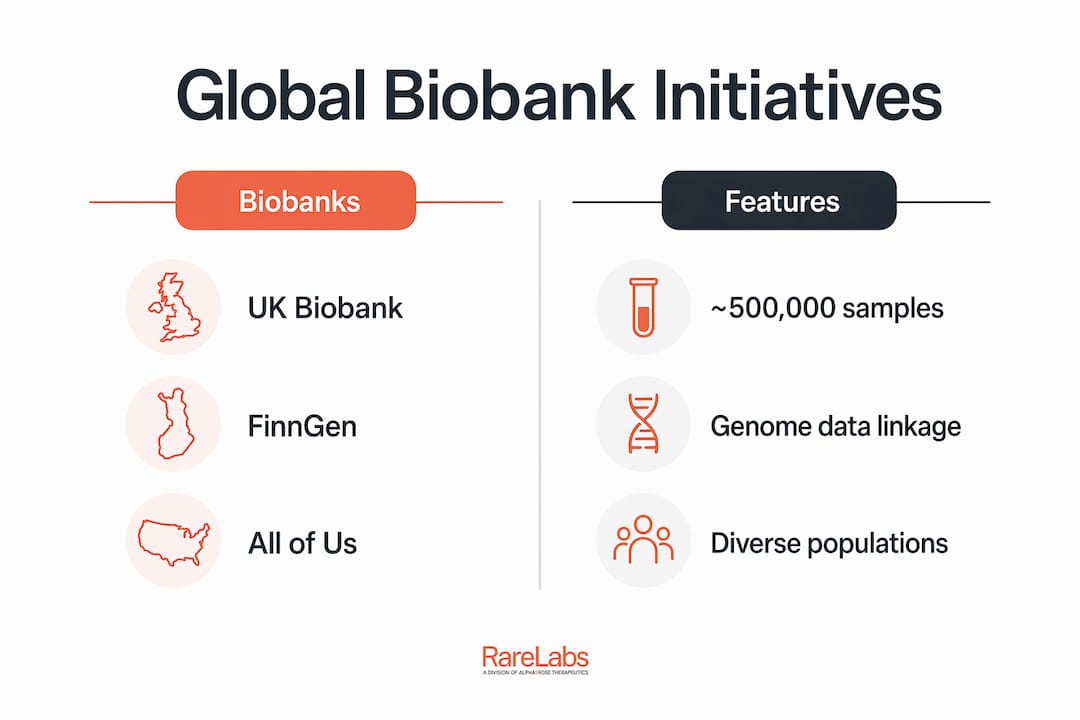
Biobanks are defined as secure repositories of biological samples linked to genomic, clinical, and lifestyle data, forming the foundational infrastructure for modern genetic research. The role of biobanks in genetics extends far beyond storage. Institutions like the UK Biobank, FinnGen, and the NIH's All of Us program have demonstrated that biospecimens linked with health records enable genotype-to-phenotype research at a scale no single clinical study can match. For researchers, clinicians, and patients navigating rare or complex diseases, understanding how biobanks function and what they make possible is not optional background knowledge. It is the starting point for understanding where genetic medicine is headed.
How do biobanks advance genetic research?
Biobanks accelerate genetics by combining large participant cohorts with integrated data types that no single lab could assemble independently. The UK Biobank's 500,000 participant dataset integrates biological samples with electronic health records (EHRs), enabling hundreds of genome-wide association studies (GWAS) that have identified thousands of genetic risk loci across dozens of diseases. That scale transforms what is statistically detectable. A GWAS needs tens of thousands of participants to achieve the statistical power required to identify variants with modest effect sizes, and biobanks make that possible.
The specific contributions of biobanks to genetic research include:
- GWAS at population scale. Biobanks supply the sample sizes needed to detect low-frequency variants and gene-environment interactions that smaller cohorts miss entirely.
- Polygenic risk score development. By aggregating data from hundreds of loci, researchers use biobank datasets to build polygenic risk scores for conditions like coronary artery disease, type 2 diabetes, and breast cancer.
- Phenome-wide association studies (PheWAS). Linking genotype data to EHR-derived phenotypes allows researchers to test one genetic variant against hundreds of clinical outcomes simultaneously.
- Drug target discovery. Genetic associations identified through biobank GWAS often point directly to protein targets, shortening the path from discovery to therapeutic hypothesis.
- Ancestry-diverse cohorts. Networks of biobanks across multiple countries are expanding sample diversity, reducing the historical bias toward European-ancestry populations in genetic databases.
Pro Tip: When designing a study using biobank data, prioritize biobanks with longitudinal EHR linkage over those with cross-sectional data only. Phenotype quality is the single largest determinant of association strength, and high-quality longitudinal records yield far more reproducible genotype-phenotype findings.
Major global biobank initiatives compared
Five biobank programs currently define the frontier of population-scale genomics. Each differs in sample size, data integration depth, governance model, and disease focus.
| Biobank | Sample Size | Key Data Types | Primary Focus |
|---|---|---|---|
| UK Biobank | ~500,000 | Genomics, EHR, imaging, wearables | Multidisease GWAS, translational research |
| FinnGen | ~500,000 | Genomics, national health registries | Disease genetics, rare variant discovery |
| Million Veteran Program (MVP) | ~900,000 | Genomics, VA health records | Veteran health, ancestry diversity |
| All of Us (NIH) | >700,000 enrolled | Genomics, EHR, surveys, wearables | Diversity-first precision medicine |
| Estonian Biobank | ~212,000 | Genomics, national registries | Population genetics, health policy |
FinnGen's model is particularly instructive. The project combines genome data from 500,000 Finns collected across 11 registered biobanks under unified national governance, linking them to longitudinal health registries. That unified governance structure is what allows FinnGen to move from sample collection to published genetic associations faster than most comparable programs. The Million Veteran Program (MVP) holds the largest single-cohort dataset and has been especially productive for cardiovascular and psychiatric genetics research in diverse populations.
The limitation shared across all five is geographic concentration. A review of 14,142 publications showed that biobank research outputs map unevenly to global disease burden, with conditions prevalent in low-income countries underrepresented. That gap is a structural problem, not a data problem, and it requires deliberate stakeholder coordination to address.
What are the ethical considerations in biobanking?
Biobanking ethical considerations center on three non-negotiable principles: informed consent, privacy protection, and governance of secondary research use. The 2026 Seattle Principles provide the most current international framework for evaluating whether secondary research use of biospecimens and associated data is ethically permissible. These principles require that ethics committees evaluate proposed uses against the original consent scope, privacy safeguards, and potential for participant harm.
The consent model used by most large biobanks is broad consent. Participants agree to future, unspecified research uses rather than consenting to each individual study. This model enables the secondary research that makes biobanks scientifically valuable, but it creates real tension when new research directions emerge that participants could not have anticipated at enrollment.
Key ethical challenges researchers and clinicians must account for:
- Re-identification risk. Genomic data is inherently identifying. Even de-identified datasets can be re-linked to individuals using publicly available information, making data security a permanent obligation rather than a one-time setup task.
- Return of findings. When a biobank study identifies a clinically significant variant in a participant's sample, the question of whether and how to return that finding is unresolved across most governance frameworks.
- Secondary use scope creep. Broad consent does not mean unlimited consent. Governance decisions on secondary use directly constrain what study designs are permissible, and researchers who do not align their protocols with biobank oversight committees risk access denial.
- Equity in benefit sharing. Populations that contribute samples should receive proportionate benefit from research outputs, a principle that current biobank structures often fail to operationalize.
Pro Tip: Before submitting a data access application to any major biobank, read the biobank's specific secondary use policy in full, not just the consent form summary. The gene variant interpretation process for rare disease research often requires additional ethical clearance beyond standard GWAS access agreements.
How do biobanks maintain data quality and operational continuity?
Operational sustainability is the least discussed and most consequential factor in biobank-based genetics research. A biobank that degrades sample integrity or loses funding mid-study invalidates years of upstream work. The Johns Hopkins Genetic Resources Core Facility demonstrates one proven model: a service-center operational structure that recovers costs through modular user fees while maintaining long-term sample availability for institutional researchers. This approach decouples biobank survival from grant cycles, which is the primary threat to continuity.

Data quality is equally critical. The NIH Replication Prize recognized a tool specifically designed to assess biobank data quality by verifying that known genotype-phenotype relationships replicate correctly within a given dataset. This matters because researchers historically assumed biobank data was correct and built analyses on that assumption. Active verification of genotype-phenotype congruence is now a first-class step in reproducible genetics workflows.
| Quality Factor | Risk if Neglected | Mitigation Approach |
|---|---|---|
| Sample integrity | Degraded DNA yields unreliable genotyping | Standardized collection and storage protocols |
| Phenotype accuracy | Weak associations, false positives | Longitudinal EHR linkage with clinical validation |
| Genotype reproducibility | Non-replicable findings | NIH-recognized quality assessment tools |
| Funding continuity | Sample loss, data gaps | Service-center cost recovery models |
The operational lesson from programs like Johns Hopkins is that sustainable biobank stewardship requires treating infrastructure as a long-term scientific asset, not a project-specific expense. Biobanks that operate on grant-dependent budgets without a cost recovery mechanism are structurally fragile, regardless of their scientific quality.
How do biobanks drive personalized medicine?
Biobanks in personalized medicine function as the data engine behind genetic risk prediction, drug target validation, and clinical trial design. The development of polygenic risk scores for prostate cancer, type 2 diabetes, and cardiovascular disease all trace directly to biobank-scale GWAS datasets. These scores are now entering clinical practice, with some health systems using them to stratify screening recommendations and preventive interventions.
The applications extend across multiple disease domains:
- Cancer genomics. Biobank data has identified germline variants associated with breast, colorectal, and prostate cancer risk, enabling carrier screening programs and targeted surveillance protocols.
- Cardiovascular disease. Polygenic risk scores derived from UK Biobank and MVP data now predict 10-year cardiovascular event risk with accuracy comparable to traditional clinical risk factors.
- Rare disease research. Biobanks support rare disease therapy development by providing reference populations for variant interpretation and enabling phenotype-matched cohort identification that individual clinical sites cannot achieve.
- Drug repurposing. Mendelian randomization studies using biobank data test whether genetic proxies for drug targets associate with disease outcomes, providing human genetic evidence for or against therapeutic hypotheses before clinical trials begin.
- Multi-omics integration. The future of biobanks in genomics lies in combining genomic data with proteomics, metabolomics, and digital health data to build richer models of disease biology. All of Us is already collecting wearable device data alongside genomic samples to enable this kind of multi-layered analysis.
For patients with ultra-rare or undiagnosed conditions, biobank-enabled genomic medicine breakthroughs are particularly significant. Reference datasets from large biobanks allow clinicians to contextualize rare variants that would otherwise be classified as variants of uncertain significance, accelerating diagnosis and opening pathways to targeted treatment.
Key takeaways
Biobanks are the foundational infrastructure of modern genetics, and their scientific value depends equally on data quality, ethical governance, operational sustainability, and population diversity.
| Point | Details |
|---|---|
| Biobanks enable GWAS at scale | Datasets like UK Biobank's 500,000 participants make statistically powered genetic discovery possible. |
| Governance shapes research access | The Seattle Principles and biobank-specific consent frameworks directly determine what study designs are permissible. |
| Data quality requires active verification | NIH-recognized tools now validate genotype-phenotype congruence as a standard reproducibility step. |
| Operational models determine longevity | Service-center cost recovery, as used by Johns Hopkins, protects sample integrity across decades. |
| Personalized medicine depends on biobank data | Polygenic risk scores for cancer, diabetes, and cardiovascular disease all originate from biobank-scale datasets. |
Why biobank governance is the variable researchers underestimate
Working at the intersection of rare disease research and genetic data, I have watched governance become the rate-limiting factor in studies that were scientifically ready to proceed. The biology was solved. The samples existed. The analysis plan was approved internally. Then a secondary use review took eight months because the consent language from the original enrollment was ambiguous about commercial research applications.
The scientific community talks extensively about sample size and ancestry diversity, and those conversations are necessary. But the operational reality is that governance decisions, including consent frameworks and secondary use permissions, dictate practical research access more than any technical factor. Researchers who treat ethics review as a compliance checkbox rather than a design constraint consistently underestimate how much it shapes what is actually achievable.
The other underappreciated issue is the alignment between biobank research outputs and actual disease burden. The data is clear that EHR-linked biobank research disproportionately addresses conditions prevalent in high-income countries. For rare disease researchers, this means the reference populations you need may simply not exist in current biobanks at the scale required. Building those populations requires deliberate investment, not just expanded enrollment.
The future I find most credible integrates biobank genomic data with AI-driven phenotype extraction from clinical notes, wearable biosensor streams, and patient-reported outcomes. That integration will not happen through better technology alone. It will happen when governance frameworks catch up to the data types being collected, and when funding models treat biobank infrastructure as permanent scientific infrastructure rather than project overhead.
— John
Explore rare disease research at Hopeatrarelabs
Hopeatrarelabs works at the frontier of rare and undiagnosed genetic disease, where biobank-enabled discoveries meet patient-specific treatment modeling. Using iPSC technology and CRISPR gene editing, Hopeatrarelabs builds disease models from patients' own cells and runs parallel screens across thousands of FDA-approved compounds, custom ASOs, and gene therapy candidates. The RareLabs Knowledge base connects researchers, clinicians, and families to the genetic research and treatment evidence that biobank-scale genomics has made possible. If you are working through a rare disease diagnosis or searching for treatment options grounded in current genetic science, the rare disease treatment search at Hopeatrarelabs is built for exactly that need.
FAQ
What is the primary role of biobanks in genetics?
Biobanks provide secure, large-scale repositories of biological samples linked to genomic and clinical data, enabling genotype-to-phenotype research that powers GWAS, polygenic risk score development, and drug target discovery.
Why are biobanks important for personalized medicine?
Biobanks supply the population-scale datasets needed to develop genetic risk scores and validate therapeutic targets, making it possible to tailor screening, prevention, and treatment strategies to individual genetic profiles.
How do biobanks handle participant privacy?
Most biobanks use de-identification protocols combined with controlled data access systems, and governance frameworks like the Seattle Principles require ethics committee review of all secondary research uses to protect participant confidentiality.
What makes a biobank scientifically reliable?
Reproducibility in biobank genetics depends on sample integrity, longitudinal phenotype quality, and active data quality verification. Tools recognized by the NIH Replication Prize now allow researchers to confirm that known genotype-phenotype relationships replicate correctly within a given dataset before building new analyses on it.
How do biobanks support rare disease research?
Biobanks provide reference populations and variant frequency data that allow clinicians to reclassify variants of uncertain significance, and they enable phenotype-matched cohort identification that individual clinical sites cannot achieve at sufficient scale.