

For most families navigating an ultra-rare genetic disease, the hardest part is not the diagnosis itself. It is the years of wrong turns, dismissed symptoms, and unanswered questions before any name is attached to what their child or loved one is experiencing. The diagnostic odyssey averages 4 to 8 years for rare disease families, a stretch of time filled with psychological strain and delayed care. Genetic diagnosis does not just give a name to the condition. It transforms confusion into a roadmap, opening doors to targeted therapies, clinical trials, and family planning that would otherwise remain locked shut.
Table of Contents
- The diagnostic odyssey: Why timely genetic answers matter
- Modern genetic testing: Tools and results
- Personalized treatments unlocked by precise diagnosis
- Family impact: Reproductive risk, screening, and future planning
- Expert perspective: Navigating the gray areas of genetic diagnosis
- Find hope and targeted solutions with RareLabs
- Frequently asked questions
Key Takeaways
| Point | Details |
|---|---|
| Shorter diagnosis time | Genetic testing reduces diagnostic delays, ending years of uncertainty for families. |
| Higher diagnostic yield | Modern genome sequencing methods provide more answers, especially with trio/family approaches. |
| Personalized treatment access | A precise diagnosis opens doors to targeted therapies and clinical trials tailored for rare diseases. |
| Family risk awareness | Genetic diagnosis informs reproductive risks and enables screening for relatives. |
| Continuous improvement | Ongoing advances and reanalysis mean the impact of genetic diagnosis grows over time. |
The diagnostic odyssey: Why timely genetic answers matter
Imagine visiting specialist after specialist for years, collecting inconclusive test results and conflicting opinions, while your child's health continues to deteriorate. This is not an edge case. It is the lived reality for the majority of families affected by ultra-rare genetic diseases. The path from first symptom to confirmed diagnosis is rarely a straight line.
Several factors extend this journey. Ultra-rare diseases often present with symptoms that overlap with more common conditions. General practitioners and even many specialists lack exposure to these disorders. Standard diagnostic panels frequently miss the mutations responsible. By the time a family reaches the right specialist, months or years have already passed.
The consequences are severe. Delayed diagnosis means delayed intervention. It means families carry enormous psychological burdens, grieving a diagnosis they do not yet have while managing a disease they cannot yet name. It means children miss treatment windows that may never reopen.
The statistics are sobering. Studies show the diagnostic odyssey averages 4 to 8 years, and for pediatric patients, 30% of children with rare diseases die before age 5, often without ever receiving a confirmed diagnosis. These are not abstract numbers. They represent families who never got the clarity they needed to act.
What changes when genetic diagnosis arrives sooner?
- Families gain a framework for understanding disease progression
- Clinicians can shift from guesswork to evidence-based management
- Children gain access to targeted therapies and disease-specific monitoring
- Families can begin reproductive risk counseling and planning
- Patients become eligible for clinical trials they previously could not access
"Receiving a diagnosis, even for a disease without a cure, gives families something critical: a foundation for hope and a direction for action."
This is where the rare disease treatment search becomes not just a scientific exercise but a deeply human one. Shortening the diagnostic gap is one of the most impactful things modern medicine can do for this population.
Modern genetic testing: Tools and results
Not all genetic tests are created equal, and for ultra-rare diseases, the choice of testing method can mean the difference between an answer and another dead end. Over the past decade, the field has moved decisively toward broader, deeper sequencing approaches that capture what targeted panels simply cannot.
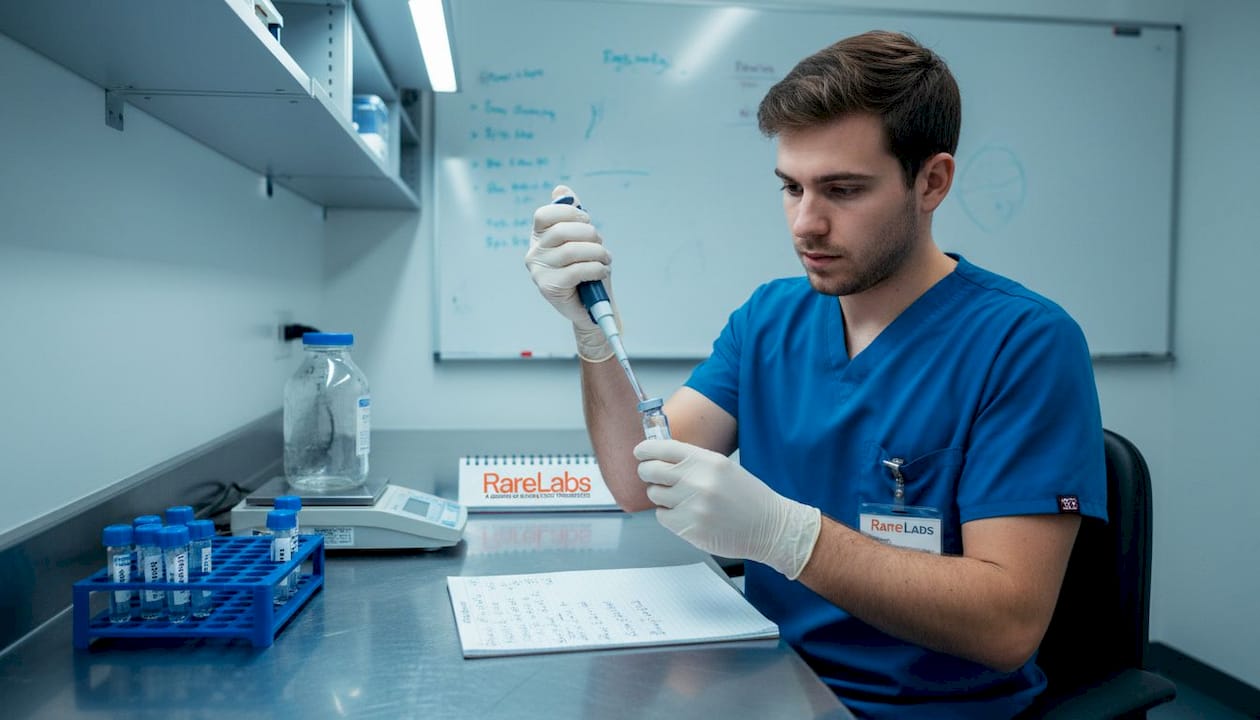
Whole Exome Sequencing (WES) analyzes the protein-coding regions of the genome, covering roughly 1 to 2% of total DNA but capturing the majority of known disease-causing variants. Whole Genome Sequencing (WGS) goes further, examining the entire genome including non-coding regions, regulatory sequences, and structural variants. Both represent a massive leap beyond older gene panel testing.
The diagnostic yields reflect this superiority. Diagnostic yields from WES/WGS in undiagnosed patient cohorts range from 33% to 49%, climbing even higher in specific contexts. Trio sequencing, which tests the patient alongside both biological parents simultaneously, pushes yields to 48.5% or above. For phenotypes like neuromuscular disease, yields can reach 62%.
WGS holds a particular advantage in detecting structural changes. WGS detects 31.6% more pathogenic or likely pathogenic variants than WES, especially copy number variants (CNVs) that traditional exome analysis misses entirely.
| Test type | Diagnostic yield | Key strength |
|---|---|---|
| Gene panel | 10 to 30% | Fast, targeted, lower cost |
| WES (singleton) | 33 to 42% | Broad, cost-effective |
| WES (trio) | 48.5%+ | Higher yield via inheritance context |
| WGS | Up to 49%+ | Detects CNVs, structural variants |
| Long-read WGS | Emerging | Complex repeat expansions, SVs |
For urgent situations, such as critically ill newborns in neonatal intensive care units (NICUs), rapid sequencing protocols can return results in 1 to 5 days, compressing a years-long process into a single week.
Pro Tip: If you are pursuing genetic testing, request trio sequencing from the start. Testing both parents alongside the patient provides critical inheritance context and meaningfully increases the chance of finding the causative variant on the first attempt.
Long-read sequencing is also emerging as a tool for edge cases where standard short-read methods fall short, particularly for complex structural rearrangements and tandem repeat expansions that shorter reads cannot resolve.
Personalized treatments unlocked by precise diagnosis
Once a genetic diagnosis is confirmed, the entire clinical conversation changes. Instead of managing symptoms in the dark, clinicians can design care around the specific biological mechanism driving the disease. That is not a minor upgrade. It is a fundamental shift.
Consider spinal muscular atrophy (SMA). Before genetic testing became standard, infants with SMA often went undiagnosed until irreversible motor neuron loss had occurred. Today, genetic diagnosis enables access to targeted therapies like gene replacement and splice-modifying drugs that dramatically alter disease trajectory, but only when administered early.
The broader rare disease landscape reflects both the opportunity and the gap. 80% of rare diseases are genetic in origin, 70% have pediatric onset, and 95% currently lack approved treatments. That last number is staggering. It means that for the vast majority of families, diagnosis does not lead to an approved drug. But it does lead to something equally important: eligibility for clinical trials.
Here is what changes after a confirmed genetic diagnosis:
- Clinical trial eligibility becomes possible, since most trials require a molecular diagnosis
- Physicians can pursue off-label use of drugs that target the same biological pathway
- Custom approaches like antisense oligonucleotides (ASOs) can be designed around the specific mutation
- Families gain access to disease registries that connect them with researchers and support networks
- Gene therapy evaluation becomes a realistic conversation
| Approach | Without diagnosis | With diagnosis |
|---|---|---|
| Drug treatment | Symptomatic only | Pathway-targeted or mutation-specific |
| Clinical trials | Ineligible (no molecular Dx) | Eligible |
| ASO therapy | Not possible | Mutation-specific design feasible |
| Gene therapy | Not applicable | Can be evaluated |
Pro Tip: Even if no treatment exists today for your loved one's condition, a confirmed genetic diagnosis preserves future options. Science moves fast in this space. A diagnosis today positions your family to act the moment a therapy becomes available.
Family impact: Reproductive risk, screening, and future planning
Genetic diagnosis does not only change the path forward for the patient. It changes the landscape for the entire family. Understanding the genetic basis of a disease answers questions that families often carry silently for years: Could this happen again? Are siblings at risk? What do we tell extended family?
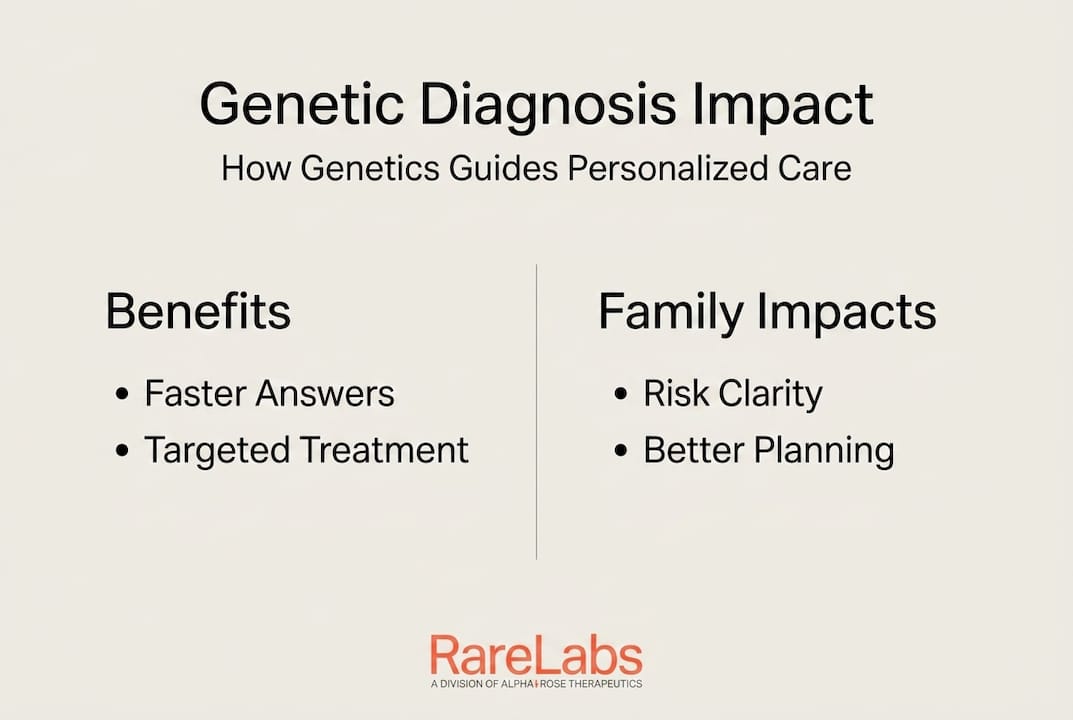
One of the most significant findings in recent rare disease genomics is how frequently de novo mutations are responsible. De novo mutations are common, accounting for more than 70% of cases in some patient cohorts. A de novo mutation arises spontaneously in the affected individual and is not inherited from either parent. This is critical information. It means the recurrence risk for future pregnancies may be far lower than families fear, or it may reveal a mosaic parental variant that does carry recurrence risk.
For families where the mutation is inherited, the implications extend outward. Siblings may be carriers. Grandparents, aunts, and uncles may carry the variant. Reproductive planning options including preimplantation genetic testing (PGT) become available.
The practical benefits of knowing extend across generations:
- Parents gain accurate recurrence risk numbers for future pregnancies
- Siblings can be screened for carrier status or early disease signs
- Extended family members can make informed decisions about their own testing
- Prenatal testing in future pregnancies becomes a genuine option
"Genetic diagnosis is not just a clinical event. For a family, it is the beginning of understanding their own biology and taking back some control over an uncertain future."
This kind of clarity also reduces the psychological burden of not knowing. Families who understand the inheritance pattern of their loved one's disease report feeling more empowered and less isolated, even when the genetic answer does not come with an immediate treatment.
Expert perspective: Navigating the gray areas of genetic diagnosis
Here is something the genetic testing world does not always say plainly: getting a result is not the same as getting an answer. A significant proportion of sequencing reports return variants of uncertain significance (VUS), genetic changes that are detected but whose clinical impact is not yet understood. These results can feel more frustrating than no result at all.
In our view, this is where the real work begins. The field of challenges in genetic testing is real and worth naming honestly. Cost and access barriers remain significant. VUS interpretation varies by laboratory. Incomplete penetrance means a variant can cause disease in one person but not in another carrying the same change. And only about 18.5% of diagnoses immediately change clinical management.
But none of this diminishes the value of pursuing genetic diagnosis. It means families need to engage with the process strategically. Trio sequencing is the single strongest first move. Asking your clinical team about reanalysis schedules matters, since variants reclassify as evidence accumulates. Functional studies can resolve uncertain variants when population data is insufficient. The genetic diagnosis benefits are real, but they require persistence and informed advocacy to fully realize.
Reanalysis is not a failure. It is the normal cadence of a science that is advancing rapidly. Families who return to their geneticist every one to two years for reanalysis of unsolved cases do receive new answers over time. Stay in that loop.
Find hope and targeted solutions with RareLabs
If your family is living with an ultra-rare or undiagnosed genetic disease, knowing where to turn after diagnosis can feel just as overwhelming as the diagnostic process itself. RareLabs was built specifically for this moment.
We create patient-specific disease models using your loved one's own cells, applying iPSC technology and CRISPR gene editing to replicate the disease in a controlled environment. From there, we run parallel treatment screens across thousands of FDA-approved compounds, custom ASOs, and gene therapy options. If you are ready to explore rare disease treatment options that are built around your unique diagnosis, RareLabs is the partner designed for exactly that mission. You do not have to wait for a treatment to be invented. We can start looking now.
Frequently asked questions
How long does genetic diagnosis usually take for rare diseases?
Modern rapid sequencing delivers results in 1 to 5 days for urgent cases, compared to the traditional diagnostic odyssey that averages 4 to 8 years for rare disease families.
What genetic tests are most effective for ultra-rare disease diagnosis?
Whole genome sequencing (WGS) and whole exome sequencing (WES), particularly in trio format, provide the highest yields, with WES/WGS yields reaching 33 to 49% in undiagnosed cohorts and higher in targeted phenotypes.
Does a genetic diagnosis always change treatment options?
Not always. Only about 18.5% of diagnoses result in immediate treatment change, but a confirmed diagnosis opens doors to clinical trials, future therapies, and personalized approaches that would otherwise be inaccessible.
Why is family screening and reproductive risk assessment important?
Genetic diagnosis reveals inheritance patterns and mutation origins, and since de novo mutations exceed 70% in some cohorts, accurate risk counseling allows families to make informed reproductive decisions and screen other relatives appropriately.
Can my genetic diagnosis change as new research emerges?
Yes. Continuous reanalysis is standard practice, and reanalysis of uncertain variants frequently yields actionable findings as genetic databases grow and scientific understanding of rare variants evolves.