

Step by step genetic diagnosis is the systematic process through which clinical evaluation, genetic counseling, laboratory testing, and result interpretation are combined to identify the genetic cause of a rare or undiagnosed condition. For families who have spent months or years searching for answers, understanding how this process works is not just reassuring. It is the foundation for making informed decisions at every stage. This guide walks you through each phase of the genetic assessment process, from your first appointment to receiving and acting on results, using plain language and real clinical context.
What is the step by step genetic diagnosis process?
Genetic diagnosis, formally called stepwise genetic evaluation, is the structured clinical methodology used to identify disease-causing variants in a patient's DNA. Genetic testing confirms suspected gene-related conditions by detecting changes in genes, chromosomes, or proteins. This means testing is not a fishing expedition. It is a targeted investigation shaped by your symptoms, family history, and clinical findings.
The process typically moves through four phases: pre-test preparation, sample collection and laboratory analysis, result interpretation, and post-result counseling. Each phase builds on the last. Skipping or rushing any step increases the risk of inconclusive or misleading results. Families navigating rare or undiagnosed conditions benefit most from understanding what happens at each stage and why the sequence matters.

Distinguishing whether testing is for screening, diagnosis, or treatment planning is one of the first decisions made in the process. A screening test estimates risk. A diagnostic test confirms or rules out a specific condition. Knowing which type you are pursuing changes how you interpret the results and what comes next.
What happens before genetic testing begins?
The pre-test phase is where the foundation of an accurate diagnosis is built. A medical geneticist or genetic counselor collects a detailed personal and family medical history, often spanning three generations. This history shapes every decision that follows, including which test to order and how to interpret results.
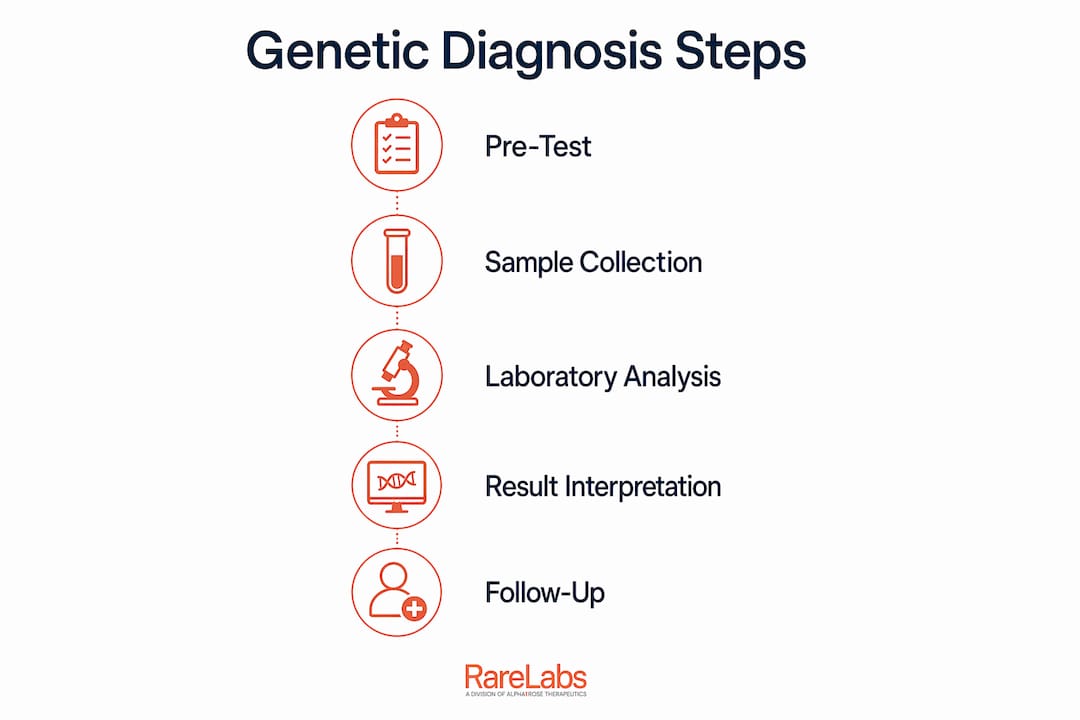
Genetic counseling takes the lead in collecting history, explaining testing options, and guiding patient decisions. A genetic counselor is not just an administrator. This professional translates complex genetic concepts into language you can act on, helps you weigh the emotional and practical implications of testing, and supports you through the decision to proceed. The role of genetic counseling in rare disease diagnosis is especially significant because the stakes of each decision are higher and the testing pathways are less straightforward.
Before any sample is collected, several practical steps must be completed:
- Medical records review: Prior test results, imaging, specialist notes, and clinical diagnoses are gathered to build a complete picture.
- Physical examination: A medical geneticist examines the patient for physical features that may point toward specific genetic syndromes.
- Testing selection: No single genetic test finds all causes. The test chosen depends on the patient's symptom profile, age, and prior results.
- Informed consent: You and your family review the purpose, limitations, and potential outcomes of testing before agreeing to proceed.
- Insurance coordination: Coverage varies significantly. Submitting documentation early reduces delays in authorization.
Pro Tip: Ask your genetic counselor to confirm in writing which specific test has been ordered and why. This prevents confusion later and helps you track results against the right reference range.
How does the genetic testing process work from sample to result?
Once pre-test steps are complete, the laboratory phase begins. This is where the genetic diagnosis methodology becomes highly technical, but the sequence is predictable and well-established.
- Sample collection: Most tests use a blood draw or saliva sample. Prenatal testing uses amniocentesis or chorionic villus sampling (CVS). Prenatal diagnostic tests such as amniocentesis and CVS are recommended after abnormal screening results or identified high-risk factors.
- DNA extraction: The laboratory isolates DNA from the collected cells. Quality at this stage determines the reliability of everything downstream.
- Fragmentation and adapter ligation: DNA is sheared into fragments of a specific size, and short synthetic sequences called adapters are attached to each fragment. These adapters allow the sequencing machine to read the DNA.
- Enrichment: For exome sequencing, only the protein-coding regions of the genome are captured and amplified. This reduces cost and analysis time while covering the regions most likely to contain disease-causing variants.
- Sequencing: The prepared library is run through a next-generation sequencing (NGS) platform. The machine reads millions of DNA fragments simultaneously.
- Data processing: Raw sequencing data is aligned to a reference genome. Variant calling software identifies differences between the patient's DNA and the reference. Labs verify sample quality, extract DNA, shear fragments, add adapters, enrich samples, sequence, and perform alignment and variant calling as part of a rigorous molecular workflow.
- Bioinformatic analysis: Variants are filtered, prioritized, and reviewed by clinical scientists against databases such as ClinVar and OMIM.
| Stage | What happens | Why it matters |
|---|---|---|
| DNA extraction | DNA isolated from blood or saliva | Poor quality DNA leads to failed or inconclusive results |
| Enrichment | Target regions captured and amplified | Focuses sequencing power on clinically relevant areas |
| Sequencing | Millions of fragments read simultaneously | Generates the raw data for variant identification |
| Variant calling | Software identifies DNA differences | Produces the list of variants for clinical review |
| Bioinformatic filtering | Variants ranked by clinical significance | Reduces thousands of variants to a manageable candidate list |
Turnaround times vary widely. Some results return in 2 to 3 weeks. Others take 4 to 8 weeks or longer, depending on test complexity and insurance processing. This means the wait is often the hardest part, and setting realistic expectations early protects families from unnecessary anxiety.
Pro Tip: Submit all required clinical documentation to your insurance provider before the sample is collected. Timely clinical documentation and insurance coordination are the single biggest controllable factors in reducing your wait time.
How are genetic test results interpreted and communicated?
Result interpretation is where the genetic testing process becomes most consequential for your family. Genetic test results typically fall into three categories, each with distinct implications:
- Pathogenic variant: A DNA change that is confirmed to cause disease. This result provides a diagnosis and opens the door to targeted management, treatment trials, and family planning decisions.
- Variant of uncertain significance (VUS): A DNA change whose clinical impact is not yet known. A VUS is not a diagnosis. It requires monitoring and may be reclassified as more data becomes available.
- No changes found (negative result): No disease-causing variant was identified in the regions tested. This does not rule out a genetic condition. It means the current test did not find one.
A negative result is not the end of the road. Negative genetic test results do not rule out genetic disease. Interpretation requires clinical context and may evolve as research advances and testing methods improve.
The follow-up appointment with your genetic counselor or medical geneticist is where results are placed in the context of your full clinical picture. A variant that looks benign in isolation may become significant when matched against your specific symptoms and family history. This is why genetic test interpretation is never purely algorithmic. It requires human clinical judgment.
Results also carry implications for biological relatives. A pathogenic variant in one family member may mean others are at risk and should consider testing. Reproductive planning decisions, including preimplantation genetic testing during IVF, may become relevant. Your genetic counselor will walk through these implications with you in detail.
What challenges should families expect during the process?
The genetic diagnosis journey for rare and undiagnosed conditions rarely follows a straight line. Understanding the common obstacles prepares you to advocate effectively and avoid discouragement.
For pediatric rare disease cases, tiered testing strategies link karyotyping, chromosomal microarray, and exome or genome sequencing. Exome and genome sequencing are increasingly used as first-tier tests because they offer the highest diagnostic yield in a single step. Still, even these comprehensive approaches do not find a cause in every case. Families often need to plan for stepwise testing expansion, where an initial negative or VUS result triggers broader testing.
Common challenges include:
- Insurance delays: Prior authorization for exome or genome sequencing can take weeks. Incomplete documentation is the most common cause of delay.
- Sample quality issues: A degraded or contaminated sample requires recollection, adding weeks to the timeline.
- Emotional weight of uncertainty: A VUS result is particularly difficult. It provides neither the clarity of a diagnosis nor the closure of a clean negative.
- Evolving classifications: Variants classified as uncertain today may be reclassified as pathogenic or benign within months or years as new research emerges.
- Access to specialists: Medical geneticists are in short supply in many regions. Telehealth genetic counseling has expanded access, but wait times for specialist appointments remain long.
Pro Tip: Keep a personal medical binder with copies of every test ordered, every result received, and every specialist note. When you seek a second opinion or transfer care, this documentation prevents you from starting over.
For families pursuing answers for ultra-rare conditions, the genetic disease research process often extends beyond standard clinical testing into research-grade sequencing and functional studies. Knowing when to make that transition is a conversation worth having with your geneticist early.
What I've learned about navigating genetic diagnosis for rare conditions
After working closely with families pursuing diagnoses for ultra-rare and undiagnosed conditions, one pattern stands out above all others: the families who reach answers fastest are not the ones with the most resources. They are the ones who ask the most specific questions at every appointment.
Most families arrive at their first genetics appointment overwhelmed and passive. They accept the first test offered without asking why that test was chosen over alternatives. They wait for results without confirming timelines or insurance status. They receive a VUS and assume the process is over. None of these responses serve you well.
The genetic diagnosis process rewards persistence and informed engagement. Advances in exome and genome sequencing have made diagnoses achievable for conditions that were completely uncharacterized a decade ago. But the technology only works when it is applied correctly, to the right patient, with the right clinical context. Your job is to make sure the clinical team has everything they need to do that well.
One more thing worth saying directly: a negative result at one point in time is not a permanent answer. Testing databases grow every month. Variants reclassified from uncertain to pathogenic are reported regularly. If your child or family member received a negative result two or more years ago, asking your geneticist whether retesting is warranted is a reasonable and often productive step.
— John
How Hopeatrarelabs supports families through the diagnosis process
Hopeatrarelabs works specifically with patients and families navigating ultra-rare and undiagnosed genetic conditions, the cases where standard clinical pathways have not delivered answers. The RareLabs knowledge hub provides detailed resources on rare disease research, testing strategies, and treatment options that go beyond what most clinical settings offer. For families at any stage of the genetic assessment process, whether preparing for a first appointment or evaluating options after an inconclusive result, Hopeatrarelabs offers a patient-centered starting point for understanding what comes next. The platform connects patients, families, and physicians with the scientific rigor and urgency that rare disease cases demand.
FAQ
What is a step by step genetic diagnosis?
Step by step genetic diagnosis is the structured clinical process of identifying a genetic cause for a condition through sequential phases: pre-test evaluation, sample collection, laboratory sequencing, and result interpretation. Each phase informs the next, making the order of steps critical to accuracy.
How long does the genetic testing process take?
Results typically return in 2 to 3 weeks for simpler tests and 4 to 8 weeks or longer for exome or genome sequencing. Insurance authorization and documentation completeness are the primary factors that extend timelines.
What does a variant of uncertain significance mean?
A variant of uncertain significance (VUS) is a DNA change whose effect on health is not yet established. It is not a diagnosis, and it may be reclassified as pathogenic or benign as scientific knowledge grows.
Can a negative genetic test result be wrong?
A negative result means no disease-causing variant was found in the regions tested, not that no genetic cause exists. Negative results require clinical context and may change as testing methods and databases improve.
When should a family consider retesting?
Retesting is worth discussing with your geneticist if two or more years have passed since a negative or VUS result, if new symptoms have emerged, or if expanded testing options such as genome sequencing were not previously used.
Key takeaways
A successful genetic diagnosis depends on sequential clinical steps, accurate laboratory methodology, and expert result interpretation within the full context of a patient's clinical picture.
| Point | Details |
|---|---|
| Pre-test preparation is foundational | Medical history, physical exam, and genetic counseling shape every testing decision that follows. |
| Lab workflow determines result quality | DNA extraction, enrichment, sequencing, and variant calling must each meet quality standards for results to be reliable. |
| Three result categories require different responses | Pathogenic, VUS, and negative results each carry distinct implications and next steps for patients and families. |
| Negative results are not final answers | Ongoing research and improved testing methods regularly reclassify variants and reveal previously missed diagnoses. |
| Insurance coordination reduces delays | Submitting complete clinical documentation before sample collection is the most controllable factor in shortening turnaround time. |