

Gene variant interpretation is the structured process of classifying genetic sequence changes into clinically meaningful categories using standardized, evidence-based guidelines. For patients and families facing rare or undiagnosed genetic diseases, this process determines whether a detected variant explains a diagnosis, guides treatment decisions, or requires further investigation. The recognized industry standard for this work is the ACMG/AMP five-tier framework, developed jointly by the American College of Medical Genetics and Genomics and the Association for Molecular Pathology. Tools like ClinVar, gnomAD, and ACVI-Med now support every step of this gene variant interpretation guide, making the process more accessible to clinicians, researchers, and informed patients alike.
What is the ACMG/AMP gene variant interpretation framework?
The ACMG/AMP guidelines classify every detected variant into one of five clinical tiers: Pathogenic, Likely Pathogenic, Variant of Uncertain Significance (VUS), Likely Benign, and Benign. Each tier carries a defined certainty level. Pathogenic and Benign represent the strongest conclusions, while Likely Pathogenic and Likely Benign reflect approximately 90 to 99 percent confidence. VUS sits in the middle, signaling that current evidence is insufficient to lean either way.
Classification is not a judgment call. It follows a structured scoring system built on evidence strength codes. PVS1, for example, signals a very strong pathogenic criterion, typically applied when a variant causes a predicted loss of function in a gene where such loss is a known disease mechanism. PM2 flags a variant as absent or extremely rare in population databases like gnomAD. Each code carries a defined weight, and the combination of codes across multiple evidence categories determines the final tier.

| Tier | Certainty level | Clinical implication |
|---|---|---|
| Pathogenic | Very high | Variant causes the disease |
| Likely Pathogenic | 90–99% | Strong evidence of disease causation |
| VUS | Uncertain | Insufficient evidence; requires monitoring |
| Likely Benign | 90–99% | Strong evidence of no disease role |
| Benign | Very high | Variant does not cause disease |
The table above shows why the tier label alone is not enough. A Likely Pathogenic result at 91 percent confidence and one at 99 percent confidence carry very different clinical weights. Requesting the full evidence report, not just the final label, is the only way to understand what a classification actually means for a specific patient.
Which types of evidence are used in genetic variant analysis?
Accurate variant classification integrates multiple independent evidence streams. No single data source is sufficient on its own, and the weight assigned to each stream depends on its quality and specificity to the gene and disease in question.
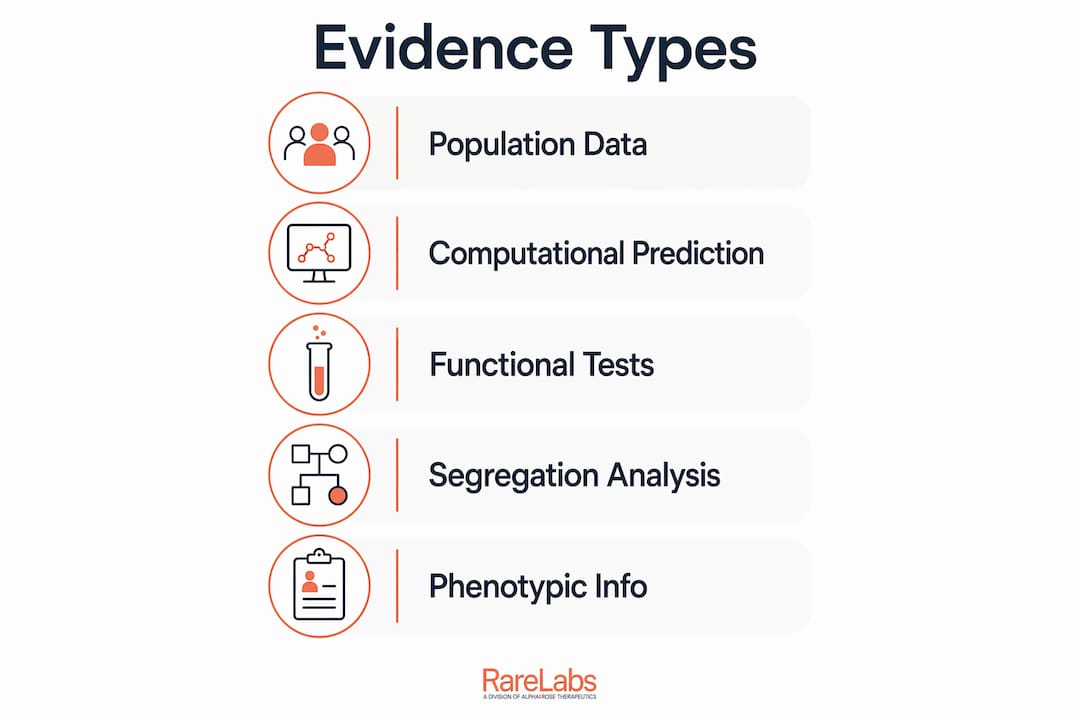
The core evidence categories include:
- Population frequency data. Databases like gnomAD catalog allele frequencies across tens of thousands of individuals. A variant present at high frequency in healthy populations is unlikely to cause a severe rare disease. Conversely, a variant absent from gnomAD (flagged by the PM2 criterion) gains pathogenic weight.
- Disease databases. ClinVar aggregates variant classifications submitted by laboratories worldwide. HGMD (Human Gene Mutation Database) catalogs published disease-causing mutations. Both are standard references in any clinical variant assessment workflow.
- In silico prediction tools. Programs like PolyPhen-2 and SIFT predict whether an amino acid change disrupts protein function. These tools are fast and scalable, but they are computational estimates, not experimental results.
- Functional studies. Laboratory experiments that directly test a variant's effect on protein function, gene expression, or cellular behavior provide the strongest evidence. Functional data can shift a VUS to Likely Pathogenic when other evidence is borderline.
- Segregation and family data. If a variant consistently appears in affected family members and is absent in unaffected ones, that pattern supports pathogenicity. Trio sequencing (patient plus both parents) is the most common approach.
- Phenotype-aware filtering. HPO term-driven prioritization refines candidate variant lists by matching the patient's clinical features to gene-disease associations. This step often improves accuracy more than any single database lookup.
Pro Tip: Never treat an in silico prediction as a standalone finding. PolyPhen-2 and SIFT scores should always be weighed against functional data and clinical context. A "damaging" prediction on a variant found in 1 percent of healthy individuals means very little.
The quality of phenotypic input directly determines how well variant prioritization workflows perform. Vague clinical descriptions produce noisy candidate lists. Precise HPO terms produce focused, clinically relevant results.
How have recent tools and machine learning improved variant interpretation?
The 2026 generation of variant interpretation software has meaningfully lowered the barrier to entry for non-specialist users. ACVI-Med, an open-source interpretation tool, enables users without deep bioinformatics training to perform ACMG-guided variant tiering, apply phenotype-aware filtering, and flag secondary findings and pharmacogenomic variants within a single workflow. This matters for rare disease research teams where a dedicated bioinformatician is not always available.
Machine learning has pushed classification accuracy further. The MetaXVP framework achieves an AUROC of 0.991 for pathogenic versus benign classification and 0.986 for VUS reclassification, using 32 integrated features. Those numbers represent a meaningful improvement over single-tool predictions, and the ability to reclassify VUS at scale is particularly valuable for rare disease cohorts where VUS rates are high.
The caution, however, is real. Black-box AI systems that produce a classification without traceable evidence logic create serious problems in clinical settings. A clinician cannot explain a Likely Pathogenic result to a patient or a referring physician if the reasoning is locked inside an opaque model. Expert panels, gene-specific criteria developed by groups like ClinGen, and deterministic evidence-scoring systems remain the gold standard for clinical use.
Pro Tip: When evaluating any variant interpretation software, ask one question before anything else: can it show you which specific evidence criteria it applied and why? If the answer is no, the tool is not ready for clinical use.
The genomic medicine advances of 2026 have made AI assistance genuinely useful, but the responsibility for clinical interpretation still rests with trained professionals who can interrogate the evidence behind every classification.
What are the challenges of interpreting variants of uncertain significance?
VUS is the classification that causes the most confusion and anxiety for patients and families. A VUS designation does not mean a variant is dangerous. It means the current evidence is insufficient to classify it as either disease-causing or benign. That distinction is critical, and communicating it clearly is one of the most important responsibilities in rare disease genetic diagnosis.
Managing VUS effectively requires a structured approach:
- Understand what VUS means. A VUS reflects knowledge limits, not a permanent risk status. Most VUS findings are eventually reclassified, the majority toward benign.
- Schedule periodic re-evaluation. Standard practice calls for reassessment every one to two years, or sooner when new family data or published research becomes available. Databases grow continuously, and a VUS from two years ago may have a clear classification today.
- Request the full evidence report. Inter-laboratory variation in applying ACMG/AMP criteria is real. Two labs can review identical evidence and reach different conclusions based on how conservatively they weight specific criteria. A detailed evidence report lets your clinical team make an independent judgment.
- Provide detailed phenotype data. The more precisely a patient's clinical features are documented using HPO terms, the more accurately a lab can contextualize a borderline variant. Vague phenotype descriptions are one of the most common reasons VUS rates remain high.
- Stay connected with your clinical team. Patients and families should ask their physician or genetic counselor to flag their VUS for active monitoring. Labs that submit data to ClinVar contribute to the shared knowledge base that drives reclassification over time.
The transparent evidence reporting behind a VUS classification is what separates a useful result from an ambiguous one. A lab that shows its reasoning gives clinicians the tools to make better decisions, even when the final label is uncertain.
How do clinicians and researchers apply variant interpretation in practice?
Applying a gene mutation interpretation guide in real clinical or research workflows follows a consistent stepwise logic, even when the specific tools vary by institution.
The standard process moves through these stages:
- Variant data gathering. Whole exome or whole genome sequencing produces a raw list of variants, often numbering in the thousands. Initial filtering removes common variants and focuses on rare, potentially functional changes.
- ACMG criteria application. Each candidate variant is scored against the full set of ACMG/AMP evidence criteria. Tools like ACVI-Med automate much of this step, but expert review remains necessary for complex cases.
- Database consultation. ClinVar, gnomAD, HGMD, and gene-specific databases are queried for each variant. Existing classifications from other labs inform but do not replace independent assessment.
- Phenotype-driven prioritization. Workflows like PipeVar use HPO terms to rank variants by their fit with the patient's clinical presentation. This step is particularly powerful in undiagnosed disease cases where the causal gene is unknown.
- Evidence synthesis and final classification. A multidisciplinary team, typically including a clinical geneticist, genetic counselor, and molecular pathologist, reviews the evidence and assigns a final tier.
- Result communication. Findings are reported to patients and families using clear, non-technical language. Uncertainty is explained honestly. For families navigating rare disease, understanding test results is as important as receiving them.
Documentation follows HGVS nomenclature standards to ensure variant descriptions are unambiguous and reproducible across institutions. Multidisciplinary review is not optional for complex cases. A variant that looks benign in isolation may be clearly pathogenic when viewed against a patient's full clinical picture.
Key takeaways
Accurate gene variant interpretation requires integrating population data, functional evidence, and precise phenotype information within the ACMG/AMP framework, not relying on any single tool or database.
| Point | Details |
|---|---|
| ACMG/AMP five-tier system | Classifies variants from Pathogenic to Benign with defined certainty levels for each tier. |
| VUS is not a permanent label | Re-evaluate every one to two years; most VUS findings are eventually reclassified. |
| Evidence transparency matters | Always request the full evidence report, not just the final classification tier. |
| Phenotype quality drives accuracy | Precise HPO terms improve variant prioritization more than any single database lookup. |
| AI tools require clinical oversight | Use software with traceable evidence logic; black-box AI is not appropriate for clinical decisions. |
Why the label matters less than the reasoning behind it
I have reviewed enough variant reports to know that the classification tier is almost never the most useful part of the document. The evidence section is. Two labs can both call a variant Likely Pathogenic and mean completely different things by it, because one applied PVS1 with strong functional support and the other applied it based on computational prediction alone.
The field has made real progress with tools like ACVI-Med and frameworks like MetaXVP, but the risk of over-automating this process is growing alongside the capability. I have seen research teams accept a machine-generated VUS reclassification without reviewing the underlying feature weights, which is exactly the kind of shortcut that leads to misdiagnosis in rare disease cases where every data point counts.
My strongest recommendation for any clinician or researcher working in this space: treat every variant classification as a hypothesis, not a verdict. The ACMG/AMP framework is designed to be updated as evidence accumulates. A VUS today is a data collection problem, not a dead end. The teams that get the best outcomes are the ones that build re-evaluation into their workflow from the start, not as an afterthought when a patient's condition changes.
Open-source tools and community data sharing through ClinVar are genuinely moving the field forward. The obligation is to use them rigorously, document the reasoning, and communicate the uncertainty honestly to the people whose lives depend on getting this right.
— John
Explore Hopeatrarelabs for rare disease research and variant resources
For patients, families, and clinicians navigating rare and undiagnosed genetic diseases, having access to current, reliable information on variant interpretation is not optional. It is the foundation of every treatment decision.

Hopeatrarelabs built its rare disease knowledge hub specifically for this community. The platform brings together research on variant classification, treatment screening, and disease modeling in one place, designed for people who need answers quickly and cannot afford to wade through fragmented sources. Whether you are a physician reviewing a complex VUS result, a researcher designing a phenotype-driven study, or a family trying to understand what a genetic report actually means, Hopeatrarelabs offers the depth and specificity this work demands.
FAQ
What is the ACMG/AMP five-tier classification system?
The ACMG/AMP system classifies genetic variants into five tiers: Pathogenic, Likely Pathogenic, VUS, Likely Benign, and Benign. Each tier reflects a defined level of evidence certainty, with Likely Pathogenic and Likely Benign representing approximately 90 to 99 percent confidence.
What does a VUS result mean for a patient?
A VUS means current evidence is insufficient to classify the variant as disease-causing or benign. It is not a permanent risk label. Standard practice calls for re-evaluation every one to two years as databases and published research expand.
How do tools like gnomAD and ClinVar support variant interpretation?
gnomAD provides population-level allele frequency data to identify variants that are too common to cause rare disease. ClinVar aggregates classifications from laboratories worldwide, giving clinicians a reference point for how other experts have assessed the same variant.
Why do different labs sometimes classify the same variant differently?
Inter-laboratory variation in applying ACMG/AMP criteria is well documented. Labs differ in how conservatively they weight specific evidence codes. Requesting the full evidence rationale, rather than just the final tier, allows clinical teams to make independent, context-specific judgments.
Can AI tools replace expert review in variant interpretation?
AI tools like MetaXVP improve classification accuracy and can reclassify VUS at scale, but they do not replace expert review. Deterministic, evidence-based systems with traceable logic are preferred for clinical use over opaque models that cannot explain their reasoning.