

Interpreting genetic test results means understanding the type of outcome you received and what it actually says about your health risk. Clinical genetic testing laboratories achieve 99.0–99.9% analytical accuracy in detecting DNA sequences, but that precision does not guarantee a clinical diagnosis. Results fall into three main categories: positive, negative, and Variant of Uncertain Significance (VUS). The American College of Medical Genetics and Genomics (ACMG) sets the classification standards labs use to sort these findings. Knowing how to read genetic reports correctly, and when to call a genetic counselor, is what turns a confusing document into a plan you can act on.
How to interpret genetic test results: positive, negative, and VUS explained
Every genetic report delivers one of three core outcomes. Understanding what each one means prevents the most common and costly misreading families make.
What a positive result actually tells you
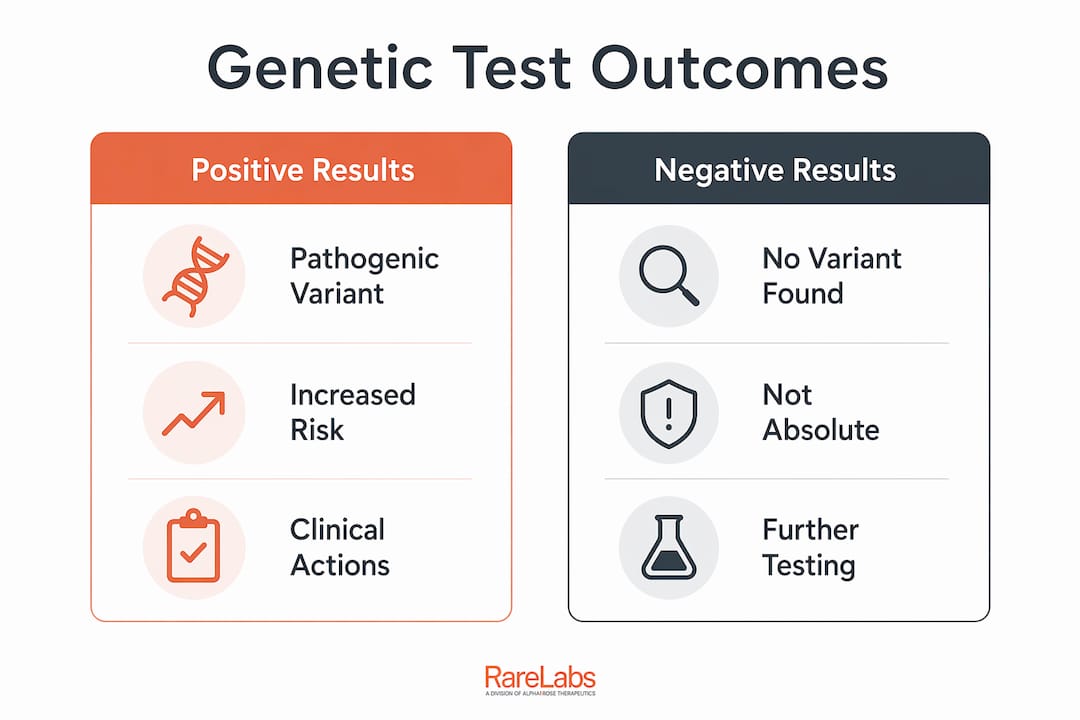
A positive result means a pathogenic or likely pathogenic variant was found in a gene linked to a specific condition. Positive results indicate elevated risk or a confirmed diagnosis, but they rarely guarantee disease will develop. A BRCA1 variant, for example, raises lifetime breast cancer risk significantly. It does not mean cancer is certain. Family history, clinical symptoms, and the specific variant type all shape what a positive finding means for you personally.
Positive results also come in subtypes:
- Diagnostic positive: Confirms a condition you already have symptoms for.
- Predictive positive: Identifies elevated future risk before symptoms appear.
- Carrier positive: Shows you carry one copy of a recessive gene variant. You may never develop the condition, but you could pass it to your children.
Pro Tip: Ask your lab or physician which subtype your positive result represents. The clinical implications differ significantly between a diagnostic and a carrier finding.
What a negative result really means
A true negative result means no pathogenic variant was found in the genes tested. That is reassuring, but it is not a clean bill of health. A negative result only covers the specific gene panel the lab ran. If your family has a strong disease history and your result comes back negative, it may be an uninformative negative rather than a true negative.
Uninformative negative results occur in 15–30% of families with a strong disease history, due to testing limitations or genes not yet discovered. That statistic matters because many families stop investigating after a negative result, assuming all risk is ruled out. A negative on a 25-gene panel does not rule out variants on genes not included in that panel.
What VUS means and why it is not a diagnosis
A Variant of Uncertain Significance is neither positive nor negative. VUS indicates that more scientific evidence is needed before the variant can be classified as harmful or harmless. Labs treat VUS findings as undetermined and will reclassify them over time as population data grows. Many VUS findings are eventually reclassified as benign. Do not make major medical decisions based on a VUS result alone.
How to read the key sections of a genetic report
Genetic reports are written for clinicians, not patients. Reports use technical language designed for professionals, so knowing which sections to focus on first saves confusion and reduces the risk of misreading your own data.

The sections that matter most
Most genetic reports follow a standard layout. Here is what each section contains and how to approach it:
| Section | What it contains | What to do with it |
|---|---|---|
| Summary / Conclusion | Plain-language interpretation of findings | Read this first; it states the core result |
| Findings / Results | Variant names, gene codes, ACMG classification | Review with a counselor or physician |
| Technical Limitations | Gene panel version, coverage gaps | Document this for future reference |
| Recommendations | Suggested clinical follow-up steps | Share with your care team immediately |
| References | Scientific literature supporting classifications | Background reading; not required for patients |
Start with the Summary or Conclusion section. It translates the technical findings into a clinical interpretation. The Findings section will list variants using gene name codes such as BRCA2, MLH1, or SCN1A, along with their ACMG classification: pathogenic, likely pathogenic, VUS, likely benign, or benign.
Common terms you will encounter
Risk estimates in genetic reports appear as lifetime risk percentages or fold-increase figures. A "3-fold increased risk" means your risk is three times the general population baseline, not that you have a 300% chance of developing a condition. Inheritance pattern labels such as autosomal dominant, autosomal recessive, and X-linked describe how a variant is passed through families. These terms directly affect whether your siblings or children need testing.
Many patients overlook the technical limitations section, but it is one of the most important parts of the report. It tells you exactly which genes were tested, which variants the method can and cannot detect, and which version of the gene panel was used. That information is critical if you ever seek a second opinion or request expanded testing such as whole-exome sequencing.
Pro Tip: Photograph or scan your full report, including the technical limitations page, and store it in a secure location. Labs update their panels regularly, and the version used in your test affects how results compare to future analyses.
When and why to seek genetic counseling after your results
Genetic counseling is the professional service that bridges a lab report and a health decision. A board-certified genetic counselor holds specialized training in both clinical genetics and patient communication. They do not just explain what a variant means. They help you understand what it means for your specific family, your clinical history, and your options going forward.
Scheduling genetic counseling within 1–2 weeks after receiving results is the recommended window for proper clinical interpretation and emotional support. Waiting longer often means patients spend that time searching online, which increases anxiety without improving understanding.
How to prepare for a counseling appointment
Arrive at your appointment with the following:
- Your full genetic report, including the technical limitations section
- A three-generation family health history, noting any relatives with the same or related conditions
- A written list of questions about your specific findings
- Any previous genetic test reports, even from other labs or years prior
- Your current medications and diagnoses, since some variants affect drug metabolism
Genetic counselors caution patients against relying on online data that often overstates risks. A counselor provides the clinical context that a search engine cannot. For families navigating rare or undiagnosed diseases, this distinction is especially consequential. You can learn more about genetic counseling in rare diseases and how specialists support families through complex findings.
Common challenges and next steps after your results arrive
Receiving a genetic report is rarely the end of the process. Most families face at least one of these challenges after their initial results.
-
You received an uninformative negative. A negative result on a limited gene panel does not rule out genetic disease. Ask your physician whether whole-exome sequencing or whole-genome sequencing would be appropriate given your family history.
-
Your VUS classification has not changed. VUS findings require periodic lab reanalysis as scientific evidence accumulates. Contact your lab annually to ask whether your VUS has been reclassified. Many labs will notify you automatically, but not all do.
-
Your results conflict with your symptoms. A negative genetic result does not override clinical evidence. If your symptoms strongly suggest a genetic condition, additional testing or a different gene panel may be warranted. Genetic diagnosis is critical for personalized care, and a single negative result should not close the door on further investigation.
-
Family members need guidance. A positive or VUS result in one person has direct implications for biological relatives. Your genetic counselor can help you communicate findings to family members and determine who should be tested next.
-
You want a second opinion. Documenting your lab's methodology and gene panel version is critical for requesting a second opinion or advancing to more comprehensive tests. Different labs use different panels, and a variant missed by one may be detected by another.
"A genetic test result is a data point, not a verdict. The clinical picture, family history, and professional interpretation together determine what that data point actually means for your health."
Understanding the gene variant interpretation process for rare diseases adds important context when standard panels return inconclusive findings.
Key takeaways
Accurate genetic result interpretation requires combining lab findings with clinical context, family history, and professional guidance. No single result category tells the complete story on its own.
| Point | Details |
|---|---|
| Positive results indicate risk, not certainty | A pathogenic variant raises probability but does not guarantee disease will develop. |
| Negative results have limits | Uninformative negatives occur in 15–30% of families with strong disease history due to panel gaps. |
| VUS requires patience and follow-up | VUS findings are reclassified over time; check with your lab annually for updates. |
| Read the summary section first | The Summary or Conclusion section translates technical findings into clinically relevant language. |
| Genetic counseling is not optional | A board-certified counselor provides the clinical context needed to act on your results safely. |
What I have learned from watching families read their first genetic report
The moment a family receives a genetic report, the instinct is to search every term online. I have seen that pattern lead to genuine harm. A VUS in a cancer-related gene becomes a self-diagnosed malignancy. A carrier result becomes a certainty of disease. The gap between what a report says and what a family believes it says is often enormous, and that gap is where decisions go wrong.
The most important shift I have seen in families who navigate this well is treating the report as a starting point, not a conclusion. They bring it to a genetic counselor before they bring it to a search engine. They ask what the result means for their specific clinical picture, not what it means in general population studies. They also ask what the result does not tell them, which is often just as important.
The other thing I have noticed is that families underestimate how much genetic science changes. A VUS from three years ago may be benign today. A gene panel that was comprehensive in 2022 may now be considered limited. Staying in contact with your lab and your care team is not overcaution. It is how you keep your interpretation current. The science moves, and your understanding of your results should move with it.
— John
Hopeatrarelabs and your path from results to answers
Receiving a genetic report is one step in a longer process, especially for families dealing with rare or undiagnosed conditions. Hopeatrarelabs works at the intersection of genetic science and patient-specific disease modeling, helping families move from a confusing report to a concrete understanding of what their results mean for treatment options.

The Hopeatrarelabs knowledge hub offers research-based resources on rare disease genetics, variant interpretation, and the science behind personalized treatment development. Whether you are trying to understand a VUS, prepare for a counseling appointment, or figure out what comes after a positive result, the knowledge hub is built for families who need clear, credible answers. Hopeatrarelabs also connects patients and physicians with the scientific depth needed to move from genetic data to real treatment pathways.
FAQ
What does a positive genetic test result mean?
A positive result means a pathogenic or likely pathogenic variant was identified in a tested gene. It indicates elevated risk or a confirmed diagnosis, but it does not guarantee disease will develop.
What is a Variant of Uncertain Significance?
A VUS is a genetic variant that cannot currently be classified as harmful or harmless due to insufficient scientific evidence. Labs reclassify VUS findings over time as more data becomes available.
How accurate are genetic tests?
Clinical genetic testing laboratories achieve 99.0–99.9% analytical accuracy in detecting DNA sequences. High analytical accuracy does not guarantee a clinical diagnosis, since results must be interpreted alongside symptoms and family history.
When should I see a genetic counselor after my results?
Booking a genetic counselor within 1–2 weeks of receiving your report is the recommended window. Early counseling prevents misinterpretation and provides emotional support during a stressful period.
Can a negative genetic test result still mean I have a genetic condition?
Yes. Uninformative negative results are common when the gene panel tested does not cover the specific mutation or gene involved. A negative result rules out only the variants included in that specific test.