
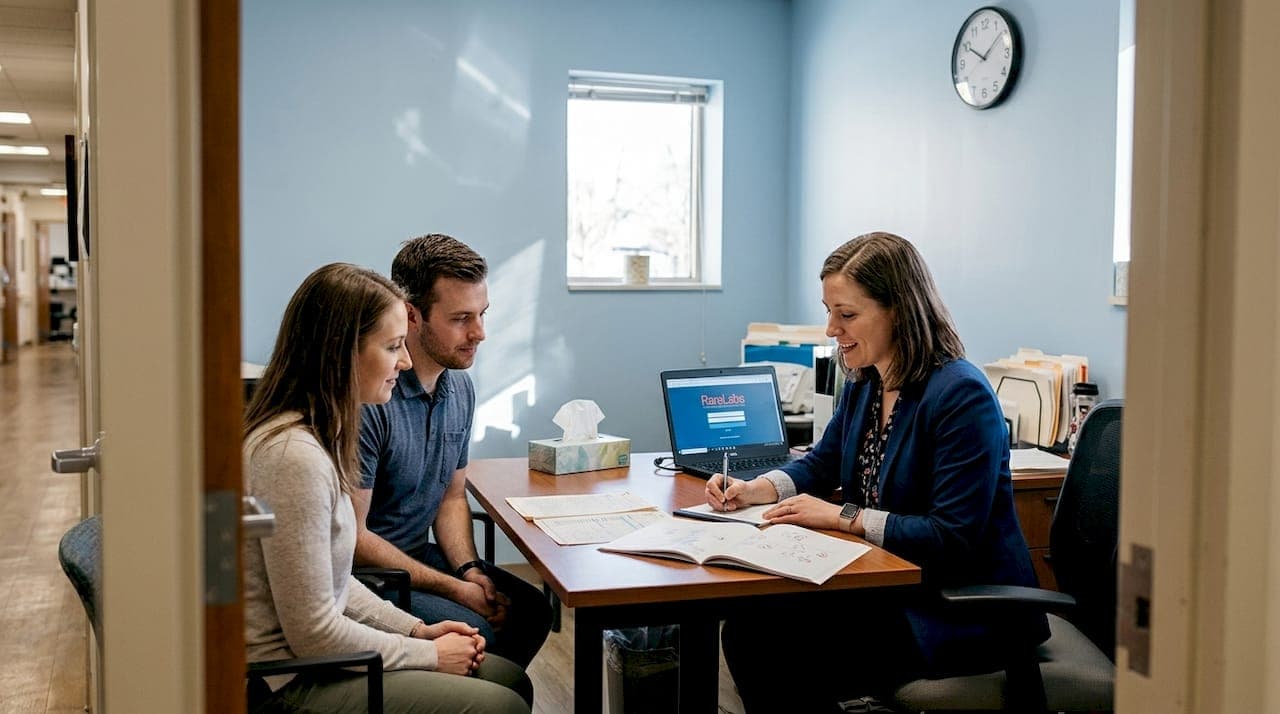
Many families believe that finally getting a diagnosis ends the uncertainty. With rare or undiagnosed genetic diseases, a diagnosis often opens entirely new questions: What caused this? Could siblings be affected? Are there treatments? Who coordinates all of this? Genetic counseling exists precisely to answer those questions. It is a specialized support system that goes far beyond explaining a test result. For families navigating a rare disease journey, genetic counselors serve as interpreters, navigators, and advocates. This guide walks through what genetic counseling actually involves, how the process works, and why it is especially indispensable when a condition is rare or still undiagnosed.
Table of Contents
- What is genetic counseling and who provides it?
- How does the genetic counseling process work?
- Why genetic counseling is critical for rare and undiagnosed diseases
- Interpreting complex genomic results: Key challenges and advances
- The psychosocial impact: Support beyond the science
- Our perspective: What most families miss about genetic counseling
- Connect with rare disease specialists and treatment options
- Frequently asked questions
Key Takeaways
| Point | Details |
|---|---|
| Genetic counseling defined | Genetic counseling helps families interpret results, assess risks, and plan care for rare diseases. |
| Care coordination advantage | Counselors guide testing, treatment options, and support services through complex medical journeys. |
| Emotional support matters | Beyond science, genetic counseling improves empowerment and reduces stress for patients and families. |
| Managing uncertainty | Expert counselors clarify uncertain test results and recommend clear next steps. |
What is genetic counseling and who provides it?
Genetic counseling is a clinical service that helps individuals and families understand, adapt to, and make informed decisions about genetic conditions. It involves much more than handing over a lab report. Genomic counseling basics covers interpreting genomic information, ordering the right tests, calculating recurrence risks, explaining inheritance patterns, interpreting genetic variants, and addressing the psychosocial and ethical dimensions that come with a life-altering diagnosis.
Genetic counselors are healthcare professionals trained specifically at the intersection of clinical genetics and counseling. Most hold a master's degree in genetic counseling and work alongside medical geneticists, neurologists, metabolic specialists, and other subspecialists. They are certified by the American Board of Genetic Counseling (ABGC) and work in hospitals, specialty clinics, research centers, and increasingly in telehealth settings.
For common genetic conditions like BRCA-related cancer risk, counseling sessions tend to follow a fairly predictable script. Rare and undiagnosed diseases are a different world entirely. The counselor may be working with incomplete literature, novel variants that have never been seen before, or a condition with no official name. This requires a level of scientific detective work, creative problem-solving, and emotional stamina that goes beyond standard practice.
Here is what a genetic counselor typically does for families with rare or undiagnosed conditions:
- Reviews and interprets complex genomic reports that may include variants of uncertain significance (VUS)
- Coordinates testing across multiple specialties and labs
- Explains inheritance risks to both the patient and extended family members
- Connects families to patient registries, advocacy organizations, and clinical trials
- Provides non-directive guidance so families can make choices aligned with their own values
- Offers emotional support throughout an often years-long diagnostic journey
Pro Tip: Before your first appointment, write down every symptom, every specialist you have seen, and every test that has already been done. Counselors work faster and more accurately when they have a complete picture from the start.
How does the genetic counseling process work?
Knowing who genetic counselors are is only half the picture. What actually happens when you sit down with one? The process is more structured and more collaborative than most families expect.
Session structure details confirms that a standard session covers family history review spanning at least three generations, physical examination findings, supportive counseling, explanation of diagnosis and prognosis, management options, and genetic testing discussions. Sessions typically last over an hour and often involve a multidisciplinary team.
Here is how the process typically unfolds:
- Intake and family history The counselor builds a detailed pedigree, a diagram of your family tree that maps out health conditions across generations. This is not just paperwork. Patterns of inheritance emerge from this diagram that can guide the entire testing strategy.
- Clinical review The counselor reviews prior medical records, imaging, and lab results. For rare diseases, this often means coordinating with multiple specialists before the session even begins.
- Test selection and coordination Not all genetic tests are equal. The counselor recommends the most appropriate test for your situation, whether that is a single-gene panel, exome sequencing, genome sequencing, or chromosomal microarray, and manages the logistics of ordering and receiving results.
- Results interpretation When results arrive, the counselor explains what they mean in plain language. This includes explaining the difference between a pathogenic variant, a benign variant, and a VUS.
- Psychosocial discussion This is where the session shifts from data to lived experience. Counselors ask how you are coping, what the information means for your family, and what support you need going forward.
- Follow-up and re-evaluation Genetic knowledge evolves rapidly. A variant classified as uncertain today may be reclassified in two years. Counselors schedule follow-ups and proactively reach out when new information changes a prior interpretation.
"The patient-provider relationship in genetic counseling is built on trust, transparency, and shared decision-making. It is not about telling families what to do. It is about making sure they have everything they need to decide for themselves."
Family members who did not attend the original session may also be invited for cascade testing, meaning testing relatives to see if they carry the same variant. This is especially important for conditions with autosomal dominant or X-linked inheritance.
Why genetic counseling is critical for rare and undiagnosed diseases
Genetic counseling is valuable for any hereditary condition, but for rare and undiagnosed diseases, it becomes essential. The complexity, the emotional weight, and the sheer volume of coordination required make it a different kind of service altogether.
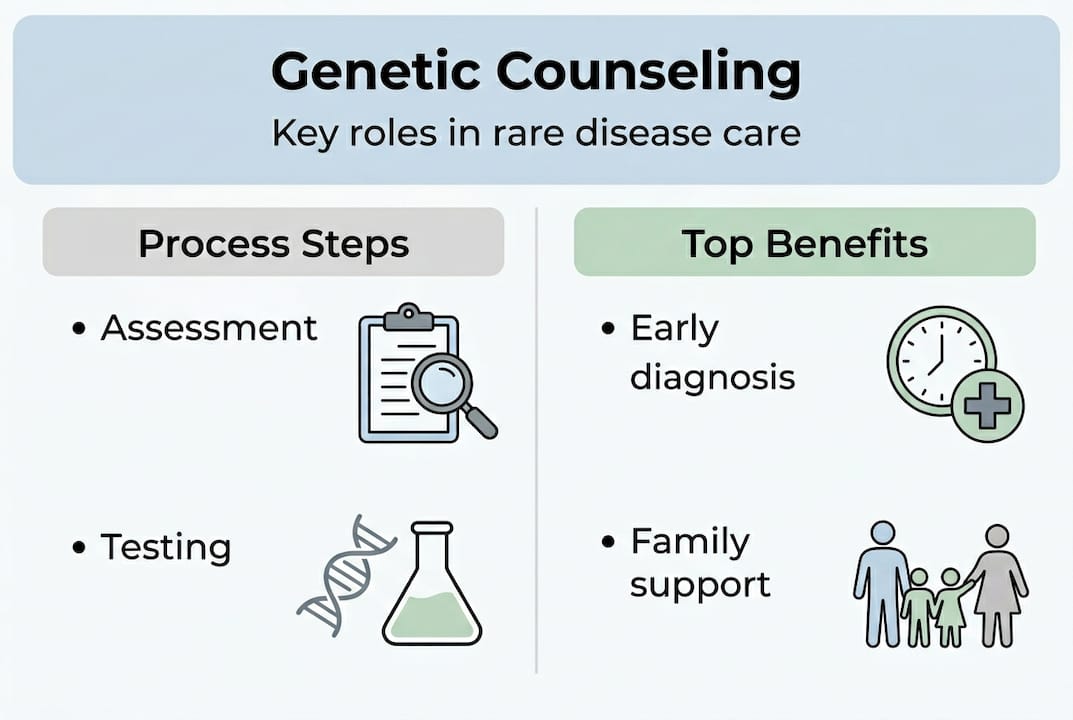
Consider the numbers. Impact on early diagnosis notes that up to 80% of rare diseases have a genetic cause, yet 95% of rare diseases have no approved treatment. Genetic counseling helps families access early and accurate diagnoses, understand orphan drug pathways, and evaluate gene therapy options before they become widely available.
Care coordination is one of the most underappreciated functions counselors provide for rare disease families. They navigate complex testing and treatment landscapes, partner across prenatal, pediatric, and adult specialties, connect families to support programs, and facilitate long-term management as new therapies emerge.
| Feature | Standard genetic counseling | Rare disease genetic counseling |
|---|---|---|
| Typical session length | 45 to 60 minutes | 60 to 120+ minutes |
| Literature availability | Well-established | Often limited or absent |
| Number of specialists involved | 1 to 2 | Often 3 or more |
| Test result certainty | Usually clear | Frequently uncertain or novel |
| Follow-up frequency | Once or twice | Ongoing, lifelong |
| Connection to clinical trials | Rare | Routine |
Beyond logistics, the emotional and practical benefits for rare disease families include:
- Reduced time to diagnosis by avoiding redundant or inappropriate testing
- Access to rare disease treatment options including experimental therapies and compassionate use programs
- Guidance on what results mean for family planning
- A point of contact who understands the whole medical picture
- Emotional validation from someone trained to hold space for uncertainty
Interpreting complex genomic results: Key challenges and advances
One of the most anxiety-provoking moments in a rare disease journey is receiving a genomic report filled with technical language and inconclusive findings. This is where skilled genetic counseling becomes genuinely irreplaceable.

Trio sequencing advantages reveal a diagnostic yield of 39% overall from trio exome or genome sequencing in rare disease cases, with higher rates in neurodevelopmental and consanguineous (related parents) scenarios. In solved cases, 46% of causative variants were de novo, meaning they appeared fresh in the child and were not inherited from either parent.
Trio analysis means testing the patient alongside both biological parents simultaneously. This approach dramatically improves the ability to identify de novo variants and distinguish true disease-causing mutations from inherited benign variants. Singleton analysis, testing only the patient, is less expensive but yields fewer answers.
| Test type | Typical diagnostic yield | Best scenario |
|---|---|---|
| Single-gene test | Variable | Known clinical diagnosis |
| Gene panel | 25 to 50% | Clinically defined syndrome |
| Singleton exome sequencing | 25 to 30% | Suspected genetic cause |
| Trio exome sequencing | 35 to 45% | Undiagnosed with living parents |
| Trio genome sequencing | 40 to 50%+ | When exome is negative |
Edge case counseling highlights the real complexity when results are indeterminate. Silent carriers of conditions like spinal muscular atrophy (SMA), mosaic variants, VUS classifications, and adult-onset findings in pediatric patients all require careful, personalized explanation. These cases cause genuine confusion and emotional distress, and sessions for them routinely run longer.
Pro Tip: Always ask your counselor specifically, "What would it mean if this result changes classification in the future, and how will I be notified?" Many families do not know that variant reclassification happens routinely as databases grow.
Counselors also help prevent the trap of repeated, redundant testing. Without guidance, families sometimes pursue the same test through different labs or chase diagnoses that the existing data already rules out. This wastes time and money and adds emotional strain. Interpreting genetic test results correctly the first time is both a science and an art.
The psychosocial impact: Support beyond the science
The science of genetics is only one dimension of what makes a rare disease diagnosis so challenging. The emotional experience of living with uncertainty, waiting for answers, or processing a devastating result is equally real and equally in need of professional attention.
Genetic counseling is one of the few clinical services that treats emotional wellbeing as a core outcome, not a side note. Psychosocial outcomes data from a randomized controlled trial shows that genetic counseling significantly improves empowerment (p=0.004), reduces depression and anxiety, and increases knowledge among participants. These are not soft benefits. They are measurable clinical outcomes.
Families dealing with rare diseases report specific emotional challenges that counseling directly addresses:
- Grief over a diagnosis or the loss of a "typical" future
- Guilt, especially in parents who may carry a causative variant
- Fear about the implications for siblings, children, or future pregnancies
- Isolation from feeling misunderstood by friends and medical providers alike
- Caregiver burnout in families with a severely affected child
"Knowing the name of a disease does not automatically make it easier to live with. What helps is having someone guide you through what it means, what comes next, and how to keep moving forward."
As gene therapies and personalized treatments enter the rare disease space at an accelerating pace, genetic counselors also play a key role in helping families understand new options and recalibrate hope appropriately. This is an ongoing relationship, not a one-time consultation. Culturally sensitive and non-directive approaches are especially important when values around reproduction, risk, and medical intervention vary widely across families.
Our perspective: What most families miss about genetic counseling
Most families come to genetic counseling expecting an answer. What they often find instead is a map. That map does not always show a clear destination, but it shows where you are, which paths have already been explored, and where the promising routes lie.
One hard truth we have observed is that families frequently treat counseling as a one-time event tied to a single test result. In reality, counseling is a lifelong, adaptive process. Genetic science moves fast. A variant classified as uncertain today may be reclassified as pathogenic within two years. New therapies may emerge that suddenly make a previously untreatable condition actionable. Counselors are the professionals who keep track of all of this for you.
We also want to be honest about AI tools. Several platforms now offer automated genomic interpretation, and while they can be genuinely useful for flagging variants, they cannot replace the nuanced, personalized judgment of a trained counselor. No algorithm accounts for your family's specific values, emotional state, or cultural context.
Finally, access is a real barrier. Not everyone lives near a specialist center. Telehealth has changed this significantly, and many major academic centers now offer remote genetic counseling. If local resources are limited, ask your physician for a telehealth referral. Do not wait.
Connect with rare disease specialists and treatment options
Understanding your genetic results is the first step. Taking action on them is the next.
At RareLabs, we work specifically with families navigating ultra-rare and undiagnosed genetic diseases. We build patient-specific disease models from your own cells, then run parallel screens across thousands of FDA-approved drugs, custom antisense oligonucleotides (ASOs), and gene therapy candidates to find options that may work for you. If your family has a diagnosis but no approved treatment, or is still searching for answers, Explore RareLabs treatment search to learn how our personalized approach can open new doors. The science is moving faster than ever. You do not have to navigate it alone.
Frequently asked questions
How do I prepare for my first genetic counseling session?
Gather your family's medical history across at least three generations and write down any questions about diagnosis, possible treatments, or inherited risks. Counseling starts with a thorough family history and open dialogue, so arriving prepared makes a real difference.
What if my genetic test results are uncertain or inconclusive?
Your counselor will explain what the uncertainty means, whether repeat or upgraded testing is warranted, and what it does and does not imply for your family's health decisions. Indeterminate results require nuance and personalized explanation that no generic report can provide.
Does genetic counseling help with emotional stress or anxiety?
Yes. A recent randomized controlled trial confirms that counseling reduces depression, anxiety, and improves empowerment, making it a clinically proven emotional resource, not just a scientific one.
Can I access genetic counseling remotely or only in person?
Many academic medical centers and specialty clinics now offer telehealth genetic counseling, making access practical even when rare disease specialists are not nearby. Ask your primary care provider or neurologist for a telehealth referral.
How is counseling adapted for children or inherited risks?
Counselors use family-centered, multidisciplinary approaches tailored for pediatric diagnoses and reproductive questions. Care coordination across prenatal, pediatric, and adult specialties is a core part of the rare disease counseling model.