

For most families facing a rare or undiagnosed disease, the path to answers is nothing like what they imagined. You might assume that a single blood test or a specialist visit will reveal what's wrong. In reality, the diagnostic odyssey stretches an average of four to eight years, filled with incomplete results, shifting opinions, and more questions than answers. This guide cuts through the confusion. It explains what genetic diagnosis actually involves, which tests exist, how results get interpreted, and what families can realistically expect at each stage.
Table of Contents
- Understanding genetic diagnosis for rare diseases
- Common genetic testing approaches: WGS, WES, and panels
- How genetic variants are interpreted and classified
- Understanding variants of uncertain significance (VUS) and reanalysis-and-reanalysis)
- What comes next? Opportunities after genetic diagnosis
- A practical perspective: why the journey to answers is rarely straightforward
- Take the next step with RareLabs
- Frequently asked questions
Key Takeaways
| Point | Details |
|---|---|
| Diagnosis can be complex | Many rare diseases require advanced and sometimes repeated genetic tests for answers. |
| WGS is often best | Whole genome sequencing finds more causes of rare diseases than older methods. |
| Uncertain results are common | Up to 40 percent receive a VUS, which may be clarified with ongoing research and family testing. |
| Reanalysis brings new answers | Periodic review of genetic findings leads to new diagnoses for families whose search was once stalled. |
| Genetic answers open doors | A confirmed diagnosis enables tailored care, access to research trials, and informed family decision-making. |
Understanding genetic diagnosis for rare diseases
Genetic diagnosis means identifying a specific change in a person's DNA that explains their symptoms or disease. For families dealing with a rare condition, this distinction matters enormously. It shifts care from "treating symptoms" to understanding root cause, which often opens doors to more targeted management and research opportunities.
The importance of genetic diagnosis becomes clear when you consider how many rare diseases are fundamentally genetic in origin. Approximately 80% of rare diseases are caused by changes in a person's genes, and most of these conditions first appear in childhood. Despite that, families typically wait four to eight years before receiving a confirmed diagnosis, a period often called the diagnostic odyssey.
That wait isn't just emotionally exhausting. It delays treatment decisions, family planning conversations, and eligibility for clinical trials. It also means years of tests, hospitalizations, and specialist visits that don't connect.
Why genetic diagnosis matters so much:
- It provides a medical explanation that informs treatment decisions and symptom management
- It tells other family members whether they might carry the same genetic change
- It opens eligibility for clinical trials that require a confirmed genetic diagnosis
- It connects families with disease-specific support communities and registries
- It gives researchers data they need to develop new therapies
Pro Tip: If you've been through multiple specialists without a clear answer, ask directly whether whole genome sequencing (WGS) has been considered. Many families don't know this option exists until they advocate for it.
One important correction to a common myth: genetic diagnosis is not always fast, and it is not always definitive. A test might return uncertain results that require months or years of follow-up before a clear picture emerges. Understanding that from the start helps families navigate without feeling like something has gone wrong when results aren't immediately clear.
Common genetic testing approaches: WGS, WES, and panels
Now that you understand the role of genetics in rare diseases, let's examine the main testing approaches you might encounter. Three types of genetic tests are most commonly ordered for rare and undiagnosed diseases, and each has a distinct role.
Whole genome sequencing (WGS) reads the entirety of a person's DNA, roughly three billion base pairs (the chemical "letters" of the genetic code). It can detect changes anywhere in the genome, including regions that control how genes are switched on or off, and large structural rearrangements that other tests miss.
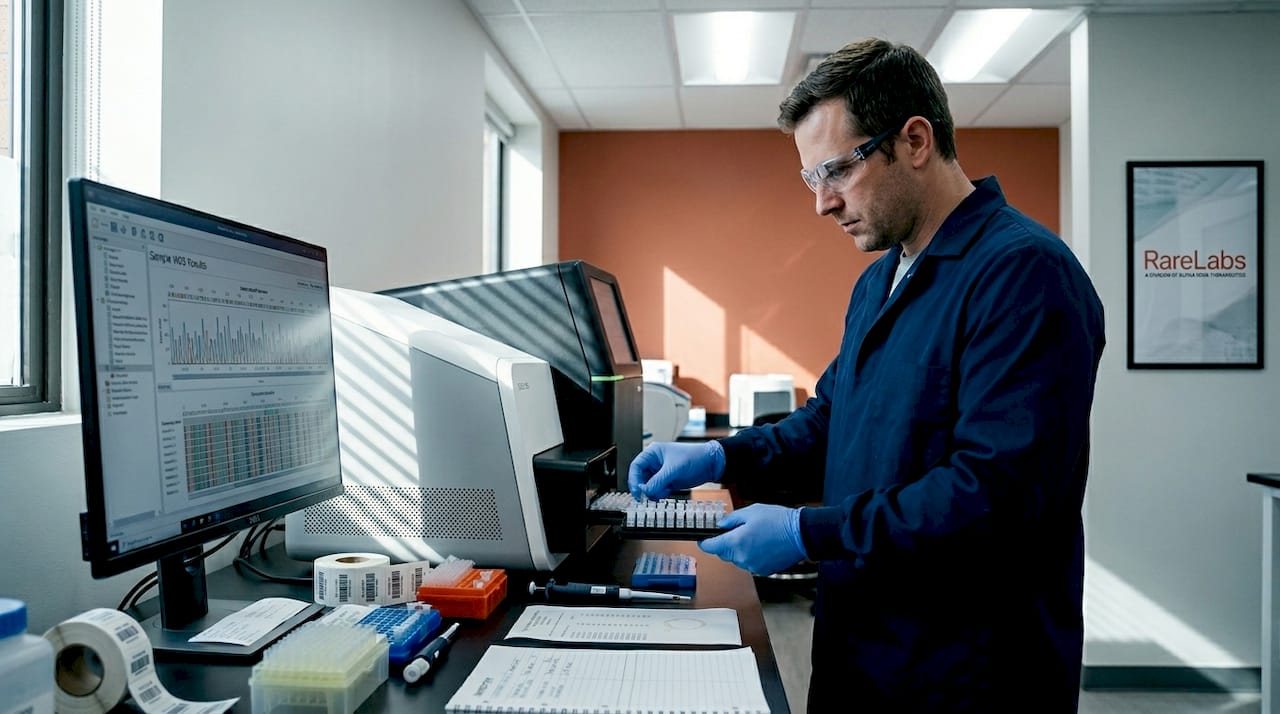
Whole exome sequencing (WES) focuses only on the exome, the approximately 1 to 2% of the genome that contains protein-coding genes. This is where most known disease-causing variants sit, so WES has historically been more cost-effective for many conditions. But it misses changes outside coding regions.
Gene panels test a predetermined list of genes linked to a specific condition or group of conditions. They're faster and cheaper but only useful when clinicians already have a strong suspicion about which disease category is involved.
| Test | What it covers | Best for | Typical diagnostic yield |
|---|---|---|---|
| Gene panel | Selected disease genes | Known syndrome suspected | 10 to 30% |
| WES | All protein-coding genes | Complex, multi-system cases | 25 to 40% |
| WGS | Entire genome | Undiagnosed, atypical cases | 27 to 46% |
WGS shows higher diagnostic yields than WES or panels for rare diseases, with reported yields of 27 to 46% in published studies, and even higher rates in complex multi-system cases. That advantage comes from its ability to detect structural variants, non-coding mutations, and other changes that WES and panels simply cannot see.
How to choose which test to start with:
- Review whether any specialist has already proposed a likely diagnosis or disease category.
- If no clear category exists, WGS is often the most efficient starting point in 2026.
- If a specific syndrome is strongly suspected, a targeted panel may give faster results.
- Ask your clinical team whether insurance or a research program covers WGS before defaulting to a panel.
- Request trio sequencing (testing the affected child plus both parents) when possible, as this significantly improves interpretation accuracy.
Pro Tip: Many families get faster rare disease answers by pushing for trio WGS upfront rather than going through sequential testing over several years. Trio data helps laboratories distinguish inherited variants from new (de novo) mutations.
How genetic variants are interpreted and classified
After a test is performed, the next challenge is making sense of the results, specifically, how individual genetic changes are interpreted. Raw sequencing data contains millions of variants. Most are harmless differences between individuals. Identifying which one causes disease is a complex, evidence-based process.
Laboratories use the ACMG/AMP classification guidelines developed by the American College of Medical Genetics and the Association for Molecular Pathology. These guidelines sort variants into five categories using 28 weighted criteria drawn from population data, computational predictions, functional lab studies, family (segregation) data, and how well the variant matches the patient's clinical picture.
| Classification | What it means | Clinical implication |
|---|---|---|
| Pathogenic | Strong evidence that this variant causes disease | Typically reported as diagnostic |
| Likely pathogenic | Good evidence, but not definitive | Usually treated as diagnostic |
| VUS | Uncertain significance; evidence is conflicting or insufficient | Not diagnostic on its own |
| Likely benign | Evidence suggests it does not cause disease | Generally not reported |
| Benign | Strong evidence it is harmless | Not reported |
These categories are not permanent labels. As evidence accumulates, a variant can be reclassified. A VUS (variant of uncertain significance, meaning a genetic change whose role in disease has not yet been established) found today may be reclassified as pathogenic or benign as databases grow and more patients with similar variants are identified.
"Variant classification is a living process, not a one-time verdict. Families should expect their laboratory or clinical team to periodically revisit results, especially for VUS findings."
Working with a genetic counselor is valuable at this stage. Genetic counseling for rare diseases helps families understand what a specific classification means for their situation, what follow-up is appropriate, and how results affect other family members.
Key factors that influence variant interpretation:
- Population frequency: is this change rare or common in the general population?
- Functional studies: do laboratory experiments show this variant disrupts normal protein function?
- Segregation: does the variant appear in other affected family members and absent in unaffected ones?
- Computational evidence: do predictive tools agree that the change is damaging?
- Phenotype match: does the patient's clinical picture fit what's known about the gene's function?
Understanding variants of uncertain significance (VUS) and reanalysis
Receiving uncertain results can be particularly stressful, so it's important to understand what a VUS means and what you can do about it. A VUS is probably the most frustrating result families receive because it doesn't confirm or rule out a diagnosis.
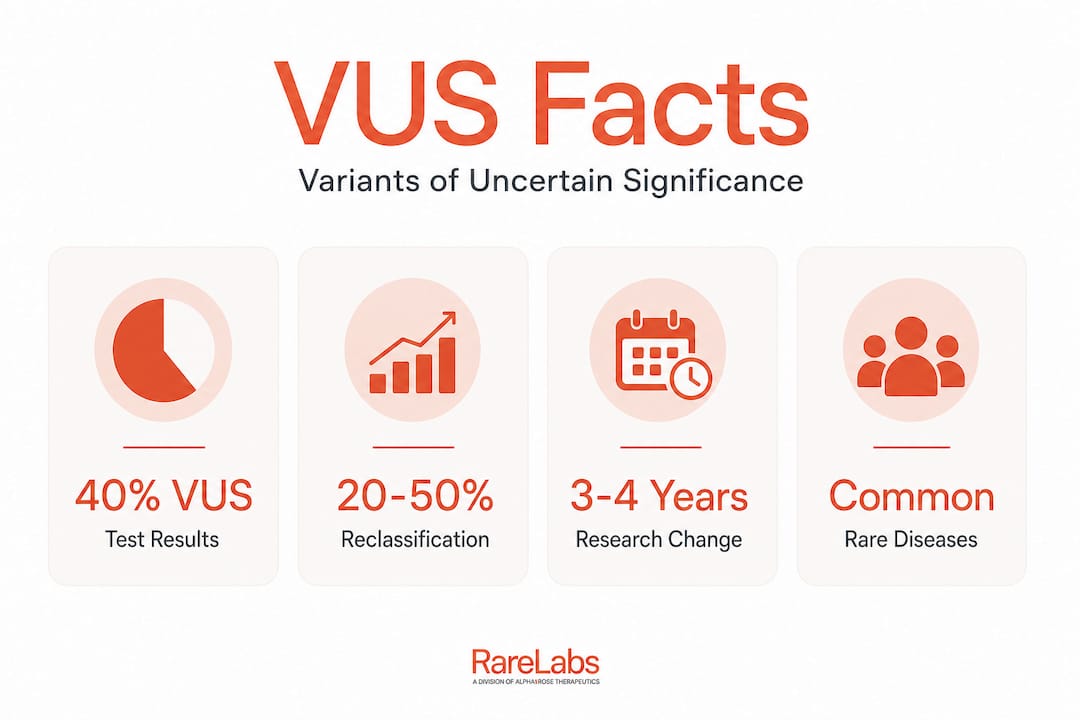
VUS findings are very common, comprising up to 40% of results from genetic testing in rare disease patients. This happens because our genetic databases are still growing. Many variants have simply never been seen enough times, or studied in enough detail, for scientists to reach a confident conclusion.
Critically, a VUS is not a diagnosis. Families should be cautious about making major medical decisions based on a VUS alone. At the same time, a VUS is not meaningless. It becomes a starting point for further investigation.
What can lead to VUS reclassification:
- Testing additional family members to see whether the variant tracks with disease (segregation analysis)
- Phenotype matching: connecting with other patients who have variants in the same gene
- Functional studies: laboratory tests that show whether the variant disrupts protein function
- Periodic reanalysis: as ClinGen and ACMG databases grow, classifications are updated
Reclassification through these methods can reduce VUS rates by 20 to 50%, a meaningful improvement for families who feel stuck. The key is to stay connected with your clinical team and ask specifically about reanalysis timelines.
Pro Tip: Request genetic disease education resources and ask your laboratory or clinical team to schedule a formal reanalysis at 12 to 18 months after your original VUS result. Many families don't know this is possible and standard practice in many centers.
Action steps families can take when facing a VUS:
- Ask whether additional family members should be tested
- Request that your clinician submit your variant to ClinVar (a public database of variant interpretations)
- Connect with patient registries for your suspected disease, which accelerates data gathering
- Keep detailed clinical records so your phenotype can be matched against new cases in the future
- Ask the laboratory for a scheduled reanalysis appointment, not just a promise to "check back"
What comes next? Opportunities after genetic diagnosis
With a confirmed or likely diagnosis, families can take concrete steps to access better care and future options. Receiving a pathogenic or likely pathogenic result is genuinely a turning point, though not an endpoint. What you do with that diagnosis determines how much benefit you actually receive.
Immediate actions after receiving a confirmed diagnosis:
- Confirm results with a certified medical geneticist or clinical team if the result came through a direct-to-consumer or research route.
- Schedule genetic counseling to understand inheritance patterns and implications for siblings or parents.
- Ask specifically about genetic therapy options that may apply to your condition, including gene therapy trials or approved treatments.
- Register in disease-specific patient registries, which can flag you for emerging trials.
- Share the diagnosis with all relevant medical providers, including those managing individual symptoms, so care can be unified under a diagnosis.
Genetic diagnosis enables management, family planning, and trial eligibility, but access and follow-through remain real challenges. Many families receive a diagnosis and don't know what to do next. That information gap is where support networks and specialized centers become essential.
Personalized rare care is now increasingly achievable thanks to advances in disease modeling, which allow researchers to create laboratory replicas of a patient's specific disease using their own cells. This means even ultra-rare conditions with no approved drugs can be tested systematically for treatment responses.
Pro Tip: If your condition has no existing treatment, ask whether your case qualifies for compassionate use programs, N-of-1 trials, or research partnerships with biotechnology labs working in your disease space.
Common pitfalls families fall into after diagnosis include failing to schedule reanalysis, not updating medical teams when diagnostic information changes, and missing clinical trial enrollment windows because eligibility criteria weren't checked regularly.
A practical perspective: why the journey to answers is rarely straightforward
Most guides about genetic diagnosis stop at the clinical steps. But families who have actually lived through this process know there's a dimension that doesn't show up in flowcharts: the emotional and logistical complexity of years of uncertainty.
A diagnosis does not always bring the relief families expect. Sometimes a result confirms a condition with no approved treatment. Sometimes it opens a new set of questions about other family members. Sometimes results change after reclassification, requiring a complete recalibration of medical plans. None of these outcomes mean the system has failed. They reflect the genuine frontier nature of rare disease science.
Diagnostic yield is higher in complex, multi-system phenotypes, but even in ideal cases, challenges include cost, access to specialized sequencing centers, VUS uncertainty, and the need for repeated reanalysis as databases grow. Families who fare best in this process tend to share a few common traits: they document everything, they ask specific questions rather than waiting for information to be volunteered, and they build relationships with both clinical teams and patient communities.
Hope for rare disease patients is not wishful thinking. It's grounded in the fact that rare disease science is moving faster than ever. What was undiagnosed five years ago may be diagnosable today. What has no treatment today may have an approved therapy in three years. Persistence isn't just an emotional coping strategy. It's clinically strategic, because staying engaged with your medical team and the research community puts you in position to benefit when new answers emerge.
The practical wisdom here is this: treat the diagnostic process as a long-term relationship with science, not a transaction. Stay engaged with your case, push for reanalysis, join registries, and connect with advocacy groups who are often the first to know about new research. Diagnosis is a journey, not a single event, and the families who understand that are better positioned to navigate it.
Take the next step with RareLabs
Families who have received a genetic diagnosis or who are still searching for one often face the same challenge: knowing what to do with the information. RareLabs was built specifically to bridge that gap.
We specialize in creating patient-specific disease models using a patient's own cells, then systematically screening thousands of FDA-approved drugs, custom antisense oligonucleotides (ASOs), and gene therapy approaches to find what might actually work for that individual. Our work is designed for exactly the situations where standard medicine has run out of answers. If you're looking for rare disease research and answers, our knowledge base brings together the latest in personalized disease modeling and treatment discovery. For families ready to explore what a truly personalized rare disease solution looks like for their specific genetic condition, we're here to help you take that next step.
Frequently asked questions
How long does it take to get a genetic diagnosis for a rare disease?
It often takes four to eight years for families to receive a confirmed genetic diagnosis, though newer technologies like trio WGS are helping shorten this timeline significantly for many patients.
What is a variant of uncertain significance (VUS)?
A VUS is a genetic change whose impact on health is still unclear. These findings are very common, affecting up to 40% of genetic tests performed for rare diseases, and results can change as more research becomes available.
Why is whole genome sequencing (WGS) often recommended for undiagnosed rare diseases?
WGS can detect more types of genetic changes than other tests, including structural variants and non-coding mutations, which is why it achieves higher diagnostic yields than WES or panels for rare and undiagnosed conditions.
Can a VUS result change over time?
Yes. As new research, functional studies, and larger patient databases emerge, a VUS can be reclassified, reducing rates by 20 to 50%. This is why periodic reanalysis at regular intervals is a standard and valuable practice.
What should families do after receiving a genetic diagnosis?
Families should seek genetic counseling, register in disease-specific patient registries, explore trial eligibility, and stay updated on management options as new research and reclassifications can change the clinical picture over time.