
You just received a genetic test report for yourself or your child, and it might as well be written in another language. Terms like "pathogenic variant," "VUS," and "likely benign" sit on the page with no clear explanation of what they mean for your life. Interpreting rare disease test results is genuinely hard, even for clinicians who don't specialize in genetics. This guide breaks down the process into clear, manageable steps so you understand what your report is actually saying, what it doesn't tell you, and exactly how to use it to get better care.
Table of Contents
- Key takeaways
- What you need before interpreting your rare disease test results
- How to read a genetic test report step by step
- Common pitfalls when reading rare disease test results
- Using your results to work with your healthcare team
- Next steps and resources after receiving your results
- My take on what these results actually mean for your family
- How Hopeatrarelabs can support your next steps
- FAQ
Key takeaways
| Point | Details |
|---|---|
| Know your terminology | Understanding terms like VUS, pathogenic, and benign is the first step to reading your report with confidence. |
| VUS is not a diagnosis | A Variant of Uncertain Significance is a placeholder, not a definitive answer, and most are later reclassified. |
| Negative results need context | A negative test does not rule out a genetic cause; it means no variant was detected with current tools. |
| Document everything immediately | Save copies of every page of your report the moment you receive it, before access can be restricted. |
| Genetic counseling is time-sensitive | Scheduling a counselor within one to two weeks of receiving results reduces anxiety and opens care options faster. |
What you need before interpreting your rare disease test results
Before you can make sense of any genetic report, you need the right materials and a baseline understanding of what type of test was performed. Not all genetic tests are created equal, and the scope of what they can detect varies significantly.
Common test types for rare disease diagnosis:
- Whole genome sequencing (WGS): Reads your entire DNA sequence. Long-read genome sequencing improves diagnostic yield by 2.5% over standard methods and shows a 96.4% concordance rate with existing diagnostics.
- Whole exome sequencing (WES): Focuses on the protein-coding portions of your genome, where most known disease-causing variants occur.
- Gene panel testing: Screens a selected list of genes associated with a specific disease category.
- Chromosomal microarray: Detects large deletions or duplications across chromosomes.
Gather these documents before you sit down to read your report:
- The full laboratory report, including any appendices
- Your personal and family medical history, as far back as possible
- A list of symptoms with approximate onset dates
- Any prior test results, imaging, or specialist notes
You will also encounter terminology that needs a working definition before anything else makes sense. "Pathogenic" means the variant is known to cause disease. "Likely pathogenic" means evidence strongly suggests it does. "Benign" or "likely benign" means the variant is not expected to cause harm. "Variant of Uncertain Significance," or VUS, means genetic interpretation is ongoing and cannot yet determine whether the variant matters clinically.
Pro Tip: Before your results appointment, write down three to five questions you want answered. Bring your family medical history in writing. This one step significantly improves how much you retain from the consultation.
How to read a genetic test report step by step
Genetic reports follow a fairly consistent structure once you know what to look for. Here is how to move through one systematically.
-
Read the patient and test information section first. Confirm the patient name, date of birth, specimen type, and the specific test ordered. Errors here, though rare, do happen and should be flagged immediately.
-
Go to the summary or results section. This is usually near the top and gives you the bottom line: whether a pathogenic, likely pathogenic, VUS, or negative finding was identified. Clinical genetic testing accuracy ranges from 99.0% to 99.9%, but a positive result only indicates increased probability except in highly penetrant conditions.
-
Read the variant details table. This section lists each variant found, the gene it affects, its classification, and often the inheritance pattern. Look for the classification column carefully. Pediatric patients with pathogenic or likely pathogenic variants show a malignant tumor incidence of 3.23 per 1,000 person-years, compared to 0.236 to 0.272 for those with VUS or other variants. That gap illustrates why classification matters in real clinical terms.
-
Read the interpretation or comments section word for word. This is where the lab explains what the findings mean in the context of your clinical picture. It often includes references to published studies, population databases, and the reasoning behind the classification assigned.
-
Note the limitations section. Every report includes one. It tells you what the test was not designed to detect. A panel looking at 50 genes cannot tell you anything about the thousands of genes it did not examine.
-
Check for any recommended follow-up tests. Labs frequently suggest confirmatory testing, parental testing, or additional panels when a VUS is found.
-
Cross-reference findings with your family history. If a variant is classified as autosomal recessive and neither parent carries it, that changes its significance. Family history is not just background information. It is clinical data.
Pro Tip: Ask the laboratory or your ordering physician whether any variants in your report are candidates for reclassification. Some labs proactively notify patients when a VUS is upgraded or downgraded. Many do not, so you have to ask.
One important note on VUS findings: VUS is a placeholder, not a diagnosis, and not a negation. Most VUS findings are eventually reclassified as benign as global population databases grow and clinical knowledge matures. Sitting with uncertainty is genuinely hard, but the science is actively catching up.

Understanding how to read genetic test results requires patience with ambiguity. No single test gives you the full picture, and that is by design, not a failure.
Common pitfalls when reading rare disease test results
Even well-informed families make predictable mistakes when they first receive a genetic report. Recognizing these patterns in advance can save you from weeks of unnecessary anxiety or, worse, a wrong decision about care.
-
Treating a VUS as a diagnosis. Families often fixate on a VUS as if it confirms the disease they fear. It does not. It means the scientific community does not yet have enough data to say. Do not make care decisions based on a VUS alone.
-
Assuming a negative result means no genetic cause. A negative genetic test does not guarantee the absence of a genetic condition. It means no variant was detected within the scope of that specific test. If symptoms persist, further testing is warranted.
-
Using internet searches as your primary interpreter. General search results will surface stories that match your result terms but not your clinical context. You will find the worst-case scenario every time. That is not interpretation. It is pattern-matching to fear.
-
Forgetting to document. Photograph every page of your report the moment you receive it. Patient portal access expires. Labs merge or close. You may need this report for a clinical trial application years from now.
-
Skipping the second opinion on complex findings. When a result is ambiguous or the stakes are high, a second laboratory or a specialist in rare disease genetics may interpret the same data differently. That is not a flaw in the system. It reflects how complex the science actually is.
"The significance of rare disease findings often changes over time as new evidence emerges. A result that feels final today may be reclassified next year. The report is a starting point, not a conclusion." — Labcorp Genetics Education
Interpreting lab results for rare diseases is not a one-time event. It is an ongoing process, and treating it as such protects you from both premature despair and premature certainty.
Using your results to work with your healthcare team
A genetic report does not do anything on its own. Its value depends entirely on how you use it in conversation with the right clinicians. Here is how to make those conversations count.
-
Schedule a genetic counseling appointment within one to two weeks. Early genetic counseling reduces anxiety, ensures accurate interpretation, and opens doors to coordinated care planning. Waiting longer closes clinical windows unnecessarily.
-
Bring a written summary of your family medical history. Include at least three generations if possible: grandparents, parents, siblings, and children. Note any similar symptoms, early deaths, or cancers.
-
Ask directly about treatment implications. Some variants have approved therapies. Others qualify patients for clinical trials. Others point to surveillance protocols that can prevent complications. Your provider should address all three categories.
-
Ask about penetrance. This term describes the probability that a person with a given variant will actually develop the associated condition. A variant with 30% penetrance is very different from one with 95% penetrance, even if both are classified as pathogenic.
-
Ask about implications for family members. Some variants carry autosomal dominant inheritance, meaning first-degree relatives have a 50% chance of carrying the same variant. Knowing this can prompt testing for siblings or parents who may benefit from early monitoring.
-
Discuss reclassification follow-up. Ask your provider whether they receive automatic updates when variants in your report are reclassified. If not, ask how often you should check back.
Pro Tip: The role of genetic counseling goes well beyond interpreting a single report. A board-certified genetic counselor can coordinate between your specialists, identify appropriate trials, and help you communicate results to at-risk family members in a way that is clinically accurate and emotionally manageable.
Understanding the significance of rare disease findings also means understanding what your insurance covers after a diagnosis. Some insurers restrict coverage based on genetic findings. Document your results before any coverage conversations, and consult an advocate if needed.
Next steps and resources after receiving your results
Receiving your report is not the end of the process. For most rare disease families, it is the beginning of a longer research and care journey. Here is how to stay proactive.
Ongoing steps to take:
- Register with a rare disease patient registry specific to your condition. Registries like those managed through the National Organization for Rare Disorders (NORD) connect patients with researchers and trial opportunities.
- Ask your provider whether you qualify for any open clinical trials. ClinicalTrials.gov allows you to search by gene name or condition.
- Re-evaluate VUS findings annually or whenever your provider receives a reclassification notice.
- Keep printed and digital copies of your full report in multiple locations.
Useful resources by category:
| Resource type | What it offers |
|---|---|
| Patient registries | Connection to research, trial eligibility, and condition-specific communities |
| Genetic counseling services | Professional interpretation, family communication support, and care coordination |
| Disease-specific foundations | Funding, advocacy, and specialist referral networks for specific rare conditions |
| AI-assisted interpretation tools | Fine-tuned language models now improve genetic interpretation accuracy by 10 to 20%, supporting clinicians in complex decisions |
| Research knowledge platforms | Up-to-date variant databases, treatment research, and scientific literature |
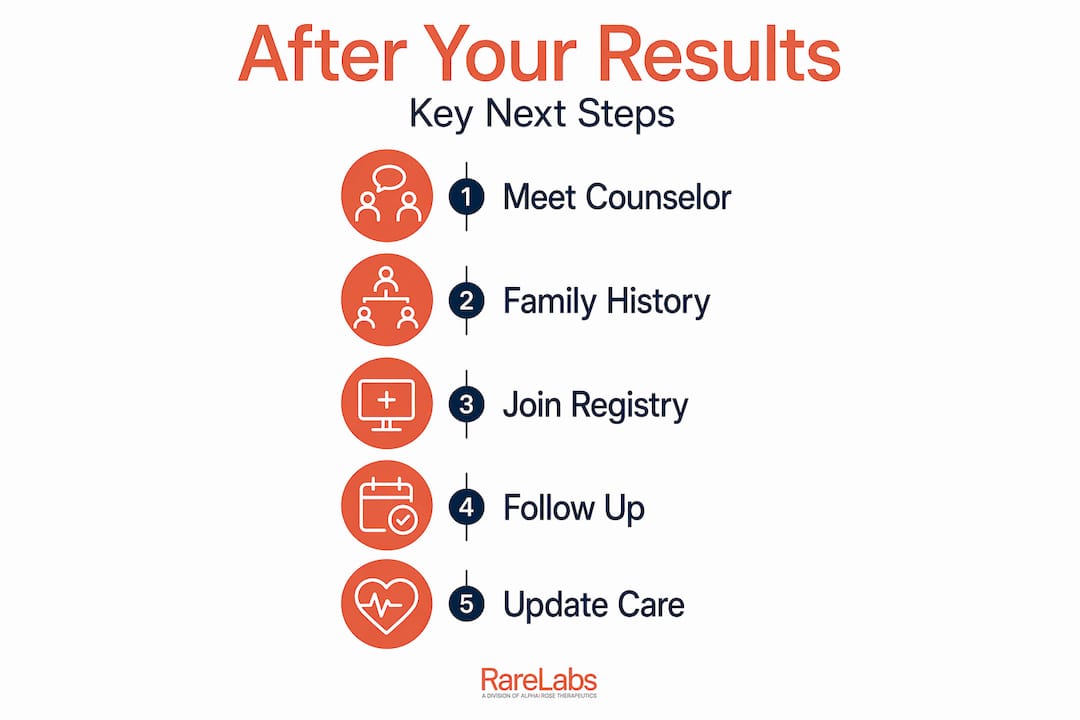
Participating in research, even passively through a registry, contributes to the data that eventually reclassifies VUS findings and builds the evidence base for future treatments. For families navigating ultra-rare diseases with no approved therapies, that contribution is not abstract. It is the pipeline through which answers eventually arrive. For a detailed look at how the research process works for ultra-rare cases, Hopeatrarelabs offers a step-by-step breakdown worth reading alongside your lab report.
My take on what these results actually mean for your family
I've spent years working alongside families at the most disorienting moment of their medical lives: the day a genetic report arrives. What I've learned is that the families who fare best are not the ones who fully understand the science. They are the ones who resist the urge to treat the report as a verdict.
Genetic interpretation is genuinely an evolving science, not a finished one. A VUS that caused heartbreak in 2022 was reclassified as benign in 2024 for many families. A negative result that felt like a door closing led another family to pursue additional testing that eventually produced a diagnosis. The science does not stop when the report prints.
What I find most often underestimated is the emotional weight of receiving ambiguous findings. Families want a clear yes or no. The reality is that most rare disease results live in gradations of probability and uncertainty. That is not a communication failure. It reflects where the science genuinely is. Accepting that ambiguity as the starting condition, rather than fighting it, changes the entire experience of the care process.
The families I've seen struggle the most are those who delay genetic counseling because they are afraid of what they might hear. The irony is that early counseling almost always reduces fear. It replaces speculation with actual data about what the result does and does not mean.
My strong recommendation: treat your report as a document to be understood over time, with professional support, not decoded alone in an evening. The significance of a genetic diagnosis for personalized care is too high to approach any other way.
— John
How Hopeatrarelabs can support your next steps
When you've finished reading your genetic report and you're ready to act, you need more than general information. You need access to current research, treatment options, and people who understand ultra-rare disease at a molecular level.
Hopeatrarelabs is built specifically for families navigating rare and undiagnosed genetic diseases. The platform uses patient-derived cell models, CRISPR gene editing, and parallel treatment screening to identify potential therapies where none currently exist. The RareLabs knowledge base offers up-to-date research, variant context, and guidance on treatment options including FDA-approved drugs, ASOs, and gene therapy candidates. If your report has left you with more questions than answers, this is where to take them.
FAQ
What does a VUS mean on a genetic test?
A Variant of Uncertain Significance (VUS) means the laboratory cannot yet determine whether the variant causes disease. Most VUS findings are eventually reclassified as benign as scientific knowledge grows.
Can a negative genetic test rule out a rare disease?
No. A negative result means no variant was detected within the scope of the specific test used. Genetic causes can still exist but fall outside what the test was designed to find.
How soon should I see a genetic counselor after getting results?
Scheduling within one to two weeks of receiving your report is strongly advised. Early counseling reduces anxiety and keeps clinical trial and treatment options open during the most time-sensitive window.
How do I know if my test result will change over time?
Genetic interpretations are regularly updated as new data becomes available. Ask your provider whether they receive automatic reclassification notices, and plan to revisit your report at least once a year with a genetic counselor.
What is the difference between pathogenic and likely pathogenic?
Pathogenic means the variant is confirmed to cause disease based on strong evidence. Likely pathogenic means evidence is substantial but not yet definitive. Both classifications typically warrant clinical follow-up and specialist consultation.