
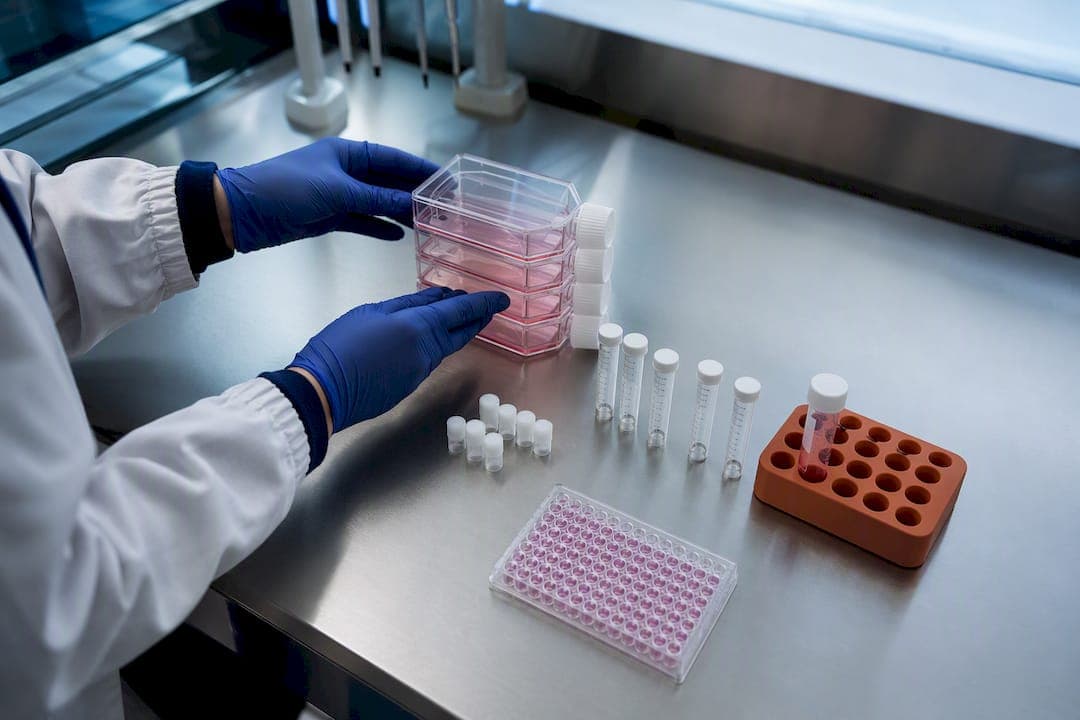
A patient-specific gene therapy feasibility assessment can vary widely in cost depending on scope and complexity, typically ranging from tens of thousands to over a hundred thousand dollars for comprehensive programs. That fee covers iPSC line generation, CRISPR-engineered isogenic controls, in vitro proof-of-concept testing, basic safety and quality checks, and a final report. Every case prices differently based on the mutation, the tissue involved, and how much safety testing the science demands, which is exactly what the next sections break down.
TL;DR:
- Pricing depends heavily on biological complexity, with hard-to-reprogram patient lines and extensive safety testing significantly increasing costs.
- A typical feasibility program spans four to nine months, with iPSC reprogramming being the longest phase at six to twelve weeks.
- Labs can quote vastly different prices based on scope, mutation type, regulatory standards, and operational practices, especially regarding GMP compliance.
- Funding often comes from families, foundations, or partnerships, and insurance generally does not cover the research-focused feasibility assessments.
- Requesting a scoped pilot with clear milestones reduces financial and scientific risk before committing to a comprehensive gene therapy development.
Table of Contents
- Gene Therapy Feasibility Cost: What You're Actually Paying For
- Why Do Gene Therapy Feasibility Quotes Vary So Much?
- How Long Does a Feasibility Program Take?
- Who Pays for a Gene Therapy Feasibility Study?
- How Do You Request and Evaluate a Lab Quote?
- What I'd Tell a Family or Foundation Weighing This Decision
- Contact Hopeatrarelabs About Your Feasibility Program
- Sources
- FAQ
Gene Therapy Feasibility Cost: What You're Actually Paying For
A feasibility quote is not one number. It's a stack of line items, each tied to a distinct piece of lab work, and understanding them is the fastest way to tell a fair quote from a padded one.
The core budget lines typically include:
- Sample intake, cell banking, and viral/mycoplasma testing
- Reprogramming and iPSC line generation from the patient's own cells
- Clone expansion and per-clone quality control (karyotyping, pluripotency markers, sterility)
- CRISPR-based isogenic control editing, when the patient's own line can't serve as its own control
- Differentiation into the relevant cell type and assay setup
- Functional screening against candidate drugs, ASOs, or gene therapy constructs
- Sequencing, bioinformatics, and data analysis
- Safety and toxicology screens where regulatory guidance calls for them
- Project management, milestone reporting, and a final feasibility report
Pro Tip: Ask any lab to price reprogramming and isogenic control work as separate line items. Bundled quotes make it nearly impossible to tell where your money is actually going.
Basic iPSC line generation alone has been estimated at $10,000 to $20,000 in peer-reviewed literature, and that figure doesn't include CRISPR editing, isogenic controls, or downstream functional testing. Per-clone quality control adds up fast, too: case-study data on hPSC bank costs cites oncogene screening around $1,600 per clone, with STR analysis near $220, flow cytometry near $200, and sterility assays running $200 to $500 per clone.
A scope-limited pilot, involving reprogramming a single line, QC of some clones, and testing a narrow drug or ASO panel, can cost in the lower tens of thousands of dollars range. Comprehensive feasibility programs including isogenic controls, multiple functional assays, and formal safety screening may cost significantly more, often exceeding $100,000. Sourcing details matter here too, and our breakdown of iPSC program costs walks through why a $400 repository line and a $6,000 custom line solve very different problems.
Why Do Gene Therapy Feasibility Quotes Vary So Much?
Two labs can quote wildly different numbers for what sounds like the same project, and the gap usually comes down to four factors: biology, technical scope, regulatory depth, and how the lab operates.
Biological complexity drives cost first. A large gene, a variant that disrupts normal reprogramming, or a hard-to-access tissue type all add hours and failed attempts before you get usable cells. Some patient lines simply resist reprogramming, which is one reason CRISPR-engineered isogenic controls from a healthy donor line sometimes replace multiple failed patient-derived attempts, a scientifically sound and often cheaper workaround, as research on CRISPR and iPSC disease modeling points out.
Technical scope is the second lever. More clones, custom ASO or vector design, and specialized functional assays each add distinct cost blocks. A feasibility assessment that only screens repurposed drugs is cheaper than one that also engineers and tests a custom ASO.
Regulatory and quality requirements matter enormously. Research-grade work costs far less than anything approaching GMP standards, and FDA guidance for individualized gene therapy programs expects in vitro and in vivo proof-of-concept work alongside toxicology studies to establish feasibility and reasonable safety. That expectation alone can double a program's scope.
Finally, operational factors matter more than most families expect. Early feasibility work is largely artisan-level bench science, dominated by skilled labor rather than automated platforms, according to industry reporting on scaling gene therapy production. Outsourced tests like whole-genome sequencing or viral clearance testing get billed separately and add up quickly. Choosing between allogeneic and autologous approaches also affects manufacturing cost per patient, and it's worth reading how different gene therapy approaches for ultra-rare diseases shift that calculation.
How Long Does a Feasibility Program Take?
Most programs move through six overlapping phases, and the total timeline usually runs four to nine months depending on how much can run in parallel.
- Intake and quality control (one to three weeks): sample receipt, viral testing, initial documentation.
- iPSC reprogramming (six to twelve weeks): the longest single bottleneck, since cells don't reprogram on a fixed schedule.
- Isogenic editing (four to eight weeks, run in parallel with reprogramming when possible): CRISPR correction of the patient line or engineering of a control line.
- Assay development and differentiation (four to twelve weeks): turning stem cells into the relevant cell type and building the test system.
- Screening and proof-of-concept testing (two to eight weeks): running the actual drug, ASO, or gene therapy panel.
- Analysis and reporting (two to four weeks): data review, statistical checks, final deliverable.
Clinical-grade, manufacturing-ready cell products can take four months or longer just for the production steps, according to research on iPSC-based disease modeling challenges. Delays usually trace back to failed reprogramming attempts, contamination requiring a restart, or assay development that needs more optimization than expected. Parallelizing isogenic control work with reprogramming, and using previously banked patient material when it exists, are the two most reliable ways to shave weeks off the timeline. Build a two-month contingency into both your calendar and your budget before you sign anything.
Who Pays for a Gene Therapy Feasibility Study?
Funding for individualized feasibility work is almost always a patchwork, not a single check. Most programs are assembled from some combination of the following sources:
- Out-of-pocket family funding, often the starting point for urgent cases
- Foundation and disease-specific advocacy grants
- Institutional or academic medical center support
- Philanthropic pooled funds aimed at rare disease research
- Biopharma partnerships, particularly when a program has broader therapeutic relevance
Insurance generally does not cover feasibility or therapeutic development work, as these are research activities rather than approved medical procedures. Some diagnostic testing tied to the underlying disease may be reimbursed separately, but the feasibility program itself typically sits outside coverage. A review of funding approaches for N-of-1 gene-targeted therapies confirms funding for this work remains fragmented and philanthropy-dependent across the field, with emerging ideas like outcome-based or subscription funding models still in early stages rather than widely available. The practical move is to document funding sources and sponsor responsibilities in writing before work starts, so no party assumes another is covering a cost nobody actually committed to.
How Do You Request and Evaluate a Lab Quote?
A good request for quote forces the lab to show its work instead of handing you a lump sum. Before you send one, decide what you actually need answered: is this go/no-go feasibility, or are you already planning downstream development?
Your RFQ should specify explicit deliverables, acceptance criteria for each phase, what data you receive and in what format, who owns the resulting cell lines and intellectual property, a realistic timeline, and milestone-based payment terms rather than one upfront lump sum.
Ask each lab directly:
- What is your historical reprogramming success rate for patient samples like mine?
- What QC pass rates do you typically see at each clone checkpoint?
- What happens, contractually and financially, if an experiment fails or a line doesn't reprogram?
- What quality standards or accreditation does your lab follow?
- Can this be scoped as a smaller pilot before committing to the full program?
Staged, milestone-gated billing, reprogramming and QC as one gate, isogenic controls and assay readiness as the next, is the standard structure serious labs use, and it caps your downstream risk if early results don't pan out. For more on structuring that request, our practical iPSC protocol guide walks through deliverables clinicians should expect at each stage. Treat vague deliverables, no defined go/no-go points, and all-upfront payment terms as red flags worth pushing back on.
What I'd Tell a Family or Foundation Weighing This Decision
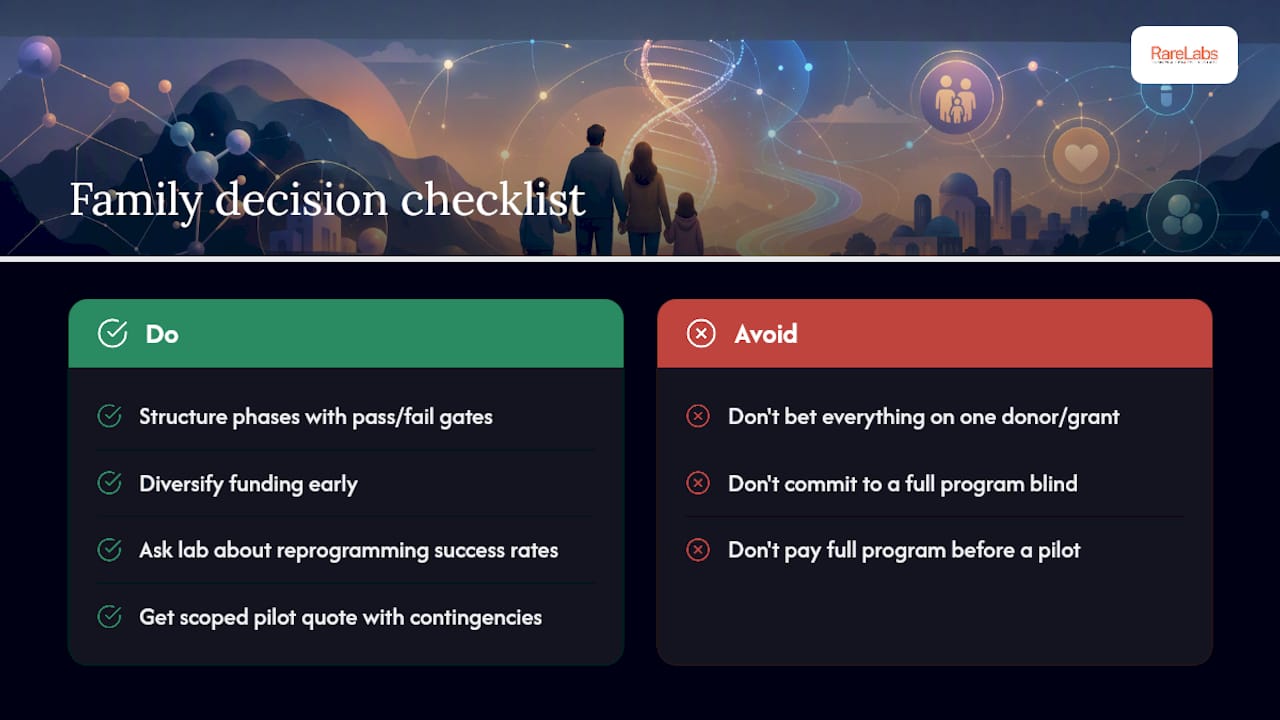
Here's the uncomfortable truth: the feasibility fee itself is rarely the risk. The real risk is paying for a comprehensive program upfront when a scoped pilot would have answered the go/no-go question for a fraction of the cost. Structure this in phases with pass/fail gates, and let the science earn its way to the next dollar spent.
Diversify your funding early rather than betting everything on one grant or one donor. And ask hard questions about reprogramming success rates before you sign, because a lab's track record tells you more about your actual timeline than any quote does. Some labs run patient-derived iPSC models, CRISPR isogenic controls, and parallel repurposing screens with staged pricing structures, which can be a reasonable approach if you're ready to scope a pilot rather than commit to a full program blind. The next concrete step is simple: get a scoped pilot quote with contingency metrics attached before anything larger.
— John
Contact Hopeatrarelabs About Your Feasibility Program
Some specialized labs build patient-derived iPSC disease models, engineer CRISPR isogenic controls when a patient's own line can't serve as its own baseline, evaluate custom ASOs, and run parallel screens against thousands of repurposed drugs, reporting findings in feasibility documents to aid funding decisions.
If you're a patient, family, foundation, or biopharma partner trying to figure out whether a specific gene therapy or ASO approach has a real shot at working before you commit six figures to development, that's the exact question a scoped pilot is built to answer. You can also see how differentiation and drug screening workflows come together in our gene therapy screening guide, and process efficiencies documented in lab testing time reductions show how far operational improvements can shrink turnaround. Reach out through Hopeatrarelabs to request a scoping call or an RFQ template built around your specific case.
Sources
- Current Challenges of iPSC-Based Disease Modeling and Therapeutic Implications
- Human Gene Therapy for Rare Diseases; Guidance for Industry
- Perspectives on the cost of goods for hPSC banks for manufacture of cell therapies
This article is general information, not a substitute for advice from a qualified doctor. Consult a qualified healthcare professional about your own circumstances before acting on anything here.
FAQ
What Is the Average Cost of a Gene Therapy Feasibility Study?
A patient-specific feasibility assessment can vary widely in cost, typically ranging from tens of thousands to over a hundred thousand dollars, depending on scope and complexity, including isogenic controls and safety testing.
How Long Does a Feasibility Assessment Take?
Most programs take four to nine months from sample intake to final report, with iPSC reprogramming as the longest single bottleneck at six to twelve weeks.
Does Insurance Cover Gene Therapy Feasibility Testing?
Insurance generally does not cover feasibility or development research, since these are studies rather than approved medical procedures, though certain diagnostic tests may be billed separately.
What Drives the Biggest Cost Differences Between Labs?
Mutation complexity, the need for CRISPR isogenic controls, GMP versus research-grade quality standards, and how much safety and toxicology testing the science requires all shift the price substantially.
Should I Request a Pilot Before Committing to a Full Program?
Yes. A scoped pilot with milestone gates lets you validate reprogramming success and early feasibility signals before paying for full-scope safety testing and screening.