

When a specialist first mentions gene therapy as a possible option for your child or family member with an ultra-rare genetic disease, the room can feel like it shifts under your feet. Hope and fear arrive at the same time. The path forward is rarely obvious, and the stakes are as high as they come. Most families are handed a stack of research papers, a list of clinical trial websites, and little else. This guide exists to change that. Here you will find clear steps for evaluating gene therapy options, key safety considerations, and practical checklists built specifically for ultra-rare disease families navigating a process that is unlike anything in mainstream medicine.
Table of Contents
- Understanding gene therapy for ultra-rare diseases
- Getting ready: Key criteria and preparing for evaluation
- Navigating clinical trials and informed consent
- What to expect during and after gene therapy
- The hard truths and hopeful outlook for families
- Find expert support for your gene therapy journey
- Frequently asked questions
Key Takeaways
| Point | Details |
|---|---|
| Early preparation matters | Gather your genetic records and consult with specialists to speed up eligibility checks for gene therapy. |
| Understand all risks | Review consent forms carefully and ask questions about long-term safety, trial commitments, and redosing limitations. |
| Access is evolving | Regulatory frameworks now allow for individualized therapies with small patient groups using natural history controls. |
| Long-term follow-up required | Most gene therapy trials require years of monitoring after treatment to check safety and effectiveness. |
| Stay proactive and hopeful | Advocate for your family, seek expert support, and use available resources to find promising gene therapy options. |
Understanding gene therapy for ultra-rare diseases
Gene therapy is not one single treatment. It is a category of therapies that work by correcting, replacing, or silencing a faulty gene. For people with ultra-rare genetic diseases, conditions affecting fewer than 6,000 patients worldwide, the landscape is both more promising and more complicated than for common diseases.
The core reason evaluation works differently here is simple: patient numbers are extremely small. Traditional randomized controlled trials (RCTs), where large groups are split into treated and untreated, are often impossible. That forces a different standard of evidence. Families and physicians need to understand several terms before moving forward.
Key terms to know:
- Gene therapy: A treatment that introduces, alters, or removes genetic material inside your cells to treat or prevent disease.
- Natural history study: Research that tracks how a disease progresses without treatment, used as a comparison baseline when a control group is not practical.
- Patient-reported outcome (PRO): A measurement of how a patient feels or functions, reported directly by the patient or family, often used as a primary endpoint in ultra-rare trials.
- Regulatory engagement: Early, formal conversations between drug developers and agencies like the FDA to agree on what evidence is enough for approval.
Gene therapy clinical trials for ultra-rare diseases prioritize early-stage patients, meaningful patient-reported endpoints, natural history controls, and early regulatory engagement when RCTs are not feasible. This matters because it changes what counts as proof that a therapy works.
The FDA has taken a concrete step forward here. The FDA's Plausible Mechanism Framework enables approval of individualized gene therapies using mechanistic rationale, natural history data, and small-sample clinical evidence when randomized trials simply cannot be done. That means therapies designed for as few as one patient can now have a recognized regulatory path.
| Trial design type | What it uses as evidence | Typical patient numbers |
|---|---|---|
| Randomized controlled trial | Two treatment arms | Hundreds to thousands |
| Natural history control | Pre-existing disease tracking data | Fewer than 20 |
| N-of-1 or small-n trial | Single patient or handful of cases | 1 to 10 |
For families exploring rare disease treatment options, understanding this regulatory shift is genuinely empowering. It means that even if your loved one's disease affects only a handful of people on earth, a formal path to therapy exists.
Getting ready: Key criteria and preparing for evaluation
Preparation is not optional in gene therapy evaluation. It is the single biggest factor families can control. Before you contact a trial site or schedule a specialist visit, a set of core requirements needs to be in place.
Preparation checklist:
- Confirmed genetic diagnosis with documented variant (whole-genome or whole-exome sequencing preferred)
- Current disease stage and severity assessment from your specialist
- Complete medical records including prior treatments, hospitalizations, and comorbidities
- Contact information for your primary geneticist or metabolic specialist
- Documentation of any prior immune exposures that could affect viral vector delivery
Key evaluation criteria include confirmed genetic diagnosis, disease stage, overall health for conditioning, trial phase, sponsor track record, and long-term follow-up capacity. Each one of these can become a gating factor that stops or delays access if it is not ready in advance.

Different gene therapy platforms also come with different requirements. Here is how they compare:
| Therapy type | Common vector or tool | Special requirements |
|---|---|---|
| AAV gene replacement | Adeno-associated virus | No prior AAV immunity; single administration |
| CRISPR gene editing | Lipid nanoparticle or viral | Specific variant type; editing target confirmed |
| Antisense oligonucleotide (ASO) | Synthetic RNA | Variant-specific design; often compassionate use |
| Lentiviral gene addition | Lentivirus | Hematopoietic stem cell conditioning required |
The NIH URGenT program supports gene-based therapies for ultra-rare neurological diseases through IND-enabling studies and clinical trials within the NeuroNEXT network, focusing on monogenic variants. If your disease is neurological and caused by a single gene change, this program is worth investigating directly.
"The family that arrives at a trial site with complete, organized records, a clear genetic report, and a prepared set of questions will always move faster through screening than the family that is still gathering paperwork."
Pro Tip: Ask your geneticist to write a one-page clinical summary covering diagnosis, variant, disease course, and treatment history. Trial coordinators review dozens of inquiries; a concise summary gets attention faster than a binder of raw records.
Navigating clinical trials and informed consent
Once preparation is solid, finding and evaluating specific trials becomes the focus. This stage has a clear sequence.
- Search ClinicalTrials.gov by disease name, gene name, or condition category. Filter for interventional studies and gene therapy as the intervention type.
- Use the Gene Therapy Trial Browser at the American Society of Gene and Cell Therapy website to find disease-specific listings.
- Talk to your specialist and ask whether they know of investigator-initiated trials or compassionate use programs not yet listed publicly.
- Contact trial coordinators directly. Families who reach out early, even before formal enrollment opens, are often remembered when slots open.
- Request the protocol summary before the full consent document. This shorter document tells you the therapy type, dosing, eligibility, and follow-up schedule without the legal complexity.
When you receive an informed consent form, read it as a contract, because it is. The informed consent process should detail risks and benefits clearly, guide you through eligibility screening, and prepare you for lifestyle changes and long-term follow-up that can extend up to 15 years.
Questions every family should ask before signing:
- What are the most serious known risks, and how often have they occurred in similar trials?
- Will the therapy be available to us if it works, after the trial ends?
- What happens if we need to withdraw partway through?
- Who covers costs for follow-up visits and monitoring?
- Is there a patient liaison or family advocate on the trial team?
Pro Tip: Review clinical trial patient guides from the American Society of Gene and Cell Therapy before your first meeting with a trial team. Going in with context makes the consent discussion far less overwhelming.
Important: Under NIH URGenT guidelines, participants in gene therapy trials may be required to commit to decades of safety monitoring. This is not a burden to minimize; it is how rare disease families contribute to science that will help the next patient after them.
What to expect during and after gene therapy
Knowing what comes next reduces fear significantly. The experience varies by therapy type, but a general arc applies to most gene therapy programs.
During therapy:
- Pre-treatment conditioning (which may include immunosuppression or chemotherapy for some approaches)
- Therapy administration, usually a one-time infusion or injection
- An inpatient observation period lasting days to weeks depending on the therapy
- Immediate side effect monitoring including liver enzyme levels, immune activation markers, and vital signs
After therapy:
- Monthly bloodwork and clinical assessments in the first year
- Imaging as needed based on the target organ
- Standardized outcome measures at 3, 6, and 12 months
- Annual or semi-annual check-ins for years two through fifteen
Of the 12 gene therapies approved between 2016 and 2023, patient voice in defining endpoints and early regulator dialogue were consistent features. The FDA framework now predicts small n-of-1 approvals moving forward, which is a meaningful signal for ultra-rare families.
| Follow-up activity | Frequency | Purpose |
|---|---|---|
| Blood panel (liver, immune) | Monthly, year 1 | Detect immune reactions or organ stress |
| Neurological or functional assessment | Every 3 months, year 1 | Measure therapy effect on symptoms |
| Patient-reported outcome survey | Every 3 months | Track quality of life and daily function |
| Imaging (MRI, ultrasound) | As indicated | Confirm gene expression at target site |
| Long-term safety visit | Annually, years 2 to 15 | Monitor for late-emerging effects |
For families connected to long-term rare disease support, having a care team that understands both the science and the emotional weight of this follow-up journey makes a real difference.
The hard truths and hopeful outlook for families
Here is an honest perspective that many official guides avoid: the clinical hurdles are rarely the biggest obstacle families face. Access, cost, and emotional exhaustion are.
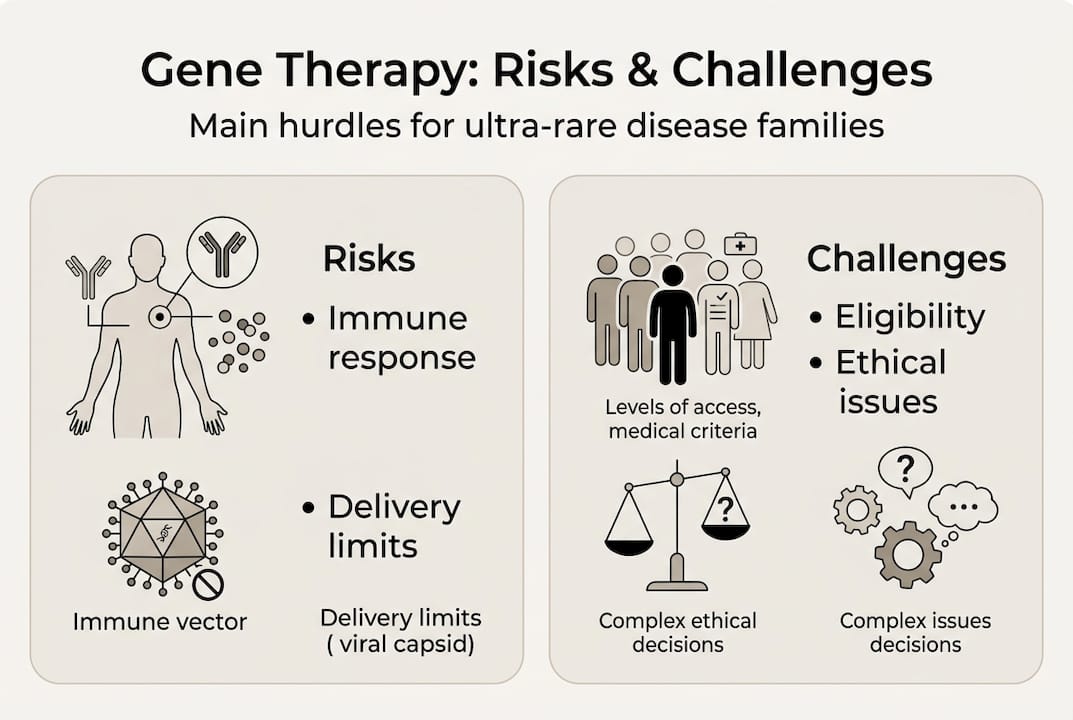
For AAV-based therapies specifically, there is no second chance. No redosing is possible after AAV therapy because the immune system builds antibodies that would attack any repeat dose. This means the first treatment is the only treatment. That reality does not diminish hope; it sharpens the importance of choosing and preparing carefully.
The curative potential of gene therapy is real, but so are the challenges: immune responses, delivery barriers, ethical concerns, and costs that can reach millions of dollars per patient. Many families are approved for trials but cannot participate because of geography or caregiver burden.
What actually tilts the odds? Early engagement with trial teams, organized advocacy, and connection with independent gene therapy resources that understand ultra-rare disease. Families who stay informed, ask hard questions early, and build relationships with researchers before trials open consistently report better experiences than those who arrive late. Hope is not passive. It moves.
Find expert support for your gene therapy journey
Navigating gene therapy for an ultra-rare disease is not something families should do alone. At RareLabs, we work directly with patients and families to model their specific disease, screen potential therapies, and evaluate gene therapy options using the patient's own biology.
Our platform was designed for exactly the situations this guide describes: a confirmed diagnosis, no approved treatment, and a family that refuses to wait. Whether you are looking to find gene therapy trials, understand your options, or connect with a scientific team that specializes in your disease, RareLabs is built to support that next step. Reach out to start a conversation about what personalized disease modeling could reveal for your family.
Frequently asked questions
How do I find gene therapy clinical trials for ultra-rare diseases?
Use ClinicalTrials.gov and the RareLabs search platform to search by gene or disease name, and discuss trial-matching options with your geneticist. Practical steps for families include searching the Gene Therapy Trial Browser and asking your specialist about unpublished investigator-initiated programs.
What are the key eligibility requirements for participating in gene therapy?
You typically need a confirmed genetic diagnosis, documentation of disease stage, and clearance for overall health requirements. Key evaluation criteria include trial phase, sponsor track record, and your capacity to complete long-term follow-up.
Is long-term follow-up required after gene therapy?
Yes. Many gene therapy trials require ongoing health monitoring for safety and effectiveness that can last up to 15 years. Long-term follow-up is a standard requirement, not an optional add-on.
Can gene therapy be repeated if the first treatment doesn't work?
Usually not for AAV-based therapies. Once treated, no redosing is possible because the immune system develops antibodies that block repeat administration.
What are the main risks and challenges of gene therapy for ultra-rare diseases?
The main risks include immune responses, delivery barriers, and unpredictable off-target effects. Gene therapy challenges also include high costs and access limitations that can prevent participation even after a trial match is confirmed.