

A single research-grade iPSC line typically runs between mid and high hundreds of dollars through a nonprofit repository, while a custom reprogramming project through a university core often costs several thousand dollars per line before quality control. The gap comes down to three variables: reprogramming method, clone number, and how much characterization (karyotyping, identity testing, mycoplasma screening) the program requires. Commercial full-service providers charge more, but guarantee delivery.
TL;DR:
- Reprogramming costs for research-grade lines typically range from several hundred to around ten thousand dollars, depending on methods and characterization needs.
- Commercial providers guarantee delivery but charge higher prices, especially for clinical-grade programs that require extensive documentation and facility standards.
- Repository lines are the fastest and cheapest option if an existing line matches the scientific needs, especially for common disease models.
- Custom reprogramming through academic cores costs more than repositories but is justified when specific patient genotypes or complex validation are necessary.
- Building an itemized budget should include contingencies of 15-25% for retries, QC failures, and additional clones, along with separate shipping and storage fees.
Table of Contents
- What Drives iPSC Program Pricing?
- Should You Buy an Existing Line, Reprogram Custom, or Outsource Fully?
- How Much Do Repositories and University Cores Actually Charge?
- Why Do Cost Estimates Vary So Much Between Labs?
- How Do You Build an Itemized iPSC Program Budget?
- Can You Cut iPSC Program Costs Without Cutting Quality?
- When Does a Contracted, Personalized iPSC Program Make Sense?
- The Real Budgeting Mistake Most Labs Make
- Ready to Talk Through Your Program's Budget?
- Sources
What Drives iPSC Program Pricing?
Every iPSC quote breaks down into discrete line items, and understanding them is the difference between a budget that survives contact with a vendor invoice and one that doesn't. Cores and repositories don't sell "an iPSC line." They sell a sequence of billable services, each priced separately.
Sample processing covers isolating starting material, usually fibroblasts from a skin biopsy or peripheral blood mononuclear cells (PBMCs) from a blood draw. This is billed per sample, regardless of outcome.
Reprogramming is the core conversion step, delivered via retroviral, episomal, or RNA-based methods. RNA and episomal approaches dominate current pricing because they avoid genomic integration, but they're not necessarily cheaper. Reprogramming is billed per attempt or per line, not per success.
Downstream of reprogramming sit the characterization services: clone expansion (per clone, since most protocols carry several clones forward before selecting a winner), identity testing via STR profiling, mycoplasma testing (a near-universal per-test fee), karyotyping to confirm chromosomal integrity, and pluripotency assays that confirm the cells actually express the right markers.
Beyond generation, labs pay for banking and storage (usually per vial, per year), differentiation into target cell types, and increasingly, genome editing to build isogenic controls.
Billing units vary by vendor:
- Per line (most repository purchases)
- Per vial (banking, storage, some distribution models)
- Per service (individual QC tests, expansion runs)
- Per test (karyotyping, mycoplasma, STR)
Research-grade work follows this pricing. Clinical-grade production, governed by FDA regulations under CFR Part 1271, multiplies costs several-fold because of documentation, traceability, and facility requirements that research labs never touch.
Should You Buy an Existing Line, Reprogram Custom, or Outsource Fully?
Three procurement paths exist, and picking the wrong one wastes both money and time.
- Buy from a repository. This is the cheapest and fastest option when your disease model already exists in a public collection. You get minimal customization, but you also skip months of derivation work entirely.
- Commission custom reprogramming through an academic core. Moderate cost, some flexibility on cell source and method, but external (non-affiliated) rates often run double the internal academic price at the same facility. This route makes sense when you need a specific patient's genotype and no repository line matches it.
- Contract a commercial full-service provider. Highest sticker price, but you get guaranteed deliverables, dedicated project management, and contractual timelines. Worth it when a failed attempt would blow your grant deadline or when you lack in-house cell culture staff to manage a multi-month derivation process.
Custom reprogramming is justified almost exclusively by biological necessity, not convenience. If your research question depends on a specific patient's genetic background, an off-the-shelf line simply doesn't answer it. If it doesn't, a repository line usually gets you into experiments faster and at a fraction of the cost.
How Much Do Repositories and University Cores Actually Charge?
Published U.S. price lists give a clearer picture than any general estimate. The CIRM iPSC Repository sells lines on a volume-tiered schedule, and the NIH Common Fund distributes some whole cell bank material at differentiated rates for nonprofit versus commercial requesters. University cores like Emory and the Gates Center at CU Anschutz publish itemized fees down to the individual assay.
A full custom reprogramming project, from isolation through banked, QC-passed clones, typically lands in the a range of several thousand to over ten thousand dollars once you stack isolation, reprogramming, and characterization fees together. That figure fits within the broader pattern seen across academic cores nationally, where reprogramming services cluster in the low thousands per line and individual QC tests add another $200 to $1,000 each. Clinical-grade programs, subject to CFR Part 1271 documentation and facility standards, routinely run into six figures, a scale gap most first-time budget planners underestimate badly.
Why Do Cost Estimates Vary So Much Between Labs?
Two labs requesting what sounds like the same service can receive quotes that differ by thousands of dollars, and the reasons are mostly structural, not arbitrary.
Cell source and reprogramming method change your yield, and yield changes your real cost per usable line. PBMC-based reprogramming, for instance, tends to run more expensive per attempt than fibroblast-based methods at some cores, partly because of the extra processing PBMCs require before they'll reprogram efficiently.
Clone number matters more than most first-time requesters expect. Cores typically carry multiple clones forward per sample and bill for each one, since a portion inevitably fail QC. Ask upfront how many clones a quoted price includes.
- Genome editing to create isogenic controls
- Directed differentiation into disease-relevant cell types
- Extended QC panels beyond the standard karyotype and mycoplasma test
- Extra banking vials for redundancy
Labor and overhead allocation differ sharply between internal and external clients. A core's internal academic rate reflects subsidized overhead; external or commercial clients pay a rate that covers full facility cost recovery, which is why the same service can carry two very different sticker prices at the same institution.
Pro Tip: Ask every core directly what their policy is on failed derivation attempts before you sign anything. Many charge a reduced retry fee rather than a full second charge, but that policy is rarely stated on the public price list, and finding out after a failed attempt is the wrong time to learn it.
How Do You Build an Itemized iPSC Program Budget?
A workable budget follows a sequence, not a lump sum.
- Define the scientific specs first: cell source, target genotype, number of clones needed, and downstream assays planned.
- Choose your procurement pathway based on whether a repository line satisfies the science or custom work is required.
- Request itemized quotes, not a single bundled number, from at least two vendors or cores.
- Build in a contingency of 15% to 25% above the base quote to cover retries, extra QC failures, or additional clone expansion.
- Confirm storage and shipping costs separately, since these are frequently quoted apart from generation fees.
When requesting quotes, ask vendors directly: What's the turnaround time? How many clones and vials are delivered per completed line? Which QC tests are included versus billed separately? What's the policy on failed attempts? And what are the ongoing storage fees once banking is complete?
Can You Cut iPSC Program Costs Without Cutting Quality?
Several strategies reliably lower total spend without compromising the biology.
- Check repository holdings before committing to custom reprogramming; a matching line saves months and thousands of dollars.
- Negotiate shared core agreements with collaborating labs to split fixed costs like equipment access and staff time.
- Route trainee-led workflows through institutional cores where discounted internal academic rates apply.
- Look into NIH grant supplements, foundation-specific rare disease funding, and institutional core subsidy programs before assuming full cost falls on one grant.
- For staff development, ISCT's training tiers run from mid two hundreds for students to around five hundred for industry professionals, often with group-registration discounts that make in-house training cheaper long-term than repeated outsourcing.
When Does a Contracted, Personalized iPSC Program Make Sense?
For ultra-rare or undiagnosed genetic diseases, buying an existing line rarely works because no repository holds that patient's exact genotype. Hopeatrarelabs runs contracted programs built around parallel drug repurposing screens, custom ASO development, and CRISPR-edited isogenic controls for this exact situation. What's typically included: reprogramming, characterization, and screening. What sponsors still budget for separately: sample logistics, IRB coordination, and downstream clinical validation, a distinction worth clarifying before a program starts.
The Real Budgeting Mistake Most Labs Make
Most cost guidance treats iPSC pricing like a catalog lookup, as if a single number could describe "the cost." It can't. The Emory and Gates Center price lists prove the point: identical-sounding services carry different fees depending on cell source, method, and client tier, and the gap between an internal academic rate and an external commercial one can be double.
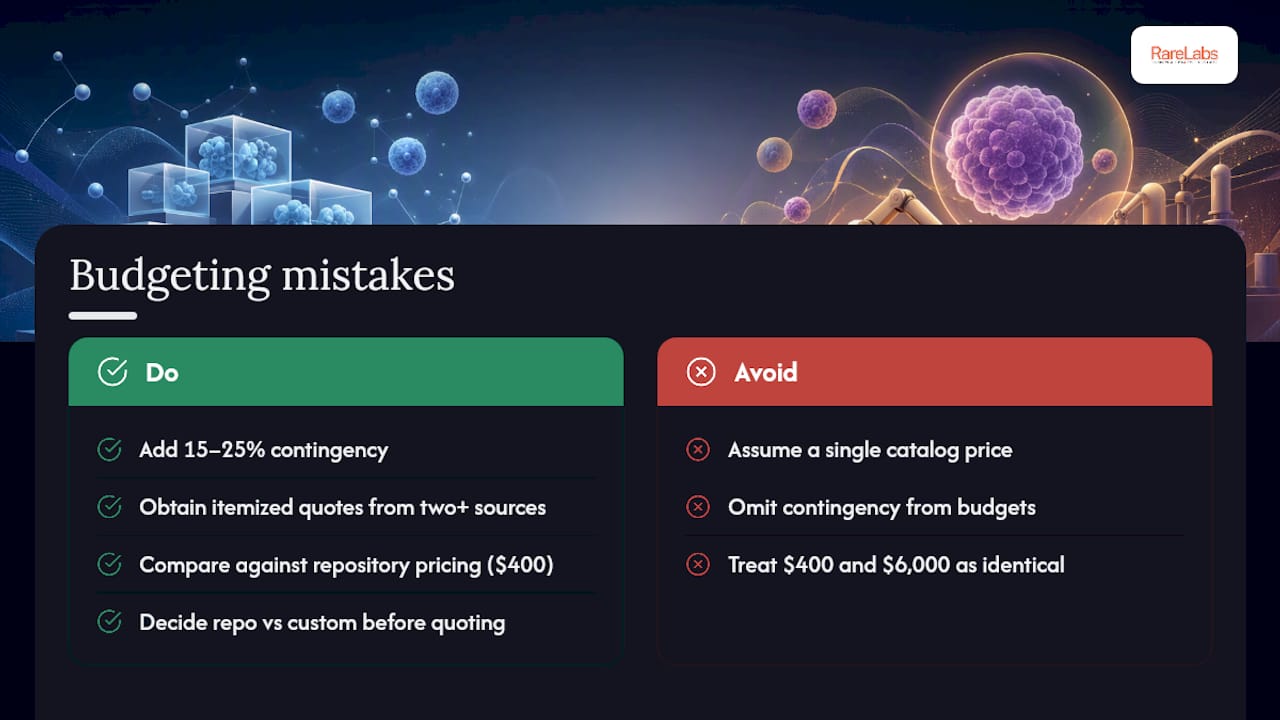
The bigger failure I see in how labs approach this is skipping the contingency line entirely. Reprogramming efficiency is genuinely variable, and a quote that assumes zero failed attempts is a fantasy, not a budget. Build in that 15% to 25% cushion before you ever submit a grant justification, not after a core tells you your first attempt didn't take.
Prioritize this first: get itemized quotes from at least two sources before committing to a pathway, and use repository pricing as your baseline comparison even if you ultimately need custom work. A $400 repository line and a $6,000 custom program aren't competing for the same job. Knowing which one your science actually requires, before you request a quote, is what separates a defensible budget from a guess dressed up in dollar signs.
— John
Ready to Talk Through Your Program's Budget?
Unlike a repository purchase or a standard core order, a contracted program with Hopeatrarelabs is built around your patient's specific genotype from the first conversation, not assembled from a catalog after the fact.
That matters most for ultra-rare and undiagnosed diseases, where no existing line will answer your question and a custom academic reprogramming project might still leave you managing edits, ASO screening, and validation across three separate vendors. Hopeatrarelabs coordinates reprogramming, CRISPR-edited isogenic controls, and high-throughput drug repurposing screens under one program, which simplifies both your budget and your timeline.
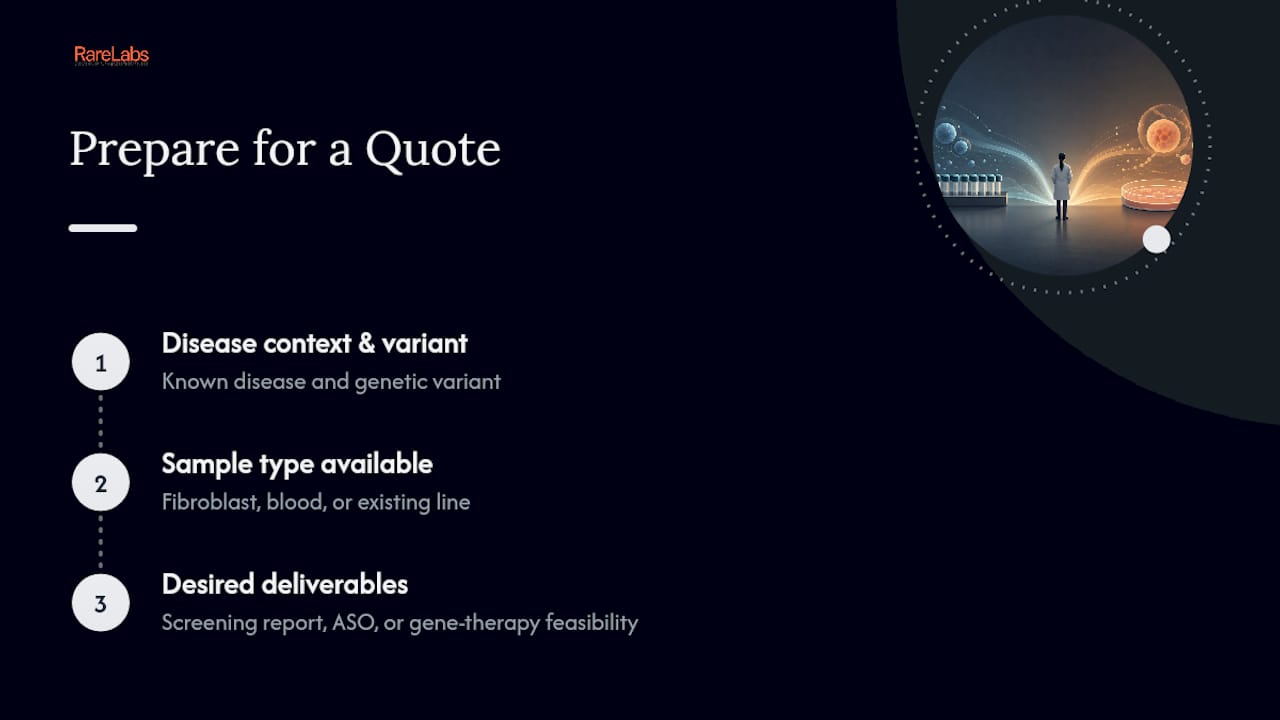
To get a real estimate, have three things ready: the disease context and known genetic variant, the sample type available (fibroblast, blood, or existing line), and the deliverables you need, whether that's a screening report, an ASO candidate, or a gene therapy feasibility assessment. Start that conversation through the Hopeatrarelabs intake page and request a program quote directly.
This article is general information, not a substitute for advice from a qualified doctor. Consult a qualified healthcare professional about your own circumstances before acting on anything here.
Sources
- IPSC Repository – CIRM
- Frequently Asked Questions (FAQs) for Requesting Stem Cell Lines (NIH/Common Fund)
- ISCT iPSC training pricing