
Screening FDA-approved drugs is defined as systematically testing existing medicines with known safety profiles to identify new therapeutic uses, a practice the research community calls drug repurposing. For researchers, clinicians, and families facing rare diseases with no approved treatments, this approach offers a faster and far less expensive path than building a new compound from scratch. The FDA's existing safety and pharmacological data on approved drugs removes one of the most costly phases of drug development. The economic case alone is compelling: repurposing costs $1.5M–$3M per candidate, compared to hundreds of millions for novel drug discovery. That cost difference can determine whether a rare disease community ever sees a treatment at all.
Why screen FDA approved drugs for rare disease treatment?
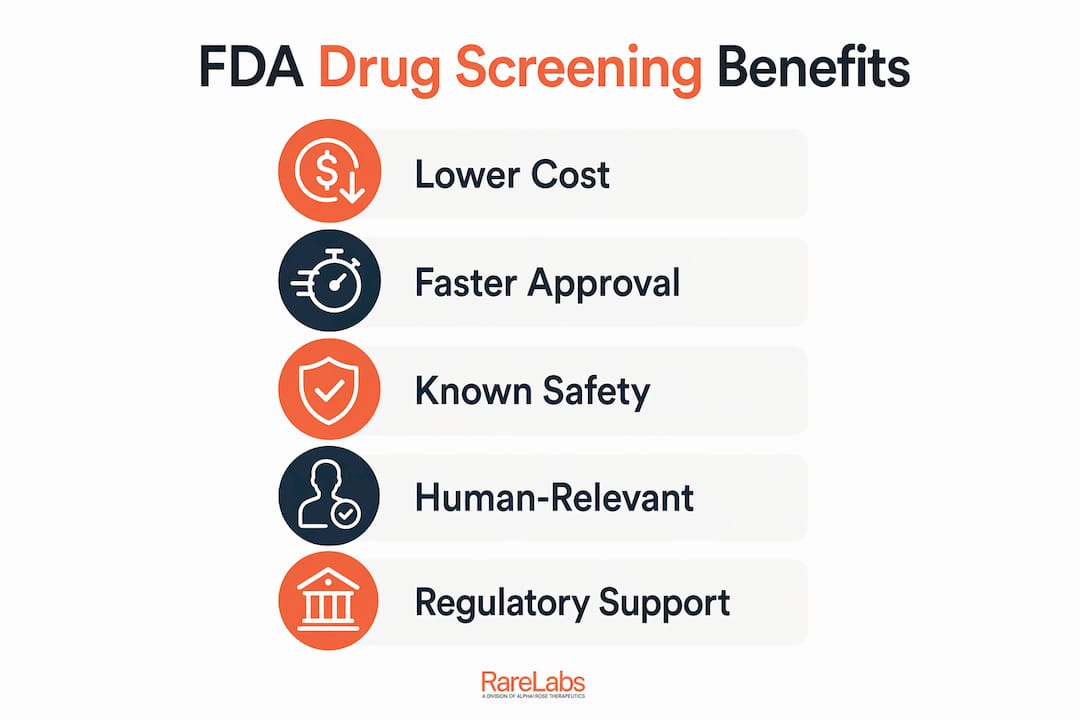
Screening FDA-approved drugs for rare diseases delivers advantages that no other research strategy currently matches. The most significant benefit is the existing safety record. Every drug in an FDA-approved library has already cleared toxicology, pharmacokinetics, and manufacturing quality reviews. That foundation eliminates years of preclinical work and reduces the risk of late-stage failures caused by unknown safety issues.
The cost reduction is not marginal. Development costs drop by up to 99% when researchers screen approved compounds instead of synthesizing new ones. For rare disease programs funded by patient foundations or small research teams, that difference is the gap between a viable program and no program at all.

Speed is the third major benefit. Because pharmacokinetic profiles, dosing ranges, and manufacturing standards are already established, researchers can move directly to efficacy testing in disease-relevant models. The FDA's benefit-risk framework also tolerates greater uncertainty in efficacy evidence for rare, life-threatening conditions, which shortens the regulatory path further.
Key benefits at a glance:
- Established safety data removes the most expensive preclinical phase
- Known side effect profiles allow clinicians to counsel patients accurately from day one
- Existing manufacturing standards mean any successful candidate can scale to production faster
- FDA rare disease frameworks such as Orphan Drug Designation and Accelerated Approval create additional regulatory support
- Parallel screening of thousands of compounds simultaneously is practical only with approved libraries, where each drug's behavior is already characterized
Pro Tip: When advocating for a repurposing program, ask the research team whether they are screening a curated FDA-approved library rather than a general compound collection. Curated libraries reduce noise and focus resources on candidates with the strongest translational potential.
How has the FDA's 2026 regulatory framework improved drug screening?
The FDA's regulatory posture in 2026 has shifted in ways that directly benefit rare disease drug screening. The most consequential change is the acceptance of single-study evidence. About 60% of first-of-a-kind approvals in recent years were cleared based on a single study. That policy reduces the time and cost burden on rare disease programs that cannot realistically recruit patients for multiple large trials.
Real-time clinical trial monitoring is a second major shift. FDA scientists can now observe safety and efficacy endpoints as they accumulate through cloud-based data streaming frameworks. This eliminates the "dead time" between data collection and regulatory review, allowing earlier detection of both safety signals and efficacy success. For rare disease trials where patient populations are small and every data point matters, that speed is critical.
The third shift is the move away from animal models. The FDA's 2026 policies formally prioritize human-centric New Approach Methodologies, known as NAMs, for preclinical safety evaluation. NAMs include in silico computational models and in vitro cell-based assays. A 15-year analysis found that 93% of NAM submissions fall into these two categories. Animal models historically fail to predict human outcomes in a large proportion of cases, so this shift directly improves the reliability of screening results.
"The FDA's embrace of real-time clinical data and flexible evidence requirements aims to accelerate cures, especially for rare genetic disorders where traditional trials are impractical. Human-centric New Approach Methodologies represent a scientific paradigm shift beyond regulatory update, resolving many limitations of animal testing for drug safety assessment."
These changes work together. A research team can now screen FDA-approved drugs in human-relevant disease models, generate real-time efficacy data, and submit a single-study package to an FDA that is explicitly designed to evaluate it with rare disease context in mind. That is a fundamentally different regulatory environment than existed five years ago.
For researchers tracking trial data delays, understanding how real-time streaming fits into the approval pipeline is worth the time.
What scientific reasons justify testing approved drugs over new compounds?
The scientific case for screening FDA-approved drugs starts with the failure rate of traditional drug discovery. Animal models, which have historically been the default preclinical tool, fail to predict human outcomes in a large proportion of cases. Compounds that show promise in mice routinely fail in human trials. Screening approved drugs on human-based disease models, including iPSC-derived cell lines and organoids, bypasses that translational gap entirely.
Bioequivalence data adds another layer of scientific reliability. FDA-approved drugs must demonstrate absorption rates within 80–125% of brand-name originals, with narrow therapeutic index drugs held to a tighter 90–111% range. That consistency means researchers can trust that the compound behaving in a disease model is the same compound a patient would receive.
Recent screening studies confirm the scientific value of this approach. A screen using the Tocriscreen FDA-approved library identified antidepressants, antimalarials, and antivirals as potential blockers of the NLRP3 inflammasome, an inflammatory pathway implicated in multiple rare diseases. None of those drug classes would have been prioritized by traditional target-based discovery for that indication.
| Drug class identified | Pathway targeted | Repurposing relevance |
|---|---|---|
| Antidepressants | NLRP3 inflammasome | Anti-inflammatory potential in rare inflammatory diseases |
| Antimalarials | NLRP3 inflammasome | Established use in autoimmune conditions |
| Antivirals | NLRP3 inflammasome | Potential for rare inflammatory and metabolic disorders |
| Anti-COPD agents | NLRP3 inflammasome | Lung-specific rare disease applications |
The numbered steps below describe how a scientifically sound screening program is structured:
- Select a curated FDA-approved library with documented pharmacokinetic and safety profiles for each compound.
- Build a human-relevant disease model using patient-derived iPSCs or CRISPR-edited cell lines that replicate the specific genetic defect.
- Run parallel screens across thousands of compounds simultaneously, measuring disease-relevant endpoints.
- Validate hits in secondary assays using the same human-based model to confirm reproducibility.
- Assess indication-specific risk because FDA approval is indication-dependent and a drug's risk profile may differ for a rare disease target.
How can researchers and families engage with FDA drug screening programs?
Researchers and families can take concrete steps to engage with or support drug screening efforts for rare diseases. The starting point is understanding what resources exist. The FDA maintains databases including ClinicalTrials.gov and the FDA Orphan Drug database, which track active repurposing studies and approved rare disease programs. These are public and searchable.
For researchers, the most direct path is accessing FDA-approved drug libraries and pairing them with human-relevant disease models. Hopeatrarelabs builds patient-specific iPSC and CRISPR-based models for exactly this purpose, allowing researchers to test thousands of approved compounds against a disease model that reflects the patient's actual genetic defect. That specificity matters because a drug that works in a generic cell line may not work in the patient's unique biological context.
Families play a real role beyond waiting. Patient advocacy in biotech has directly accelerated screening programs by funding research, connecting researchers to patient registries, and pushing for Orphan Drug Designation applications that unlock FDA incentives. Families who organize around a specific diagnosis can make a program financially viable that would otherwise not exist.
Practical steps for families and clinicians:
- Connect with a disease-specific foundation to identify whether a repurposing screen is already underway
- Ask your clinician whether any FDA-approved drugs in adjacent indications have been tested in your disease model
- Request access to results from any existing screening programs through the research team or foundation
- Evaluate candidates carefully because FDA approval is indication-specific and risk profiles vary for rare disease applications
Pro Tip: Families navigating rare disease research should ask any research partner whether their screening program uses patient-derived cells rather than generic disease models. The difference in predictive accuracy is significant, and it directly affects whether a screening hit will translate to the actual patient.
The case for human-centric screening is stronger than most people realize
The conversation about drug repurposing in rare diseases tends to focus on cost and speed. Those are real advantages. But the deeper argument, the one that gets less attention, is about scientific accuracy.
I have spent years watching research programs generate promising animal model data that collapsed the moment it reached human trials. The problem was never the researchers. The problem was the model. Animal biology does not replicate human rare disease pathology with enough fidelity to predict what will happen in a patient. Screening FDA-approved drugs on patient-derived human cells changes that equation. You are testing the actual compound in the actual biological context. The data you generate is the data that matters.
The FDA's 2026 shift toward NAMs and real-time trial monitoring is not just a regulatory update. It is the regulatory system catching up to what good science already demanded. For rare disease families, that alignment between scientific best practice and regulatory expectation is the most hopeful development in years.
My practical advice for families: do not wait for a perfect clinical trial. Ask whether a repurposing screen using your family member's own cells is possible now. The personalized research approach that organizations like Hopeatrarelabs use is not experimental in the abstract sense. It is grounded in FDA-recognized methodologies and produces results that clinicians can act on.
The pace of this field is accelerating. Families who engage early, ask the right questions, and connect with research teams running human-centric screens will be better positioned than those waiting for traditional drug development timelines to deliver.
— John
Hopeatrarelabs and the science of rare disease drug screening
Hopeatrarelabs specializes in building patient-specific disease models for ultra-rare and undiagnosed genetic conditions, then running parallel screens of thousands of FDA-approved drugs against those models. Their work uses iPSC technology and CRISPR gene editing to replicate each patient's exact genetic defect, making the screening results directly relevant to that individual.
For researchers and families who want to understand how this process works in practice, Hopeatrarelabs offers detailed explanations of their drug screening approach and the science behind it. Their team works with patients, clinicians, foundations, and biopharma partners to move from disease model to treatment candidate as quickly as the science allows. If you are navigating a rare disease with no approved treatment, their platform is a concrete next step worth exploring.
FAQ
Why screen FDA approved drugs instead of developing new ones?
Screening FDA-approved drugs reduces development costs by up to 99% and skips the most time-consuming preclinical phases because safety and pharmacokinetic data already exist. For rare diseases with small patient populations, this is often the only financially viable path to finding a treatment.
What does the FDA's benefit-risk framework mean for rare disease approvals?
The FDA accepts greater uncertainty in efficacy evidence for rare, life-threatening conditions, which means a smaller or less conventional study can support approval. This flexibility is built into the regulatory framework and directly benefits repurposing programs targeting rare diseases.
How do New Approach Methodologies improve drug screening accuracy?
NAMs use human-relevant in vitro and in silico methods instead of animal models, which historically fail to predict human outcomes in a large proportion of cases. Testing on human-derived disease models produces data that is more likely to hold up in actual patients.
Can families directly support or initiate a drug screening program?
Yes. Families can fund research through disease-specific foundations, connect researchers to patient registries, and advocate for Orphan Drug Designation, which unlocks FDA incentives and can make a screening program financially viable.
What is the role of real-time clinical trial monitoring in drug repurposing?
Real-time data streaming allows FDA scientists to observe safety and efficacy endpoints as they accumulate, eliminating delays between data collection and regulatory review. For rare disease trials with small patient numbers, faster signal detection can shorten the entire development timeline.
Key Takeaways
Screening FDA-approved drugs is the most cost-effective and scientifically reliable strategy for rare disease treatment discovery, combining established safety data with human-centric disease models and a regulatory framework built to support it.
| Point | Details |
|---|---|
| Cost advantage is decisive | Repurposing costs $1.5M–$3M versus hundreds of millions for novel drug discovery, making it viable for rare disease programs. |
| FDA regulatory flexibility helps | About 60% of first-of-a-kind approvals rely on single-study evidence, reducing the trial burden for rare disease candidates. |
| Human-centric models improve accuracy | NAMs and patient-derived iPSC models replace animal testing, producing data that better predicts outcomes in actual patients. |
| Families can accelerate programs | Patient advocacy, foundation funding, and registry connections have directly enabled repurposing screens that would not otherwise exist. |
| Indication-specific risk assessment is required | FDA approval is indication-dependent, so each repurposed candidate must be evaluated for safety and efficacy in the specific rare disease context. |