

Personalized research is defined as the practice of tailoring therapeutic development to an individual's unique genetic, molecular, and cellular profile rather than applying population-wide treatment assumptions. This approach directly explains why personalized research accelerates cures: it eliminates the guesswork that slows conventional drug development by targeting the biology that actually drives each patient's disease. In rare genetic diseases, where patient populations are small and molecular heterogeneity is high, this precision is not a luxury. It is the only viable path. Companion diagnostics now reduce development timelines by an average of 379.5 days, AI agent teams are compressing research cycles from months to weeks, and the 2026 I-PREDICT trial demonstrated that 95% of advanced cancer patients carry unique tumor DNA profiles requiring individualized regimens. The evidence is no longer theoretical.
Why personalized research accelerates cures faster than standard approaches
Conventional drug development treats patient populations as largely uniform, which forces researchers to design trials broad enough to capture statistical significance across diverse biology. That breadth introduces noise. When a therapy works for 30% of a trial population but fails for 70%, the signal gets buried, and development stalls. Personalized medicine, the recognized industry term for this field, solves that problem by stratifying patients based on molecular markers before a trial even begins.
The fastest path to a cure is reducing uncertainty early by selecting the right molecular targets and the right patients simultaneously. This is not a theoretical claim. FDA approval data from 2014 to 2024 across 354 oncology indications shows that companion diagnostic-associated approvals climbed to 43% of all oncology approvals by 2022. That shift reflects a structural change in how drug development works when biology guides patient selection from day one.

For families navigating a rare genetic disease diagnosis, this matters in a direct and immediate way. A child with an ultra-rare mutation does not benefit from a trial designed for a heterogeneous population. The advantages of tailored treatments become most visible precisely where the disease is most specific, and where standard approaches fail most completely.
How companion diagnostics shorten drug development timelines
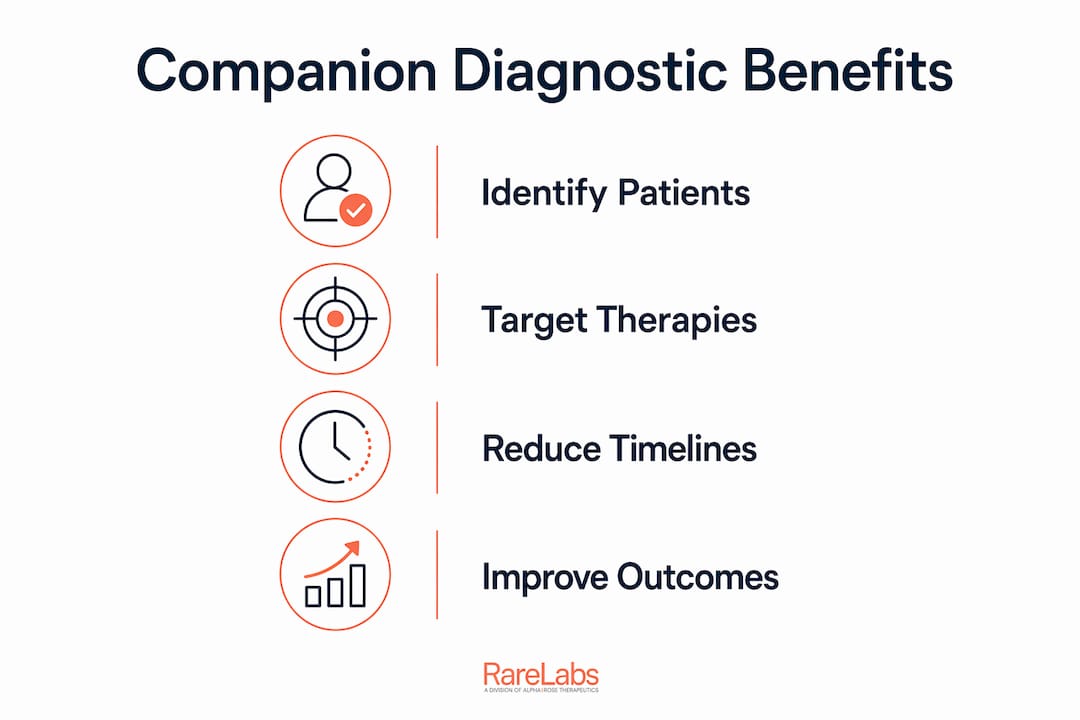
Companion diagnostics, or CDx, are tests developed alongside a therapy to identify which patients carry the molecular profile that makes them likely to respond. They are not add-ons. They are co-developed tools that define the trial population before enrollment begins, which is what makes them so effective at compressing timelines.
A 2026 analysis of 127 FDA-approved drugs found that CDx-linked approvals reduced anticancer drug development timelines by an average of 379.5 days. That is more than a year removed from a process that typically spans a decade. The mechanism is straightforward: when you enroll only patients whose biology matches the therapy's mechanism of action, you observe treatment effects faster, with smaller sample sizes, and with fewer failed arms.
| Development factor | Without CDx | With CDx |
|---|---|---|
| Average timeline reduction | Baseline | 379.5 days shorter |
| Trial population selection | Broad, heterogeneous | Molecularly defined |
| Phase of approval | Typically late-phase | Earlier-phase possible |
| Biomarker prevalence advantage | Limited | Strong for low-prevalence subgroups |
CDx adoption is especially strong for low-prevalence biomarkers, with an odds ratio of 49.07, meaning rare molecular subgroups benefit disproportionately from this approach. For rare genetic diseases, that statistic is particularly significant. The rarer the biology, the more a companion diagnostic concentrates the signal and makes a trial feasible at all.
Pro Tip: Co-develop your diagnostic assay alongside your therapeutic candidate from the earliest research phase. Teams that wait until Phase II to align their CDx often lose the timeline gains entirely, because assay validation then runs on the critical path of the trial rather than parallel to it.
What role does real-world evidence play in speeding up personalized medicine?
Real-world evidence, or RWE, refers to data collected outside controlled clinical trials, drawn from electronic health records, patient registries, insurance claims, and longitudinal population studies. It does not replace trial data. It extends it by capturing what happens to patients after a therapy reaches clinical practice, across a far wider range of conditions than any trial can replicate.
RWE bridges the gap between clinical trial efficacy and everyday patient outcomes, and its role in regulatory and reimbursement decisions is growing. The FDA and health technology assessment bodies in multiple countries now accept RWE as supporting evidence for label expansions, post-market surveillance, and comparative effectiveness claims. That acceptance shortens the time between a therapy's approval and its broader clinical adoption.
For personalized medicine specifically, RWE enables a capability that trials cannot: repeated hypothesis testing in routine clinical settings. When a molecular subgroup responds unexpectedly well or poorly in practice, RWE captures that signal and feeds it back into research design. This creates an adaptive learning loop that accelerates iterative improvements.
Key sources and benefits of real-world evidence in personalized medicine include:
- Electronic health records capturing longitudinal treatment and outcome data across diverse patient populations
- Patient registries for rare diseases providing molecular and clinical data where trial enrollment is impossible at scale
- Insurance and claims databases enabling large-scale safety and adherence analysis
- Regulatory support through FDA's Real-World Evidence Program, which formalizes RWE's role in approval decisions
- Health technology assessments using RWE to evaluate cost-effectiveness of personalized therapies for reimbursement
Pro Tip: Treat molecular profiling as a continuous data stream rather than a one-time diagnostic event. Longitudinal re-interpretation of genomic data alongside accumulating real-world outcomes is what enables therapy adjustments and trial matching over time, particularly for patients whose disease evolves.
What did the I-PREDICT trial reveal about personalized cancer treatment?
The I-PREDICT trial, published in 2026, enrolled 210 patients with advanced cancers that had failed standard therapies. The trial's central finding was that 95% of patients had unique tumor DNA profiles, meaning no two patients shared the same molecular landscape. Researchers used those profiles to design individualized treatment regimens matched to each patient's specific mutations and immune markers.
The result was 157 distinct treatment regimens across 210 patients, including 103 novel drug pairings that had never been tested together in this context. Patients who received matched therapy showed improved response rates and survival outcomes compared to those receiving unmatched treatment, and critically, there was no increase in severe side effects. That last point matters because one of the persistent concerns about highly individualized regimens is compounding toxicity.
| Outcome measure | Standard treatment | I-PREDICT personalized approach |
|---|---|---|
| Unique molecular profiles | Not assessed | 95% of patients |
| Distinct regimens used | Standardized protocols | 157 regimens across 210 patients |
| Novel drug combinations | Rare | 103 new pairings tested |
| Severe side effect increase | Baseline | No increase observed |
The implications for rare genetic diseases are direct. If 95% of advanced cancer patients carry unique tumor profiles, the same molecular individuality almost certainly applies to patients with ultra-rare genetic conditions. Designing a single trial protocol for a heterogeneous rare disease population is not just inefficient. It is scientifically misaligned with the biology. The I-PREDICT data makes the case for individualized approaches in any disease where molecular heterogeneity is high, which is precisely the situation families and clinicians face in rare genetic disease research. You can explore personalized treatment pathways in more detail to understand how these principles translate to non-oncology rare diseases.
How is AI accelerating research cycles in personalized medicine?
AI's role in personalized research has moved well past data analysis. Teams of AI agents can now autonomously propose experiments, execute analysis pipelines, interpret results, and generate the next round of hypotheses, compressing what previously required months of iterative laboratory work into days. Nature reported in 2026 that this autonomous experimental design capability is already improving throughput in research settings. That compression directly shortens the time from molecular insight to testable therapeutic candidate.
For rare disease research specifically, AI's impact is amplified by the data scarcity problem. Traditional statistical methods require large sample sizes to detect treatment effects. AI models trained on molecular pathway data, protein interaction networks, and published genomic datasets can generate predictions about likely therapeutic targets even when patient-level data is limited. This is how the impact of custom research tools becomes most visible in ultra-rare conditions where no trial cohort of meaningful size will ever exist.
Key ways AI is accelerating personalized research cycles:
- Autonomous experiment design through agent-based systems that propose and prioritize hypotheses without human bottlenecks between iterations
- Multimodal data integration combining genomic, proteomic, imaging, and clinical data to identify patterns no single data type reveals alone
- Drug repurposing screens using AI to identify FDA-approved compounds with activity against rare disease targets, dramatically shortening preclinical timelines
- Adaptive trial design support through real-time outcome modeling that adjusts enrollment criteria and endpoints as data accumulates
- Biomarker discovery at scale, identifying molecular signatures that define responsive subgroups before a trial begins
The role of peptide biomarkers in this pipeline is particularly relevant: AI-driven biomarker discovery is identifying peptide signatures that serve as both diagnostic markers and therapeutic targets, collapsing two traditionally separate research phases into one.
Why rare genetic diseases benefit most from personalized approaches
Rare genetic diseases present a research challenge that standard drug development frameworks were never designed to solve. Trial populations are too small for conventional statistical power. Disease manifestations vary widely even among patients sharing the same mutation. And the commercial incentives that drive large-scale pharmaceutical investment are absent for conditions affecting fewer than 200,000 people in the United States.
Personalized research transforms this problem by enriching trials for actionable biology, which reduces heterogeneity and limits the number of ineffective treatment cycles needed to observe a true effect. Instead of searching for a signal across a noisy, mixed population, researchers define the genetically coherent subgroup first, then design the intervention around that biology. This is why individualized therapies work where population-level approaches fail in rare disease contexts.
Here is how personalized approaches address the specific bottlenecks in rare disease research:
- Molecular stratification before enrollment eliminates the heterogeneity that forces large sample sizes, making trials feasible with the small populations available in rare diseases.
- Companion diagnostic co-development aligns the diagnostic assay with the therapeutic mechanism from the start, preventing the timeline losses that occur when diagnostics are developed after the drug.
- Real-world evidence integration allows continuous learning from every treated patient, turning each clinical encounter into a data point that refines the next treatment decision.
- AI-driven drug repurposing identifies existing FDA-approved compounds with potential activity against rare disease targets, bypassing years of de novo drug development.
- iPSC-based disease modeling using a patient's own cells creates a testable biological system that reflects the individual's unique molecular pathology, not a population average.
Families working with clinicians on rare genetic disease research should ask specifically whether molecular profiling is being treated as a one-time event or an ongoing process. The difference between those two approaches determines whether the research generates a static snapshot or a dynamic, continuously refined therapeutic strategy.
Key takeaways
Personalized research accelerates cures by reducing molecular uncertainty early, enabling smaller and faster trials, and creating adaptive learning loops that compound over time.
| Point | Details |
|---|---|
| Companion diagnostics cut timelines | CDx-linked drug development runs an average of 379.5 days shorter than standard approaches. |
| Unique profiles demand unique regimens | The I-PREDICT trial found 95% of patients had distinct tumor DNA, requiring individualized treatment plans. |
| RWE extends trial learning | Real-world evidence enables repeated hypothesis testing in clinical practice, accelerating iterative refinement. |
| AI compresses research cycles | Autonomous AI agent teams now propose and analyze experiments, cutting months from discovery timelines. |
| Rare diseases benefit most | Enriching trials for actionable biology reduces heterogeneity and makes small-population trials statistically viable. |
The case for treating personalization as infrastructure, not innovation
I have spent enough time working at the intersection of rare disease research and therapeutic development to say this plainly: the field still treats personalization as a feature when it should be treating it as the foundation. Every time a research program launches without co-developing a companion diagnostic, or without a plan to integrate real-world evidence from the first treated patient, it is accepting a timeline penalty that will compound across every subsequent phase.
The I-PREDICT data is not surprising to anyone who has watched rare disease trials fail because the enrolled population was molecularly too diverse to show a clean signal. What is surprising is how slowly that lesson is being operationalized. Families who come to research teams with an ultra-rare diagnosis do not have the luxury of waiting for the field to catch up. They need programs that treat molecular profiling as a continuous process, that use AI to screen existing compounds before committing to de novo development, and that build real-world evidence collection into the treatment protocol from day one.
The good news is that the tools exist. The ways to accelerate rare disease therapy are no longer speculative. Companion diagnostics, RWE frameworks, iPSC modeling, and AI-driven screens are all deployable now. The gap is not technological. It is organizational. Programs that close that gap will deliver cures faster. Programs that do not will keep running trials that generate inconclusive data and exhaust the patience of the families who funded them.
— John
How Hopeatrarelabs supports personalized rare disease research
Hopeatrarelabs was built specifically for the research gap this article describes. The platform creates patient-specific disease models from a patient's own cells using iPSC technology and CRISPR gene editing, then runs parallel treatment screens across thousands of FDA-approved drugs, custom antisense oligonucleotides, and gene therapy candidates. Every screen is designed around the individual's molecular profile, not a population average. For families, researchers, and clinicians who need a faster, more targeted path to viable therapy options, the RareLabs Knowledge platform provides access to rare disease research resources and personalized treatment discovery tools built for ultra-rare and undiagnosed conditions. The platform is designed to support the kind of continuous, adaptive research strategy that the evidence consistently shows produces results.
FAQ
What is personalized research in medicine?
Personalized research, also called precision medicine, tailors therapeutic development to an individual's unique genetic and molecular profile rather than applying uniform population-level treatments. This approach improves both the speed and accuracy of identifying effective therapies.
How do companion diagnostics speed up drug approvals?
Companion diagnostics identify patients whose molecular profiles match a therapy's mechanism of action before trial enrollment, which concentrates the treatment signal and enables earlier-phase FDA approvals. A 2026 analysis found CDx-linked development timelines are an average of 379.5 days shorter than standard approaches.
Why does personalized research matter more for rare diseases?
Rare disease populations are too small and molecularly diverse for conventional trial designs to detect reliable treatment effects. Personalized approaches enrich trials for genetically defined subgroups, making statistically meaningful results achievable with the limited patient numbers available.
What did the I-PREDICT trial prove about individualized cancer treatment?
The I-PREDICT trial showed that 95% of advanced cancer patients had unique tumor DNA profiles, and that matched individualized regimens improved outcomes without increasing severe side effects. This confirms that population-level treatment protocols are structurally misaligned with the biology of molecularly heterogeneous diseases.
How does AI contribute to accelerating medical breakthroughs in personalized medicine?
AI agent teams can autonomously propose experiments, analyze results, and generate new hypotheses, compressing iterative research cycles from months to days. In rare disease contexts, AI-driven drug repurposing screens identify existing FDA-approved compounds with activity against rare targets, bypassing years of de novo development.