

Patient advocacy in biotech is defined as the active participation of patients, caregivers, and organized advocacy groups in shaping drug development, clinical trial design, and regulatory decisions throughout the medical product life cycle. For the 30 million Americans living with rare diseases, this participation is not symbolic. It determines whether a treatment ever gets developed. The role of patient advocacy in biotech has shifted from passive support to strategic partnership, with formal frameworks like the FDA's patient-focused drug development (PFDD) program and patient preference information (PPI) guidance giving patient voices real weight in regulatory decisions. Organizations like the National Organization for Rare Disorders (NORD) have demonstrated that advocacy groups are now foundational infrastructure in rare disease research, not optional stakeholders.
How patient advocacy groups contribute to biotech research and development
Advocacy groups do the work that commercial drug developers often cannot justify financially. For rare diseases affecting fewer than 200,000 people, the market is too small to attract early-stage investment without external pressure and infrastructure. Patient advocacy organizations fill that gap in concrete, measurable ways.
The most direct contributions include:
- Funding early research. Groups like the Cystic Fibrosis Foundation and Parent Project Muscular Dystrophy have funded preclinical and clinical research that later attracted pharmaceutical partners. This model, sometimes called the "venture philanthropy" approach, has produced FDA-approved therapies that would not otherwise exist.
- Building patient registries and natural history studies. These data sets are the backbone of clinical trial design. Without them, sponsors cannot define endpoints, estimate disease progression, or recruit participants efficiently. Advocacy groups often fund and manage these registries for years before a biotech partner arrives.
- Defining what outcomes matter. Advocacy groups translate patient experience into measurable clinical endpoints. This is not a soft contribution. Rare disease advocacy directly alters which outcomes sponsors use in trials, replacing surrogate markers with patient-experience-driven measures that regulators accept.
- Supporting trial recruitment and retention. Rare disease trials fail most often because of enrollment problems. Advocacy groups maintain trusted relationships with patient communities that no sponsor can replicate through advertising alone.
- Connecting patients to reputable research centers. Many families spend years without a diagnosis or a specialist. Advocacy organizations maintain networks of expert clinicians and researchers, shortening that search significantly.
Pro Tip: If you are a caregiver looking to engage with an advocacy group, prioritize organizations that maintain a patient registry or have published natural history data. These groups have the infrastructure to translate your experience into research impact.
The advocacy-biotech partnership model works best when both sides commit early. Biotech companies that engage advocacy groups before Phase 1 trials consistently design better studies and face fewer regulatory surprises.

How does patient input actually influence regulatory decisions?
The FDA does not treat patient testimony as background noise. Since 2012, the PFDD program has created a structured process for capturing patient experience data, and the 2026 FDA guidance on voluntary patient preference information expanded that framework significantly. Sponsors are now encouraged to collect and submit PPI across every stage of the product life cycle, from premarket review through post-approval enforcement actions. This means patient input is not a one-time submission. It is an ongoing evidentiary record.
Here is how the regulatory influence mechanism works in practice:
- PFDD meetings capture structured patient data. The FDA requests information on how these meetings affect community engagement and trial design, which means the agency is actively tracking downstream impact, not just collecting testimony.
- PPI informs benefit-risk assessments. When a sponsor submits a new drug application, structured patient preference data can shift how the FDA weighs a therapy's side effect profile against its benefits. For a disease with no alternatives, patients may accept risks that regulators would otherwise flag.
- Advocacy organizations submit formal comments and data. Groups like NORD submit detailed briefings to FDA advisory committees. These submissions carry weight when they include rigorous, quantitative preference data rather than anecdotal accounts.
- Post-approval monitoring incorporates patient voice. The 2026 PPI guidance makes clear that patient input is relevant to enforcement decisions and label updates, not just initial approval. This extends advocacy's influence well beyond the premarket phase.
"FDA frameworks increasingly view patient input as substantive evidence that shapes regulatory decisions rather than token feedback." — FDA PPI Guidance, 2026
The critical distinction here is rigor. Testimonials at public hearings have limited regulatory impact. Properly formatted PPI studies, collected iteratively and submitted with statistical support, carry genuine evidentiary weight. Advocacy groups that understand this distinction produce the most durable regulatory influence.
Why rare disease advocacy faces unique challenges
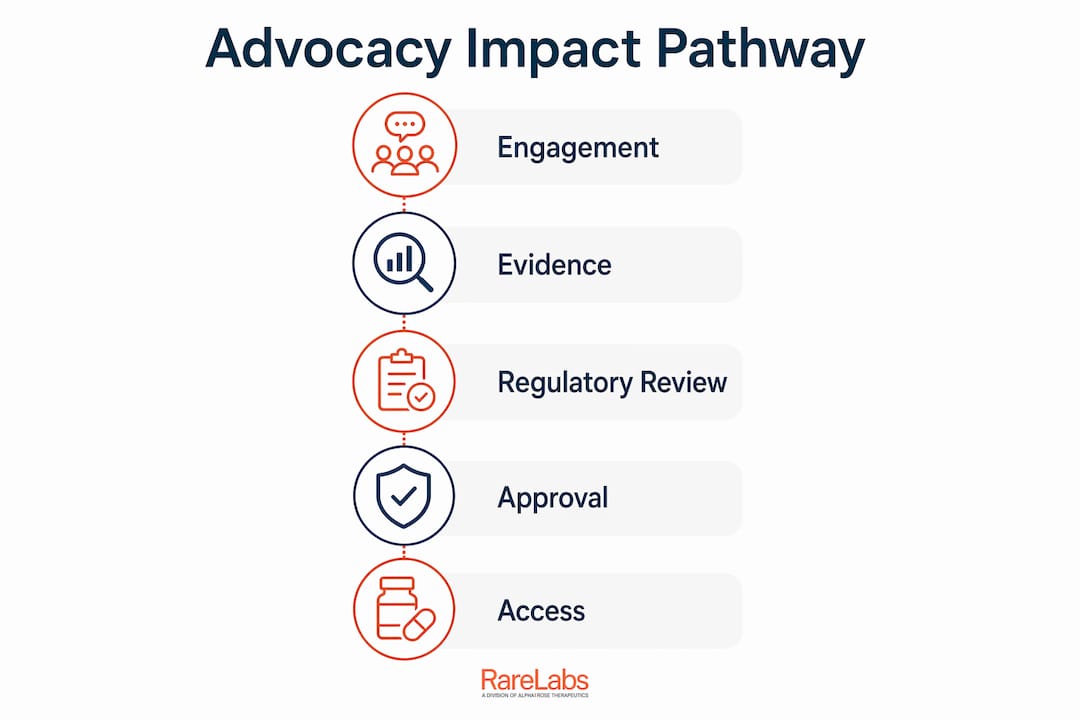
Rare diseases present a specific set of problems that make advocacy both harder and more necessary than in common disease areas. Fewer than 5% of 10,000-plus rare diseases have FDA-approved treatments. That statistic reflects not just a scientific gap but a structural one. Commercial drug development follows market size, and most rare diseases do not meet that threshold without advocacy-driven intervention.
| Challenge | Impact on patients and research |
|---|---|
| Few disease experts worldwide | Families wait years for accurate diagnosis and specialist referral |
| No approved treatments | Advocacy must build the entire research case from scratch |
| Small patient populations | Clinical trials are statistically underpowered without global recruitment |
| Fragmented scientific knowledge | Advocacy groups must synthesize and translate emerging science for families |
| Regulatory communication limits | Current FDA rules treat expert advocates like the general public, limiting scientific dialogue despite their deep expertise |
The last row in that table deserves emphasis. Advocacy leaders in rare diseases often possess scientific knowledge that rivals academic researchers. Yet FDA communication rules restrict the depth of scientific exchange between agency staff and these intermediaries. This regulatory gap slows the very collaboration it should support.
Advocacy groups compensate by building internal scientific capacity. Organizations like the Progeria Research Foundation and Batten Disease Support and Research Association employ scientists, fund academic labs, and publish peer-reviewed research. They do not wait for commercial partners. They create the conditions that attract them.
Pro Tip: When searching for an advocacy group for your condition, check whether they have published in peer-reviewed journals or funded a natural history study. These are reliable signals of scientific credibility and regulatory influence capacity. The step-by-step guide to finding rare disease treatments from Hopeatrarelabs can help you identify where to start.
What are effective strategies for engaging with advocacy groups?
Knowing the importance of patient advocacy is one thing. Knowing how to engage with it productively is another. Patients and caregivers who participate actively in advocacy efforts have a measurable impact on research priorities and regulatory submissions. Here is how to do it well.
- Identify advocacy groups with governance capacity. Not all patient organizations are equally positioned to influence biotech development. Organizational maturity and governance systems determine advocacy effectiveness at the institutional level. Look for groups with scientific advisory boards, published research, and formal relationships with FDA or NIH programs.
- Contribute your patient preference information. When advocacy groups or sponsors collect PPI data, participate. Your structured input, documenting which symptoms matter most, which side effects are acceptable, and what daily function looks like, feeds directly into regulatory submissions. This is one of the highest-leverage contributions a patient or caregiver can make.
- Engage in community research programs. Many advocacy groups run patient-reported outcome surveys, biobank programs, and natural history studies. Enrolling in these programs adds to the data infrastructure that sponsors need before they can design a trial.
- Support research prioritization efforts. Advocacy groups regularly convene scientific workshops to set research agendas. Attending these events, even as a non-scientist, gives you direct input into which questions get studied first.
- Understand the regulatory communication landscape. Advocacy leaders who want to engage directly with FDA scientists face structural limits. Partnering with healthcare networks like ConnectedMedics can help families access professionals who understand how to navigate these boundaries and translate scientific developments into practical guidance.
- Document your disease experience systematically. Journals, symptom logs, and functional assessments are not just personal records. They are the raw material of patient preference data. Advocacy groups and sponsors can use structured patient narratives in regulatory submissions when they meet FDA formatting standards.
The rare disease trial best practices guide from Hopeatrarelabs outlines how researchers and patient communities can work together to build the infrastructure that makes trials possible. Reading it as a caregiver gives you a clearer picture of what sponsors actually need from patient communities.
Key takeaways
Patient advocacy in biotech is most effective when it produces rigorous, structured evidence that regulators and sponsors can use directly in decision-making, not when it relies on emotional appeals alone.
| Point | Details |
|---|---|
| Advocacy drives rare disease research | Groups fund studies, build registries, and define endpoints where commercial developers will not invest. |
| FDA treats patient input as evidence | The 2026 PPI guidance integrates patient preference data across the full product life cycle. |
| Rare disease advocacy faces structural gaps | Fewer than 5% of rare diseases have approved treatments, and regulatory communication rules limit expert dialogue. |
| Organizational maturity determines impact | Advocacy groups with governance systems and scientific capacity produce the most durable regulatory influence. |
| Patients can contribute directly | Submitting structured patient preference information and enrolling in natural history studies are high-leverage actions. |
What I have learned watching advocacy reshape biotech
I have spent years watching patient advocacy evolve from a support function into a genuine driver of biotech strategy. The shift is real, and it is accelerating. What strikes me most is how the most effective advocates have stopped thinking of themselves as petitioners and started thinking of themselves as partners with data.
The maturation of advocacy from individual case representation to system-level governance influence is not automatic. It requires organizations to invest in scientific staff, data infrastructure, and regulatory expertise. The groups that have done this, NORD, the Cystic Fibrosis Foundation, the Muscular Dystrophy Association, have produced tangible results: approved therapies, redesigned trials, and regulatory precedents that benefit entire disease communities.
My honest view is that the FDA's 2026 PPI guidance is the most significant structural change for patient advocacy in a decade. It formalizes what good advocates have been doing informally for years and gives every patient community a documented pathway to regulatory influence. The families I see doing this work are not waiting for a biotech company to notice their disease. They are building the case that makes it impossible to ignore.
If you are a caregiver reading this, the most important thing I can tell you is this: your experience is evidence. The question is whether it is collected and formatted in a way that regulators can use. That is a solvable problem, and advocacy groups are the organizations best positioned to help you solve it.
— John
Explore rare disease research and treatment options with Hopeatrarelabs
Hopeatrarelabs exists specifically for families who cannot afford to wait for commercial drug development to catch up with their disease. The RareLabs Knowledge portal connects patients, caregivers, and advocacy groups with rare disease research, treatment screening data, and therapy development resources organized for people who need answers now. Hopeatrarelabs uses iPSC modeling and CRISPR-based disease models built from patients' own cells to test thousands of FDA-approved compounds and custom therapeutic options in parallel. If your disease has no approved treatment, that is exactly the situation Hopeatrarelabs was built for. Visit hopeatrarelabs.com to explore what a personalized treatment search looks like for your specific condition.
FAQ
What is the role of patient advocacy in biotech?
Patient advocacy in biotech is the active involvement of patients, caregivers, and organized groups in drug development, clinical trial design, and regulatory decisions. Advocacy groups provide patient preference data, fund early research, build registries, and influence FDA benefit-risk assessments through formal programs like PFDD and PPI submissions.
How do advocacy groups influence FDA drug approval decisions?
Advocacy groups submit structured patient preference information and participate in PFDD meetings that the FDA uses as regulatory evidence. The 2026 FDA PPI guidance formally integrates this data across the full product life cycle, from premarket review through post-approval enforcement.
Why is patient advocacy especially important for rare diseases?
Fewer than 5% of rare diseases have FDA-approved treatments, and commercial drug developers rarely invest without external pressure and infrastructure. Advocacy groups build the natural history studies, patient registries, and endpoint definitions that make rare disease trials scientifically and regulatorily viable.
How can patients and caregivers engage with biotech patient advocacy?
Patients can contribute by enrolling in natural history studies, submitting structured patient preference information, and joining advocacy groups that have scientific advisory boards and formal FDA relationships. Organizational maturity determines how effectively your input translates into regulatory and research impact.
What makes patient preference information effective for regulatory submissions?
Properly formatted PPI that is collected iteratively, statistically supported, and reusable across product lifecycle stages carries the most regulatory weight. Anecdotal testimony has limited impact. Structured, quantitative preference studies submitted through formal FDA channels directly inform benefit-risk assessments and trial endpoint selection.