

Personalized medicine is defined as the practice of tailoring medical treatment to each patient's unique genetic makeup, environment, and lifestyle rather than applying a single standard protocol to everyone. Also called precision medicine in clinical settings, though the two terms carry distinct meanings, this approach uses tools like pharmacogenomics and multi-omics analysis to match therapies to the individual. Personalized therapeutic approaches have demonstrated response rates ranging from 48.7% to 87%, compared to significantly lower rates from traditional treatments. That gap explains why families navigating rare genetic conditions are increasingly turning to personalized strategies when standard options fall short.
What is personalized medicine and how does it work scientifically?
Personalized medicine works by reading the biological signals that make each patient different and using that data to guide treatment decisions. The core scientific foundation is pharmacogenomics, the study of how genes affect a person's response to drugs. Genetic markers like CYP450 enzymes, for example, determine how quickly a patient metabolizes medications such as warfarin. A patient who metabolizes warfarin too fast on a standard dose risks a blood clot. A patient who metabolizes it too slowly risks a dangerous bleed.

Beyond single-gene analysis, personalized medicine now draws on multi-omics, a combination of genomics, proteomics, and metabolomics, to build a fuller picture of a patient's biology. Pharmacogenomics guides drug therapy across oncology, cardiology, and psychiatry by adjusting doses based on genetic profiles. Artificial intelligence then processes these large datasets to identify patterns no clinician could spot manually. The result is a treatment recommendation grounded in the patient's actual biology, not population averages.
Key technologies driving personalized medicine today include:
- Pharmacogenomic testing: Identifies gene variants that predict drug response and toxicity risk
- Induced pluripotent stem cells (iPSCs): Allow labs to grow patient-specific cell models for testing therapies directly on a patient's own cells
- CRISPR gene editing: Enables targeted correction or study of disease-causing mutations at the DNA level
- AI-assisted clinical decision support: Processes genomic and clinical data to recommend therapy options
- Antisense oligonucleotides (ASOs): Custom molecules designed to silence or correct specific genetic errors
Each of these tools serves a different layer of the problem. Together, they let clinicians and researchers move from "what works for most patients" to "what works for this patient."
Pro Tip: If your family is pursuing genetic testing, ask your physician specifically about pharmacogenomic panels, not just diagnostic gene panels. They answer different questions and both matter for treatment planning.
How does personalized medicine differ from traditional and precision medicine?
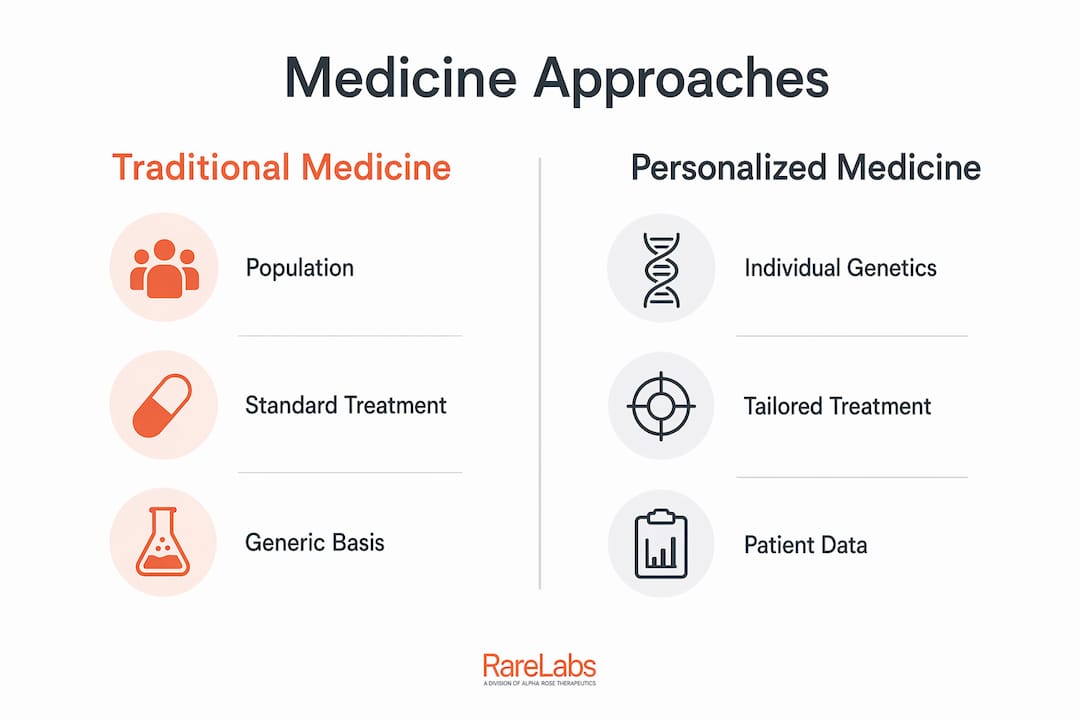
The three terms, traditional medicine, precision medicine, and personalized medicine, are often used interchangeably, but they describe meaningfully different approaches.
| Approach | Focus | Basis for treatment |
|---|---|---|
| Traditional medicine | Population averages | Standard protocols applied broadly |
| Precision medicine | Patient subgroups | Shared biological traits (e.g., tumor type) |
| Personalized medicine | The individual | Unique genetics, history, lifestyle, and environment |
Traditional medicine applies the same first-line treatment to every patient with a given diagnosis. Precision medicine improves on that by grouping patients who share a biological characteristic, such as a specific gene mutation, and targeting that group with a matched therapy. Personalized medicine goes one step further. It treats the patient as an individual, not a member of a subgroup.
Experts distinguish precision medicine from personalized medicine on exactly this point: precision medicine stratifies groups, while personalized medicine adapts care to the full individual context. That distinction matters most for patients with rare or undiagnosed conditions, where no subgroup protocol exists. The patient's lived experience and environmental context must be integrated alongside molecular data for treatment to be truly effective.
Pro Tip: When speaking with a specialist, ask whether a proposed treatment is based on your specific genetic data or on a broader patient subgroup. The answer tells you how personalized the plan actually is.
What are the real benefits of personalized medicine for patients with rare diseases?
The advantages of personalized medicine are most visible where standard treatments fail entirely, and that is precisely the situation most families with rare genetic diseases face. When no approved therapy exists for a condition, the only path forward is building one from the patient's own biology.
Pharmacogenomic-guided dosing improves antidepressant response rates while reducing adverse drug effects. That same principle scales to rare disease treatment: matching a therapy to a patient's specific mutation reduces the trial-and-error cycle that costs families months or years. For custom therapeutics in rare disease, the difference between a matched and unmatched therapy can be the difference between a response and no response at all.
The core benefits of personalized medicine for patients and families include:
- Higher treatment response rates: Therapies matched to genetic profiles outperform population-average protocols
- Fewer adverse drug reactions: Genetic screening identifies patients at risk before a harmful drug is prescribed
- Faster diagnosis: Genomic tools reduce the diagnostic odyssey common in rare disease, where families often wait years for a confirmed diagnosis
- Custom therapeutic development: Technologies like iPSCs and ASOs allow labs to design treatments for a single patient's mutation
- Better family planning: Genetic findings inform risk assessments for siblings and future children
- More informed clinical decisions: Physicians can prioritize therapies most likely to work rather than cycling through standard options
For caregivers, the importance of personalized medicine extends beyond the patient. Understanding a child's genetic profile gives families a concrete basis for decisions about schooling, nutrition, and long-term care planning. Early genetic testing can identify risk before symptoms worsen, creating a window for intervention that standard diagnostic timelines often miss.
Successful personalized treatment also depends on more than genetics. Treatment response is affected by age, lifestyle, and environment in addition to molecular data. A complete patient history is not a formality. It is clinical data.
What barriers currently limit access to personalized medicine?
The science of personalized medicine is well ahead of its delivery. Several systemic barriers prevent most patients from accessing the approaches that research supports.
-
Cost of genomic testing. Advanced sequencing and multi-omics panels carry significant costs. Precision diagnostic tests are not consistently covered by insurance, which creates a financial barrier that disproportionately affects families already managing the costs of a rare disease diagnosis.
-
Limited clinician awareness. Most physicians receive minimal training in genomics and pharmacogenomics. Limited clinician awareness and the absence of robust regulatory frameworks slow adoption even when the evidence supports a personalized approach.
-
Infrastructure gaps. Many hospital systems lack the integrated multi-omics and AI decision support tools needed to translate genomic data into bedside treatment recommendations. Specialized centers exist, but they are not evenly distributed.
-
Data privacy and ethics. Sharing genomic data across institutions accelerates research but raises legitimate concerns about who owns that data and how it is protected. Families deserve clear answers before consenting to data sharing.
-
Equity gaps. Building inclusive ecosystems with strong data infrastructure and patient literacy is the only way to ensure personalized medicine reaches patients regardless of income or geography. Without deliberate policy attention, the benefits will concentrate among those who can already afford specialized care.
Pro Tip: Before pursuing advanced genomic testing, ask your care team for a referral to both a genetic counselor and a financial counselor. Understanding the cost and coverage picture upfront prevents surprises and helps you plan the right testing sequence.
Key Takeaways
Personalized medicine delivers its greatest value when genetic data, patient history, and clinical context are combined rather than treated as separate inputs.
| Point | Details |
|---|---|
| Personalized medicine definition | Treatment tailored to individual genetics, environment, and lifestyle rather than population averages |
| Response rate advantage | Personalized therapies show response rates of 48.7%–87%, well above traditional treatment benchmarks |
| Rare disease relevance | iPSCs, CRISPR, and ASOs allow labs to build and test therapies for a single patient's mutation |
| Key barriers to access | High testing costs, limited insurance coverage, and clinician knowledge gaps slow adoption |
| Full context required | Genetics alone is insufficient; age, lifestyle, and environment must inform every treatment plan |
Why biology and biography must work together
The part of personalized medicine that most clinical conversations skip is the biography. I have seen families arrive at specialist appointments with a full genomic report and leave without a treatment plan, because the physician had no framework for connecting the molecular findings to the patient's actual life. The science was there. The integration was not.
The imperative to combine biology and biography is not a soft concept. It is a clinical necessity. A mutation that causes severe symptoms in a sedentary adult with environmental exposures may present differently in a child with a different metabolic baseline. Treating the gene without treating the person produces incomplete medicine.
What gives me confidence about the next decade is the convergence of AI clinical decision support with patient-reported data. When a system can cross-reference a patient's genomic profile, medication history, lifestyle inputs, and real-world outcomes simultaneously, the gap between precision and personalization closes. The personalized health programs emerging from forward-thinking clinical practices already show what this looks like in practice.
The urgency is real for rare disease families. Every month without a matched therapy is a month of disease progression. The tools exist. The gap is in delivery, literacy, and access. Closing that gap requires clinicians, researchers, policymakers, and families to push in the same direction at the same time.
— John
How Hopeatrarelabs supports families seeking personalized therapies
Families dealing with ultra-rare or undiagnosed genetic conditions often reach a point where standard medicine has no more answers. Hopeatrarelabs was built for exactly that moment.
Hopeatrarelabs develops patient-specific disease models using iPSCs and CRISPR gene editing, then runs parallel treatment screens across thousands of FDA-approved drugs, custom ASOs, and gene therapy candidates. The goal is to find a viable therapy for conditions that have no approved treatment. The RareLabs knowledge base gives patients, families, and physicians access to rare disease research and treatment search tools built around personalized approaches. For families ready to take the next step, the rare disease treatment search at Hopeatrarelabs connects your specific case to the science most likely to help.
FAQ
What is personalized medicine in simple terms?
Personalized medicine is the practice of choosing treatments based on a patient's individual genetic profile, lifestyle, and environment rather than using a one-size-fits-all protocol. It uses tools like pharmacogenomics and genomic sequencing to match therapies to the specific patient.
How does personalized medicine differ from precision medicine?
Precision medicine groups patients by shared biological traits and targets those groups with matched therapies. Personalized medicine goes further by adapting care to the full individual context, including lifestyle, history, and environment, not just molecular subgroup membership.
What are the main benefits of personalized medicine for rare disease patients?
The core benefits include higher treatment response rates, fewer adverse drug reactions, faster diagnosis, and the ability to develop custom therapies like ASOs or gene therapy for a single patient's mutation when no approved treatment exists.
Is personalized medicine covered by insurance?
Coverage varies widely. Advanced genomic and multi-omics tests are not consistently covered by insurance plans, making financial counseling an important step before pursuing testing. Families should ask their care team about coverage and seek a financial counselor alongside a genetic counselor.
What role does genetics play in personalized medicine?
Genetics is the primary data source, but not the only one. Genetic markers like CYP450 variants guide drug dosing and therapy selection. However, treatment response is also shaped by age, environment, and lifestyle, so a complete patient history is required alongside any genomic report.