

The personalized therapy discovery process is the systematic method of identifying treatment options matched to the unique genetic and clinical profile of each patient with a rare or undiagnosed disease. For families navigating conditions that affect fewer than 200,000 people in the United States, this approach replaces the exhausting cycle of trial-and-error with a data-driven, biology-first strategy. Tools like AI-powered genomic analysis, induced pluripotent stem cell (iPSC) modeling, and platforms such as Hopeatrarelabs are reshaping what is possible. Traditional drug development takes 10 to 15 years and costs billions of dollars. Personalized discovery compresses that timeline significantly for patients who cannot afford to wait.
What does the personalized therapy discovery process require?
Before any therapy can be identified, a specific set of data and tools must be in place. Think of this phase as building the foundation. Without it, even the most advanced AI platform cannot generate reliable results.
The core data requirements include:
- Whole genome or exome sequencing: High-quality genetic sequencing is the single most critical input. Personalized therapy discovery depends heavily on quality initial genetic sequencing, and low-quality reads produce unreliable variant calls that cascade into flawed therapy suggestions.
- Clinical history and phenotype data: Documented symptoms, prior diagnoses, treatment responses, and lab results give AI systems the clinical context to interpret genetic findings accurately.
- Functional and lifestyle data: Metabolic panels, organ function tests, and medication history feed pharmacogenomic models that predict how a patient will process specific drugs.
- Curated database access: Databases like ClinVar, OncoKB, and rare disease patient registries provide the reference points that AI tools use to cross-validate variant pathogenicity and match known therapeutic targets.
- Patient consent and data governance: Privacy protections under HIPAA and institutional review board protocols are non-negotiable. Families should confirm that any platform they engage with has clear data-use agreements before sharing genomic files.
Data integration is where most families hit their first obstacle. Genomic files, clinical records, and lab results often live in separate systems with incompatible formats. Harmonizing these inputs into a single structured dataset is a prerequisite, not an optional step.
Pro Tip: Ask your genetic counselor or rare disease specialist to provide your variant call format (VCF) file directly. This raw file is what computational platforms actually need, not just a PDF summary report.

Step-by-step workflow for personalized therapy discovery
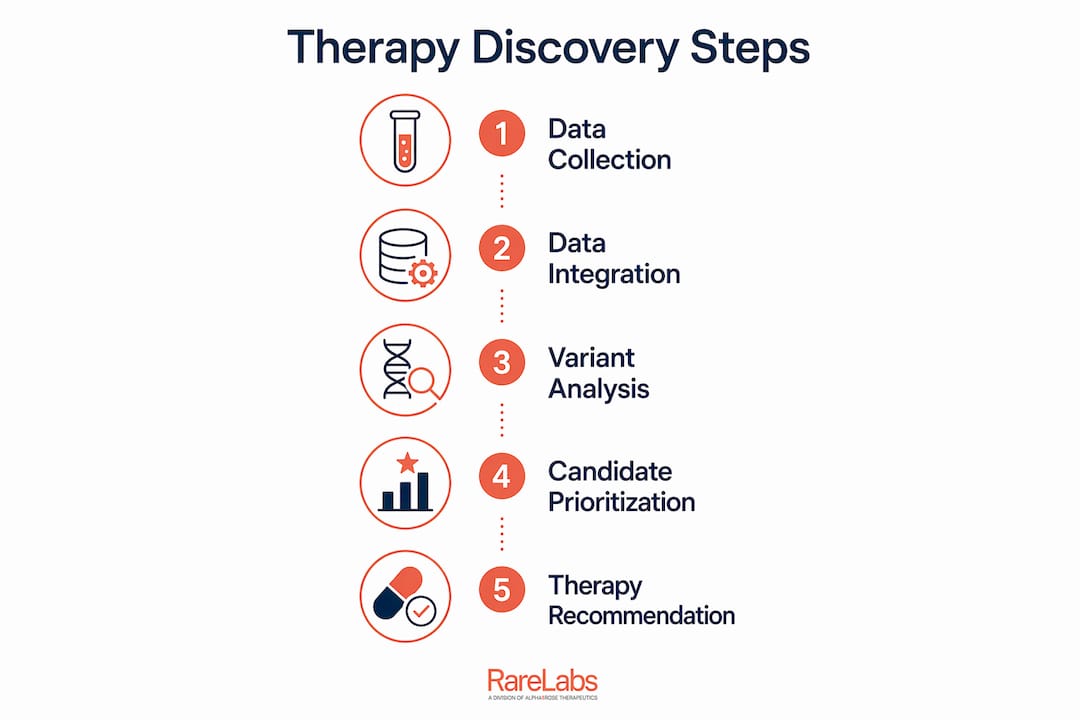
The individualized therapy approach follows a defined sequence. Each step builds on the last, and skipping any phase increases the risk of missing a viable treatment candidate.
-
Initial patient assessment and data collection. The process begins with a structured intake that captures genomic sequences, clinical history, and phenotype data. Platforms like Hopeatrarelabs derive patient-specific disease models directly from the patient's own cells, using iPSC technology to replicate the disease biology in a lab setting.
-
Multimodal data integration. All data streams are harmonized into a single computational environment. Effective personalized discovery uses parallel queries of public databases and raw variant data files to cross-validate findings, reducing the chance that a relevant variant is missed.
-
Automated literature and database mining. AI agents scan PubMed, ClinVar, OncoKB, and proprietary drug databases simultaneously. Automated AI systems for pharmacogenomic recommendations achieve 91.9% accuracy extracting clinical data from biomedical literature. That level of precision means fewer false leads and faster hypothesis generation.
-
Therapeutic hypothesis generation and prioritization. The system ranks candidate therapies by biological plausibility, evidence strength, and patient-specific safety profile. Network-informed reinforcement learning models improve drug prioritization performance by over 95% compared to baseline methods. For a family with no approved treatment options, that improvement is the difference between a dead end and a viable path forward.
-
Digital twin simulation. Before any physical testing, digital twins simulate individual biological profiles in-silico to test drug response and potential toxicity. This step screens out candidates likely to cause harm before they ever reach a patient.
-
Clinical decision support and physician collaboration. AI outputs are reviewed by a multidisciplinary team that includes geneticists, neurologists, and clinical pharmacologists. Human-in-the-loop AI systems produce safer, more transparent therapy recommendations precisely because clinician oversight catches errors that automated systems cannot.
-
Iterative refinement and safety checks. As new data arrives, such as a patient's response to a candidate therapy or updated database entries, the model is re-run. This iterative cycle is what separates a living therapy discovery workflow from a one-time analysis.
| Workflow step | Primary tool | Output |
|---|---|---|
| Data collection | Whole genome sequencing, EHR extraction | Structured patient dataset |
| Database mining | ClinVar, OncoKB, PubMed AI agents | Ranked variant-therapy associations |
| Drug prioritization | Reinforcement learning models | Scored candidate therapy list |
| Safety simulation | Digital twin modeling | Predicted toxicity and response profiles |
| Clinical review | Multidisciplinary team | Approved therapy candidates for testing |
Pro Tip: Request a written summary of the AI platform's evidence provenance for each therapy candidate. Knowing which database or study generated a recommendation helps your physician evaluate its clinical weight.
How does personalized therapy differ from conventional treatment?
Conventional medicine is built on population-level evidence. A drug is approved because it works for a statistically significant portion of trial participants. For a patient with an ultra-rare genetic disease, that population may not include anyone with their specific mutation. The result is a treatment protocol designed for someone else.
AI-powered precision medicine shifts from broad population statistics to stratified medicine, grouping patients by biological similarities rather than symptoms alone. A child with a KCNQ2 variant and a child with a SCN1A variant may both present with seizures, but their optimal therapies are biologically distinct. Treating them identically is not just inefficient. It can be harmful.
The practical differences are significant:
- Drug repurposing speed: AI accelerates drug repurposing by analyzing large datasets of approved drugs and natural compounds, identifying candidates that were never tested for a given rare condition but have a plausible mechanism of action.
- Adverse reaction reduction: Pharmacogenomic profiling predicts how a patient's liver enzymes will metabolize a specific drug, flagging toxicity risks before the first dose is administered.
- Patient involvement: Families in a tailored therapy solutions model are active participants. They contribute data, review candidate lists with their physicians, and make informed decisions rather than accepting a default protocol.
- Timeline compression: Where conventional rare disease research can take over a decade, AI-driven discovery can generate a prioritized candidate list within weeks of receiving complete genomic and clinical data.
The goal of custom therapy planning is not to replace clinical medicine. It is to give clinicians a far more specific map before they begin treatment.
Common challenges in the personalized therapy discovery process
No discovery workflow is free of friction. Families who understand the obstacles in advance are better positioned to navigate them without losing momentum.
Data quality gaps are the most common barrier. A sequencing report that covers only coding regions misses intronic variants that may be causative. Incomplete clinical records force AI systems to make inferences rather than calculations. The solution is to pursue whole genome sequencing over targeted panels wherever possible, and to compile a thorough longitudinal symptom record before initiating any discovery platform.
Algorithm limitations are real and underappreciated. Workflow-orchestrated AI agents restricted to curated tools provide safer, traceable therapy suggestions than unconstrained large language models. Families should ask any platform they work with whether their AI operates within a defined, auditable workflow or generates free-form outputs. The distinction matters for safety.
Access and cost remain significant barriers for many families. Whole genome sequencing has dropped below $1,000 in many clinical settings, but the computational analysis, disease modeling, and multidisciplinary review layers add cost. Rare disease foundations, NIH Undiagnosed Diseases Network programs, and patient advocacy organizations often provide funding pathways that families are unaware of.
Interpreting complex results requires specialist support. A variant of uncertain significance (VUS) in a gene associated with your child's symptoms is not a diagnosis. Genetic counselors trained in rare disease interpretation are the right resource for translating raw findings into clinical meaning.
"Families gain hope by understanding that personalized therapy discovery can bypass much of traditional trial-and-error, reducing adverse effects and accelerating effective treatments." Source
Engaging with specialized research labs and rare disease networks also opens doors that standard clinical channels do not. Labs like Hopeatrarelabs operate specifically at this intersection, building patient-derived models and running parallel treatment screens for conditions that have no approved therapy.
Key takeaways
The personalized therapy discovery process works because it replaces population-level assumptions with patient-specific biological data, AI-driven analysis, and clinician-guided decision-making at every step.
| Point | Details |
|---|---|
| Quality sequencing is foundational | Whole genome sequencing produces more complete variant data than targeted panels, improving downstream analysis accuracy. |
| AI prioritization outperforms manual review | Reinforcement learning models improve drug prioritization by over 95% compared to baseline methods, narrowing candidate lists faster. |
| Digital twins reduce physical risk | In-silico drug response simulations screen out toxic candidates before any physical treatment is attempted. |
| Clinician oversight is non-negotiable | Human-in-the-loop review of AI outputs catches errors and ensures therapy recommendations align with clinical safety guidelines. |
| Families are active participants | Informed engagement with discovery platforms, genetic counselors, and rare disease networks directly improves the quality of outcomes. |
What I've learned working at the intersection of AI and rare disease
The shift I have watched over the past several years is not primarily technological. It is psychological. Families who once arrived at rare disease clinics resigned to a years-long diagnostic odyssey now arrive asking specific questions about iPSC modeling, ASO design, and drug repurposing pipelines. That change in posture matters more than most researchers acknowledge.
The uncomfortable truth about AI-driven therapy discovery is that the technology is only as good as the data fed into it. I have seen cases where a family spent months on a discovery platform only to learn that their sequencing file was incomplete. The platform was not wrong. The input was. This is why I push hard on the sequencing-first principle before any computational work begins.
I also want to push back on the idea that AI replaces the need for expert human judgment. The most effective discovery workflows I have encountered treat AI as a research accelerator, not a clinician substitute. The physician who reviews a ranked candidate list brings clinical intuition, patient relationship knowledge, and ethical judgment that no model replicates. Families should be skeptical of any platform that presents AI outputs as final answers rather than starting points for expert review.
The most encouraging development I have seen is the growing number of genetic therapy options available for ultra-rare conditions that had zero candidates five years ago. Custom antisense oligonucleotides designed for a single patient's mutation are no longer theoretical. They are happening. For families in the middle of a diagnostic odyssey, that is not a distant promise. It is a concrete reason to pursue the discovery process with urgency.
— John
How Hopeatrarelabs supports your therapy discovery
Hopeatrarelabs was built specifically for families and physicians facing rare and undiagnosed genetic diseases with no approved treatment path. The platform creates patient-derived disease models from the patient's own cells, then runs parallel treatment screens across thousands of FDA-approved drugs, custom ASOs, and gene therapy candidates.
For families who want to understand what therapy options may exist for their specific condition, the RareLabs Knowledge platform aggregates rare disease research, genetic data, and therapy discovery resources in one place. It is built to support the kind of informed, biology-first search that the personalized therapy discovery process demands. Start there to understand what is known about your condition and what discovery pathways are currently available.
FAQ
What is the personalized therapy discovery process?
The personalized therapy discovery process is a systematic, biology-first method of identifying treatment candidates matched to a specific patient's genetic and clinical profile. It uses tools like whole genome sequencing, AI-driven drug prioritization, and digital twin simulations to replace broad trial-and-error with targeted therapy identification.
How long does personalized therapy discovery take?
Timeline varies by case complexity, but AI-driven workflows can generate a prioritized candidate list within weeks of receiving complete genomic and clinical data. This compresses a process that traditionally takes years in conventional rare disease research.
What type of genetic testing is needed to start?
Whole genome sequencing is the preferred starting point because it captures both coding and non-coding variants. Targeted gene panels may miss causative variants outside their scope, limiting the quality of downstream AI analysis.
Can personalized therapy discovery work for undiagnosed diseases?
Yes. Platforms like Hopeatrarelabs are specifically designed for undiagnosed conditions where no approved therapy exists. Disease models for undiagnosed conditions allow researchers to study the biology directly and test candidate therapies without requiring a confirmed diagnosis first.
Is AI safe to use in therapy discovery without a doctor?
AI tools should augment clinician judgment, not replace it. Human-in-the-loop review is required to verify that AI-generated therapy recommendations meet clinical safety standards and align with the patient's full medical picture.