
Drug repurposing is defined as the identification and clinical development of existing approved or investigational drugs for new therapeutic indications beyond their original approvals. Traditional new drug development costs exceed $2.5 billion with timelines of 10–17 years and failure rates near 90%. Repurposing sidesteps much of that burden by starting with compounds whose safety profiles are already established. The FDA, NIH, and programs like CURE ID actively support this approach, particularly for rare and chronic diseases where conventional development is economically unviable. For researchers and healthcare professionals, understanding what is drug repurposing means understanding one of the most practical tools available for addressing unmet medical needs today.
What is drug repurposing, and how does it work scientifically?
Drug repurposing, also called treatment repurposing or drug repositioning, rests on a core biological insight: many diseases share molecular pathways, protein targets, or cellular mechanisms. A drug designed for one condition may modulate a target that drives a completely different disease. Identifying those overlaps is the scientific foundation of the entire field.
The most reliable repurposing candidates come from mechanism-based hypothesis generation, which uses integrative molecular data such as transcriptomic profiles and protein-protein interaction networks to connect diseases with shared pathways. This approach is more systematic than chance observation and produces candidates with a clearer biological rationale. High-quality integrative data are the prerequisite, not the bonus.
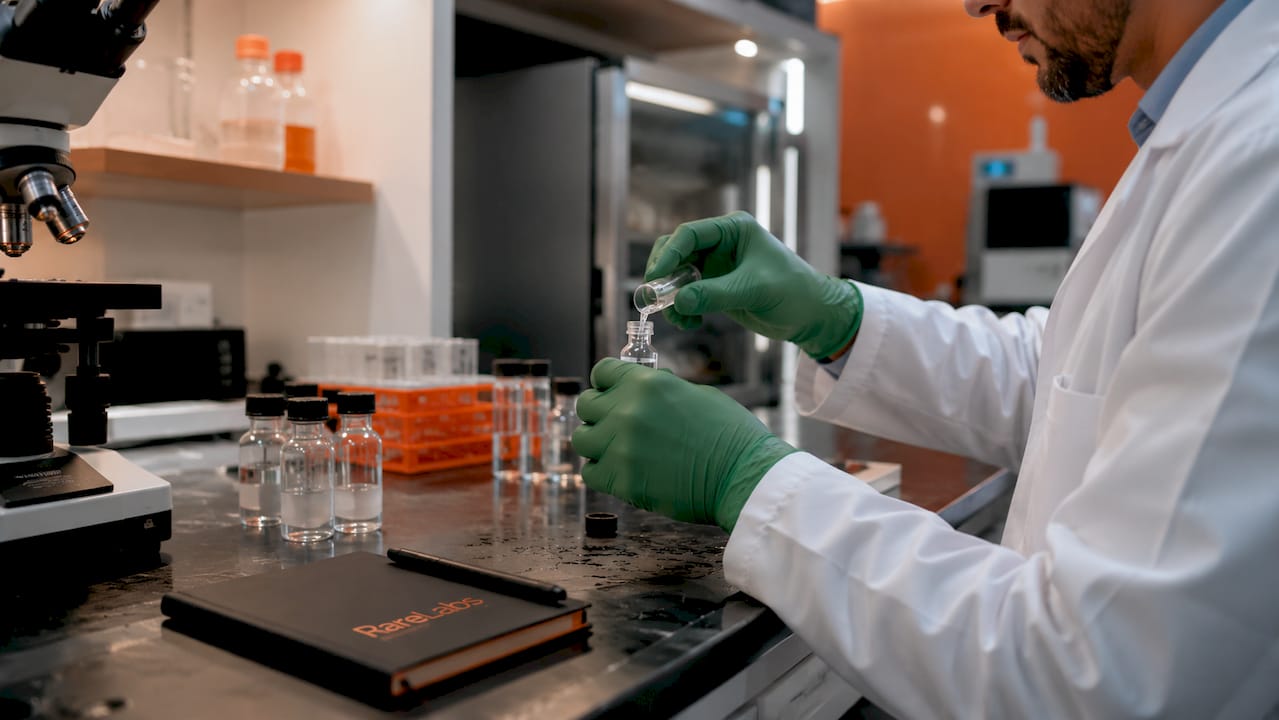
Computational methods have transformed how researchers identify those candidates. AI and machine learning models, molecular docking simulations, graph neural networks, and knowledge graphs now cut identification time and cost compared to conventional screening. Network pharmacology maps how a drug interacts across multiple biological systems simultaneously, revealing off-target effects that may be therapeutically useful.
Experimental validation follows computational prediction. Methods include:
- High-throughput screening: Testing thousands of compounds against a disease target rapidly.
- Binding affinity assays: Confirming that a candidate drug physically interacts with the new target.
- Patient-derived disease models: Using cells from actual patients, including induced pluripotent stem cell (iPSC) models, to test drug effects in biologically relevant systems.
- Pharmacovigilance and electronic health record mining: Analyzing real-world clinical data to spot unexpected therapeutic signals in patient populations.
Pro Tip: No single method is sufficient. The most productive repurposing pipelines combine computational screening with mechanism-based hypotheses and then validate findings in patient-derived models before advancing to clinical trials.
Checking a candidate's full safety and interaction profile early is also critical. Tools like MediGuide's drug database provide detailed side effect and interaction data on approved drugs, which helps researchers quickly rule out candidates with prohibitive safety signals before investing in wet-lab validation.
How does drug repurposing compare to traditional drug development?
The efficiency argument for repurposing is grounded in hard numbers. Traditional development failure rates sit near 90%, with costs ranging from $314 million to $2.8 billion per approved drug. That failure rate reflects how often a compound that looks promising in early research turns out to be unsafe or ineffective in humans.
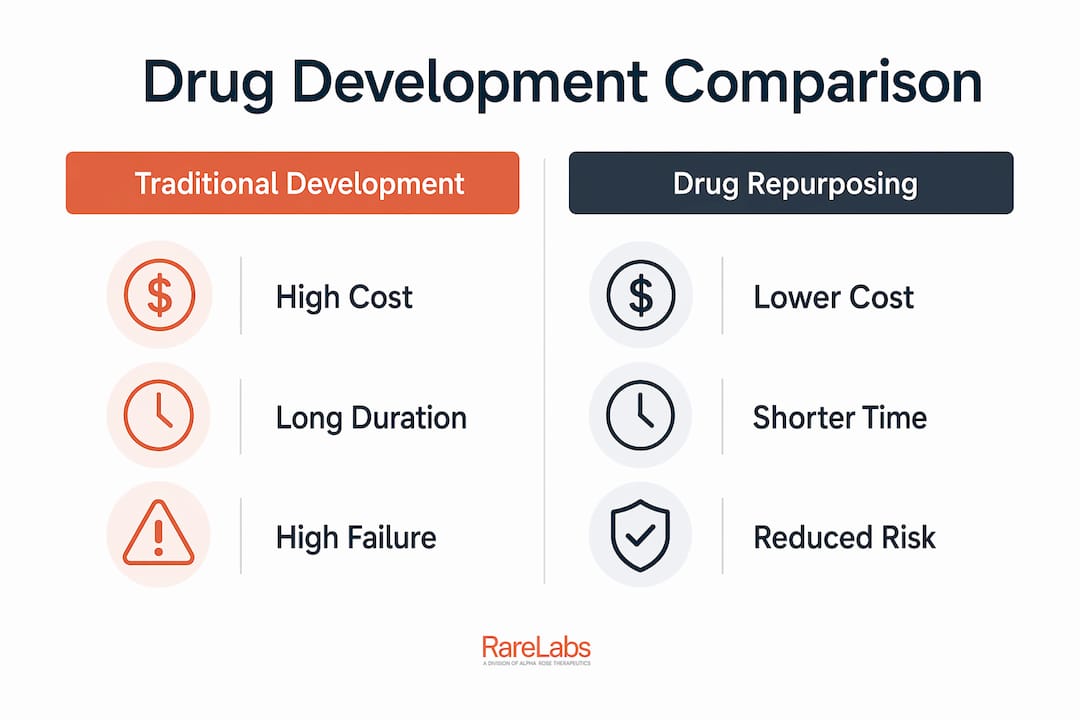
Repurposing changes the risk profile at the starting line. As Dr. Dajiang Liu explains, existing safety profiles allow researchers to skip early-phase safety trials and move directly to evaluating clinical effectiveness in the new disease context. Phase I trials, which exist primarily to establish safe dosing in humans, are largely unnecessary when a drug already has years of human exposure data behind it.
The table below contrasts the two approaches across the metrics that matter most to research teams and funders:
| Metric | Traditional development | Drug repurposing |
|---|---|---|
| Estimated cost | $314 million to $2.8 billion | Substantially lower; early phases skipped |
| Timeline | 10–17 years | Significantly shorter; Phase I often bypassed |
| Failure rate | ~90% | Lower; safety already established |
| Safety data | Must be generated from scratch | Pre-existing from prior approvals |
| Regulatory path | Full NDA/BLA process | Supplemental approval or label update possible |
The FDA and NIH have built infrastructure to support this faster path. CURE ID and related programs facilitate clinical trials for repurposed drugs and help update labeling for new indications, particularly in rare and chronic diseases. A September 2025 federal report mandated joint agency efforts to strengthen repurposed drug utilization across the healthcare system. That regulatory momentum matters because it reduces the uncertainty researchers face when planning a repurposing trial.
The benefits of drug repurposing extend beyond speed. Physicians and patients gain access to treatments with known tolerability, which simplifies informed consent and reduces the risk of unexpected adverse events in early trials. For rare disease therapy discovery, where patient populations are small and trial recruitment is difficult, that predictability is especially valuable.
What are the challenges of drug repurposing?
Repurposing is faster and cheaper than de novo development, but it is not easy. Researchers who enter this field expecting a shortcut often encounter a different set of obstacles than they anticipated.
The most immediate challenge is clinical validation. Repurposed drugs still require rigorous Phase II and Phase III trials to prove efficacy in the new indication. Safety data transfers, but proof of benefit does not. Those trials demand significant time and financial investment, and clinical success is never guaranteed regardless of how strong the mechanistic rationale appears.
The commercial incentive problem is equally serious. Many of the most scientifically promising repurposing candidates are off-patent generic drugs. Their low profit margins make them unattractive to pharmaceutical companies, which means trial funding gaps are common. No company wants to fund a $50 million Phase III trial for a drug that any manufacturer can sell the day after approval.
Additional barriers include:
- Regulatory integration: Clinical guidelines and prescribing practices take years to update after a new indication is approved, limiting real-world adoption.
- Physician awareness: Many clinicians are unaware of repurposed indications, especially for rare diseases, which delays patient access.
- Data quality demands: Mechanism-based repurposing requires high-quality transcriptomic, proteomic, and clinical datasets. Incomplete or inconsistent data produce unreliable candidates.
- Overfitting in computational models: AI predictions trained on biased datasets can generate false positives that waste experimental resources.
Pro Tip: When evaluating a repurposing candidate, prioritize drugs with strong mechanistic overlap and existing human pharmacokinetic data in a dose range relevant to the new indication. Mechanistic fit without pharmacokinetic plausibility rarely survives Phase II.
Public-private partnerships and patient advocacy organizations fill the funding gap that commercial sponsors leave open. For unmet needs in rare disease, these partnerships are often the only viable path to a funded clinical trial.
How is drug repurposing applied in practice today?
The most cited drug repurposing examples demonstrate how broad the strategy's reach actually is. Minoxidil was originally approved as an antihypertensive and is now the standard topical treatment for androgenetic alopecia. Imatinib, developed for chronic myeloid leukemia, was later approved for gastrointestinal stromal tumors and several other cancers. PD-1 inhibitors and TNF inhibitors represent mechanism-based repurposing at scale, with PD-1 inhibitors now approved across multiple cancer types and TNF inhibitors used across a range of autoimmune diseases.
The step-by-step drug repurposing process in active research programs today generally follows this sequence:
- Target and pathway identification: Define the molecular mechanism driving the new disease indication.
- Computational candidate screening: Use AI, molecular docking, or network pharmacology to identify approved drugs that interact with that target.
- Safety and pharmacokinetic review: Confirm that the candidate's known safety profile and dosing range are compatible with the new indication.
- Preclinical validation: Test the candidate in patient-derived cell models or animal models of the new disease.
- Phase II trial design: Design an efficacy trial using the new indication as the primary endpoint, with safety monitoring adapted from existing data.
- Regulatory submission: File for a supplemental approval or new indication label update with the FDA.
Databases and platforms now support each stage of this process. The Drug Repurposing Hub catalogs thousands of approved and investigational compounds with associated target data. CURE ID collects real-world clinical use cases of repurposed drugs submitted by physicians treating infectious and rare diseases. AI platforms in 2026 increasingly use knowledge graphs and large language models to surface repurposing hypotheses from published literature and clinical trial registries at a speed no human team can match.
Drug rescue, the repurposing of drugs that failed in their original indication for a different disease, is a growing subfield. A compound that failed in Alzheimer's disease because it did not slow cognitive decline may still be a potent anti-inflammatory agent useful in a different neurological condition. That reframing of "failure" as "unexplored potential" is one of the most productive mindset shifts in modern drug development. For FDA-approved drugs in repurposing, the regulatory pathway for indication expansion is well established and increasingly used.
Key Takeaways
Drug repurposing is the most time-efficient and cost-effective strategy available for identifying new treatments, particularly for rare diseases where traditional development is economically and logistically impractical.
| Point | Details |
|---|---|
| Core definition | Repurposing uses existing approved drugs for new indications, bypassing early safety trials. |
| Cost and time advantage | Traditional development costs up to $2.8 billion over 10–17 years; repurposing cuts both significantly. |
| Scientific foundation | Mechanism-based hypotheses using transcriptomics and protein networks identify the strongest candidates. |
| Remaining challenges | Phase II/III trials are still required, and off-patent drugs face serious commercial funding gaps. |
| Rare disease relevance | Repurposing is often the only viable development path for ultra-rare and undiagnosed conditions. |
Why I think drug repurposing deserves more strategic investment than it gets
After years of watching drug development programs stall, I find the gap between repurposing's demonstrated value and the resources it receives genuinely frustrating. The science is sound. The regulatory pathway exists. The safety data is already there. Yet the majority of promising repurposing candidates for rare diseases never reach a Phase II trial because no one will fund them.
The computational tools available in 2026 are genuinely impressive. AI-driven candidate identification has compressed what used to take years into months. But I have seen too many research teams treat a strong in silico prediction as near-proof of efficacy. Computational models are hypothesis generators, not clinical validators. Every prediction still needs rigorous experimental and clinical confirmation before anyone should consider it actionable.
The most underrated factor in successful repurposing is stakeholder alignment. Patient advocacy groups, academic researchers, regulatory agencies, and funders need to coordinate from the earliest stages. Programs that treat these groups as separate audiences rather than active partners consistently underperform. The field needs funding models that make off-patent drug trials economically viable, not just scientifically justified.
Researchers entering this field should treat rare disease drug repurposing as a full development program, not a shortcut. The timeline is shorter and the risk profile is better, but the scientific rigor required is identical. That distinction matters enormously for setting realistic expectations with patients, families, and funders.
— John
Hopeatrarelabs and rare disease drug repurposing
Hopeatrarelabs works at the intersection of patient-specific disease modeling and treatment screening, which makes it directly relevant to researchers pursuing repurposing for ultra-rare and undiagnosed conditions.
The platform builds personalized disease models from patients' own cells using iPSC technology and CRISPR gene editing, then runs parallel screens across thousands of FDA-approved drugs to identify candidates with real biological activity in that patient's disease context. That approach converts the abstract promise of repurposing into a concrete, patient-specific answer. Researchers and physicians can access the RareLabs Knowledge platform to support repurposing research and connect with treatment search resources designed specifically for diseases that lack approved therapies. For conditions where traditional development will never happen, this kind of targeted screening is the most direct path to a viable treatment option.
FAQ
What is the definition of drug repurposing?
Drug repurposing is the process of identifying new therapeutic uses for existing approved or investigational drugs beyond their original indications. It reduces development time and cost by leveraging pre-existing safety and pharmacokinetic data.
Is drug repurposing effective?
Drug repurposing is effective when candidates are selected through rigorous mechanism-based hypotheses and validated in clinical trials. Examples like imatinib and PD-1 inhibitors confirm that repurposed drugs can achieve major clinical impact across multiple diseases.
How does drug repurposing work step by step?
The drug repurposing process starts with target identification, followed by computational candidate screening, safety review, preclinical validation in patient-derived models, Phase II/III clinical trials, and finally a regulatory submission for a new indication label.
What are the biggest challenges in drug repurposing?
The two largest barriers are the requirement for Phase II/III efficacy trials despite existing safety data, and the lack of commercial incentives for off-patent drugs that makes large-scale trial funding difficult to secure.
Why is drug repurposing especially important for rare diseases?
Traditional drug development is economically unviable for most rare diseases due to small patient populations and limited market size. Repurposing offers a faster, lower-cost path to identifying treatments for conditions that would otherwise receive no development investment.