

Unmet medical need is defined as a condition or disease for which no adequate therapy exists, or where available treatments fail to address the full burden experienced by patients. For researchers and clinicians working in rare and undiagnosed genetic diseases, this concept is more than a regulatory term. It is the single most reliable signal for where scientific effort and funding will generate the greatest return. The median R&D cost per approved drug stands at $1.1 billion. That figure makes prioritization a scientific and financial imperative, not a preference.
Why focus on unmet medical needs: definitions and measurement challenges
The first obstacle in addressing unmet medical needs is agreeing on what they are. No universally accepted definition of unmet medical need exists across regulatory agencies, payers, or research institutions. That gap creates real downstream consequences: funders apply inconsistent criteria, developers target different endpoints, and patients fall through the cracks between competing frameworks.
Rare and undiagnosed genetic diseases face a compounded version of this problem. Clinical codes capture diagnoses that have names. Patients without a confirmed diagnosis generate no code, and therefore no data trail. The absence of comprehensive disease databases forces researchers to synthesize clinical trial registries, natural history studies, and patient advocacy records manually. That process is slow, inconsistent, and prone to systematic blind spots.

Emerging methods are beginning to close this gap. Large language models trained on biomedical literature can now scan millions of publications to generate quantitative estimates of unmet need across disease categories. PLOS Medicine published a methodology in 2026 demonstrating this approach at scale. The technique does not replace clinical judgment, but it surfaces patterns that no single research team could identify manually.
Patient-reported outcomes add a layer that clinical codes cannot. A patient with a lysosomal storage disorder may have a confirmed diagnosis and a partially effective enzyme replacement therapy, yet still experience severe fatigue, cognitive impairment, and loss of employment. Administrative data records the treatment. It does not record the residual burden. Embedding patient-reported data into unmet need assessments captures functional limitations that surrogate clinical markers miss entirely.
- Relying solely on ICD codes to define unmet need systematically excludes undiagnosed patients, the population with the highest need.
- Treating published prevalence estimates as ground truth ignores the well-documented underdiagnosis rate in rare genetic diseases.
- Ignoring patient-reported burden produces research targets that address biomarkers but not lived experience.
- Failing to update assessments as new therapies enter the market leaves outdated need profiles driving current investment decisions.
Pro Tip: When building an unmet need case for a rare disease grant or regulatory submission, combine natural history study data with patient registry data and at least one validated patient-reported outcome instrument. Relying on a single source type is the most common reason reviewers push back on need severity claims.
How does addressing unmet needs drive innovation and patient outcomes?
Focusing on the hardest problems produces the most durable scientific advances. Ipsen, the specialty biopharma company, has built its oncology and rare disease pipeline explicitly around conditions where unmet need is greatest. Their rationale is direct: working in high-need areas forces the development of novel scientific platforms that generate value far beyond any single therapy.
This dynamic plays out consistently in rare disease drug development. When a team builds an induced pluripotent stem cell model for an ultra-rare genetic condition, the platform they create, the assay protocols, the CRISPR editing workflows, the treatment screening infrastructure, becomes reusable across related conditions. The strategic value of novel platforms developed in rare disease programs extends well beyond the original target.
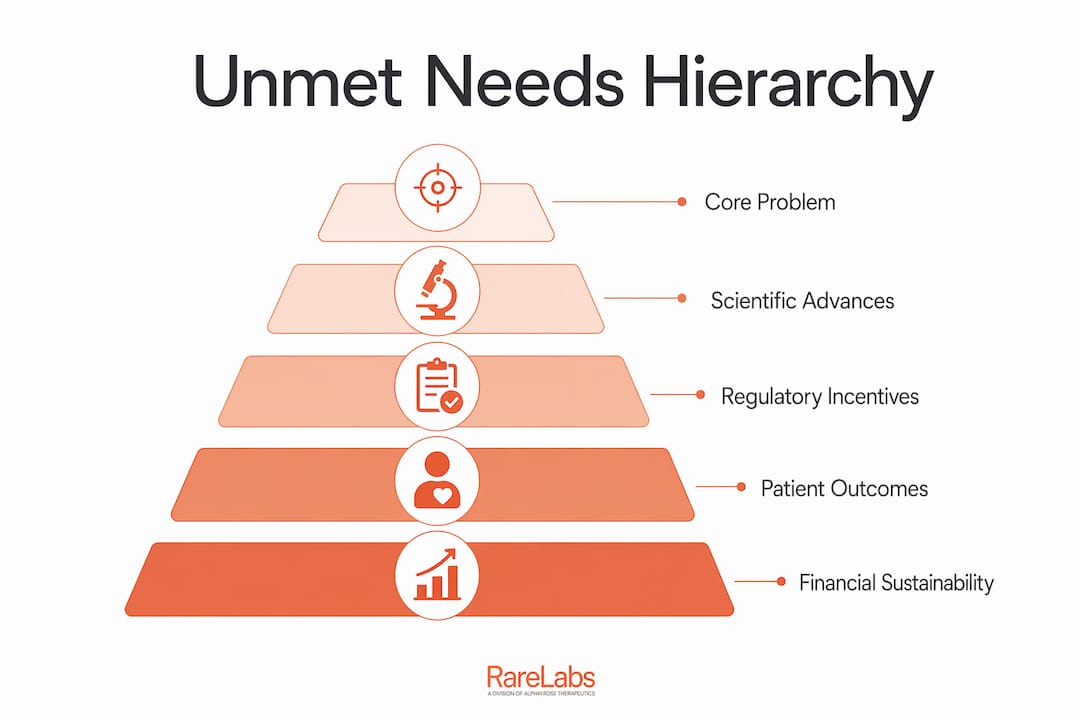
Regulatory agencies recognize this logic and have built incentive structures around it. The FDA's Breakthrough Therapy designation, Orphan Drug designation, and Accelerated Approval pathway all exist to reduce the time and cost burden for programs targeting high unmet need. These pathways are not charity. They reflect the agency's assessment that the public health benefit of faster access outweighs the risk of approving on earlier evidence.
The financial case reinforces the scientific one. With drug development costs at $1.1 billion per approved product, programs that cannot demonstrate clear unmet need face higher regulatory risk, lower probability of market access, and weaker reimbursement arguments. Unmet need is not just a moral frame. It is a risk management tool.
The patient-level evidence is equally clear. Unmet community care needs correlate significantly with lower life satisfaction and reduced self-rated health. That correlation is not incidental. It means that leaving needs unaddressed produces measurable, compounding harm over time.
Consider the following sequence that characterizes high-impact rare disease programs:
- Quantify the burden. Use patient registries, natural history studies, and validated outcome instruments to establish the full disease burden, not just the clinical endpoints.
- Map the treatment gap. Identify what existing therapies address and, more critically, what they do not address in terms of function, quality of life, and disease progression.
- Align the research target. Design the program around the gap, not around the most tractable biology.
- Engage regulatory early. Use the quantified unmet need assessment to open dialogue with the FDA or EMA before the IND stage.
- Build in patient-reported endpoints. Ensure the trial captures outcomes that matter to patients, not only outcomes that are easy to measure.
"Tackling the hardest problems, those with the highest unmet need, is where science advances most powerfully and where patients gain the most." — Ipsen leadership on rare disease strategy
Traditional vs. patient-centered approaches to closing care gaps
The importance of addressing medical gaps looks different depending on who defines the gap. Traditional clinical approaches rely on physician assessment, administrative claims, and population-level epidemiology. These methods are reproducible and scalable, but they systematically undercount patients who are undiagnosed, underinsured, or geographically isolated from specialist care.
Patient-centered approaches use real-world evidence, patient-reported outcomes, and direct engagement to surface needs that administrative data cannot see. The difference is not merely philosophical. Same-call appointment booking achieves 2–3 times higher patient engagement compared to traditional callback workflows. That gap in engagement translates directly into gaps in care data, which then distorts the unmet need picture that researchers and payers rely on.
For rare and undiagnosed genetic disease research, the implications are significant. A patient who cannot get a specialist appointment generates no specialist data. A patient who cannot afford genetic testing generates no genomic data. The research record reflects access, not prevalence.
| Approach | Primary Data Source | Strengths | Limitations |
|---|---|---|---|
| Traditional clinical | ICD codes, claims data | Scalable, reproducible | Misses undiagnosed patients |
| Epidemiological modeling | Population surveys, registries | Captures broad trends | Underestimates rare disease burden |
| Patient-reported outcomes | Surveys, interviews, diaries | Captures functional burden | Requires validated instruments |
| Real-world evidence | EHR data, wearables, apps | Longitudinal, naturalistic | Data quality varies widely |
| AI-assisted synthesis | Published literature, registries | Broad coverage, fast | Dependent on source data quality |
The most effective programs for rare disease research challenges combine at least three of these approaches. No single method captures the full picture. The combination of administrative data, patient-reported outcomes, and AI-assisted literature synthesis produces the most defensible unmet need assessment for regulatory and funding purposes.
How do unmet needs shape health policy and funding strategies?
Unmet medical needs drive health policy in ways that directly affect research funding and program viability. Accelerated approval pathways at the FDA and EMA are explicitly conditioned on demonstrated unmet need. Programs that quantify need rigorously gain access to faster review timelines, reduced trial size requirements, and priority review vouchers. These are not minor administrative benefits. They can reduce time to market by years and cut development costs substantially.
The insurance benefit design challenge is equally consequential. The Milbank Memorial Fund's 2026 analysis found that effective coverage for high-need populations requires expanding outcome measures beyond traditional cost metrics. Payers who evaluate coverage decisions only on near-term cost miss the long-term burden of untreated rare disease, including hospitalizations, caregiver costs, and productivity loss.
Transparency in benefit design matters for accountability. When payers make coverage decisions without publishing the criteria they use, researchers and advocates cannot identify where the gaps are or make the case for change. Public accountability in benefit design is a prerequisite for systematic improvement.
- Align grant proposals with payer outcome frameworks. Funders increasingly require applicants to demonstrate how their research addresses measurable health outcomes, not just biological endpoints.
- Use health technology assessment language. Agencies like NICE in the UK and ICER in the US publish explicit frameworks for evaluating unmet need. Researchers who write to these frameworks get faster traction with payers and policy makers.
- Document the cost of inaction. The impact of ignoring medical needs is quantifiable. Use it. Payers respond to total cost of illness arguments when they are backed by longitudinal data.
- Engage patient advocacy organizations early. Groups like the National Organization for Rare Disorders (NORD) and Global Genes have established relationships with policy makers. Researchers who partner with them gain credibility and access that independent submissions rarely achieve.
Pro Tip: When submitting a research proposal that targets a rare disease with no approved therapy, include a one-page unmet need summary written specifically for a non-clinical audience. Program officers and payers often make preliminary decisions before the scientific review. That summary is what they read first.
Key takeaways
Focusing on unmet medical needs is the most direct path to generating research that matters, securing funding, and delivering therapies to patients who have no other options.
| Point | Details |
|---|---|
| No standard definition exists | Researchers must build their own unmet need case using multiple data sources and validated instruments. |
| Financial stakes are high | At $1.1 billion per approved drug, programs without clear unmet need face higher regulatory and market access risk. |
| Patient data is irreplaceable | Administrative codes miss undiagnosed patients; patient-reported outcomes capture the functional burden that drives real-world impact. |
| Policy alignment accelerates access | Regulatory pathways like FDA Breakthrough Therapy designation reward rigorously documented unmet need with faster timelines. |
| Ignoring need compounds harm | Unmet community care needs correlate directly with lower life satisfaction and worse self-rated health over time. |
The hardest problems are the right problems
I have spent years reviewing research proposals and watching programs fail not because the science was weak, but because the team could not articulate who was suffering, how much, and why nothing else was working. That is an unmet need argument. And most researchers underestimate how much it matters.
The instinct in academic science is to chase tractable problems. Tractable problems generate publications. Tractable problems have existing models, established assays, and reviewers who understand the biology. Rare and undiagnosed genetic diseases are the opposite of tractable. They are poorly characterized, sparsely populated in registries, and often invisible to the clinical infrastructure that generates research data.
That is exactly why they deserve priority. When you build a patient-specific iPSC model for a condition affecting 200 people worldwide, you are not just working on that condition. You are building a platform, a methodology, a proof of concept that the field did not have before. The long-term strategic value of that work compounds in ways that incremental improvements to well-served conditions never do.
The collaboration piece is non-negotiable. Researchers who define unmet need without patients in the room consistently miss the outcomes that matter most. Clinicians who define it without researchers miss the biological mechanisms driving the burden. Advocates who define it without payers miss the coverage barriers that prevent patients from accessing therapies that already exist. The most accurate unmet need assessments I have seen come from teams that forced all three perspectives into the same room before writing a single protocol.
My honest recommendation: treat the unmet need assessment as a scientific deliverable, not a grant-writing formality. Quantify it. Validate it with patients. Update it as the field moves. Use it to guide every downstream decision from trial design to regulatory strategy to publication targets. That discipline is what separates programs that generate real impact from programs that generate papers.
— John
How Hopeatrarelabs supports unmet needs research
Hopeatrarelabs exists precisely because the gap between a rare disease diagnosis and an effective therapy is too wide and too slow to close through conventional means. The team builds patient-specific disease models using iPSCs and CRISPR gene editing, then runs parallel treatment screens across thousands of FDA-approved drugs, custom antisense oligonucleotides, and gene therapy candidates.
For researchers and advocates working on conditions with no approved therapy, the RareLabs Knowledge platform provides a centralized resource for rare disease research data and treatment options. Hopeatrarelabs also publishes detailed guidance on finding rare disease treatments and personalized therapy pathways for conditions that lack standard-of-care options. If you are building an unmet need case or searching for treatment candidates for a specific genetic condition, the Knowledge platform is the right starting point.
FAQ
What is an unmet medical need in rare disease research?
An unmet medical need is a condition for which no adequate therapy exists or where current treatments fail to address the full patient burden. In rare and undiagnosed genetic diseases, this typically means no FDA-approved treatment and no validated disease model for drug screening.
Why does measuring unmet need matter for regulatory strategy?
Quantitative unmet need assessments directly inform regulatory strategy by supporting applications for Breakthrough Therapy designation, Orphan Drug status, and Accelerated Approval. Programs with rigorous need documentation gain faster review timelines and reduced evidence thresholds.
How do patient-reported outcomes improve unmet need assessments?
Patient-reported outcomes capture functional limitations, quality of life deficits, and daily burden that clinical codes and biomarkers cannot measure. Embedding these instruments into unmet need assessments produces a more complete and defensible picture of the gap that research must close.
What is the impact of ignoring unmet medical needs?
Unmet care needs correlate directly with lower life satisfaction and reduced self-rated health. At the system level, ignoring unmet needs drives avoidable hospitalizations, caregiver burden, and long-term productivity loss that far exceed the cost of early intervention.
How can researchers align their work with payer priorities on unmet needs?
Researchers should frame proposals using health technology assessment frameworks from agencies like ICER and document the total cost of illness, not just clinical endpoints. Partnering with patient advocacy organizations like NORD strengthens both the evidence base and the policy credibility of the unmet need argument.