

Thousands of families go through months or even years of testing, specialist visits, and anxious waiting, only to hear the same words: "We still don't know." Despite remarkable advances in genetic sequencing, undiagnosed genetic diseases still affect a significant portion of people whose symptoms strongly suggest a genetic cause. This guide walks through what it means to have an undiagnosed genetic disease, why diagnosis can be so difficult, what the evaluation process looks like in practice, and what real options remain when testing falls short. If you're a family in that position, you are not alone, and you are not out of options.
Table of Contents
- What does 'undiagnosed genetic disease' mean?
- Why can a diagnosis remain elusive?
- How are undiagnosed genetic diseases evaluated?
- What happens after nondiagnostic results?
- Treatment and care: Navigating uncertainty
- A new perspective: Why 'undiagnosed' is not a dead end
- Connecting with research, knowledge, and support
- Frequently asked questions
Key Takeaways
| Point | Details |
|---|---|
| Definition clarified | Undiagnosed genetic diseases mean symptoms suggest a genetic cause but no specific disorder is found. |
| Diagnosis is evolving | Even with advanced methods, not all genetic diseases are diagnosed, and answers often come over time as science advances. |
| Evaluation matters | Structured, multidisciplinary approaches and genome-scale sequencing improve chances for diagnosis. |
| Options exist after testing | A nondiagnostic result is not the end—reevaluation and new research can open up possibilities. |
| Treatment pathways | Care can continue with symptom management and support, even if a diagnosis remains uncertain. |
What does 'undiagnosed genetic disease' mean?
When a doctor says your child or loved one may have a genetic condition, but no specific disorder has been confirmed, it can feel like you're in a medical gray zone. The term "undiagnosed genetic disease" has a specific meaning, and understanding it helps you navigate what comes next.
"Undiagnosed rare diseases (URDs) include conditions with a well-characterized phenotype but unclear pathogenesis, including cases with unknown molecular basis; absence of etiologic diagnosis makes treatment harder."
That quote captures something important. A person can have a clearly recognizable pattern of symptoms (called a phenotype) and still have no confirmed genetic diagnosis. The "why" behind the symptoms remains unknown.
It's also worth understanding the difference between a few terms you may encounter:
- Undiagnosed: Symptoms are present and likely genetic, but no specific disorder has been identified after testing.
- Unclassified: A condition exists, but it doesn't fit neatly into any known disease category.
- Variant of uncertain significance (VUS): Genetic testing found a change in DNA, but current science can't confirm whether that change is the cause.
These distinctions matter. An "undiagnosed" status is not the same as saying nothing is wrong. It means the available tools and knowledge haven't yet produced a complete answer. For a deeper look at what leads to these labels, the genetic diagnosis guide at the RareLabs blog offers a thorough breakdown of how the diagnostic process works.
Common scenarios leading to an undiagnosed status include a child with developmental delays and unusual physical features, an adult with a progressive neurological condition, or a newborn with abnormal screening results that don't match a known syndrome. In all these cases, care and planning become harder when the underlying cause is unclear. Families face uncertainty about prognosis, recurrence risk, and which specialists to involve.
Why can a diagnosis remain elusive?
Understanding the definition is only the first step. So why do so many cases remain without a precise diagnosis, even when families have done everything right?

The short answer is that human genetics is extraordinarily complex, and our knowledge is still evolving. Here are the key reasons:
| Reason | What it means in practice |
|---|---|
| Novel gene variants | Many disease-causing mutations haven't been documented before |
| Incomplete databases | Reference databases used to interpret results are still growing |
| Overlapping symptoms | One phenotype can match many disorders, making interpretation hard |
| Complex inheritance | Some conditions require multiple gene changes to cause disease |
| Technology limits | Even whole genome sequencing misses some types of changes |
| Limited research | Ultra-rare conditions lack published data for comparison |
"Some cases remain unsolved even in expert research networks; unsolved cases are re-evaluated as knowledge improves."
This point deserves emphasis. A case that has no answer today may have one in two years, simply because a new gene was discovered or a database was updated. Science moves, and so does the likelihood of a diagnosis.
Families often encounter a situation where a VUS is found but can't be confirmed. Genetic testing labs compare findings against large databases of known variants. If your child has a mutation that's never been reported or has only been seen in a handful of cases worldwide, there may not be enough data to confirm it as pathogenic (disease-causing). The more we learn, the more these uncertain findings get resolved.
Symptom overlap adds another layer of challenge. A child with hypotonia (low muscle tone), intellectual disability, and seizures could fit dozens of known syndromes. Without a clear molecular cause, distinguishing between them can be nearly impossible.
Pro Tip: Ask your geneticist to schedule a reanalysis of your genomic data at least every 12 to 18 months. New data is added to genetic databases regularly, and a variant that was uncertain last year may have been reclassified.
For families who want to understand these roadblocks more deeply, the post on challenges in rare disease research explains the structural and scientific barriers that make rare diagnosis so difficult.
How are undiagnosed genetic diseases evaluated?
Given these challenges, what practical steps can families and clinicians take toward a diagnosis? The modern evaluation process is multi-layered, and the order of testing matters.
- Clinical review: A medical geneticist reviews symptoms, medical history, family history, and prior test results to look for patterns that point to known conditions.
- Genetic counseling: A certified genetic counselor explains your options, the implications of testing, and what results might and might not tell you.
- Chromosomal microarray: This test looks for extra or missing segments of chromosomes that standard karyotyping might miss.
- Gene panels: When a condition category is suspected (e.g., epilepsy or metabolic disease), targeted panels test groups of relevant genes at once.
- Exome sequencing: Tests the protein-coding portions of all genes, identifying variants in regions most likely to cause disease.
- Genome sequencing: Tests all DNA, including non-coding regions, offering the broadest possible view.
- Data reanalysis: Previously collected genomic data is reinterpreted using newer knowledge and updated databases.
The NIH Undiagnosed Diseases Network (UDN) identifies most diagnoses through genome-scale sequencing, though other methods still add significant value when sequencing alone is not diagnostic. This tells us that no single test should be considered a final answer.
| Evaluation method | Genes covered | Best suited for |
|---|---|---|
| Chromosomal microarray | Large deletions/duplications | Intellectual disability, autism |
| Gene panel | Targeted list | Suspected disease category |
| Exome sequencing | ~20,000 genes | Broad, unguided search |
| Genome sequencing | All DNA | Unsolved exome cases |
| RNA sequencing | Gene expression | Variants affecting gene activity |
| Metabolomics | Metabolic function | Enzyme or pathway defects |
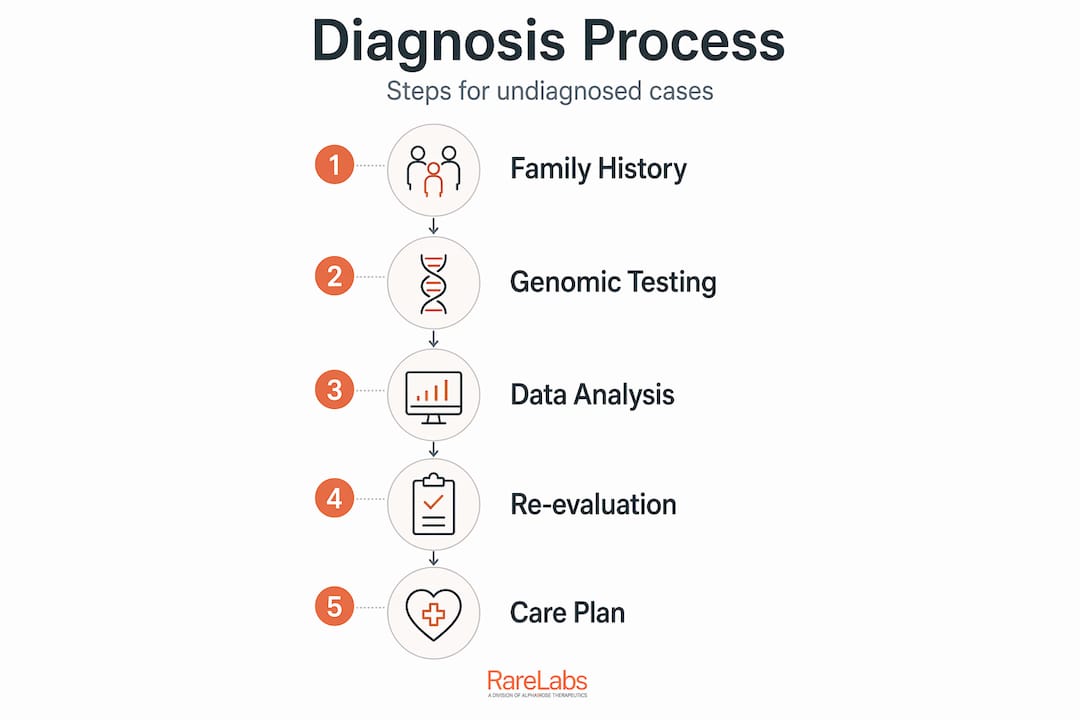
Structured national programs consistently outperform fragmented individual clinical efforts. In Italy, a national genomic program achieved a 49% diagnosis rate for pediatric rare disease cases. That number is meaningful. It shows that organized, systematic evaluation done in dedicated centers makes a real difference.
Pro Tip: If you have only had a gene panel or chromosomal microarray so far, ask specifically about trio exome or genome sequencing. Testing both parents alongside the patient (a "trio") significantly improves the ability to interpret results.
For a step-by-step breakdown of what to expect throughout this process, the post on getting rare disease answers walks families through the most efficient pathways in detail.
What happens after nondiagnostic results?
But what do families do if the best available tests still leave them without an answer? It's important to know that a nondiagnostic result is not a closed door.
Nondiagnostic genetic testing does not necessarily exclude a genetic disease, and overall diagnostic success for comprehensive genetic evaluation reaches only about 50%. That means roughly half of families who complete full workups still don't get a definitive answer from their first round of testing.
Here's what remains available to you:
- Request data reanalysis. Genomic data you already have can be reinterpreted as science advances, often without new testing.
- Submit to a research program. Programs like the NIH UDN accept unsolved cases and apply cutting-edge tools beyond routine clinical care.
- Pursue functional testing. RNA sequencing, proteomics, and metabolomics can uncover disease mechanisms that DNA sequencing alone misses.
- Enroll in natural history studies. These studies track patients over time and can contribute to future diagnostic criteria.
- Seek second opinions. A second geneticist may notice patterns the first missed, especially at a center specializing in rare diseases.
- Connect with patient registries. Registries help researchers find clusters of patients with similar undiagnosed presentations, which can accelerate discovery.
📊 About 50% of individuals who undergo comprehensive genetic evaluation still receive nondiagnostic results.
That statistic should feel both sobering and motivating. It means you're in good company, and it also means there is an entire scientific community working on the unsolved half.
Pro Tip: When submitting for reanalysis or a research program, bring a complete summary of all prior testing. Many programs can act faster and more effectively when they don't need to repeat work that's already been done.
Understanding how genetic disease modeling works can also open new doors. When a candidate gene is identified but not confirmed, building a lab model of that gene's behavior in patient-derived cells can provide functional evidence that strengthens or refutes the diagnosis.
Treatment and care: Navigating uncertainty
Knowing how to move forward requires understanding both the limits and the opportunities for care when a genetic disease is strongly suspected but not yet confirmed.
One of the most important things to know is that treatment does not always require a precise diagnosis. Care falls into two broad categories:
- Targeted therapy: A treatment designed for a specific genetic defect. This is ideal when a diagnosis is confirmed and a treatment exists for that disease.
- Symptomatic management: Treatments that address specific symptoms or functional problems, regardless of the underlying cause.
When an etiologic diagnosis is lacking, clinicians shift focus to symptomatic management. That might include seizure control medications, physical therapy for motor delays, feeding support for swallowing difficulties, or behavioral interventions for developmental challenges.
"Treatment strategy often depends on whether an etiologic diagnosis is achieved; without it, clinicians may need to rely on symptomatic management."
This doesn't mean treatment is substandard. Many families achieve significant improvements in quality of life and function through symptom-focused care. The goal shifts from curing a specific defect to maximizing daily function and wellbeing.
The care team matters enormously. Coordinating across neurology, genetics, therapy services, and subspecialties ensures nothing is missed. Key components of strong undiagnosed care include:
- Regular developmental assessments to track progress and adjust therapies
- Nutritional evaluation and support, especially for metabolic concerns
- Mental health resources for caregivers and patients
- Family support groups and disease-specific foundations
- Consistent communication between all providers
Advocacy also plays a real role. Families who stay engaged with research, attend relevant conferences, and connect with condition-specific communities often learn about emerging options before they reach standard clinical practice. The post on therapeutic options for rare diseases outlines what types of treatments are being pursued and how families can engage with the pipeline.
A new perspective: Why 'undiagnosed' is not a dead end
Conventional wisdom might lead you to believe that without a diagnosis, you're stuck waiting indefinitely. That framing is outdated, and we'd argue it's harmful.
The undiagnosed space has changed dramatically. What used to be a medical dead end is increasingly an active research frontier. The difference between families who find answers and those who don't often comes down to persistence, connection, and timing, not luck. Families who engage with research networks, share their data, and stay in contact with their genetic teams are far more likely to receive updated information when new discoveries emerge.
Re-evaluation is underused. Genomic data sits in clinical files for years without being reanalyzed. Simply requesting that your geneticist submit prior data for review, or applying to a research program, can restart a stalled diagnostic journey without any new invasive testing.
There's also something powerful about the community of undiagnosed patients. When families connect through registries and foundations, researchers begin to recognize shared patterns among cases that previously seemed isolated. Some of today's newly named rare diseases began as collections of "undiagnosed" cases that nobody had thought to link together.
We've seen, again and again, that the families who stay informed and overcome rare disease challenges are the ones who eventually get answers or find meaningful care options. This isn't about false hope. It's about understanding that the diagnostic and treatment landscape is genuinely changing, and engagement keeps you positioned to benefit from that change.
Connecting with research, knowledge, and support
For practical next steps and ongoing support, here are resources designed to empower patients and families facing undiagnosed genetic diseases.
Finding reliable information in the rare disease space is harder than it should be. For families navigating undiagnosed conditions, having access to vetted research, current treatment pathways, and specialist communities can make a real difference in both clinical outcomes and daily life.
The RareLabs Knowledge Center brings together expert-reviewed content on rare disease science, treatment discovery, and the diagnostic journey. Whether you're just starting out or have spent years searching, it's a resource built specifically for families like yours. And if you're ready to explore whether personalized disease modeling and treatment screening might be an option, the RareLabs treatment search platform can help you understand what a patient-specific research approach might look like for your situation.
Frequently asked questions
Can you have a genetic disease even if testing is negative?
Yes. Nondiagnostic results do not exclude a genetic disease, and the underlying cause may be identified through reanalysis, functional testing, or future research advances.
How often are undiagnosed genetic diseases eventually solved?
Rates vary significantly, but structured programs achieve around 49% diagnosis rates for pediatric cases, and that number continues to improve as databases grow and new genes are characterized.
What can I do if there is no clear diagnosis?
Work with a multidisciplinary team, pursue data reanalysis, consider enrollment in research studies, and revisit testing regularly. Periodic reassessment is a recognized part of best-practice care for undiagnosed patients.
Is treatment possible without a confirmed diagnosis?
Yes. Symptomatic management remains available and can meaningfully improve quality of life, even when the precise genetic cause has not been confirmed.
Why is my child's test result called 'variant of uncertain significance'?
Some genetic findings remain inconclusive because the variant is too new or too rare to have been studied adequately. As more patients are identified and more data is collected, many VUS findings are eventually reclassified as pathogenic or benign.