

Most people assume genetic diseases are rare enough that they'll never be personally affected. That assumption is wrong. There are over 7,000 known genetic diseases, the vast majority considered rare, with each affecting fewer than 1 in 2,000 people. Yet collectively, these conditions touch the lives of hundreds of millions of people worldwide. If you or someone you love has received a puzzling diagnosis, or no diagnosis at all, you're far from alone. The good news is that scientific progress is accelerating faster than most families realize, and understanding the basics of how genetic diseases work is the first step toward finding real answers.
Table of Contents
- What is a genetic disease?
- How are genetic diseases inherited?
- Not just simple inheritance: Nuances in genetic disease
- Hope on the horizon: Recent advances in genetic disease treatment
- A new era for patients: What families need to know
- How RareLabs helps you move forward
- Frequently asked questions
Key Takeaways
| Point | Details |
|---|---|
| Genetic disease basics | Genetic diseases result from mutations in genes, with over 7,000 identified types. |
| Inheritance patterns matter | Understanding dominant, recessive, and X-linked inheritance helps explain family risk. |
| Symptoms are variable | The same mutation can cause different symptoms or no disease due to genetic complexity. |
| Treatments are advancing | Personalized therapies like CRISPR and gene editing offer new hope for rare diseases. |
| Support and resources | Accessing reliable information and specialized care empowers families and improves outcomes. |
What is a genetic disease?
Think of your DNA as a massive instruction manual, written in a language made up of just four letters. Genes are individual chapters within that manual, each one telling your body how to build a specific protein. Proteins do almost everything: they form tissues, regulate chemical reactions, carry oxygen, and fight infection. When a gene contains a mutation, meaning an error or change in its sequence, the resulting protein can be missing, misshapen, or totally absent.
That disruption is at the heart of every genetic disease. Some mutations are inherited from one or both parents. Others arise spontaneously, called de novo mutations, with no family history at all. This is one of the most important points for families to understand: the absence of a family history does not rule out a genetic cause.
Here are some key facts about genetic diseases that challenge common assumptions:
- Over 7,000 recognized genetic diseases exist, approximately 80% of which have a genetic origin, and most are considered rare
- A disease qualifies as rare in the United States when it affects fewer than 200,000 Americans
- Many people spend years undiagnosed, cycling through specialist after specialist before a genetic cause is identified
- Genetic diseases affect people of every ethnicity, age, and background, not just those with obvious family patterns
"Rare diseases are individually uncommon but collectively they affect millions. No family is immune, and no physician can know them all by memory."
Exploring a rare disease overview can help families orient themselves when they first enter this landscape. Understanding the category your condition falls into shapes every decision that follows, from which specialists to see to which research programs may be relevant to your situation.
How are genetic diseases inherited?
Now that you know what a genetic disease is, understanding how these conditions are inherited is just as crucial, especially for families weighing reproductive decisions, deciding whether siblings should be tested, or trying to interpret a genetic counselor's report.

Most single-gene disorders follow predictable inheritance patterns. These core patterns are autosomal dominant, autosomal recessive, and X-linked, and each carries different implications for risk within a family.
| Inheritance pattern | How it works | Example | Risk to children |
|---|---|---|---|
| Autosomal dominant | One mutated copy causes disease | Huntington's disease | 50% per child |
| Autosomal recessive | Two mutated copies needed | Cystic fibrosis | 25% if both parents are carriers |
| X-linked recessive | Mutation on X chromosome | Hemophilia A | Affects males more often; females usually carriers |
| X-linked dominant | One copy on X causes disease | Rett syndrome | Variable, often affects females |
| De novo | New mutation, no family history | Many rare syndromes | Very low recurrence risk |
Here is what this means practically for families:
- If a parent has an autosomal dominant condition, each child has a 50% chance of inheriting it, regardless of sex
- Autosomal recessive diseases can appear in children with no affected parent, making carrier testing critically valuable before or during pregnancy
- X-linked conditions explain why some diseases appear almost exclusively in boys, even though mothers carry the mutation without symptoms
- De novo mutations are increasingly identified through whole-exome or whole-genome sequencing, which is now more accessible than ever
Understanding rare disease inheritance patterns also helps families ask better questions when meeting with a geneticist. Going in prepared with a three-generation family history, sometimes called a pedigree, significantly improves the quality of any genetic evaluation.
Pro Tip: Before your first genetics appointment, write down every family member's health issues, including those that seem unrelated, along with their age of onset. Patterns that seem coincidental to families are often meaningful to geneticists.
Not just simple inheritance: Nuances in genetic disease
But it's not always straightforward. Genetic diseases can be unpredictable, with nuances that make each case unique, even within the same family. This is where many families get confused, and honestly, where even experienced clinicians can be caught off guard.
Consider a family where a parent carries a well-documented disease-causing mutation but has no symptoms, while their child is severely affected. Or two siblings with the same mutation who experience completely different levels of illness. These aren't errors. They reflect real, documented complexities of how genes behave.
The key concepts to know are:
- Incomplete penetrance: Not everyone who carries a disease-causing mutation will actually develop the disease. Some people carry mutations their whole lives without symptoms.
- Variable expressivity: The same mutation can cause mild symptoms in one person and severe disease in another. This affects how families understand their own risk.
- Anticipation: In some conditions, the mutation becomes more severe or appears earlier in each successive generation. Myotonic dystrophy is a classic example.
- Pleiotropy: A single gene mutation can affect multiple organ systems simultaneously. One mutation, many problems across the body.
| Concept | What it means | Example |
|---|---|---|
| Incomplete penetrance | Carrier may never develop disease | BRCA1 gene and breast cancer risk |
| Variable expressivity | Same mutation, different severity | Neurofibromatosis type 1 |
| Anticipation | Worsens across generations | Myotonic dystrophy, Fragile X |
| Pleiotropy | One gene, many organ effects | Marfan syndrome |
These inheritance nuances are exactly why genetic counseling is not optional. It's essential. A counselor doesn't just interpret test results. They help families understand what those results do and do not predict about future health, and they explore the emotional and practical weight of that knowledge.
Pro Tip: If a genetic test comes back "variant of uncertain significance," that is not a dead end. Push to have the variant reclassified over time, as more data accumulates. Many variants once labeled uncertain are later confirmed as disease-causing or benign.
A critical step that many families delay is finding a diagnosis through the right channels. Whole-genome sequencing, functional studies, and specialist referrals at academic centers all increase the odds of getting real answers faster.
Hope on the horizon: Recent advances in genetic disease treatment
Given these complexities, what hope is there for effective treatment or even a cure for rare genetic diseases? The answer is truly inspiring, especially for families who have been told there is nothing that can be done.
The treatment landscape has shifted dramatically in the past decade. Here is a quick look at how far things have come:
- Sickle cell disease (SCD): Once a condition that cut life expectancy to childhood, NIH-funded research has extended life expectancy for people with SCD in the United States to their 40s and 50s. More than 100,000 Americans live with SCD today, and gene therapy options are now available.
- Cystic fibrosis (CF): Life expectancy has jumped from the teen years to middle age for many patients. Modulator drugs that correct the underlying protein defect have transformed care for more than 35,000 Americans living with CF.
- Neurofibromatosis type 1 (NF1): A targeted drug has been shown to shrink tumors by 70%, a result that would have seemed impossible just fifteen years ago.
- CRISPR base editing for ultra-rare diseases: In 2025, an infant with CPS1 deficiency, a life-threatening metabolic disease so rare that a traditional clinical trial was not feasible, received a custom base-editing therapy designed specifically for their mutation. The treatment allowed the child to tolerate normal protein intake. This was a world first.
"The 2025 CPS1 case demonstrated that personalized gene editing therapies can be designed, manufactured, and administered to a single patient in a matter of months, not years."
The FDA's plausible mechanism pathway has become a critical tool in this space, allowing custom therapies to reach patients with ultra-rare diseases without requiring the large clinical trials that simply aren't possible when only a handful of patients exist worldwide.
Families exploring emerging treatment options today have access to a landscape that looks nothing like it did even five years ago. iPSC-based disease modeling, antisense oligonucleotides (ASOs), and gene therapy platforms can now be tailored to a single patient's specific mutation, offering a fundamentally different kind of hope than a one-size-fits-all drug.
A new era for patients: What families need to know
Here is the perspective that doesn't always make it into clinical conversations: the single biggest barrier between a rare disease patient and a potential therapy today is not science. It is access to information and the confidence to push for it.
For decades, families facing a rare or undiagnosed genetic disease were essentially told to go home and manage symptoms. Research was too slow, drug development was financially unattractive for small patient populations, and personalized treatment was science fiction. That era is ending.
Rapid genome sequencing and custom therapies like base editing now offer a legitimate path for patients who have no approved treatment options. The FDA's willingness to allow treatment under the plausible mechanism pathway, where full trials aren't feasible, represents a seismic shift in what's possible for individual patients.
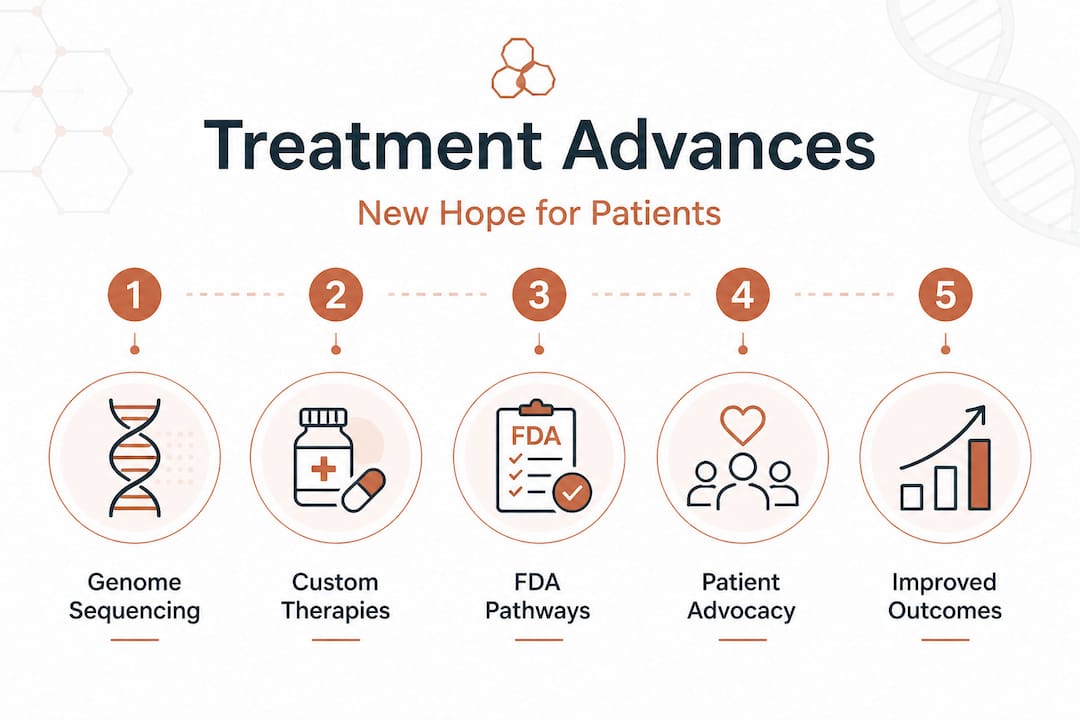
What this means for families is practical and urgent. First, don't accept a diagnosis of "no known treatment" as a permanent verdict. The research landscape changes every year, sometimes every few months. Second, seek out academic medical centers and rare disease specialists who are plugged into current research. General practitioners and even most specialists simply don't have the bandwidth to track advances in diseases they see once a decade.
Third, genetic counselors are genuinely your allies in this process. They don't just interpret test results. They help you understand your options, navigate the emotional complexity of genetic information, and connect you with the right researchers and clinicians. Finding a genetic counselor with experience in rare disease is worth the effort.
Finally, patient advocacy organizations have driven the funding and attention behind many of the breakthroughs described above. Connecting with a disease-specific foundation often puts families in touch with researchers who are actively looking for patients to include in studies.
The path toward answers when finding rare disease treatments is rarely straight. But it is more navigable than it has ever been, and more families are reaching meaningful answers than at any point in history.
How RareLabs helps you move forward
If you or your family are facing the challenges of a rare or undiagnosed genetic disease, there are supportive resources and expert guidance available for your next steps.
RareLabs was built specifically for families in exactly this situation. The science is moving fast, but knowing where to look and how to ask the right questions makes all the difference.
At RareLabs, we build patient-specific disease models using your loved one's own cells, screen thousands of FDA-approved drugs and experimental compounds, and evaluate gene therapy and ASO options in parallel. Our rare disease knowledge center is a strong starting point for understanding your condition and the current state of research. When you're ready to explore what personalized modeling might reveal for your specific case, our personalized treatment search platform is designed to give families actionable science, not just answers in a waiting room.
Frequently asked questions
Can a person have a genetic mutation but not develop a disease?
Yes. Due to incomplete penetrance, some people who carry a confirmed disease-causing gene mutation never develop any symptoms, which is why genetic counseling is essential when interpreting test results.
What are some examples of treatable genetic diseases?
Sickle cell disease, cystic fibrosis, and neurofibromatosis type 1 have all seen major treatment advances, with life expectancy improvements extending from childhood into middle age and targeted therapies now available for each condition.
How are new genetic therapies approved for patients with rare diseases?
The FDA can authorize use of custom treatments for ultra-rare cases through the plausible mechanism pathway, which allowed a custom base-editing therapy to reach an infant with CPS1 deficiency even without a traditional clinical trial.
What should families ask about genetic testing and counseling?
Ask specifically which testing method is being used and whether whole-genome sequencing has been considered, what a positive or uncertain result would mean for other family members, and how penetrance factors might affect individual risk predictions within your family.