
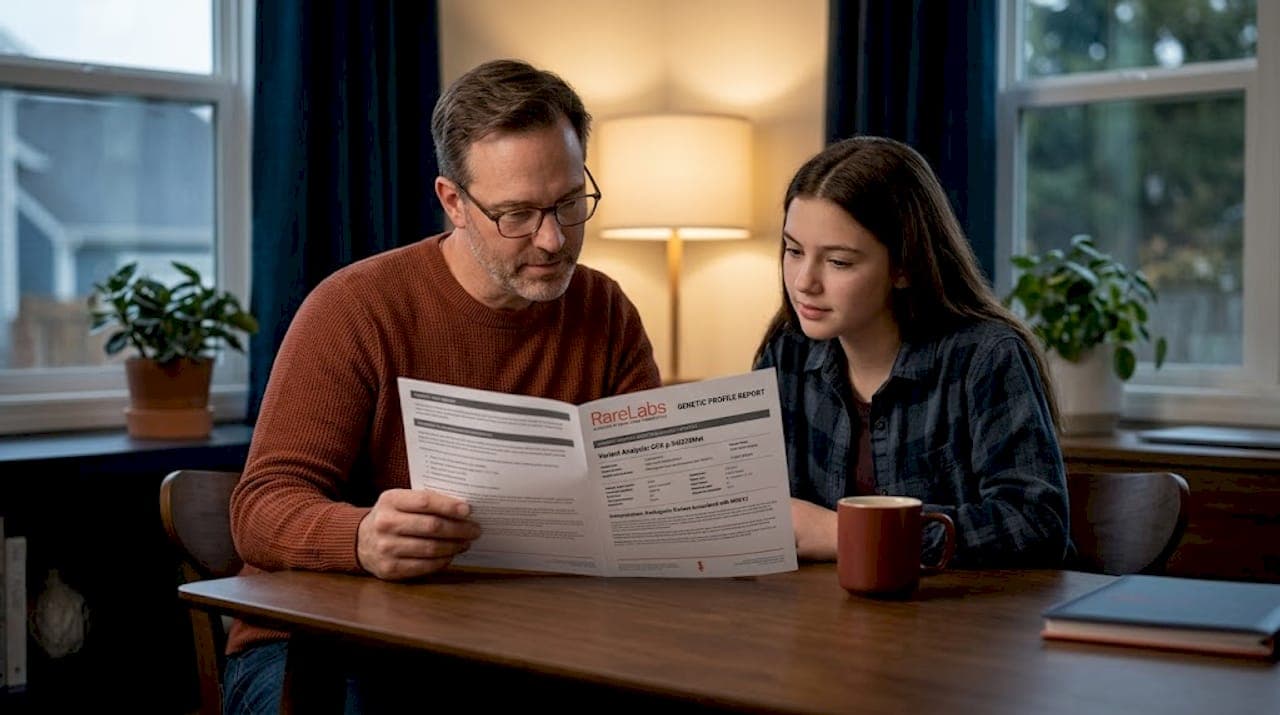
When a doctor mentions a genetic mutation, it's natural to feel a wave of uncertainty. What does it actually mean? What types of genetic mutations exist, and why does the specific type matter for your health or your child's diagnosis? The answer shapes everything from inheritance risk to treatment options. Mutations are not a single category of biological error. They range from a single letter change in a three-billion-letter genetic code to massive rearrangements of entire chromosomes. Understanding the differences is the first step toward making sense of a diagnosis, asking better questions, and exploring the right paths forward.
Table of Contents
- Key takeaways
- 1. How types of genetic mutations are classified
- 2. Silent mutations: changes that leave no trace
- 3. Missense mutations: when one amino acid changes everything
- 4. Nonsense mutations: when the protein gets cut short
- 5. Insertions, deletions, and frameshift mutations
- 6. Large-scale mutations: chromosomal rearrangements
- 7. Germline vs. somatic mutations: who inherits what
- 8. Neutral and beneficial mutations: not all changes are harmful
- 9. Comparing mutation types: what families and patients should know
- My perspective on mutation knowledge and patient empowerment
- How Hopeatrarelabs can help you move forward
- FAQ
Key takeaways
| Point | Details |
|---|---|
| Mutations vary widely in scale | They range from single nucleotide changes to chromosomal rearrangements affecting thousands of genes. |
| Origin determines inheritability | Germline mutations are inherited; somatic mutations arise after conception and stay in specific tissues. |
| Most mutations are neutral | DNA repair systems catch most errors, and many variants have no effect on health. |
| Frameshift mutations are often severe | Insertions or deletions that shift the reading frame commonly produce nonfunctional proteins linked to rare diseases. |
| Mutation type guides treatment | Knowing the exact mutation class helps clinicians select targeted therapies and genetic counseling strategies. |
1. How types of genetic mutations are classified
Before examining each category, it helps to understand the frameworks scientists and clinicians use to sort mutations. There is no single system. Researchers apply multiple classification criteria depending on what question they are trying to answer, and the same mutation can be described using more than one framework at once.
The four main classification criteria are:
- Molecular change: What physically happened to the DNA sequence? Did a single base get swapped, or was a large segment deleted?
- Origin: Did the mutation arise in a sperm or egg cell (germline), making it heritable? Or did it occur in a body cell after conception (somatic), limiting it to certain tissues?
- Functional impact: Does the mutation change the protein the gene produces? Does it silence it entirely, alter its function, or have no detectable effect?
- Scale: Does the mutation affect one nucleotide, a handful of base pairs, or an entire chromosome?
Clinicians and genetic counselors rely heavily on functional impact when discussing a diagnosis, because that classification speaks most directly to what the mutation does to the body. Molecular and origin-based classifications are equally important for determining inheritance risk and choosing diagnostic tools.
Pro Tip: When reviewing a genetic report, look for the functional classification first. Terms like "pathogenic missense variant" or "loss-of-function frameshift" tell you far more about health impact than the molecular coordinates alone.
2. Silent mutations: changes that leave no trace
A silent mutation, also called a synonymous mutation, swaps one DNA base for another but does not change the amino acid that gets coded into the resulting protein. Because the genetic code is redundant (multiple three-letter codons can specify the same amino acid), some base swaps are essentially invisible at the protein level.
That said, "silent" does not always mean consequence-free. Some synonymous variants affect how quickly a gene is read, alter RNA stability, or disrupt regulatory signals embedded in the DNA sequence. For most people, though, silent mutations represent the largest category of variants discovered through genetic testing that require no clinical action.
Most mutations are neutral or silent, with no measurable effect on health. That fact is genuinely reassuring when a genetic report returns a long list of variants, most of which will carry a classification of "benign" or "likely benign."
3. Missense mutations: when one amino acid changes everything
A missense mutation swaps a single nucleotide and lands on a codon that codes for a different amino acid. The protein still gets made, but it has one wrong building block. Whether that matters depends entirely on where in the protein the swap occurs.

Some missense mutations disrupt a critical active site or structural region, disabling the protein completely. Others land in a region where the change is tolerated, producing a protein that functions nearly normally. A well-known genetic mutation example is the sickle cell disease variant in the HBB gene, where a single glutamic acid is replaced by valine. That one amino acid change causes red blood cells to deform under low-oxygen conditions, producing a life-altering disease from a single nucleotide swap.
Missense mutations are among the most common types of DNA mutations found in rare disease panels, and their interpretation requires careful comparison against population databases and functional studies.
Pro Tip: If your genetic report lists a missense variant of uncertain significance (VUS), ask your clinician whether functional studies or additional family testing could reclassify it. Classification can change as research advances.
4. Nonsense mutations: when the protein gets cut short
A nonsense mutation converts a coding codon into a stop codon. The cell's protein-building machinery reads along the messenger RNA, hits the premature stop signal, and drops the chain. The result is a truncated protein that is usually nonfunctional and often rapidly degraded.
Frameshifts and nonsense mutations are the two most common causes of complete gene silencing in rare genetic diseases. Because the full-length protein is never made, these variants are typically classified as loss-of-function, which carries significant clinical weight.
The position of the premature stop codon matters. A stop codon introduced near the very end of the gene may still allow a near-complete functional protein. One introduced early in the sequence is almost always severe.
5. Insertions, deletions, and frameshift mutations
Insertions add one or more extra nucleotides into the sequence. Deletions remove them. Together, these are called indels. The critical question for indels is whether the number of bases added or removed is divisible by three.
Here's why that matters. DNA is read in three-letter codons. Indels not divisible by three shift every codon downstream of the mutation. The entire protein sequence from that point forward becomes scrambled. These are frameshift mutations, and they almost always produce a nonfunctional protein, often with a premature stop codon introduced somewhere in the shifted sequence.
| Indel type | Reading frame affected? | Typical outcome |
|---|---|---|
| Insertion or deletion of 3 bases | No | In-frame: one amino acid added or removed |
| Insertion or deletion of 1 or 2 bases | Yes | Frameshift: downstream sequence scrambled |
| Insertion or deletion of 6 bases | No | In-frame: two amino acids added or removed |
| Insertion or deletion of 4 or 5 bases | Yes | Frameshift: protein likely nonfunctional |
Frameshift mutations are responsible for a substantial portion of rare genetic diseases. Duchenne muscular dystrophy, for example, is caused primarily by frameshift deletions in the DMD gene that destroy the reading frame and prevent production of functional dystrophin. In contrast, Becker muscular dystrophy often results from in-frame deletions that preserve the reading frame and produce a shorter but partially functional protein, explaining the milder clinical course.
Understanding whether a deletion is frameshift or in-frame is not just academic. It directly informs prognosis and shapes which gene therapy options may apply.
6. Large-scale mutations: chromosomal rearrangements
Some mutations affect not just a single gene but entire regions of chromosomes. Chromosomal rearrangements include translocations (where segments move between chromosomes), inversions (where a segment flips), duplications, and large deletions. These large-scale changes can disrupt dozens of genes simultaneously or create entirely new gene fusions.
| Rearrangement type | What happens | Disease example |
|---|---|---|
| Translocation | Chromosome segments swap between chromosomes | BCR-ABL fusion in chronic myeloid leukemia |
| Inversion | A segment within one chromosome flips | Factor VIII inversion in hemophilia A |
| Duplication | A segment is copied, creating extra copies | HER2 amplification in breast cancer |
| Large deletion | A segment is lost entirely | 22q11.2 deletion syndrome (DiGeorge) |
Copy number variants (CNVs) are a related category. A gene amplification multiplies the number of gene copies, and a gene deletion removes copies. HER2 amplification in breast cancer is a clinically significant example where the overproduction of the HER2 protein drives tumor growth and also serves as the target for specific therapies.
For families dealing with undiagnosed conditions, chromosomal microarray analysis is often the first large-scale test ordered, specifically to detect CNVs and large rearrangements that would be missed by standard sequencing.
7. Germline vs. somatic mutations: who inherits what
The distinction between germline and somatic mutations is one of the most practically important concepts in genetics for families to understand. Germline mutations originate in reproductive cells and are present in every cell of the body from the moment of conception. They can be passed to children.
Somatic mutations arise after conception, in a specific cell that then divides. The mutation exists in the descendants of that cell but not throughout the body. This is why somatic mutations create genetic mosaics, where different tissues carry different genetic profiles. Somatic mosaicism can complicate diagnosis because a mutation present in only a fraction of blood cells may be missed by standard testing.
Somatic mutations accumulate over decades through normal cell division and environmental exposures, and their buildup is the primary driver of most cancers. Driver mutations in oncogenes or tumor suppressor genes gain a growth advantage that leads to clonal expansion and tumor formation. Understanding mutation function, whether it represents a gain or loss of function, is central to selecting targeted cancer therapies.
For rare inherited diseases, germline classification is what defines family risk and guides decisions about genetic testing for relatives.
8. Neutral and beneficial mutations: not all changes are harmful
Most people assume that any mutation is bad news. The reality is more nuanced. DNA repair mechanisms keep the rate of heritable errors extraordinarily low, roughly one mistake per 100 million base substitutions per cell division. Of those that do persist, the majority are functionally neutral and have no measurable effect on health.
A smaller subset are genuinely beneficial. Certain MSTN gene variants that disrupt myostatin production, the protein that limits muscle growth, result in significantly increased muscle mass and decreased fat. These mutations provide a physiological advantage rather than a disease state.
The concept of beneficial mutations matters for families in two ways. First, it reframes how to think about a positive genetic test result. A variant is not automatically dangerous. Its effect depends on which gene, which protein, and what the protein normally does. Second, it points toward a class of therapeutic strategies in which gene editing aims to introduce function-disrupting variants that mimic naturally occurring beneficial mutations. Hopeatrarelabs's work with gene editing technologies draws directly on this principle.
9. Comparing mutation types: what families and patients should know
The table below pulls the key differences together in a way that maps directly to the questions families tend to ask when receiving a genetic diagnosis.
| Mutation type | Heritable? | Typical severity | Common in rare diseases? |
|---|---|---|---|
| Silent (synonymous) | Yes (germline) | Usually none | Rarely causative |
| Missense | Yes (germline) | Variable | Very common |
| Nonsense | Yes (germline) | Often severe | Common |
| Frameshift (indel) | Yes (germline) | Often severe | Common |
| Chromosomal rearrangement | Yes (germline) | Severe to moderate | Less common but significant |
| Somatic mutation | No | Variable | Driver of cancer |
| Copy number variant | Yes (germline) | Variable | Common in syndromic conditions |
A few things stand out from this comparison. Frameshift and nonsense mutations are the most reliably severe categories because both eliminate normal protein production. Missense mutations are the most common type but also the hardest to interpret, because their effect depends on protein context. Somatic mutations are the only type that does not carry a direct inheritance risk for children, though family members may share a germline predisposition.
Pro Tip: When a genetic report classifies a variant as a "variant of uncertain significance" (VUS), that does not mean harmless or confirmed pathogenic. Ask your genetic counselor about reclassification timelines and whether functional testing can speed up the answer.
- Germline mutations carry direct inheritance risk; somatic mutations do not.
- Loss-of-function mutations (frameshift, nonsense) tend to produce more predictable, severe outcomes.
- Missense mutations require functional evidence before clinical conclusions can be drawn.
- Mutation type and function determine which therapies can be targeted to a specific gene change.
My perspective on mutation knowledge and patient empowerment
I've worked in and around rare disease science long enough to know that the moment a family hears "your child has a genetic mutation," the word mutation becomes the entire story. It crowds out everything else.
What I've learned is that the category of mutation matters far more than the word itself. A silent variant found incidentally on a carrier screen is a completely different clinical situation than a frameshift mutation in a critical developmental gene. Conflating the two causes real harm, mostly in the form of unnecessary fear that delays the practical work of understanding what comes next.
I've also seen families who were told a mutation was a VUS, assumed the worst, and spent years in distress before reclassification confirmed it was benign. The reverse happens too, and it's why staying engaged with your genetic team and asking for updates as classification databases grow is not optional. It's part of managing a genetic condition well.
What gives me genuine optimism is how rapidly the tools are improving. Functional assays that once took years can now be run in weeks. ASO and gene therapy programs are being designed against specific mutation classes with precision that was not possible a decade ago. If you are facing a rare or undiagnosed genetic disease, the type of mutation your family carries is not just a data point. It is the starting coordinate for every treatment conversation that follows.
— John
How Hopeatrarelabs can help you move forward
Understanding the type of mutation you or your child carries is the beginning of a longer road, not the end of it. If that road includes a rare or undiagnosed genetic condition, Hopeatrarelabs was built specifically for this situation.

Hopeatrarelabs creates personalized disease models from patients' own cells using iPSC and CRISPR technology, then screens thousands of FDA-approved drugs and evaluates gene therapy options against the exact mutation profile driving the disease. The process is built for cases where no approved treatment exists yet. Whether you are just beginning to understand a diagnosis or have been searching for years, the rare disease research hub at Hopeatrarelabs gives you a place to start, with science that is specific to your family's situation, not a generic condition category.
FAQ
What are the main types of genetic mutations?
Genetic mutations fall into several categories: silent, missense, and nonsense point mutations; frameshift mutations caused by insertions or deletions; chromosomal rearrangements such as translocations and inversions; and copy number variants. Each type differs in scale, severity, and health impact.
What is a frameshift mutation?
A frameshift mutation occurs when an insertion or deletion adds or removes a number of nucleotides not divisible by three, shifting the entire reading frame downstream. The result is usually a scrambled or truncated protein that cannot perform its normal function.
Are all genetic mutations harmful?
No. Most mutations are neutral and have no effect on health, and a small number are beneficial. The effects of genetic mutations depend on which gene is affected, what kind of change occurred, and whether the resulting protein is still functional.
What is the difference between germline and somatic mutations?
Germline mutations are present in reproductive cells and are passed to children, appearing in every cell of the body. Somatic mutations arise after conception in specific body cells and are not inherited, though they are the primary driver of cancer development.
How does mutation type affect treatment options?
The type and functional impact of a mutation directly guide therapy selection. Loss-of-function mutations may be candidates for gene replacement approaches, while specific missense or gain-of-function mutations may respond to small molecule inhibitors or ASO therapies designed to target the exact molecular change.