

A patient-specific research program can shorten the diagnostic odyssey and produce testable therapeutic leads within months, not years. Here is what to expect and where to start:
- Diagnosis likelihood: Whole-genome sequencing resolves roughly 8% of previously unsolved cases in large studies; automated reanalysis adds further yield over time.
- Therapeutic leads: iPSC-based disease models and high-throughput drug screens can generate prioritized candidate compounds or custom ASOs within a single program.
- Timeline cadence: Most programs move from sample collection to first results in 3–9 months, depending on sample quality and prior genomic data.
First step: Contact your specialist or a rare disease research partner like Hopeatrarelabs, and prepare a complete set of medical records plus any prior sequencing data before that first call.
Table of Contents
- What does rare diseases research actually cover?
- Which scientific methods drive modern rare-disease programs?
- Why do patient registries and data sharing matter so much?
- How does a patient-specific disease modeling program work, step by step?
- Who should engage a research partner, and how?
- How do you evaluate a biotech research partner before signing?
- What are the U.S. regulatory pathways from research to patient care?
- What emerging technologies should you ask vendors about?
- What should each audience do next?
- Key Takeaways
- The case for patient-specific programs, stated plainly
- Hopeatrarelabs: patient-specific programs, built around your case
What does rare diseases research actually cover?
Rare diseases research spans four interconnected activities: diagnosis (finding the genetic cause), disease modeling (recreating the biology in a lab), treatment discovery (testing compounds against that model), and translational support (moving a promising lead toward clinical access). The National Organization for Rare Disorders (NORD) frames the core problem as a "diagnostic odyssey," a systemic delay averaging 5–7 years before patients receive a confirmed diagnosis, driven by clinical fragmentation and limited specialist access.
The Rare Diseases Clinical Research Network (RDCRN) addresses this through multisite consortia spanning nearly 200 diseases, pooling patient recruitment and data across institutions. Early multidisciplinary case review shortens that delay substantially. The table below summarizes the diagnostic gap and what coordinated research adds.
| Metric | Finding |
|---|---|
| Average diagnostic delay | 5–7 years without coordinated care |
| WGS unique diagnoses in unsolved cases | 8% additional yield |
| Automated reanalysis (Talos) additional yield | 5.1% in 4,735 previously undiagnosed individuals |
| Trio WES vs. standard WES diagnostic improvement | marked increase in diagnostic yield |
Which scientific methods drive modern rare-disease programs?
The rare disease screening workflow has expanded well beyond a single sequencing test. Each method below has a specific role and real limits:
- WES/WGS (short-read): First-line genomic test; misses structural variants and deep intronic changes.
- Long-read sequencing: Resolves complex structural variants and repeat expansions that short-read misses; higher cost.
- RNA/transcriptomics: Catches splicing defects invisible to DNA sequencing; requires fresh tissue.
- iPSC-derived disease models: Patient cells reprogrammed to the affected cell type; gold standard for functional validation.
- CRISPR isogenic controls: Corrected cell lines that isolate the variant's effect; essential for confirming causality.
- High-throughput drug repurposing screens: Tests thousands of FDA-approved compounds against the disease model; fastest path to a candidate.
- ASO design and screening: Custom antisense oligonucleotides targeting the specific mutation; viable for many single-gene disorders.
- Gene therapy feasibility assessment: Evaluates AAV or base-editing approaches; depends on gene size, tissue target, and delivery route.
- Functional genomics (proteomics/transcriptomics): Adds mechanistic depth; most useful after a candidate variant is identified.
Pro Tip: In an unsolved case, prioritize WGS and RNA-seq together before investing in functional modeling. Structural variants and splicing defects account for a meaningful share of missed diagnoses, and catching them early prevents months of misdirected lab work.
Why do patient registries and data sharing matter so much?
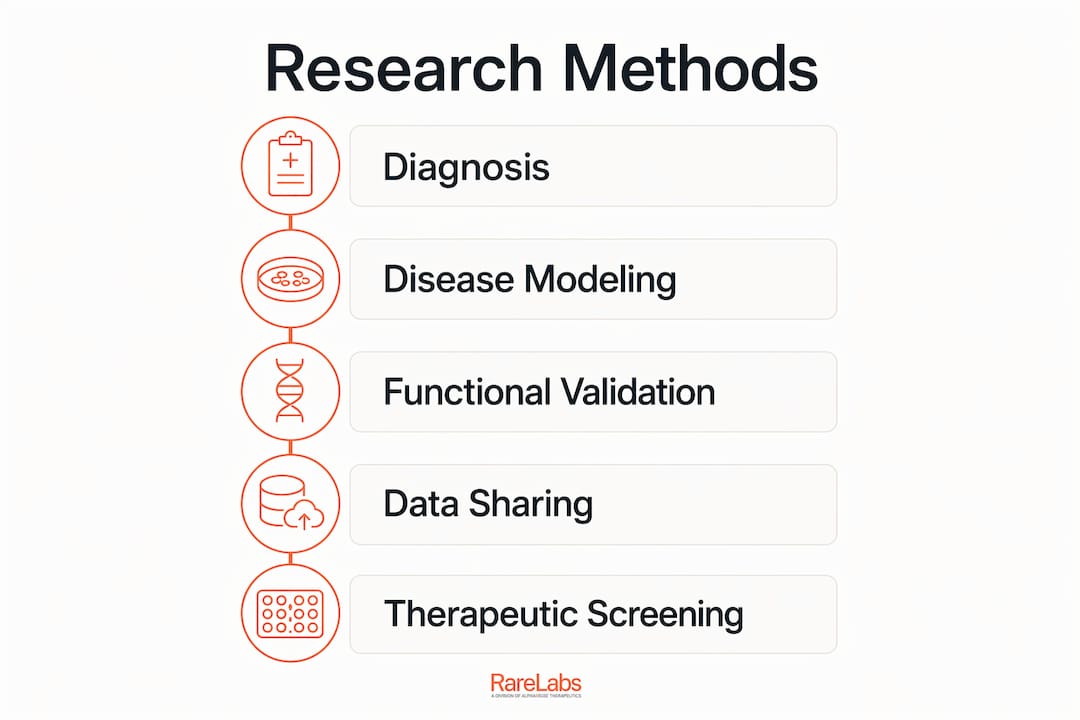
NORD's patient registry model and the GREGoR consortium, which has shared data on over 7,500 individuals, both demonstrate the same principle: rare disease cohorts are too small for any single center to power a study alone. Registries aggregate natural history data, enable recontact when new findings emerge, and let researchers reanalyze stored genomic data as variant databases grow.
When evaluating a registry or research data policy, look at four things. Consent scope should specify exactly what data will be shared, with whom, and for how long. Data ownership should remain with the patient or family, with a clear process to withdraw. Recontact policy should commit to notifying participants when reanalysis produces a new finding. Publication rules should state whether individual-level data will appear in papers and how de-identification is handled. U.S. research participation is governed by the Common Rule (45 CFR 46), which requires IRB oversight and documented informed consent for federally funded studies. Privately funded programs follow their own IRB protocols, but reputable labs maintain equivalent standards.
How does a patient-specific disease modeling program work, step by step?
The ultra-rare disease workflow steps below reflect how a full program runs from intake to clinical translation:
- Intake and consent: Medical records, prior sequencing data, and phenotype documentation are reviewed. IRB-approved consent is signed.
- Genomic analysis: WGS or WES (plus RNA-seq if indicated) identifies candidate variants. Confirm the gene-disease relationship before applying ACMG pathogenicity criteria to avoid misclassifying variants of uncertain significance.
- iPSC derivation: Patient blood or skin cells are reprogrammed into induced pluripotent stem cells (2–4 months, depending on sample quality).
- CRISPR isogenic controls: The candidate variant is corrected in a matched cell line to isolate its functional effect (4–8 weeks).
- Disease-model validation: iPSC-derived cells are differentiated into the affected cell type and confirmed to recapitulate the disease phenotype.
- High-throughput screens: Thousands of FDA-approved compounds, plus custom ASOs, are tested against the validated model. Gene therapy vectors are assessed in parallel if applicable.
- Lead prioritization: Hits are ranked by efficacy, safety profile, and clinical translatability. A prioritized candidate list is compiled.
- Translational report and clinical-access support: Deliverables include a diagnostic report, prioritized compound list, ASO design summary, and experimental data package. The team supports trial referral, expanded access applications, or compassionate use requests.
Total program duration typically runs 6–12 months. Factors that shorten it: high-quality prior WGS data, a clear phenotype, and a cell line already in biobank. Factors that lengthen it: poor sample viability, ambiguous phenotype, or regulatory complexity.
Pro Tip: Ship blood samples with a detailed phenotype summary using Human Phenotype Ontology (HPO) terms. Computational tools match symptoms to candidate genes far more reliably with structured HPO codes than with free-text clinical notes, which can shave weeks off the analysis phase.
Who should engage a research partner, and how?
Patients and families are often the ones who initiate contact after years without a diagnosis. The most productive first step is gathering all prior genetic reports, imaging, and specialist notes into one file before reaching out. Funding options include fee-for-service contracts, foundation grants, and crowdfunding campaigns specifically designed for rare disease research.

Clinicians typically engage to access functional validation they cannot run in a clinical lab. A referring physician can co-design the research question and receive a structured report that feeds directly into patient management decisions.
Foundations and advocacy groups often fund programs on behalf of patient communities, particularly when a disease affects too few people to attract commercial interest. A foundation can commission a program for multiple patients simultaneously, generating cohort-level data that strengthens future trial applications.
Biopharma partners engage to validate targets, test repurposed compounds, or de-risk an asset before committing to a full IND-enabling program. The patient-specific model serves as a human-relevant system that animal models often cannot replicate for ultra-rare genetic diseases.
Before any first contact, prepare: complete medical records, prior genomic data files, a written phenotype summary, consent preferences, and a clear statement of the primary question (diagnosis, treatment lead, or both). Ask the research team about their IRB status, typical turnaround, deliverable format, and how they handle incidental findings.
How do you evaluate a biotech research partner before signing?
Trust signals to look for:
- Peer-reviewed publications or case studies demonstrating the lab's methods have produced reproducible results in comparable diseases.
- CLIA certification or GCLP-compliant lab partnerships for any genomic testing used in the program.
- IRB oversight with documented, patient-specific informed consent procedures.
- Transparent timelines and deliverables stated in writing before the program starts.
- Data-sharing and ownership policy that specifies patient rights and publication terms.
- Track record of translational referrals: Has the lab supported expanded access applications, trial referrals, or compassionate use requests for prior patients?
Red flags: no documented methodology, vague or verbal-only deliverable descriptions, no ethics oversight, and promises of guaranteed diagnoses or cures. Ask specifically: "Can you share a redacted example report?" and "How do you handle a variant of uncertain significance?" A lab that cannot answer those two questions clearly is not ready for a patient program.
What are the U.S. regulatory pathways from research to patient care?
Three routes connect research results to actual treatment access. Clinical trials require an IND filed with the FDA and IRB approval; they offer the most rigorous evidence but take years to design and enroll. Expanded access (compassionate use) lets a patient receive an investigational drug outside a trial when no alternatives exist; the treating physician submits a request directly to the FDA, and most single-patient requests are approved within days. Emergency IND is the fastest route, used when a patient cannot wait for standard expanded access review.
Practical steps to pursue access:
- Document the research findings in a clinical summary your physician can submit to the FDA.
- Identify the drug manufacturer and confirm they will supply the compound for expanded access.
- File the expanded access request through the FDA's online portal.
- Use the RDCRN's trial-matching resources to identify open studies that match the diagnosis.
What emerging technologies should you ask vendors about?
Four developments are materially changing diagnostic yield and therapeutic prioritization right now:
- Automated iterative reanalysis (Talos): Returned 241 new diagnoses in a cohort of 4,735 previously undiagnosed individuals; periodic reanalysis of stored data is now a standard recommendation, not an optional add-on.
- Agentic AI systems (DeepRare-style): Multi-agent frameworks integrating HPO terms, genomic data, and clinical literature can generate ranked diagnostic hypotheses with traceable reasoning, reducing manual clinician workload.
- Machine-learning target prioritization (RareGPS): Integrates 11 evidence sources to score gene-phenotype pairs and outperforms existing resources for predicting drug indications in rare diseases.
- Long-read and multi-omics integration: Resolves structural variants and methylation patterns that short-read pipelines miss entirely.
The risks are real: automation produces false positives, and AI-generated hypotheses require human expert review before clinical action. Ask any vendor for peer-reviewed validation data, the specific dataset their tool was tested on, and at least one independent case study. A tool without published validation is a prototype, not a clinical-grade resource.
What should each audience do next?
Patients and families: Compile all medical records and prior genomic data into a single folder. Write a phenotype summary using HPO terms (your clinician can help). Contact Hopeatrarelabs or a specialist center to request a program consultation. For faster answers, see how to get rare disease answers faster.
Clinicians: Identify patients with unsolved genetic presentations and pull prior sequencing files. Reach out to a research partner to discuss co-design of a functional validation program. Review the collaborative rare disease trials guide for trial design considerations.
Foundations: Define the patient population and primary research question. Explore fee-for-service contracts or multi-patient cohort programs. Contact Hopeatrarelabs to discuss foundation-funded program structures.
Biopharma: Identify the target and the patient population. Request a feasibility call to discuss iPSC model generation, compound screening, and data package deliverables.
Costs vary based on program scope, number of compounds screened, and whether iPSC derivation is included. A genomics-only diagnostic program sits at the lower end; a full iPSC plus high-throughput screen program is more substantial. Hopeatrarelabs provides transparent cost estimates at the program design stage, before any commitment.
Key Takeaways
Patient-specific disease modeling using iPSCs and CRISPR, combined with high-throughput drug screening, is the most direct route from an unsolved rare disease to a testable therapeutic lead.
| Point | Details |
|---|---|
| Diagnostic gap is real | Average delay to diagnosis is 5–7 years; WGS resolves 8% of previously unsolved cases. |
| Reanalysis adds yield | Automated reanalysis (Talos) found 5.1% additional diagnoses in a cohort of 4,735 undiagnosed individuals. |
| iPSC + CRISPR is the standard | Patient-specific disease models with isogenic controls are the most reliable way to confirm variant causality and test treatments. |
| Vetting partners matters | Require CLIA/GCLP certification, IRB oversight, peer-reviewed methods, and written deliverables before contracting. |
| Hopeatrarelabs next step | Request a program consultation at Hopeatrarelabs; prepare medical records and prior genomic data before the first call. |
The case for patient-specific programs, stated plainly
The conventional wisdom in rare disease care is to wait: wait for a clinical trial, wait for a drug company to notice the disease, wait for a registry to accumulate enough patients to matter. That logic made sense when the only tools were population-scale studies. It does not hold when you can build a disease model from a single patient's cells and test hundreds of compounds against it in weeks.
What gets underestimated is how much the iPSC plus CRISPR combination changes the evidence standard. An isogenic control line is not an approximation of the patient's biology. It is the patient's biology with one variable changed. That is a level of experimental precision that animal models rarely achieve for monogenic ultra-rare diseases. The translational gap between a mouse model and a human patient is where most rare disease drug programs fail.
The pledge from any serious research partner should be straightforward: IRB-approved consent for every program, full data ownership retained by the patient or family, reproducible methods documented in writing, and no clinical recommendations made without peer-reviewed support for the underlying methodology.
Hopeatrarelabs: patient-specific programs, built around your case
For families and clinicians who have exhausted standard diagnostic pathways, Hopeatrarelabs offers something the clinical system typically cannot: a fully personalized disease modeling and treatment discovery program built from the patient's own cells.
The program covers iPSC derivation, CRISPR isogenic controls, high-throughput repurposed drug screening across thousands of FDA-approved compounds, custom ASO design, and gene therapy feasibility assessment. Every program produces a written deliverable package, including a diagnostic report, prioritized candidate list, and translational recommendations. Hopeatrarelabs supports expanded access applications and trial referrals for leads that clear the screening threshold.
Funding options include fee-for-service contracts, foundation grants, and biopharma partnerships. Costs vary by program scope and are quoted transparently at the design stage. To request a consultation or explore the rare disease knowledge hub, visit Hopeatrarelabs and submit your program inquiry. Bring your medical records and any prior sequencing data. That is the only preparation needed to start.