

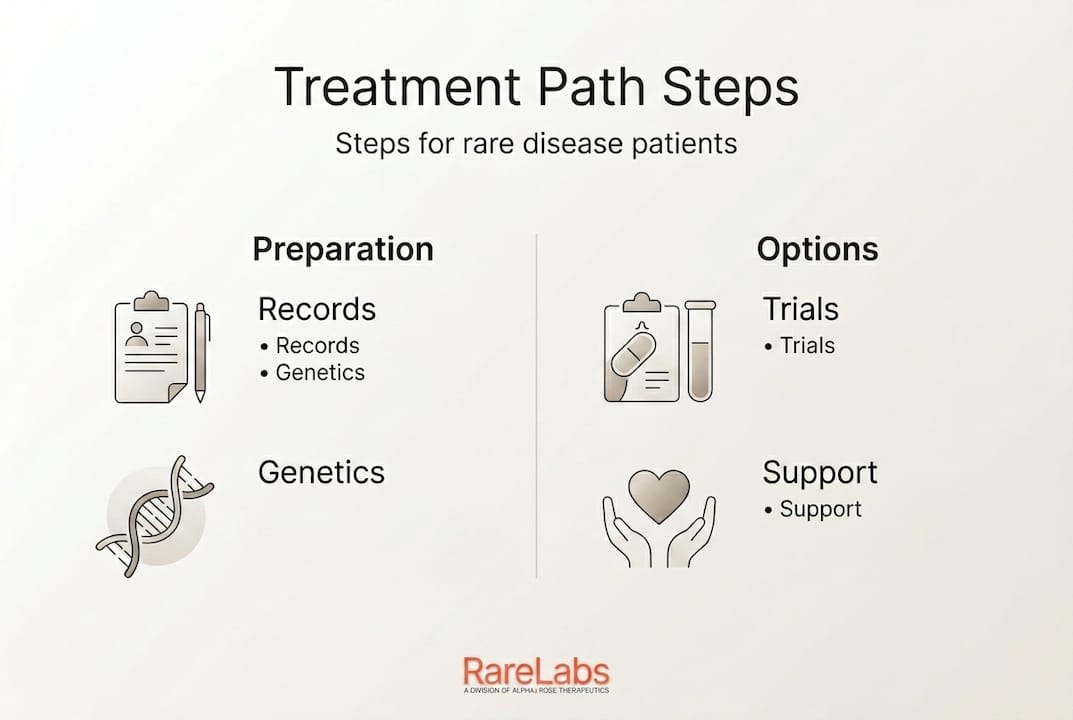
The road to finding a treatment for a rare or ultra-rare genetic disease is unlike anything in mainstream medicine. There are no clear signposts, the number of specialists is small, and the published evidence is often thin or nonexistent. Families spend years chasing diagnoses, and physicians find themselves operating outside their training with little institutional support. The good news: a structured, step-by-step approach can dramatically narrow the uncertainty. This guide walks patients, families, and clinical teams through preparation, clinical trial navigation, patient support programs, and individualized therapy pathways to help accelerate the search.
Table of Contents
- Get prepared: What you need before starting your search
- Search clinical trial and expanded access options
- Connect with patient support programs and resources
- Explore individualized and N-of-1 therapy development
- Why ultra-rare treatment discovery demands new strategies
- Take the next step with RareLabs
- Frequently asked questions
Key Takeaways
| Point | Details |
|---|---|
| Organize your records | Having comprehensive medical and genetic information enables a smoother treatment search process. |
| Explore all trial options | Use clinical trial databases and understand expanded access for broader possibilities. |
| Leverage patient support | Programs like NORD can help with costs and logistics, expanding your access to care. |
| Consider personalized treatments | For ultra-rare conditions, N-of-1 therapies and FDA pathways may open new opportunities. |
Get prepared: What you need before starting your search
Once you know what's ahead, the next step is making sure you have everything on hand to start an effective search.
Starting without organized information is one of the most common and costly mistakes families make. Before you contact a specialist, search any database, or apply to any program, you need a complete and clearly organized medical record package. This sounds straightforward, but in practice it requires deliberate effort, especially when records are scattered across multiple hospitals, labs, and specialists.
The core documents you need to gather include:
- Formal diagnosis reports with ICD codes and clinical descriptions
- Genetic testing results, including whole exome sequencing (WES) or whole genome sequencing (WGS) reports with variant classifications
- Variant of uncertain significance (VUS) documentation and any updated interpretations
- Complete medication history, including drugs tried and discontinued with reasons
- A detailed symptom timeline, noting onset, progression, and severity
- Imaging results, pathology reports, and metabolic or biomarker lab panels
- Contact information for every treating specialist
Understanding the exact genetic finding matters enormously. A diagnosis of "Batten disease" is not specific enough for a treatment search. CLN2, CLN3, and CLN7 subtypes each have different biology, different trial landscapes, and different personalized therapy options. The more precise the molecular finding, the more targeted your search will be.
If your case remains unresolved after standard genetic workup, the Undiagnosed Diseases Network is a critical next step. The UDN accepts about 40% of referrals, requires a physician referral, and uses advanced tools including WGS, WES, and metabolomics. Since its inception, the UDN has made 374 confirmed diagnoses from 4,077 referrals. Testing costs are covered, though treatment development falls outside its scope.
| Preparation item | Why it matters | Who needs it |
|---|---|---|
| Genetic variant report | Enables precise trial and therapy matching | All patients |
| Symptom timeline | Required for eligibility screening | All patients |
| Treatment history | Avoids redundant interventions | All patients |
| UDN referral letter | Required for application | Undiagnosed cases |
| Specialist contact list | Speeds up coordination | All patients |
Pro Tip: Create a one-page medical summary that covers diagnosis, key genetic findings, current symptoms, and prior treatments. Keep it updated and share it at every new clinical contact. This single document can cut intake time in half and reduce the risk of errors during care transitions.
Search clinical trial and expanded access options
With your information organized, you're ready to actively search for treatment opportunities.
ClinicalTrials.gov is the first and most important database to search. It lists over 480,000 studies globally, and for rare diseases, even a handful of recruiting trials represents significant opportunity. Here's a practical process to search it effectively:
- Go to clinicaltrials.gov and enter your specific disease name, gene name, or protein target in the search bar.
- Apply filters: set recruitment status to "Recruiting" or "Not yet recruiting," and filter by phase, geographic location, age group, and sex.
- Click into each result and review the eligibility section carefully. Look at diagnosis duration requirements, required symptom profiles, prohibited medications, and biomarker thresholds.
- Identify the study type. Interventional trials test a treatment directly. Natural history studies collect data without intervening. Biomarker studies define disease progression. All three have value for a patient working toward access.
- Note the contact information for each trial site and reach out directly, even if the patient doesn't immediately appear eligible.
"Inclusion/exclusion criteria are strict, so persistence and communication are key."
The comparison below clarifies the major pathways so you know which to prioritize:
| Pathway | Purpose | Eligibility | Availability |
|---|---|---|---|
| Interventional trial | Test a treatment under protocol | Strict criteria | Limited sites |
| Expanded access | Off-protocol drug access | Declined or ineligible from trial | Case-by-case basis |
| Natural history study | Document disease progression | Broader eligibility | More widely available |
| Compassionate use | Emergency access to investigational drug | Serious or life-threatening need | Requires FDA + sponsor approval |
Many trial sites quietly offer expanded access to patients who don't qualify under the formal protocol. This is especially true in rare diseases, where sponsors are eager to generate additional safety and efficacy data. Trial coordinators will rarely advertise this option upfront, which is why direct, informed communication is essential. Travel assistance is also common in rare disease studies, as sponsors understand that patients may be traveling hundreds or thousands of miles to access a site.
Pro Tip: When contacting a trial site, ask specifically: "Do you offer expanded access or compassionate use for patients who don't meet all inclusion criteria?" Frame the question clearly and provide the patient's summary sheet. A single conversation can open a door that a database search alone never would.
Connect with patient support programs and resources
Alongside medical pathways, financial and logistical support is essential to access possibilities.

Finding a trial or a specialist is only part of the challenge. Getting there, paying for it, and sustaining the effort over months or years is where many families hit a wall. National patient organizations provide an often-overlooked infrastructure of support that can make the difference between accessing care and giving up.
The National Organization for Rare Disorders (NORD) operates a set of programs under its RareCare umbrella that cover medication costs, insurance premiums, co-pay assistance, diagnostic testing, and travel reimbursement for patients seeking specialist care or trial participation. Caregiver respite grants of up to $250 are also available, as is educational support to help families navigate the medical system.
The scale of impact is significant. Since 2018, NORD RareCare has distributed $174 million in assistance and reimbursed over 2 million travel miles for rare disease patients and families. These aren't token amounts. For families managing repeated specialist visits, genetic testing costs, and out-of-network care, this support can be the difference between sustained access and financial collapse.
Key NORD RareCare programs include:
- Medication assistance: covers prescription costs for approved rare disease drugs
- Premium and co-pay assistance: reduces insurance-related financial burden
- Diagnostic testing grants: funds genetic and metabolic tests not covered by insurance
- Travel assistance: reimburses travel and lodging for trials, specialists, and diagnostic centers
- Caregiver respite: provides short-term financial support for caregiver relief
- Educational grants: supports patient and family education about disease management
Beyond NORD, disease-specific foundations often operate their own assistance programs tailored to a single condition. These can be faster to access and more flexible in eligibility. The rare disease patient assistance guide can help you identify programs relevant to specific diagnoses.
Pro Tip: Patient assistance programs update their eligibility criteria and funding availability regularly. Always contact the program directly and ask whether there are new initiatives or temporary grants that may not be listed on the website. A phone call often surfaces options that a web search misses entirely.
Explore individualized and N-of-1 therapy development
When standard medical and trial resources cannot address extremely rare cases, highly personalized options may be possible.
For patients with diseases affecting fewer than a few hundred individuals worldwide, no clinical trial may exist. No FDA-approved drug may target their specific variant. In these situations, individualized or N-of-1 therapy development becomes not just an option, but often the only viable scientific path forward.
An N-of-1 therapy is designed, developed, and tested for a single patient, usually based on their precise genetic variant. Examples include patient-specific antisense oligonucleotides (ASOs) that silence or correct a mutant gene, or CRISPR-based gene editing approaches targeting a unique pathogenic variant. These therapies don't follow the traditional drug development pipeline. They require a different regulatory framework and a different evidence standard.
In 2026, the FDA's Plausible Mechanism Framework formalized a pathway for individualized therapies that targets specific genetic variants using genome editing and RNA-based treatments such as ASOs and CRISPR. Under this framework, approval does not require a large randomized controlled trial. Instead, the sponsor must demonstrate a plausible biological mechanism, provide natural history data, confirm the genetic target, and conduct a single well-controlled trial with supportive confirmatory evidence. This framework applies beyond ultra-rare cases if the defined criteria are met.
"N-of-1 pathways can bypass traditional RCT hurdles for ultra-rare cases."
The IRDiRC N-of-1 roadmap provides a practical guide for development teams working through this process:
- Patient identification: Confirm the specific genetic variant, assess natural history data, and establish a clinical baseline.
- Preclinical therapy development: Design and test the therapeutic candidate in cell models or animal models that reflect the patient's biology.
- Go/no-go checkpoint: Evaluate preclinical efficacy and safety before moving to clinical use.
- Clinical assessment: Administer the therapy under a rigorous single-patient protocol with defined endpoints.
- Data sharing: Submit findings to international registries to support learning across similar cases worldwide.
| Development phase | Key requirement | FDA/IRDiRC checkpoint |
|---|---|---|
| Variant confirmation | Genetic diagnosis + natural history | Required before development |
| Preclinical evaluation | Cell/animal model efficacy | Go/no-go decision point |
| Regulatory submission | Plausible mechanism + IND filing | FDA Plausible Mechanism Framework |
| Clinical trial | Single well-controlled study | IRDiRC clinical assessment phase |
| Post-treatment data | Registry submission | Required for knowledge sharing |
Data sharing is not a bureaucratic afterthought in this model. It is strategically essential. When a therapy developed for one patient with a specific CLN7 variant produces a measurable clinical response, that data can inform the next family whose child carries the same variant. International registries are building the evidence base that makes N-of-1 development scalable over time.
Why ultra-rare treatment discovery demands new strategies
The conventional evidence model was built for common diseases. Randomized controlled trials assume you can enroll hundreds of patients across multiple sites, randomize them into treatment and control arms, and generate statistically significant outcomes. For diseases with global patient populations measured in the dozens, this is mathematically and ethically impossible. You cannot randomize twelve patients worldwide into a placebo arm while watching them decline.
This is not a regulatory failure. It's a structural mismatch. And rethinking evidence generation for ultra-rare diseases is one of the most important scientific conversations happening in biopharma right now. The FDA's N-of-1 framework avoids large trials by accepting plausible mechanism plus single-study data as a sufficient regulatory basis for diseases with fewer than 1 in 50,000 prevalence. Real-world data, natural history registries, and international data sharing are filling the gaps that RCTs cannot.
What this means practically is that persistence, creativity, and cross-border collaboration are now core clinical competencies in ultra-rare disease care. A physician who connects with a European counterpart treating the same variant, shares functional data from a cell model, and co-publishes a case report is doing something that moves the field. That's not peripheral. It's the field.
Patient organizations and groups like NORD close the gaps that the system leaves open. NORD's $174 million in cumulative aid isn't just financial relief. It represents sustained access to care that would otherwise be impossible for many families. For biopharma teams, real-world data from these patient journeys is increasingly the primary evidence source for ultra-rare indication development.
"The ultra-rare community is rewriting what evidence means, who generates it, and how quickly it can drive decisions that matter to patients still waiting."
The families who push hardest, the clinicians who communicate across institutions, and the organizations that fund access are now the engine of drug development in this space. The system is catching up to what this community has always known: urgency is not optional.
Take the next step with RareLabs
Finding a treatment path for an ultra-rare genetic disease requires more than a database search. It requires integrating genetic precision, trial intelligence, regulatory strategy, and personalized therapy options into a coherent plan specific to your patient.
RareLabs works directly with patients, families, and clinical teams to do exactly that. Our platform uses iPSC-based disease modeling, parallel drug screening, and custom ASO development to identify viable options when no approved treatment exists. Whether you're beginning a comprehensive rare disease treatment search or need expert guidance on N-of-1 development, we're built for exactly these situations. Visit the RareLabs platform to connect with our team or explore how patient-specific models can accelerate your next step.
Frequently asked questions
What documents are needed to start a rare disease treatment search?
Collect all medical records, genetic testing results with variant classifications, diagnosis confirmation, a detailed symptom and progression history, and a complete list of prior treatments. Having these organized into a one-page summary significantly speeds up specialist intake and eligibility screening.
How can I find clinical trials for ultra-rare diseases?
Search ClinicalTrials.gov, filter by disease name, recruitment status, location, and age group, and review each trial's eligibility criteria carefully. Also contact trial sites directly to ask about expanded access options for patients who may not meet all formal inclusion criteria.
What support can patient organizations provide?
NORD offers assistance with medication, co-pays, testing, and travel for rare disease patients and families, with over $174 million distributed since 2018. Disease-specific foundations often have additional targeted programs worth exploring in parallel.
Are individualized treatments available for my rare genetic disease?
The FDA's 2026 Plausible Mechanism Framework creates a formal pathway for N-of-1 and personalized therapies such as ASOs and CRISPR approaches for patients with specific genetic variants when traditional trials are not feasible. Working with a specialized team is essential to navigate this process effectively.