

One in ten Americans lives with a rare disease, yet many of them wait years before anyone can tell them what that disease actually is. The confusion around rare vs undiagnosed diseases is more than semantic. It shapes which specialists you see, which clinical trials you qualify for, and whether a treatment even exists for your condition. If you or someone you love has been through rounds of testing with no clear answers, understanding this distinction is the first practical step toward finding real options.
Table of Contents
- Understanding rare diseases: scope and challenges
- Distinguishing undiagnosed diseases from rare diseases
- Diagnostic and treatment pathways for undiagnosed and rare diseases
- Navigating the diagnostic odyssey: practical tips for patients and families
- Role of advanced biotechnology in rare and undiagnosed diseases
- Why the journey from undiagnosed to treatment remains challenging and how to overcome it
- Access advanced rare disease support and personalized treatment options
- Frequently asked questions
Key Takeaways
| Point | Details |
|---|---|
| Rare diseases defined | Rare diseases affect fewer than 200,000 Americans and collectively impact millions. |
| Undiagnosed disease challenges | Many diseases remain undiagnosed due to symptom overlap and limited specialized testing. |
| Lengthy diagnosis times | Diagnosis often takes years, creating uncertainty and delays in care. |
| Specialized networks help | Programs like the Undiagnosed Diseases Network improve diagnosis rates and support. |
| Biotech offers hope | Genomic and gene therapies enable personalized treatment for many rare and undiagnosed conditions. |
Understanding rare diseases: scope and challenges
The term "rare disease" is surprisingly precise. By the FDA's definition, a rare disease affects fewer than 200,000 people in the United States, yet collectively these conditions impact over 30 million Americans, roughly 1 in 10 people. That contradiction, rare individually but common collectively, is one of the most important things to grasp at the start.
More than 7,000 recognized rare diseases exist. About 80% have a genetic root, which means they are not lifestyle-related and often cannot be prevented. Many are present from birth, even when symptoms don't surface until adulthood. Because each individual condition affects so few people, most physicians never encounter more than a handful of cases in their careers. That clinical inexperience creates diagnostic gaps that can stretch on for years.
Patients and families navigating the diagnostic process for rare diseases face a specific set of overlapping challenges:
- Symptom variability: Two people with the same rare disease may present completely differently, which makes pattern recognition nearly impossible without specialized expertise.
- Misdiagnosis: Because rare disease symptoms often overlap with common conditions, patients frequently receive incorrect diagnoses first, sometimes more than one.
- Geographic barriers: Centers with genuine rare disease expertise are concentrated in large academic medical centers, leaving rural and underserved families at a structural disadvantage.
- Insurance and financial strain: Testing, travel, and specialist consultations accumulate quickly without a diagnosis code that insurers recognize.
"When a disease affects fewer than 200,000 people nationally, no primary care physician can realistically be expected to recognize it on sight. The burden of identification falls on patients and specialized teams working together."
The emotional weight on families should not be underestimated either. Parents watching a child's health decline without a name for what is happening describe a particular kind of helplessness. That uncertainty is not just psychologically difficult; it actively delays treatment because most physicians will not prescribe or recommend therapies without a working diagnosis.
Distinguishing undiagnosed diseases from rare diseases

Here is where the language gets genuinely important. A rare disease is known to medical science. It has a name, a recognized set of symptoms, often a genetic marker, and at least some published literature. An undiagnosed disease is different: it describes a patient's situation, not a disease category. Rare diseases are known with recognized names; undiagnosed diseases have unexplained symptoms despite testing and may represent conditions science has never formally catalogued.
Think of it this way. A patient with Gaucher disease has a rare disease. A patient with severe neurological decline, abnormal metabolic markers, and a genetic variant of unknown significance may have an undiagnosed disease, possibly something never documented before in any medical literature. Those two patients are in very different situations, and they need very different kinds of support.
The overlap is real: many patients with undiagnosed diseases eventually receive a rare disease diagnosis. But until that happens, they exist in diagnostic limbo. This is where the concept of the diagnostic odyssey becomes central.
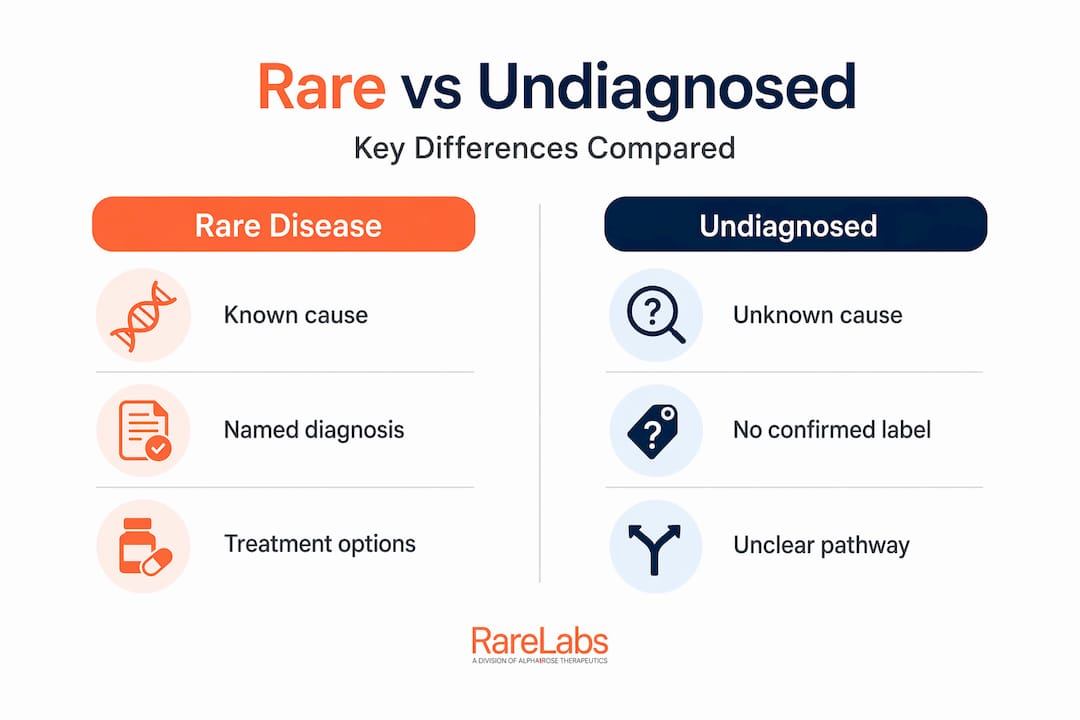
| Feature | Rare disease | Undiagnosed disease |
|---|---|---|
| Medical recognition | Known, named condition | No confirmed diagnosis |
| Diagnostic path | Possible with specialized testing | Unclear, often requires novel methods |
| Treatment availability | Limited but some exist | Often none; supportive care only |
| Research base | Published literature available | Little to none |
| Patient population | Defined (under 200,000 in US) | Unknown |
The diagnostic odyssey can span 4 to 7 years on average. Patients see an average of 7 to 8 specialists before receiving a correct diagnosis. During that time, wrong diagnoses lead to wrong treatments, some of which cause real harm. Families spend years in a cycle of hope and disappointment. Understanding this pattern is critical when you are in the middle of it, because it means the absence of a diagnosis is not a personal failure or a sign that nothing is wrong.
Pro Tip: When your genetic diagnosis guide becomes a central document in your care, request that all physicians annotate it with their clinical reasoning, not just their conclusions. This trail of reasoning becomes invaluable when you transfer to a specialist or research program.
The concept of the diagnostic odyssey explanation also helps families understand why repeat testing is sometimes necessary. A variant of unknown significance on a genetic panel from three years ago might have a definitive classification today, as databases grow and science advances.
Diagnostic and treatment pathways for undiagnosed and rare diseases
More than 90% of patients with rare disorders remain undiagnosed and often receive only supportive care. That statistic is stark. It means that for most patients navigating this space, the primary medical response is symptom management rather than disease-targeted treatment.
Specialized programs exist specifically to change that. The Undiagnosed Diseases Network (UDN), funded by the NIH, connects patients to multidisciplinary teams at academic medical centers across the country. The UDN achieves a 35% diagnostic rate with an average 18-month diagnosis time after enrollment, following years of prior testing. That is a meaningful improvement over the usual trajectory, though the process still demands patience and persistence.
Here is how a structured diagnostic and treatment pathway typically looks for patients in this space:
- Primary care recognition: A physician identifies unexplained symptoms that resist standard explanation and initiates a referral chain.
- Specialist evaluations: Neurology, genetics, metabolic medicine, and other relevant specialties conduct targeted testing.
- Genomic sequencing: Whole exome or whole genome sequencing is ordered when targeted panels return unclear results.
- Functional genomics: When a variant is found but its significance is unknown, labs perform functional assays to determine whether it actually disrupts protein function.
- Multidisciplinary review: Cases are presented to specialist panels, sometimes including researchers, to identify patterns across rare case databases.
- Treatment exploration: Once a diagnosis or working hypothesis exists, physicians identify any existing therapies, compassionate use programs, or clinical trials.
| Stage | Typical timeline | Key resources |
|---|---|---|
| Initial specialist referrals | 6 to 24 months | Local academic centers |
| Genomic sequencing and review | 3 to 12 months | Commercial labs, research programs |
| UDN enrollment and evaluation | 12 to 18 months post-enrollment | NIH-funded UDN sites |
| Treatment identification | Variable | Biotech programs, clinical trials |
Pro Tip: Ask your physician specifically about genetic therapies for rare diseases during the genomic review phase, not after. Understanding what therapeutic options might exist for a given gene pathway can shape which additional tests are worth pursuing.
For families seeking personalized rare disease treatments, biotechnology is opening doors that did not exist five years ago. Patient-derived cell models, antisense oligonucleotides (ASOs) custom-designed for individual mutations, and gene editing platforms are no longer purely theoretical.
Navigating the diagnostic odyssey: practical tips for patients and families
Knowledge without action is just frustration. Here is what families who successfully navigate this process actually do differently.
- Build a master medical record. Compile every test result, imaging study, specialist note, and genetic report into one organized file. Include dates and physician contact information. When you transfer to a new specialist or program, this document cuts months off the learning curve.
- Request raw genomic data. Many patients receive a report that says "no pathogenic variants found" but never request the actual sequencing data. Raw data can be reanalyzed as databases expand, and a variant classified as benign in 2022 may be reclassified as disease-causing in 2026.
- Pursue the UDN early. Early referral to the UDN after multiple specialist evaluations fail is the right move. Patients should prepare comprehensive medical records including all genomic data before applying.
- Connect with patient foundations. Disease-specific foundations and broader undiagnosed disease communities often know about emerging research, unpublished findings, and compassionate use opportunities before that information reaches most clinicians.
- Document symptom progression systematically. Diary-style symptom records with dates, severity scales, and triggers give clinicians longitudinal data that a single office visit cannot capture.
Pro Tip: When getting diagnosis faster is the goal, the most underused tool is the second opinion at a research-focused academic center. Community hospitals, even excellent ones, rarely have the rare disease case volume to recognize novel presentations. If you haven't been evaluated at a major academic medical center, that is the most impactful single step you can take.
Understanding rare disease research challenges also helps families set realistic expectations. Research timelines in this space are long, resources are thin, and the path from discovery to approved therapy is rarely linear. But patients who stay engaged with research communities position themselves to access emerging options first.
Role of advanced biotechnology in rare and undiagnosed diseases
Biotechnology is now the primary engine of progress for patients where conventional medicine has nothing to offer. The landscape has changed dramatically in the past decade, and the pace is accelerating.
Key biotech approaches currently being applied to rare and undiagnosed genetic diseases:
- Whole genome sequencing: Identifies mutations across the entire genome, not just targeted regions, dramatically increasing diagnostic yield for undiagnosed cases.
- Induced pluripotent stem cells (iPSCs): Patient-derived stem cells can be reprogrammed into any cell type, creating disease models that reflect the patient's actual biology rather than an approximation.
- CRISPR gene editing: Allows precise correction of genetic mutations in cell models and, increasingly, in living patients through therapeutic applications.
- Antisense oligonucleotides (ASOs): Short synthetic molecules designed to modify gene expression at the RNA level, and now customizable for individual patients with unique mutations.
- Drug repurposing screens: Testing thousands of FDA-approved drugs against patient-derived cell models to identify unexpected therapeutic matches without waiting for de novo drug development.
"FDA guidance encourages individualized therapies like genome editing for ultra-rare diseases where large clinical trials are impossible due to tiny patient populations."
That regulatory shift is significant. For decades, the clinical trial model required hundreds or thousands of patients to validate a therapy. For a disease affecting 30 people worldwide, that model simply does not work. The FDA's evolving framework for n-of-1 therapies, therapies designed for a single patient, is creating a legitimate regulatory pathway where none existed before.
| Approach | Best for | Current status |
|---|---|---|
| ASOs | Single-gene disorders, splicing defects | Clinical and compassionate use |
| Gene therapy (viral vectors) | Monogenic disorders with known targets | Clinical trials and some approvals |
| CRISPR in vivo | Selected genetic diseases | Early clinical trials |
| iPSC drug screens | Ultra-rare, undiagnosed cases | Research and translational use |
For families exploring gene editing for rare diseases and gene therapy approaches, the critical question is no longer "does anything exist?" but "how do we access what is emerging?"
Why the journey from undiagnosed to treatment remains challenging and how to overcome it
Here is the uncomfortable reality that most patient-facing resources gloss over: a diagnosis, even a long-awaited one, does not automatically open a treatment door. Even after diagnosis, 90% of rare disease patients still lack approved treatments and must pursue clinical trials or compassionate use programs. The diagnosis is not the finish line. It is the starting line for the next phase of advocacy.
What we see consistently is that patients who enter this phase with the clearest outcomes are the ones who treated their diagnostic journey as data collection, not just medical care. They have organized records. They engaged with researchers. They asked hard questions early. They did not wait for the system to move on their behalf, because the system was not designed with ultra-rare patients in mind.
Data sharing is another factor that is dramatically underutilized. When a patient's genomic data and clinical information are contributed to rare disease registries, it does not just help researchers. It helps the next family whose child presents with identical symptoms. The rare disease community advances through collective data in a way that no other medical field depends on so heavily.
Multidisciplinary collaboration, the combination of geneticists, neurologists, biochemists, and biotech researchers working together on a single case, produces outcomes that no single specialist can achieve alone. Yet most healthcare systems still route rare disease patients through sequential specialist appointments rather than coordinated team reviews. Families who understand this advocate for case conferences and multidisciplinary reviews rather than accepting the sequential model.
The path to personalized treatment pathways is rarely handed to you. It is built, methodically, by engaged patients and families who understand the landscape they are navigating.
Access advanced rare disease support and personalized treatment options
The research, treatment models, and biotechnology described in this article are no longer theoretical. For families who have exhausted conventional options, these tools are being applied right now to real patients with real answers emerging.
RareLabs was built specifically for this gap: the space between a diagnosis that does not exist yet and a treatment that does not exist yet. Using patient-derived cell models, parallel drug screens across thousands of FDA-approved compounds, and custom ASO development, RareLabs works to find real therapeutic options for ultra-rare and undiagnosed genetic diseases. Explore the rare disease research knowledge base to understand what is scientifically possible for your specific situation, or visit the rare disease treatment search platform to begin the process of building a personalized strategy.
Frequently asked questions
What differentiates a rare disease from an undiagnosed disease?
A rare disease is a known condition with a name affecting fewer than 200,000 people in the US, while an undiagnosed disease describes a patient whose symptoms have no confirmed explanation after extensive testing.
How long does it typically take to get diagnosed with a rare or undiagnosed disease?
Rare disease diagnosis typically takes 4 to 7 years globally; patients enrolled in specialized programs like the UDN average 18 months after enrollment, following years of prior evaluations.
What is the Undiagnosed Diseases Network and how can it help?
The UDN is an NIH-funded collaborative program that applies multidisciplinary expertise and advanced genomic testing to diagnose complex, previously unresolved conditions and connect patients with researchers and specialists.
Are there effective treatments available for rare or undiagnosed diseases?
Most rare diseases lack approved treatments, but gene therapy, custom ASOs, and drug repurposing screens are creating new personalized options for patients with ultra-rare and undiagnosed genetic conditions.
How can patients advocate for themselves during the diagnostic process?
Compile all medical records and raw genomic data, seek early UDN referral after multiple specialists have been unable to provide answers, and actively engage with patient communities and research networks to stay informed about emerging options.