

Rare diseases affect roughly 300 million people worldwide, yet most clinical trials for these conditions fail not because of science, but because of fragmentation. Patient populations are scattered across continents, data lives in silos, and research sites operate without aligned protocols. This guide to collaborative rare disease trials exists because the conventional single-sponsor, single-site model simply does not work at this scale. Across these sections, you will find concrete strategies for planning, executing, and governing multi-stakeholder trials that actually reach patients, generate meaningful data, and move therapies forward.
Table of Contents
- Key takeaways
- Guide to collaborative rare disease trials: essential prerequisites
- Designing and running collaborative rare disease trials
- Governance, safety oversight, and regulatory compliance
- Patient-centric collaboration and decentralized trial models
- My honest take on what most collaborations get wrong
- How Hopeatrarelabs supports your rare disease trial work
- FAQ
Key takeaways
| Point | Details |
|---|---|
| Multi-stakeholder structure is foundational | Build consortia with investigators, advocates, and coordinating centers before any protocol is drafted. |
| Governance beats goodwill | 84% of study sites report improved performance when formal collaboration documents replace trust-alone frameworks. |
| Patient advocacy belongs at the design table | Embedding patients from protocol development through dissemination improves relevance and recruitment. |
| Logistics, not recruitment, is the bottleneck | Decentralized trials stall on shipping, sample workflows, and onboarding, not on finding patients. |
| Technology without operational planning fails | Digital platforms require tightly coordinated clinical operations to deliver real-world value. |
Guide to collaborative rare disease trials: essential prerequisites
Before a single patient is screened, successful collaborative rare disease trials require a governance infrastructure that most teams underestimate. The first decision is structural: will your collaboration operate as a loose investigator network, a formal consortium, or a funded research network? Each model carries different accountability structures, and that choice shapes everything from budgets to data ownership.
The NIH's Rare Diseases Clinical Research Network (RDCRN) offers the most studied model. The RDCRN mandates active patient advocacy partnership and supports a Data Management and Coordinating Center (DMCC) to reduce fragmentation across sites. Consortia funded under this framework do not treat patient advocates as optional advisors. They treat them as structural partners from day one. That distinction matters enormously for trial relevance and retention.
Key prerequisites include:
- Governance framework: Define decision rights, escalation paths, and authorship agreements before any memoranda of understanding are signed.
- Patient advocacy integration: Identify which advocacy organizations represent your disease community and negotiate their formal role in protocol review and recruitment planning.
- DMCC or equivalent: A dedicated coordinating center for rare disease networks standardizes data handling across consortia and prevents the operational fragmentation that kills multi-site studies.
- Regulatory alignment: Sponsors, CROs, and sites must align on applicable frameworks early. The UK MHRA's proposed Rare Disease Therapies Framework, which aims to compress traditional 10-to-12-year timelines, reflects a global trend toward flexible, risk-proportionate pathways worth tracking.
- Natural history studies: NORD's IAMRARE platform enables natural history studies for trial readiness, though these require a minimum five-year commitment and ongoing maintenance budgets around $5,000 annually.
| Infrastructure element | Why it matters | Common gap |
|---|---|---|
| Governance framework | Clarifies roles and conflict resolution | Assumed, not documented |
| DMCC or data center | Standardizes data across sites | Added late in planning |
| Patient advocacy partnership | Improves relevance and retention | Treated as optional |
| Regulatory alignment | Prevents late-stage compliance failures | Handled per site separately |
Pro Tip: Do not begin site identification until your governance framework is drafted. Sites that join without a clear accountability structure become liabilities rather than assets when protocol amendments arrive.
Designing and running collaborative rare disease trials
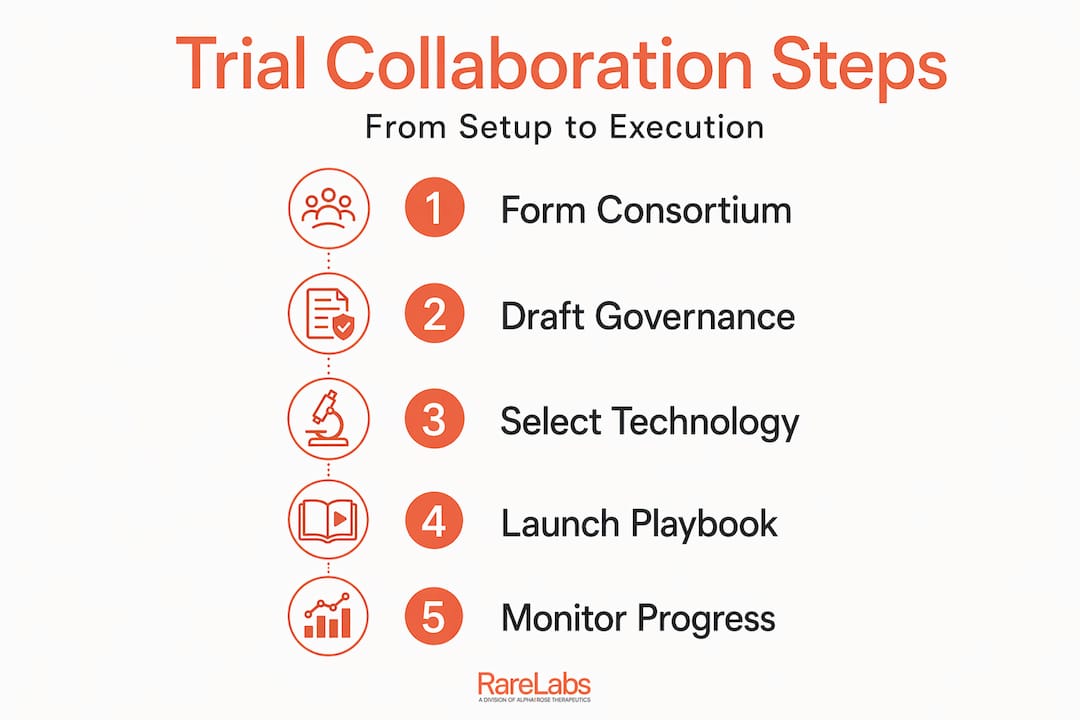
With governance in place, the design and operational phase is where most collaborations either gain momentum or collapse. The process below reflects best practices in clinical trials drawn from networks that have run successfully across multiple sites and jurisdictions.
-
Draft a collaborative protocol with patient input. This means co-designing endpoints, visit schedules, and burden assessments with patient representatives, not just running a survey after the protocol is written. PCORnet's multistakeholder model demonstrates that engaging patients, clinicians, and system partners in all phases, from topic selection to dissemination, accelerates research meaningfully.
-
Select and contract study sites with defined roles. Assign each site a written scope of responsibilities. Multi-site ambiguity about who owns recruitment, who coordinates shipments, and who handles protocol deviations causes 90% of operational conflicts.
-
Plan decentralized and hybrid operations explicitly. Decentralized clinical trial models reduce patient burden, but operational planning for decentralized trials requires detailed workflows covering investigational product shipping, remote onboarding procedures, and home-based sample collection. Do not assume digital tools handle this automatically.
-
Coordinate investigational product logistics. For rare diseases, supply chains are often fragile. Build temperature-monitoring protocols, backup shipping routes, and site-specific pharmacy agreements before enrollment opens.
-
Establish a communication architecture. Determine meeting cadences for the steering committee, site coordinators, and patient representatives separately. Combining all three into one call produces meetings that serve none of them well.
-
Finalize budget frameworks and contracts early. Payment milestones, publication rights, and data access terms should be resolved before a single IRB submission is filed.
Operational execution also benefits from a standardized technology stack. Shared eClinical platforms, real-time enrollment dashboards, and centralized document repositories reduce the coordination overhead that consumes researcher time in multi-site studies. That said, technology is only as useful as the clinical operations supporting it.
Pro Tip: Build a shared "playbook" document that all sites, advocates, and CRO partners receive at kickoff. It should cover escalation contacts, amendment procedures, and shipment protocols in one place. Teams that do this report fewer protocol deviations and faster conflict resolution.
Governance, safety oversight, and regulatory compliance
Safety oversight in multi-site rare disease trials is not just a regulatory checkbox. It is the mechanism through which your entire collaboration maintains credibility with patients, regulators, and the broader scientific community.

Under Good Clinical Practice (GCP) guidelines, the principal investigator (PI) carries direct accountability for safety systems. That means the PI designs and enforces safety and monitoring systems, ensures version control of consent forms, and manages adverse event reporting across all participating sites. In collaborative trials, this responsibility must be explicitly distributed with clear documentation of who serves as coordinating PI versus site PI.
Best practices in safety governance include:
- Version-controlled consent management: When protocol amendments occur, outdated consent language at sites represents one of the most common compliance failures. Implement a central document control system that flags each site when reconsent is required.
- Adverse event escalation protocols: Every site must have the same reporting timeline, escalation contact, and documentation format. Inconsistency across sites creates data integrity problems and delays safety reporting to regulators.
- Data integrity across sites: Centralized monitoring, remote source data verification, and pre-specified data quality thresholds prevent the silent accumulation of protocol deviations that only surface at an audit.
- International regulatory alignment: For trials spanning multiple jurisdictions, map the applicable regulatory frameworks by country at the planning stage. Do not assume FDA guidance translates directly to EMA or national rare disease programs.
"Process-driven collaboration with measurable governance improves rare disease study performance. Formal agreements, not goodwill, are what make multi-site trials function under pressure."
This is especially true when collaborative trials experience the inevitable stress points: enrollment shortfalls, protocol amendments, or safety signal reviews. A governance document that has anticipated these scenarios reduces the reaction time from weeks to days.
Patient-centric collaboration and decentralized trial models
The shift toward patient-centric rare disease trials is not a trend. It is a correction. For decades, clinical trial design optimized for site convenience, regulatory symmetry, and sponsor timelines. Patients absorbed the burden. Collaborative rare disease trials, done well, reverse that logic.
Hybrid and decentralized clinical trial models are the most practical expression of this shift. By enabling remote onboarding, home nursing visits, and direct-to-patient investigational product delivery, these models substantially expand the eligible patient pool, particularly for ultra-rare diseases where patients may be geographically isolated. The operational reality, however, is that logistics are the primary bottleneck in decentralized rare disease trials, not recruitment. Teams that focus solely on protocol writing and assume operations will follow are routinely surprised.
Practical approaches to optimize patient-centric collaboration include:
- Remote onboarding workflows: Map every step of the patient journey from consent to first dose, identifying which steps can be completed digitally, by phone, or via home visit.
- Direct patient communication channels: Patients and caregivers need a single point of contact who can answer logistical questions without routing everything through a site coordinator.
- Interdisciplinary team composition: Bring data scientists, regulatory experts, and patient advocates into your operational team, not just your advisory board. Their input during execution, not just design, changes outcomes.
- Registry-informed recruitment: Leverage existing patient registries and natural history studies to identify and pre-qualify candidates. This is one of the highest-return investments in rare disease trial strategies.
Studies show that multistakeholder engagement since 2014 in networks like PCORnet has accelerated clinical research significantly by combining patient partnerships with real-world health data. The lesson is that patient involvement is not a communication strategy. It is a scientific accelerator.
Pro Tip: When designing patient-reported outcome measures, have patient advocates review the instrument language before cognitive debriefing. Researchers consistently underestimate how clinical language alienates the patients who are supposed to complete these forms.
For a broader look at how these approaches intersect with accelerating rare disease therapy, the operational and scientific levers are more interconnected than they first appear.
My honest take on what most collaborations get wrong
I have spent considerable time working at the intersection of rare disease research and clinical operations, and I will share what I consistently see teams miscalculate. The ambition is almost always there. The operational humility rarely is.
Most collaborators spend enormous energy on the science and almost none on the logistics. They write elegant protocols and sign consortium agreements. Then they hit the first protocol amendment and discover that two sites are using different consent versions, nobody owns the investigational product shipping decision, and the patient advocacy partner was not told about the amendment for three weeks. The collaboration does not fail because of bad science. It fails because of assumptions.
What I have learned is that formal, measurable governance is not bureaucracy. It is the actual product of good collaboration. The SCRS Collaborate Forward data showing 84% of sites reporting improved performance from documented collaboration is not surprising to anyone who has managed a multi-site study. The teams that formalize their accountability structures outperform the ones relying on relationships and goodwill, every single time.
I also think the field underestimates how much patient advocates have to offer beyond recruitment support. When advocates participate in protocol design, they catch burden elements researchers normalize. A twice-weekly blood draw that a researcher considers minor might represent an impossible logistical challenge for a family managing a child with a rare disease.
The future of optimizing rare disease research depends on treating collaboration as both a scientific strategy and an operational discipline. Digital tools matter. Networks matter. But the foundational insight is simpler: agree on process before you agree on science, and document everything.
You can explore more on overcoming research collaboration challenges if the structural framing resonates with your current work.
— John
How Hopeatrarelabs supports your rare disease trial work
Collaborative rare disease trials require more than coordination frameworks. They require access to the best available treatment and research data to inform decisions at every stage.
Hopeatrarelabs built its rare disease knowledge platform specifically to give researchers, clinicians, and patient advocates a centralized hub for treatment and research data across ultra-rare and undiagnosed conditions. Whether you are designing a protocol, evaluating therapeutic options, or identifying prior evidence for a natural history study, the Hopeatrarelabs knowledge base surfaces relevant findings fast. For those conducting rare disease trials and evaluating therapeutic candidates, the Hopeatrarelabs treatment search offers a parallel screening resource built on the same patient-specific, scientifically rigorous model that defines the company's work. Start with the knowledge portal before your next protocol meeting.
FAQ
What makes rare disease clinical trials different from standard trials?
Rare disease trials face severely limited patient populations, which makes statistical power, recruitment, and site selection fundamentally different from standard trials. Collaborative networks and adaptive trial designs are often necessary to achieve meaningful results.
How does patient involvement improve rare disease trial outcomes?
Patient advocates embedded from protocol design through execution improve endpoint relevance, reduce patient burden in study design, and increase retention. Networks like PCORnet show that multistakeholder engagement accelerates research across all phases.
What is the role of a DMCC in collaborative trials?
A Data Management and Coordinating Center standardizes data collection, sharing, and quality oversight across multiple sites in a rare disease network. Without one, fragmentation in data handling is one of the most common causes of study failure.
Why do decentralized rare disease trials stall operationally?
The primary bottleneck in decentralized trials is logistical: managing investigational product supply chains, sample collection workflows, and remote onboarding rather than patient recruitment itself. Detailed operational planning before enrollment opens is the most reliable fix.
What governance documents should collaborative trials have before launch?
At minimum, a collaborative trial should have a signed consortium agreement, a communication and escalation plan, version-controlled consent management procedures, and a shared operational playbook distributed to all participating sites and partners.