

Accessing undiagnosed disease resources means connecting with specialized research programs, patient navigation support, and organized medical data to find answers for complex conditions. For families caught in what clinicians call the "diagnostic odyssey," knowing where to start is the hardest part. The Undiagnosed Diseases Network (UDN), funded by the NIH, and the Undiagnosed Diseases Network Foundation (UDNF) are the two most important entry points in the United States. Understanding how to navigate undiagnosed disease resources, from application to community support, can cut months off your search and reduce the emotional toll on your family.
What is the Undiagnosed Diseases Network and how can it help you?
The UDN is a national, NIH-funded research network designed to evaluate patients with complex, unresolved medical conditions that have stumped conventional clinical care. It operates across multiple academic medical centers and focuses on generating diagnoses through advanced genomic testing, multidisciplinary expert review, and collaborative research. The network has facilitated diagnoses for over 650 individuals since its founding. That number reflects only patients who received a confirmed diagnosis, not the full scope of families who gained meaningful clinical insight from the evaluation.
The acceptance process is selective. The UDN accepts roughly 30–35% of referred applicants, which means preparation matters enormously. Here is what the timeline looks like once you submit:
- Medical record review: The UDN team reviews submitted records within up to 60 business days.
- Application evaluation: After records review, formal application evaluation takes 8–12 weeks.
- Admission to evaluation: If accepted, onsite evaluation is scheduled 2–6 months after acceptance.
- Onsite evaluation: The visit at the NIH Clinical Center typically lasts 2–5 days and includes DNA analysis, telehealth consultations, and review by specialists across multiple disciplines.
- Post-evaluation follow-up: Results and recommendations are shared with the patient and referring provider.
Onsite evaluations involve specialists in endocrinology, immunology, neurology, cardiology, and genetics, ensuring no system is overlooked. That breadth is what separates the UDN from a standard academic referral.
One critical point: the UDN is a research and diagnostic program, not a treatment center. Families who arrive expecting ongoing clinical management often feel blindsided. The UDN's role is to identify what is wrong, not to become your primary care team.
Pro Tip: Before applying, read the UDN's published eligibility criteria carefully. Patients with conditions that already have a known diagnosis, even a partial one, are typically not eligible. Knowing this upfront saves weeks of effort.
How to prepare and submit your medical records for specialized programs
Organizing your medical history is the single most controllable factor in getting your case reviewed quickly. A disorganized submission slows review and reduces the chance of acceptance. Compiling a complete, digital, chronological binder of all clinical notes, test results, and imaging is the standard preparation method recommended by the UDNF.
What to include in your medical record packet
- Clinical notes: All physician visit summaries, specialist consultations, and hospitalization records in date order
- Lab results: Complete blood panels, metabolic workups, genetic test reports, and any prior whole exome or genome sequencing results
- Imaging: MRI, CT, X-ray, and ultrasound reports with the actual images on disc or digital file when possible
- Surgical and pathology reports: Any biopsy results, operative notes, or tissue analysis
- Prior diagnoses and ruled-out conditions: A clear list of what has been tested and excluded, which helps reviewers avoid duplication
Common submission mistakes to avoid
| Mistake | Better approach |
|---|---|
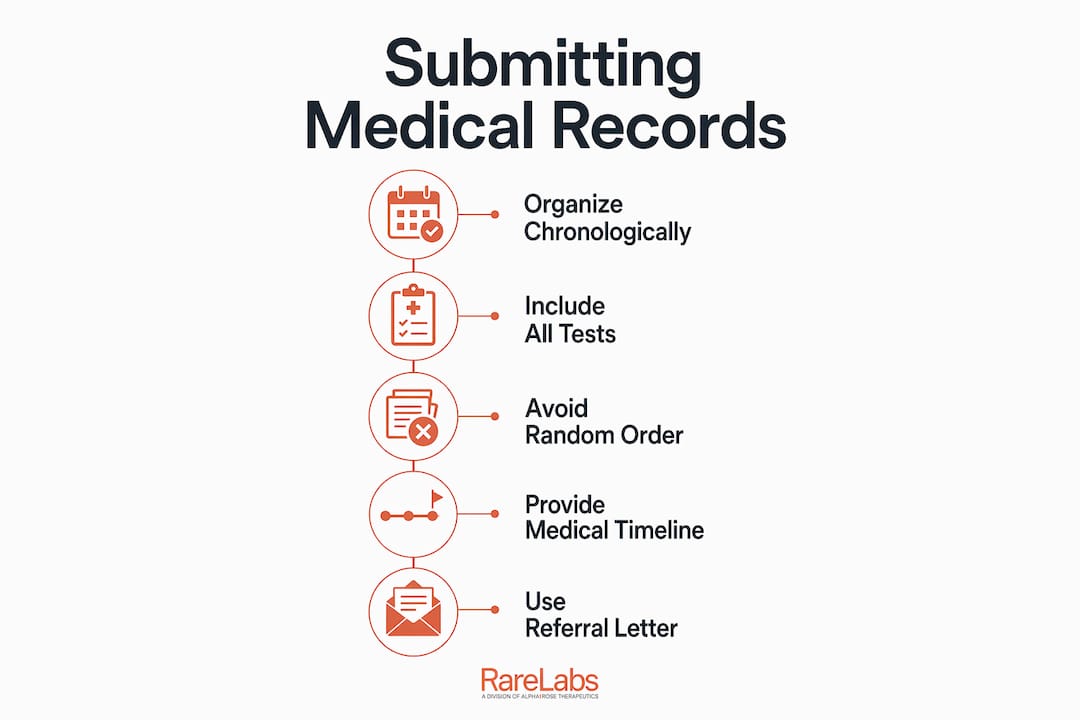
| Sending records in random order | Organize chronologically by date of service |
| Omitting imaging files | Include both the report and the actual image files |
| Skipping genetic test results | Include all prior genetic panels, even if negative |
| Submitting without a summary letter | Ask your referring physician to write a concise case summary |
| Applying without patient navigator support | Contact the UDNF navigation program before submitting |
Patient advocacy support through the UDNF increases the likelihood that a case gets flagged for review by aligning the medical history with the program's research criteria. This is not a minor advantage. Navigators understand exactly what reviewers look for and can identify gaps in your submission before it goes in.
Pro Tip: Create a one-page medical timeline that lists the patient's major symptoms, key test dates, and specialist visits in bullet form. Attach it to the front of your submission. Reviewers process dozens of cases; a clear summary makes yours easier to evaluate quickly.
For a broader look at accelerating rare disease answers, the Hopeatrarelabs blog offers practical guidance on speeding up the diagnostic process.
What support is available beyond the diagnostic process?
Finding resources for undiagnosed illness does not stop at the clinic door. The emotional and psychological weight of an undiagnosed condition is significant, and the support infrastructure around the UDN addresses this directly.
The UDNF Patient Navigation program offers free support throughout the case journey, from initial application through post-evaluation follow-up. Navigators are not just administrative helpers. They are trained advocates who understand the medical and emotional dimensions of the diagnostic odyssey.
"Navigating undiagnosed diseases requires a dual-track approach: active medical pursuit combined with psychoeducational support to endure long diagnostic journeys." — UDNF Undiagnosed Community
Beyond navigation, the UDNF offers several community-based resources:
- Undiagnosed Exchange: A psychoeducational support program led by mental health professionals with both clinical and personal experience in rare disease. Sessions help families process uncertainty, grief, and the stress of prolonged medical searching.
- Patient and family councils: Volunteer-led groups where families share practical knowledge about submitting cases, managing specialists, and maintaining daily life during a diagnostic odyssey.
- Online communities: Private forums and social groups where families connect with others in similar situations, reducing the isolation that often accompanies undiagnosed conditions.
- Genetics education resources: Guides explaining concepts like whole genome sequencing, variant classification, and inheritance patterns in plain language.
For families who want to go deeper on the science, genetic disease education resources from Hopeatrarelabs explain key concepts without requiring a biology degree. Understanding the basics of genetics helps families ask better questions and evaluate recommendations more confidently.
The support for undiagnosed diseases available through community networks is often underused. Families focused entirely on the medical search sometimes neglect the psychological infrastructure that makes a long search survivable.
How to coordinate care after a diagnostic program evaluation
Diagnosis is a starting point, not a finish line. Implementing treatment recommendations requires active coordination with local healthcare providers. This is where many families lose momentum after a UDN evaluation.
The UDN and similar programs provide consultation. They do not provide ongoing clinical care. Understanding that distinction before you arrive prevents a painful letdown after you leave.
Here is how to make the transition from diagnostic program to local care work:
- Share the full evaluation report with your primary care physician and all relevant specialists immediately after receiving it.
- Request a care coordination call with the UDN team and your local provider to walk through recommendations together.
- Identify which recommendations require specialist referrals and start those referral requests before you leave the evaluation site.
- Ask the UDN team explicitly which findings are actionable now versus which require monitoring over time.
- Document everything your local providers say in response to the UDN findings, and keep a running record of what has been implemented.
Responsibility for acting on recommendations sits with the patient and the local clinician. The UDN provides the map. Your local team drives the car. Families who treat the UDN report as a living document, updating their local providers as new research emerges, get the most out of the evaluation long-term.
For a detailed look at finding rare disease treatments after a diagnosis, Hopeatrarelabs offers a step-by-step guide that covers treatment pathways for conditions with limited approved options.
Key takeaways
Effective navigation of undiagnosed disease resources requires organized medical records, strategic use of patient navigation programs, and clear expectations about what diagnostic programs can and cannot provide.
| Point | Details |
|---|---|
| UDN acceptance is competitive | Only 30–35% of applicants are accepted; strong preparation directly improves your odds. |
| Organize records before applying | A complete, chronological digital binder reduces delays and strengthens your submission. |
| Use patient navigators | UDNF navigators align your case with research criteria and increase review likelihood. |
| Diagnosis requires local follow-through | UDN provides consultation only; local providers must implement treatment recommendations. |
| Emotional support is part of the process | Programs like Undiagnosed Exchange address the psychological toll alongside the medical search. |
What I have learned from watching families navigate this process
The families who do best in the diagnostic odyssey share one trait: they treat the process like a project, not a prayer. They build binders, they call navigators, they show up to evaluations with printed timelines and specific questions. That level of preparation is not natural for most people in crisis. It has to be learned, and it has to be practiced.
What I have also seen is that families often underestimate how much the emotional side of this journey matters. A parent who has not slept in months because of anxiety about an undiagnosed child is not going to advocate effectively in a clinical setting. The Undiagnosed Exchange program exists for exactly this reason. Using it is not a sign of weakness. It is a strategic decision.
The other thing I would say plainly: do not wait for a perfect submission. Many families spend six months trying to compile every record before applying, when a strong partial submission with navigator support would have moved faster. Done is better than perfect when your child is still undiagnosed.
The UDN model, where patients contribute to research that benefits future families, reframes the experience in a meaningful way. You are not just seeking answers for your family. You are adding to a body of knowledge that helps the next family find answers faster. That perspective does not make the wait easier, but it makes it feel less pointless.
— John
How Hopeatrarelabs can support your rare disease search
When diagnostic programs provide answers but treatment options remain unclear, Hopeatrarelabs offers a resource built specifically for that gap.
The RareLabs Knowledge hub is a curated research and treatment information platform for patients and families dealing with ultra-rare and undiagnosed genetic diseases. It covers disease modeling, treatment screening approaches, and the latest research on conditions that lack approved therapies. If you have received a diagnosis from the UDN or a similar program and are now asking "what comes next," this is where to look. Hopeatrarelabs combines scientific depth with patient-centered clarity, so you can evaluate your options without needing a PhD to understand them.
FAQ
What is the Undiagnosed Diseases Network?
The Undiagnosed Diseases Network is a national, NIH-funded research program that evaluates patients with complex conditions that have not been diagnosed through standard clinical care. It operates across multiple academic medical centers and uses advanced genomic testing and multidisciplinary expert review.
How long does the UDN application process take?
Medical record review takes up to 60 business days, application evaluation takes 8–12 weeks, and onsite evaluation is scheduled 2–6 months after acceptance. The full process from submission to evaluation can take close to a year.
Do I need a doctor to refer me to the UDN?
Yes. The UDN requires a referring healthcare provider to submit a case on your behalf. Your primary care physician or a specialist can initiate the referral through the UDN's online submission portal.
What is the UDNF Patient Navigation program?
The UDNF Patient Navigation program provides free support to families throughout the UDN application and evaluation process. Navigators help align medical histories with research criteria and guide families through each stage of the case journey.
What happens after a UDN evaluation if no diagnosis is found?
Families receive a detailed report of findings and recommendations even without a confirmed diagnosis. The UDN may suggest additional testing, monitoring protocols, or referrals to other specialists, and the case may remain open for future review as new research emerges.