

A genetic variant assessment workflow is the structured, multi-stage process that takes a raw DNA finding from sequencing all the way to a clinically meaningful answer, whether that answer is a confirmed diagnosis, a reclassified variant, or a shortlist of treatment candidates. For ultra-rare and undiagnosed diseases, the workflow rarely ends at the bioinformatics report. Personalized disease modeling, using patient-derived induced pluripotent stem cells (iPSCs), CRISPR-edited isogenic controls, and high-throughput drug screens, is the experimental layer that resolves variants that standard classification cannot settle. If your family has received a Variant of Uncertain Significance (VUS) or a diagnosis with no approved treatment, that is the point at which contacting a specialized modeling lab like Hopeatrarelabs becomes worth a serious conversation.
What this guide covers:
- The end-to-end genomic variant evaluation process, stage by stage
- What a VUS actually means and what can move it toward an answer
- How iPSC and CRISPR disease models work in plain terms
- What to bring to a lab consultation and what realistic timelines look like
- Costs, funding routes, and U.S. regulatory context
Table of Contents
- What does the genetic variant assessment workflow look like, step by step?
- What does a VUS actually mean for your family?
- How do personalized disease models actually work?
- How are experimental results interpreted and used?
- What should you bring before contacting a disease-modeling lab?
- What do timelines and costs typically look like?
- What are the real limitations and ethical considerations?
- How does Hopeatrarelabs run a variant-assessment and disease-modeling program?
- Starting a program with Hopeatrarelabs
- Key Takeaways
- What the standard workflow misses for ultra-rare cases
- Useful sources and further reading
What does the genetic variant assessment workflow look like, step by step?
The workflow runs through eight stages. Each stage has a distinct owner, output, and clinical status.
| Stage | Purpose | Who performs it | Typical timeline | What you receive | Typical cost range | Likely next step |
|---|---|---|---|---|---|---|
| 1. Deep phenotyping | Capture HPO-coded symptoms, family history, prior diagnoses | Clinician / genetic counselor | 1–4 weeks | Structured phenotype record | Included in clinical visit | Guides sequencing choice |
| 2. Sequencing | Generate raw DNA data (WES or WGS) | CLIA-certified diagnostic lab | 4 weeks | FASTQ/BAM files, lab report | $1,000+ | Bioinformatics pipeline |
| 3. Alignment and variant calling | Map reads to GRCh, call SNVs/indels/SVs | Diagnostic or core bioinformatics facility | 1–3 weeks | VCF file | Often bundled with sequencing | Annotation and filtering |
| 4. Filtering and prioritization | Narrow thousands of variants to candidates using gnomAD frequency, in silico scores, HPO match | Bioinformatician / diagnostic lab | 1–2 weeks | Prioritized variant list | Bundled | ACMG classification |
| 5. ACMG/AMP classification | Apply ACMG/AMP criteria (pathogenic/likely pathogenic/VUS/likely benign/benign) | Clinical molecular geneticist | 1–4 weeks | Clinical variant report (CLIA) | Bundled with diagnostic testing | Diagnosis, or functional work if VUS |
| 6. Functional validation | Test variant effect in patient-derived cells; iPSC derivation, CRISPR isogenic controls, MAVEs | Research lab (e.g., Hopeatrarelabs) | 3 months | Research-grade functional evidence | $30,000+ | Reclassification support, treatment screen |
| 7. Treatment | Screen FDA-approved drugs, ASOs, gene therapy candidates in disease model | Research lab | 2–6 months | Drug/ASO hit list, preclinical data | Included in program or additional | N-of-1 trial planning, compassionate use |
| 8. Interpretation and translation | Integrate all evidence; plan clinical next steps | Clinician + research lab together | 2–4 weeks | Translational report | Included in program | Clinical team action |
CLIA vs. research results: Stages 1–5 produce CLIA-certified clinical reports. Those reports can directly inform diagnosis and clinical care. Stages 6–8 produce research-grade evidence. Research results cannot substitute for a CLIA-certified clinical test, but they can support variant reclassification submissions to ClinVar and ClinGen, inform compassionate-use applications, and guide N-of-1 trial design. A systematic approach to variant assessment confirms that raw sequence review, population frequency checks via gnomAD, and literature searches are all required steps before any classification is final.
What does a VUS actually mean for your family?
A VUS, Variant of Uncertain Significance, is not a negative result. It means the evidence is incomplete, not that the variant is harmless.
Under the ACMG/AMP framework, variants land in five categories: pathogenic, likely pathogenic, VUS, likely benign, and benign. A VUS sits in the middle because labs lack sufficient population frequency data (gnomAD), functional studies, or family segregation evidence to tip the scales. ClinVar archives these classifications publicly; ClinGen expert panels review them for specific genes. The ClinGen and ACMG/AMP frameworks (Clinical Variant Analysis Tool (CVAT) — Genetics in Medicine00703-1/fulltext) create a classification bottleneck: without functional data, many variants stay uncertain indefinitely.
Three things can move a VUS toward pathogenic or benign:
- Family segregation testing: Does the variant track with affected relatives? Does it appear in unaffected ones?
- Deep phenotype documentation: HPO-coded symptom lists improve the odds that a variant is correctly prioritized. Insufficient phenotype documentation is one of the most common reasons prioritization tools miss the causative variant.
- Functional assays: Patient-derived iPSCs, isogenic CRISPR lines, and multiplexed assays of variant effect (MAVEs) generate experimental evidence that directly tests whether the variant disrupts the relevant biology.
Questions to ask your clinician when you receive a VUS:
- Can I get the raw VCF or FASTQ files for future reanalysis?
- What is your lab's reanalysis policy as new evidence emerges?
- Has this variant been submitted to ClinVar? Under what review status?
- Is there a ClinGen expert panel for this gene?
- What functional data would be needed to reclassify it?
For a plain-language guide to reading your lab report, the family guide to genetic test results at Hopeatrarelabs walks through each category in accessible terms.
How do personalized disease models actually work?
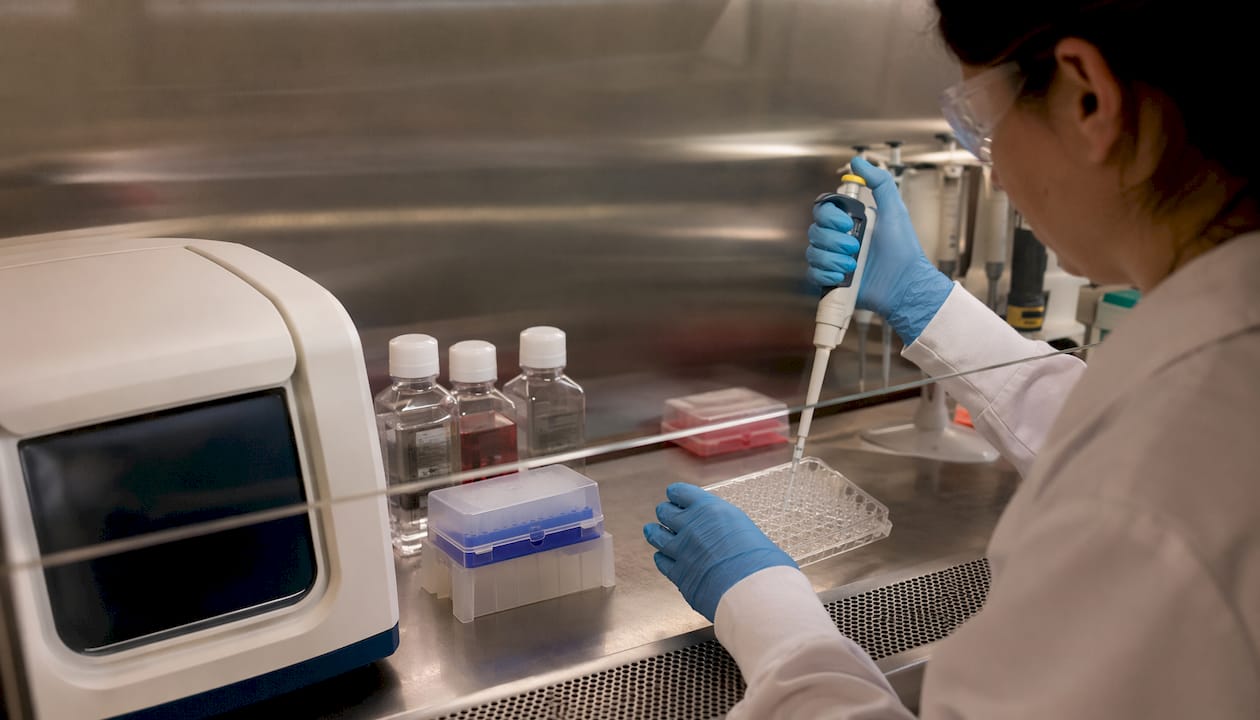
Patient-derived iPSCs start with a blood draw or skin biopsy. The cells are reprogrammed into a pluripotent state and then differentiated into the cell type most relevant to the disease, neurons for a neurological condition, cardiomyocytes for a cardiac one. This gives researchers a living model that carries the patient's exact genetic background, not a generic cell line.
CRISPR isogenic controls are the critical comparison. The lab uses CRISPR to correct the variant in one set of patient iPSCs, creating a cell line that is genetically identical except at the variant site. Any difference in behavior between the corrected and uncorrected lines is attributable to that specific variant. Without isogenic controls, it is impossible to separate the variant's effect from background genetic noise.
MAVEs (multiplexed assays of variant effect) scale this further. Instead of testing one variant at a time, MAVEs generate functional scores for thousands of variants in parallel. They have been used to reclassify variants in genes like BRCA1 and TP53, and consensus recommendations now guide how MAVE data maps to ACMG PS3/BS3 criteria for clinical interpretation. For a deeper look at how this modeling approach translates to treatment discovery, the Hopeatrarelabs post on genetic disease modeling is worth reading.
Pro Tip: When evaluating a lab's functional work, ask specifically whether they use CRISPR isogenic controls and whether their assay readouts are tied to your patient's actual phenotype. A cellular assay measuring the wrong endpoint in the wrong cell type produces data that looks rigorous but cannot support reclassification.
How are experimental results interpreted and used?
Functional results come in several forms: quantitative cellular phenotype measurements, MAVE functional scores, and rescue experiments where a drug or ASO partially or fully restores normal cell behavior. The strength of the evidence depends on assay design, reproducibility across replicates, and whether appropriate controls were included.
From there, the downstream paths branch:
- Variant reclassification: Strong PS3 evidence supports a ClinVar submission and potential reclassification by a ClinGen expert panel, which can change clinical care.
- Preclinical drug development: A drug hit from a high-throughput screen becomes a candidate for compassionate use, expanded access, or a formal N-of-1 trial.
- ASO development: Custom antisense oligonucleotides targeting the specific variant or splicing defect can be designed and tested in the same disease model.
- Gene therapy feasibility: The iPSC model can assess whether gene replacement or editing is a viable path.
The translational path from functional validation to preclinical evidence is not linear. Most programs generate a ranked list of candidates, not a single definitive answer.
What should you bring before contacting a disease-modeling lab?
Preparation shortens the intake process significantly. Labs need clinical context to design assays that are relevant to your patient's phenotype.
Documents and data to gather:
- All prior genetic test reports (panel, exome, genome), including variant classifications
- Raw data files if available: VCF, FASTQ, or BAM
- Detailed clinical notes with HPO-coded phenotype terms
- Family history and any segregation testing already completed
- Prior functional data, if any exists
- Relevant imaging, biochemical labs, and pathology reports
Sample logistics: iPSC derivation typically requires a blood sample (peripheral blood mononuclear cells) or a skin punch biopsy. Some labs also accept fibroblast cultures already established elsewhere. Confirm sample shipping requirements and processing windows before collection.
Consent and regulatory questions to ask a lab:
- Is this program conducted under IRB oversight, or is it a fee-for-service research program?
- Will results be CLIA-certified or research-grade only?
- Who owns the data and the iPSC lines generated?
- What is the data-sharing and publication policy?
- What is the cost structure and payment schedule?
Thorough clinical-grade variant assessment also requires raw-data validation steps, transcript selection, and HGVS coordinate mapping before any functional work begins. Bring everything you have.
What do timelines and costs typically look like?
| Program stage | Typical duration | Typical cost range | Who usually funds it |
|---|---|---|---|
| Sample prep and iPSC derivation | 2–4 months | $15,000+ | Patient/family, foundation |
| Assay development and QC | 1–3 months | $10,000+ | Foundation, grant |
| Functional validation (CRISPR + assays) | 2–4 months | $20,000+ | Foundation, biopharma partner |
| Drug/ASO screening | 2–4 months | $15,000+ | Biopharma, philanthropic grant |
| Analysis, reporting, translational planning | 1–2 months | $5,000+ | Patient/family, foundation |
| Total program (typical range) | 8 months | $65,000–$160,000+ | Mixed |
Cost varies substantially based on disease complexity, assay depth, and whether CLIA confirmation is added. CLIA confirmation of a functional finding adds time (typically 2–4 months) and cost but is required before a result can be used in a formal clinical report or reclassification submission.
Common funding routes:
- Disease-specific foundations and advocacy organizations (many fund individual family programs)
- NIH grants (R21, R01, Rare Diseases Clinical Research Network)
- Crowdfunding campaigns tied to a named foundation
- Biopharma partnerships, particularly when the disease has broader commercial interest
- Philanthropic family foundations
What are the real limitations and ethical considerations?
Personalized disease modeling is powerful, but families and funders need honest expectations.
Primary limitations:
- An iPSC model reflects the patient's genetics, but not always the full disease context (age of onset, tissue environment, modifier genes)
- False positives and false negatives occur; a single assay result is not definitive
- N-of-1 findings have limited generalizability; what works in one patient's cells may not work in another's
Regulatory and ethical points:
- Research-grade results cannot be used as a standalone basis for prescribing a treatment; a clinician must make that decision
- IRB oversight is required when results will be used in a clinical trial or published with patient-identifiable data
- Informed consent should explicitly cover data sharing, biobank storage of iPSC lines, and return-of-results policies
- Off-label use of a drug identified in a screen requires physician involvement and, in many cases, FDA compassionate use or expanded access authorization
The genetics and clinical risk context from clinical practice illustrates how genetic findings translate into medical decisions across specialties. The same principle applies here: research evidence informs, but a qualified clinician decides.
This article is general information, not medical or legal advice. Confirm current regulatory requirements and clinical applicability with a board-certified clinical geneticist or your treating physician.
How does Hopeatrarelabs run a variant-assessment and disease-modeling program?
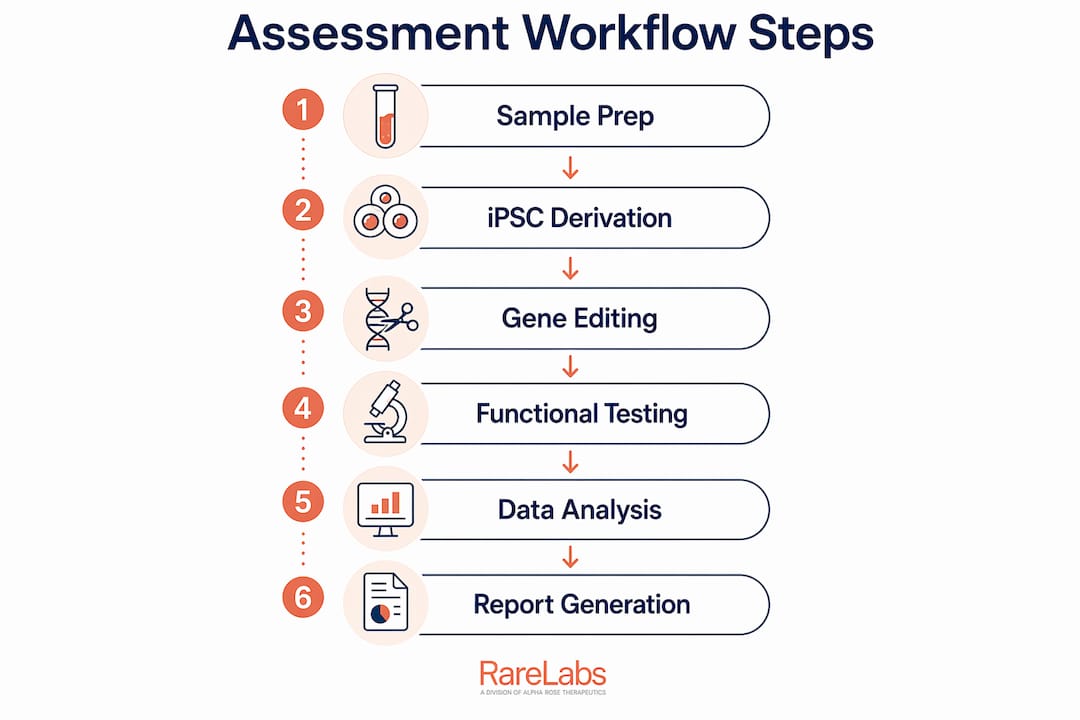
Hopeatrarelabs runs programs in six phases: intake and deep phenotyping, iPSC derivation and quality control, CRISPR isogenic line generation, functional assay development, high-throughput drug and ASO screening, and final reporting with translational planning.
Deliverables include a full technical report, raw data access, documented assay protocols, a functional evidence summary mapped to ACMG PS3/BS3 criteria where applicable, and a translational recommendations memo. Hopeatrarelabs references ClinVar and ClinGen records throughout and applies the ACMG/AMP framework to contextualize functional findings. The iterative, evidence-driven workflow used in programs like this reflects what clinical variant analysis research00703-1/fulltext) confirms: final interpretation requires human evidence synthesis, not just automated output.
To start a conversation, reach out through the Hopeatrarelabs intake process. The initial call covers scientific scope, expected timelines, and budget range.
Starting a program with Hopeatrarelabs
For families and foundations who have exhausted standard diagnostic routes, Hopeatrarelabs offers a fee-for-service personalized disease-modeling program built around your patient's specific variant and phenotype. Programs typically fall in the $65,000–$160,000+ range depending on scope, and the team works actively with families to identify foundation support, philanthropic partnerships, and biopharma co-funding where applicable.
To begin, gather your prior genetic reports, raw data files if available, and a summary of your patient's clinical history. Submit through the RareLabs knowledge hub, where you can also review program details and request an initial scientific consultation. The team responds to intake inquiries with a scoping call, typically within a few business days, to discuss whether a program is the right fit and what it would involve.
Key Takeaways
A VUS is not a negative result, and personalized disease modeling using iPSCs, CRISPR isogenic controls, and high-throughput screens is the primary experimental path to resolving it and identifying treatment candidates.
| Point | Details |
|---|---|
| Collect raw data early | Request VCF and FASTQ files from your diagnostic lab; they are required for reanalysis and functional program intake. |
| VUS requires functional work | ACMG/AMP classification stalls without functional evidence; iPSC and MAVE assays provide the PS3/BS3 data needed to move forward. |
| Timelines are long | A full personalized disease-modeling program typically runs several months; plan funding and clinical coordination accordingly. |
| Funding is available | Disease foundations, NIH grants, and biopharma partnerships regularly co-fund ultra-rare disease modeling programs. |
| Hopeatrarelabs as next step | Hopeatrarelabs runs end-to-end iPSC, CRISPR, and drug-screen programs for ultra-rare cases; start with the knowledge hub. |
What the standard workflow misses for ultra-rare cases
The conventional wisdom in genomic medicine is that sequencing plus ACMG classification is the endpoint. For common diseases with well-curated genes, that is often true. For ultra-rare conditions, it is almost never enough.
The gap is not a failure of the diagnostic lab. It is structural. ACMG/AMP criteria require prior evidence, and for a gene with three published cases worldwide, that evidence simply does not exist yet. Waiting for the literature to catch up is not a strategy when a child is losing function.
What actually moves the needle is treating the patient's own cells as the primary data source. An isogenic iPSC model does not need a published cohort. It needs a well-designed assay and a clear phenotypic question. That shift in framing, from population evidence to patient-specific experimental evidence, is what separates a program that produces actionable results from one that produces another uncertain report.
The families and foundations who engage early, before the clinical team has exhausted all options, tend to get more out of the process. The biology does not change, but the time available to act on it does.
Useful sources and further reading
These primary resources back the claims in this article and are worth bookmarking for your own research.
- ACMG/AMP Standards and Guidelines for Sequence Variant Interpretation: The foundational framework for the five-tier classification system (pathogenic through benign). Essential reading for understanding what your lab report means.
- ClinVar: NCBI's public archive of variant classifications and their supporting evidence. Search your variant by gene name or HGVS notation to see how other labs have classified it.
- ClinGen: Expert panels that curate gene-disease validity and variant classifications. Check whether a panel exists for your gene.
- gnomAD: Population frequency database covering hundreds of thousands of genomes. A variant's frequency in gnomAD is a key input to ACMG criteria PM2, BS1, and BA1.
- Multiplexed Assays of Variant Effect (MAVEs) — Nature Reviews Genetics: Current state of high-throughput functional variant scoring and how MAVE data maps to clinical interpretation criteria.
- A Systematic Approach to Variant Assessment — PMC: Step-by-step protocol for clinical variant interpretation, including raw-data validation and HGVS mapping. Useful for understanding what a thorough diagnostic review involves.
- Clinical Variant Analysis Tool (CVAT) — Genetics in Medicine00703-1/fulltext): Evidence that structured, semi-automated variant review tools improve consistency; relevant for families evaluating lab quality.
- CLIA Program (CMS): The U.S. regulatory framework governing clinical laboratory testing. Confirms what CLIA certification means for a lab report's clinical validity.
- Hopeatrarelabs variant interpretation primer: Clinician-level overview of how variants are assessed and interpreted, written for the rare disease context.
On CLIA vs. research results: A CLIA-certified report from a licensed laboratory can be used directly in clinical decision-making. Research-grade functional data from a non-CLIA lab cannot substitute for that report, but it can inform reclassification submissions, compassionate-use requests, and N-of-1 trial design. Always confirm the regulatory status of any result with your clinical team before acting on it.