
A Pre-IND meeting is a Type B FDA consultation that gives sponsors targeted feedback on chemistry, manufacturing and controls (CMC), nonclinical, and clinical development plans before an IND submission. It's optional, but skipping it on a novel program is usually a mistake. Build your project plan around three numbers: FDA decides whether to grant the meeting within 21 days, schedules it within 60 days if granted, and requires your briefing package roughly 30 days before that date.
TL;DR:
- Failure to include detailed lot-linkage and assay validation data in the briefing package is a common reason for delays or resubmissions.
- The meeting request must be submitted at least 8 weeks before the planned meeting date, with a properly drafted letter and a working briefing package ready in advance.
- The FDA's formal decision on granting the Pre-IND request occurs within 21 days, and a scheduled meeting typically takes place within 60 days if approved.
- A comprehensive briefing package should not exceed 300 pages, with clearly numbered questions grouped by discipline, to ensure focused and efficient review.
- FDA's feedback often highlights gaps in CMC and assay linkage, making pre-meeting lab work and patient-derived models crucial for a successful program.
Table of Contents
- What is an FDA Pre-IND meeting for?
- How long does the Pre-IND meeting process take?
- How do you request a Pre-IND meeting with FDA?
- What goes in the Pre-IND briefing package?
- Why do Pre-IND meeting requests get denied or canceled?
- What happens during and after the Pre-IND meeting?
- Building a backward timeline for your Pre-IND meeting
- RareLabs perspective: what translational readiness actually looks like
- Strengthening your briefing package with translational lab support
- Sources
What is an FDA Pre-IND meeting for?
The point of a Pre-IND meeting isn't a rubber stamp. It's a chance to get the review division's actual position on your CMC characterization, your nonclinical safety package, and your proposed starting dose and monitoring plan before you commit resources to the wrong protocol design. Sponsors walk away with either verbal alignment during a live discussion or written answers to specific numbered questions.
Request one when your development questions genuinely aren't answered by existing FDA guidance documents. That covers more situations than people assume:
- A first-in-human program with a novel mechanism or modality
- A gene therapy, ASO, or cell therapy without a directly applicable product-class guidance
- A small-business sponsor without in-house regulatory precedent for the target indication
- A program where preclinical data could plausibly justify more than one starting-dose approach
If you have five separate open questions across CMC, tox, and clinical design, don't file three separate meeting requests. The CDER SBIA FAQ and FDA's own formal meetings guidance both encourage folding related issues into a single Type B meeting rather than fragmenting the review division's attention across multiple requests.
How long does the Pre-IND meeting process take?
The clock starts the day FDA receives your written meeting request, not the day you finish drafting it. FDA's formal meetings guidance for PDUFA products sets a 21-calendar-day window for the division to notify you whether the Type B meeting is granted. If granted, the meeting is generally scheduled within 60 calendar days of that original request.
| Milestone | Timing |
|---|---|
| FDA grant/deny decision | Within 21 calendar days of request |
| Meeting scheduled (if granted) | Generally within 60 calendar days of receipt |
| Briefing package due | At least 30 days before the meeting date |
| Preliminary written comments from FDA | Typically 1 to 2 days before the meeting |
| Official meeting minutes issued | Typically within 30 calendar days after the meeting |
FDA can also opt for a Written Response Only (WRO) instead of holding a live discussion. Per the OTP Pre-IND meetings page, a WRO carries the same question-volume limits as a standard 60-minute Type B meeting. If FDA's written answers actually resolve your questions, there's no requirement to insist on the live session. Treat a WRO as a contingency worth planning for, not a downgrade.
How do you request a Pre-IND meeting with FDA?
Your request goes to the review division most likely to handle the eventual IND, not to a general FDA mailbox. For cell and gene therapy programs, that's typically the Office of Therapeutic Products (OTP), which publishes dedicated procedural pages and, in some cases, division-specific email addresses for meeting requests. Once your request is logged, FDA assigns a Regulatory Project Manager (RPM) who becomes your primary point of contact through the review.
- Confirm the right division. Match your product type to the correct center or office before drafting anything; a misrouted request adds delay you can't recover.
- Draft the meeting request letter. Include product identity, proposed meeting type (Pre-IND, Type B), a short development summary, your specific objectives, proposed attendees with titles, and a preliminary question list.
- Propose two or three meeting dates. Aim 6 to 8 weeks out from your submission date to leave real time for briefing-package assembly after a grant decision.
- Submit and track your PTS number. FDA assigns a tracking number on receipt; use it in all follow-up correspondence.
- Watch for the 21-day decision. If granted, you'll get a scheduled date and an RPM assignment, which starts your 30-day countdown to the briefing package deadline.
Pro Tip: Draft a working version of your briefing package before you even submit the request letter. The gap between a grant decision and your package deadline is often compressed, and starting from a blank page at that point routinely produces a rushed, weaker submission.
What goes in the Pre-IND briefing package?
Reviewers read your briefing package in advance and form their answers based on what's in it, not on what you say live. A weak package produces vague, general answers no matter how well the meeting itself is run.
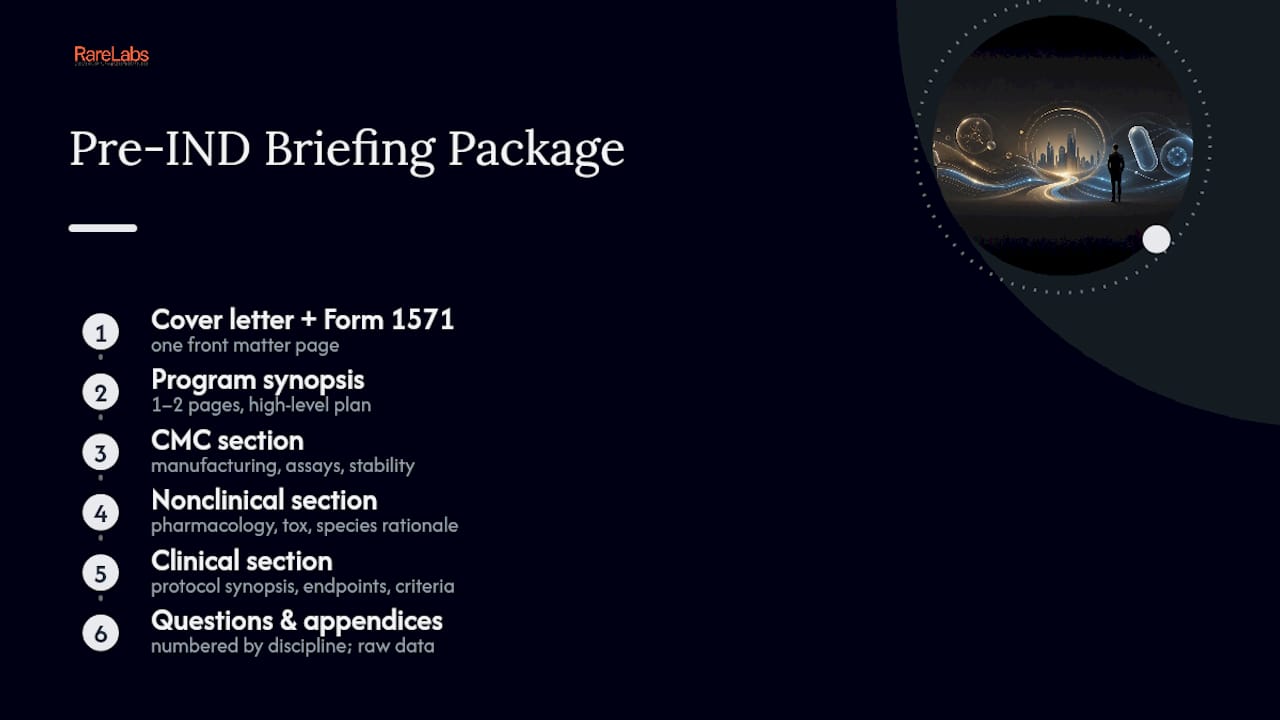
Structure it with a cover letter, the relevant Form FDA 1571 information, and a tight one-to-two-page synopsis of your development program up front, before the technical sections.
CMC section should cover your manufacturing scheme, key assays and their validation status, lot-linkage between test articles used in nonclinical studies and the material planned for clinical use, release criteria, and a stability summary. This is the section sponsors most often shortchange, and it's the one most likely to trigger a clinical hold later if it's thin.
Nonclinical section should present your pharmacology and toxicology data, the rationale for species selection, and margins that justify your proposed starting dose. If your safety margin calculation depends on an assumption FDA hasn't seen you defend before, defend it here.
Clinical section should include a protocol synopsis: dose-escalation scheme, safety monitoring plan, primary and secondary endpoints, and inclusion/exclusion criteria in enough detail that a reviewer can evaluate feasibility without guessing.
Number every question, group them by discipline (CMC, nonclinical, clinical), and avoid compound questions that bury two issues in one sentence. The OTP guidance discourages packages beyond roughly 250 to 300 pages and flags overly long question lists as a reason meetings run poorly. Appendices with raw data are fine when the main narrative stays lean; don't let supporting material substitute for a clear synopsis. Clear lot-linkage information tying nonclinical batches to your planned clinical batch is one of the highest-leverage things you can include, because it heads off a whole category of follow-up questions before they're asked.
Why do Pre-IND meeting requests get denied or canceled?
Most denials trace back to a handful of repeat mistakes, and nearly all of them are avoidable with better internal review before submission.
- Insufficient CMC detail, especially missing lot-linkage between test articles and planned clinical material, is one of the most common substantive problems the OTP page calls out.
- Too many or unfocused questions overwhelm a 60-minute meeting and push FDA toward generic answers rather than specific guidance.
- A late or missing briefing package past the 30-day deadline is grounds for cancellation, not just a delay.
- Misrouted requests that don't reach the correct review division, or requests that fragment related issues across multiple filings instead of consolidating them, waste review time and your own.
What happens during and after the Pre-IND meeting?
A live Pre-IND meeting typically runs 60 minutes and includes your regulatory, CMC, nonclinical, and clinical leads alongside FDA's review team and RPM. FDA usually sends preliminary written comments 1 to 2 days ahead, and those comments often answer several of your questions outright.
- If preliminary responses genuinely resolve your open items, you can cancel the live meeting and accept a de facto WRO outcome, saving everyone's time.
- If issues remain, use the live session narrowly, to clarify FDA's written comments and press on the questions still open rather than re-litigating settled points.
- FDA issues official meeting minutes, generally within about 30 calendar days after the meeting, and those minutes become the formal record you'll cite in your eventual IND submission, not your own notes from the call.
Building a backward timeline for your Pre-IND meeting
Work backward from your target IND filing date. A realistic internal schedule looks something like this:
- 12 weeks out: Assign regulatory, CMC, nonclinical, and clinical leads; begin drafting the meeting request letter and a working briefing package outline.
- 10 weeks out: Submit the meeting request letter to the correct division, proposing dates 6 to 8 weeks ahead.
- 8 to 9 weeks out: Receive the grant decision and RPM assignment within FDA's 21-day window; finalize question list by discipline.
- 4 to 5 weeks out: Run an internal dry run of the full briefing package with all functional leads present.
- 30 days before the meeting: Submit the finalized briefing package.
- Meeting week: Review FDA's preliminary comments, decide whether to hold or cancel the live session, and assign someone to capture action items in real time.
- Within 30 days post-meeting: Archive the official FDA minutes alongside your request letter and briefing package for direct reference in the IND.
Pro Tip: Assign one person, usually your regulatory lead, as the sole document-control owner for the briefing package. Version confusion across CMC, nonclinical, and clinical contributors is a quiet but common reason packages arrive at FDA with inconsistent numbers between sections.
RareLabs perspective: what translational readiness actually looks like
FDA's feedback on CMC and assay linkage tells you more about your program's real risk than most sponsors expect going in. When a review division asks pointed questions about lot linkage or assay validation, it's usually because the briefing package left a gap between what was tested and what's proposed for the clinic. That gap is exactly where Hopeatrarelabs spends most of its time: producing assay validation summaries, lot-linkage reports, and feasibility screens using patient-derived models that give sponsors defensible answers before FDA asks the question, not after. For rare-disease programs without a template to follow, that documentation discipline is often the difference between a productive meeting and a written response full of hedges.
— John
Strengthening your briefing package with translational lab support
There are other ways to fill CMC and nonclinical gaps before a Pre-IND meeting, including in-house assay development or contract labs built for standard small-molecule programs. For an ultra-rare or undiagnosed disease with no existing model system, that route often means building from scratch on a timeline your meeting date won't wait for.
Hopeatrarelabs works from patient-derived induced pluripotent stem cells (iPSCs) and CRISPR-edited isogenic controls to run parallel screens across FDA-approved drugs, custom antisense oligonucleotides, and gene therapy feasibility assessments, generating the kind of assay linkage and feasibility data that maps directly onto a CMC or nonclinical briefing section. That work can inform your drug candidate prioritization and shape a dose-rationale narrative with real patient-cell evidence behind it, rather than a projection based on analog programs. If your team is heading toward a Pre-IND meeting without a disease model to point to, start a conversation with Hopeatrarelabs about what a translational program could add to your package before that 30-day deadline arrives.
This article is general information, not a substitute for advice from a qualified doctor. Consult a qualified healthcare professional about your own circumstances before acting on anything here.