

Expanded access, often called compassionate use, is the U.S. Food and Drug Administration pathway that lets patients with serious or immediately life-threatening conditions receive investigational drugs, biologics, or devices outside a clinical trial when no satisfactory approved option exists. It requires agreement from several parties at once: the manufacturer has to be willing to supply the product, the treating physician has to sponsor or oversee treatment, an Institutional Review Board (IRB) typically has to weigh in, and FDA has to authorize the request or decline to object.
The FDA authorizes the large majority of expanded access requests to move forward. That approval isn't a safety guarantee. It means FDA sees a reasonable basis to try, not that the product's benefit for that patient's condition has been established.
Requests fall into three tracks:
- Individual patient access, including emergency use for one person
- Intermediate-size population access for a defined group sharing a condition
- Treatment IND or IDE, for wider distribution while a marketing application moves forward
Key Takeaways
Expanded access succeeds when manufacturer agreement, physician sponsorship, IRB review, and FDA authorization all align around a well-documented clinical rationale.
| Point | Details |
|---|---|
| Three categories exist | Individual patient (including emergency), intermediate population, and treatment IND/IDE each fit different situations. |
| Manufacturer agreement is the real gate | FDA authorizes most requests, but cannot force a company to supply its investigational product. |
| Form FDA 3926 drives single-patient cases | Use it alongside a Letter of Authorization and, when eligible, IRB chair concurrence to save time. |
| Emergency timelines differ by product type | Drug and biologic emergencies allow phone authorization with a 15-business-day written follow-up; emergency device use requires a 5-day report. |
| Documentation prevents most delays | A complete LOA, clear consent language, and a real monitoring plan avoid the administrative traps that stall requests. |
Table of Contents
- What Expanded Access to FDA-Regulated Products Covers
- How a Physician or Sponsor Submits an Expanded Access Request
- Expanded Access for Medical Devices Follows a Different Set of Rules
- Who Is Responsible for What in an Expanded Access Case
- Timelines and Reporting Requirements You Need to Plan Around
- What Actually Slows Down a Request, and How to Fix It
- How Lab-Derived Evidence Can Strengthen an Expanded Access Request
- Bridging the Gap Between Lab Findings and Regulatory Submission
- The Real Barrier Isn't the FDA
- Sources
What Expanded Access to FDA-Regulated Products Covers
Expanded access fda programs split into three formal categories, and picking the right one shapes everything downstream, from paperwork to timeline.
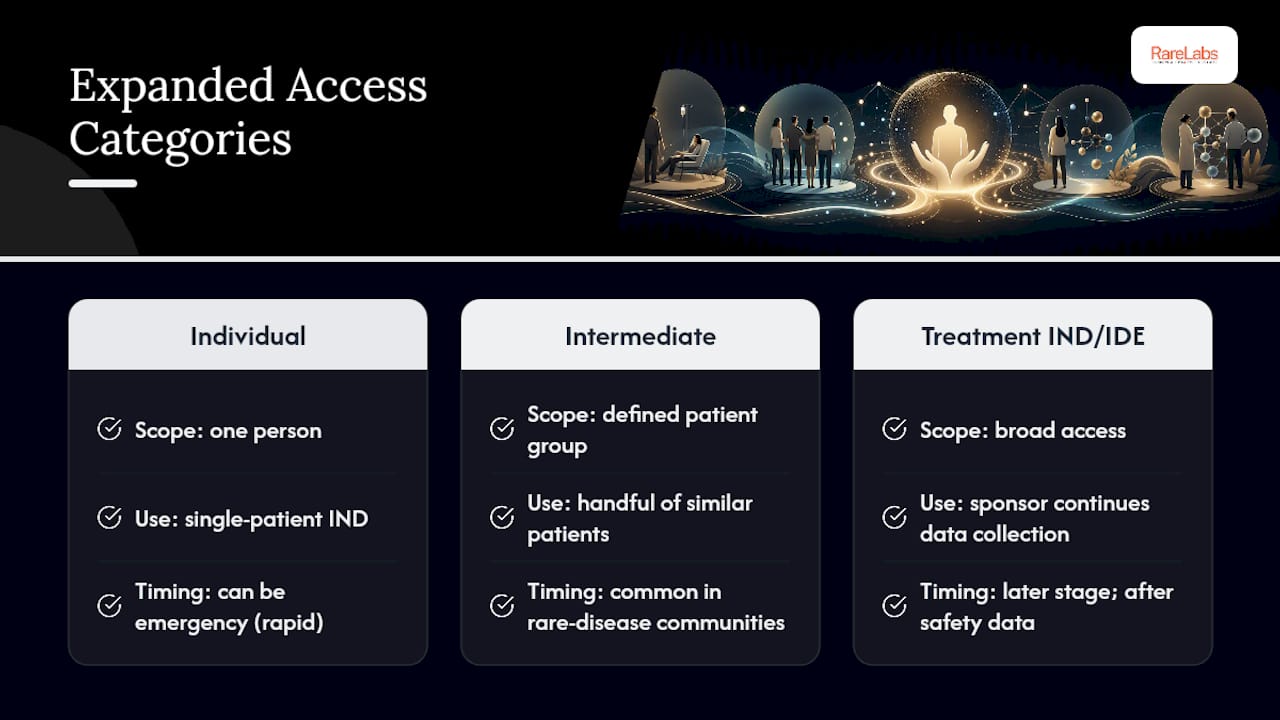
Individual patient expanded access, sometimes filed as an emergency, covers one person. A physician requests a single-patient investigational new drug (IND) when a patient has exhausted approved options and a specific investigational product looks like a reasonable next step. Emergency versions of this exist for situations where waiting even a few days isn't an option.
Intermediate-size population access applies when a defined group of patients, not just one, shares the same serious condition and could benefit from the same investigational product. This is common in rare disease communities where a handful of patients nationwide might qualify for the same experimental therapy.
Treatment IND or treatment IDE, the widest-reach category, allows broader access while the sponsor continues gathering data toward approval. This path usually appears later in a product's development, once there's already meaningful safety data from ongoing trials.
A clinical trial should always be the first option when a patient can enroll in one. Expanded access exists specifically for people who cannot, whether due to eligibility criteria, geography, condition severity, or a trial simply not being available for that disease.
How a Physician or Sponsor Submits an Expanded Access Request
Submitting a compassionate use application for drugs or biologics follows a fairly predictable sequence, even though every case has its own wrinkles.
-
Secure manufacturer agreement first. Nothing moves without it. Contact the company's medical affairs or regulatory team, explain the patient's situation, and request a Letter of Authorization (LOA) that lets you reference their existing IND. If the manufacturer declines, and companies do sometimes decline over supply constraints or liability concerns, expanded access for that specific product ends there. There's no FDA mechanism to override a manufacturer's refusal.
-
Complete Form FDA 3926 for single-patient requests, drugs, or biologics. This form was built to simplify what used to be a much heavier submission process. The Reagan-Udall Foundation's EA eRequest tool can help draft and route the form electronically, which saves real time compared to paper submission. Intermediate and treatment-category requests typically require a full IND submission or protocol amendment instead.
-
Route the request through IRB review. For single-patient INDs, Form FDA 3926's Field 10.b allows IRB chairperson concurrence in place of full board review, which is faster when time matters. Larger population requests generally need full board review.
-
For true emergencies, call FDA. The agency can authorize emergency use of a drug or biologic over the phone, often within hours, once the manufacturer has agreed to supply product. Treatment can begin immediately after that verbal authorization. FDA then requires written follow-up within 15 business days.
-
Assemble supporting documentation before you make that first call: a concise patient history, the clinical rationale for this specific product, a monitoring plan, and informed consent language. Having this ready in advance is what actually determines how fast the process moves.
Pro Tip: Build a single-page summary before contacting anyone, patient history, rationale, proposed dose, monitoring plan. Manufacturers and FDA staff move faster when they can assess a request in one read instead of chasing details across five emails.
Expanded Access for Medical Devices Follows a Different Set of Rules
Devices don't follow the same playbook as drugs, and conflating the two is a common mistake among first-time applicants.
- Emergency device use doesn't always require prior FDA approval. A physician can use an unapproved device in a genuine emergency, then must file an IDE report within five business days of that use.
- Compassionate use for devices covers individual patients or small groups outside emergencies. This usually requires an IDE supplement submitted to the device's existing sponsor before use.
- Treatment IDEs cover broader device distribution. Treatment IDEs can begin 30 days after FDA receives the submission unless FDA notifies the sponsor sooner, and sponsors then owe semi-annual progress reports until a marketing application is filed, then annual reports after that.
- IRB involvement mirrors the drug side: chair concurrence can substitute for full board review in urgent single-patient cases, but broader device access generally needs full board sign-off, along with documentation showing device design, intended use, and prior safety experience.
Who Is Responsible for What in an Expanded Access Case
A physician acting as sponsor-investigator on a single-patient IND takes on obligations that look a lot like those of a small commercial IND sponsor. That includes reporting adverse events promptly, keeping detailed treatment records, and filing an annual report if treatment continues past one year.
The manufacturer's role is narrower but decisive: agreeing to supply the product and signing the LOA. FDA cannot force a company to provide access to its investigational product, no matter how compelling the patient's case is. This single fact explains most of the delays and dead ends people run into.
- IRBs review informed consent and study conduct under 21 CFR 56.111, and can use expedited or chair-concurrence review for qualifying single-patient cases.
- FDA's job is authorization, not supply. Once authorized, physicians still owe IND safety reports and, for extended treatment, annual reports.
- Expanded access differs from clinical trial participation in a fundamental way: its purpose is treating one patient, not generating systematic data for an approval package, even though reporting and consent obligations still apply.
Timelines and Reporting Requirements You Need to Plan Around
Most non-emergency single-patient and intermediate-population requests fall under a 30-day default review window, though FDA often responds faster and will notify sponsors sooner when possible.
Emergency cases move on a different clock entirely. Treatment can start the moment FDA grants phone authorization, with a written submission due within 15 business days for drugs and biologics. Emergency device use carries a tighter five-day reporting deadline, a distinction that trips up teams who assume the drug and device rules match.
Post-treatment obligations don't end once the patient receives the product:
- IND safety reports under 21 CFR 312.32 for any serious, unexpected adverse events
- A brief summary report after treatment concludes
- Annual reports for any case extending beyond a year
The traps that actually stall requests are rarely regulatory denials. They're administrative: a missing LOA, an incomplete consent form, a vague monitoring plan, or a manufacturer that never formally agreed to supply. Fixing these before submission, rather than after FDA asks about them, is the single biggest lever a physician has over timeline.
What Actually Slows Down a Request, and How to Fix It
Most delays trace back to paperwork, not policy. Before contacting a manufacturer, assemble a compact data package: diagnosis, prior treatments tried and failed, and a specific rationale for why this investigational product fits this patient.
Approach the manufacturer's medical affairs team directly, and make it easy for them to say yes. Offer to complete their LOA template and provide a data summary they can circulate internally without extra digging.
On the IRB side, ask early whether chair concurrence applies to your case, since it can save days compared to waiting for a full board meeting. Draft consent language that plainly states the product's investigational status and the genuine uncertainty around outcomes. Ask about billing rules early too. Investigational product itself is often provided free, but associated care, monitoring, and administration costs are not automatically covered.
Keep FDA's expanded access contact information on hand before you need it, not after. A prepared one-page summary is what turns a frantic phone call into a fast one.
How Lab-Derived Evidence Can Strengthen an Expanded Access Request
Patient-specific lab data doesn't replace manufacturer agreement or IRB review, but it can change how persuasive a request looks. When Hopeatrarelabs builds an induced pluripotent stem cell (iPSC) model from a patient's own cells and runs it through parallel drug screens, the resulting mechanistic rationale and preclinical dose-response signal gives physicians something concrete to attach to a Letter of Authorization or IND submission.
Manufacturers, IRBs, and FDA reviewers respond to specifics: a plausible mechanism, an observed signal in a patient-derived model, and an honest accounting of safety flags. A generic request rarely carries the same weight.
- Summarize iPSC screening results and any antisense oligonucleotide (ASO) feasibility work in plain clinical language
- Time lab reports so they're ready before you contact the manufacturer, not after
- Address confidentiality and consent for any patient-derived material referenced in the submission
- Ask what next steps make sense given the screening data available for that specific disease
Bridging the Gap Between Lab Findings and Regulatory Submission
Turning a personalized screening result into something a manufacturer or FDA reviewer will act on takes more than raw data. It takes packaging that speaks the language of a regulatory submission, mechanistic rationale up front, dose and safety signals clearly flagged, and a clean line from lab finding to clinical request.

Hopeatrarelabs builds patient-specific disease models from a patient's own cells, then runs parallel screens across thousands of FDA-approved drugs alongside custom ASO and gene therapy feasibility work. For families and physicians already navigating an expanded access fda request, that kind of evidence can be the difference between a vague ask and a documented rationale a manufacturer can actually evaluate. Explore RareLabs Knowledge to see how personalized screening results get organized into something clinically usable, or review this practical workflow guide for moving from lab data to a formal request.
The Real Barrier Isn't the FDA
Here's what surprises most people once they've been through this process: FDA is rarely the bottleneck. The agency authorizes most requests that reach it, and its review windows are short compared to what a lot of people expect walking in.
The real friction sits with manufacturers. A company has zero legal obligation to provide investigational product, and FDA has zero authority to compel it. That single fact reshapes how you should spend your time and energy. Instead of worrying about whether FDA will say no, worry about whether you've made the manufacturer's decision easy: a clean data package, a completed LOA template, a monitoring plan that shows you've thought through the risk.
The framing of "right to try vs expanded access" that circulates online oversimplifies this. Right to try laws remove FDA from the equation for a narrow set of terminal cases but still require manufacturer agreement, the same bottleneck that exists under expanded access. Neither pathway solves the supply problem. Compassionate use vs right to try is really a choice between two routes to the same gatekeeper, not a choice between hard and easy.
Where physicians and families get the most leverage is upstream, in the quality of the clinical and scientific case they bring to that manufacturer conversation. A specific mechanistic rationale, grounded in real preclinical signal rather than hope, changes the tenor of that conversation entirely.
— John
Sources
- Expanded Access | Information for Physicians | FDA
- Overview of FDA's Expanded Access Program for Investigational Drugs (PMC/NIH)
This article is general information, not a substitute for advice from a qualified doctor. Consult a qualified healthcare professional about your own circumstances before acting on anything here.