

Orphan drug approval is defined as the FDA regulatory process that grants special designation and eventual marketing authorization to treatments targeting diseases affecting fewer than 200,000 people in the United States. Knowing how to navigate orphan drug approval gives patients, caregivers, and researchers a real path forward when no approved treatment exists. The FDA's Office of Orphan Products Development (OOPD) manages designation requests, while separate centers, CDER and CBER, handle full marketing approval. Key FDA incentives include a waiver of the Prescription Drug User Fee (approximately $3 million), federal tax credits for qualified clinical testing, and seven years of market exclusivity after approval. These incentives exist because rare disease drug development is expensive and commercially risky without them.
How to navigate orphan drug approval: FDA criteria and evidence requirements
The FDA grants orphan drug designation based on two core criteria: population rarity and medical plausibility. Both must be clearly demonstrated in your application.
Population rarity means the disease affects fewer than 200,000 people in the US. A second pathway applies when the disease affects more than 200,000 people but the drug cannot recover its development costs through US sales alone. Most applicants qualify under the first pathway.
Medical plausibility requires scientific evidence that the drug has a reasonable basis for treating the disease. The FDA accepts several forms of supporting evidence:
- Published clinical data from human studies
- In vivo animal model data showing disease relevance
- Validated in vitro studies demonstrating biological activity
- Peer-reviewed literature describing the disease mechanism
The medical plausibility standard requires no application fee to submit, which removes one barrier for early-stage researchers and small sponsors. That said, the quality of your scientific rationale determines whether the application succeeds or triggers a deficiency letter.
Common pitfalls include submitting prevalence estimates without citing primary sources, using animal data from models that do not reflect the human disease, and misidentifying the specific disease subset the drug targets. The FDA evaluates the drug-disease pair, not the drug alone. A treatment for a broad disease category will not qualify unless you define the specific orphan subset.
Pro Tip: Cite peer-reviewed prevalence studies from sources like the National Institutes of Health (NIH) or published patient registries. Unsupported prevalence claims are the most common reason for deficiency letters.
How to prepare and submit a successful designation application
A complete orphan drug designation application requires several specific documents. Organizing them correctly before submission saves weeks of back-and-forth with the OOPD.
- Drug description. Identify the drug by chemical name, structure, and mechanism of action. Include any existing IND number if applicable.
- Disease description. Define the disease or condition clearly, including its medical name, ICD code, and the patient population affected.
- Prevalence data. Provide documented evidence of US patient numbers, citing published epidemiological studies or patient registry data.
- Scientific rationale. Explain why the drug is medically plausible for the condition, supported by clinical, animal, or in vitro evidence.
- Regulatory history. Disclose any prior FDA interactions, including IND filings or prior designation requests for the same drug.
Foreign sponsors must designate a US permanent resident agent to receive official FDA correspondence. Skipping this step delays the entire review.
Submissions go to orphan@fda.hhs.gov for electronic filing. The OOPD targets a response to 100% of new designation requests within 90–150 days. That response will be one of three outcomes:
| Outcome | What it means | Next step |
|---|---|---|
| Designation letter | Application approved | Proceed to clinical development with incentives active |
| Deficiency letter | Information gaps identified | Respond with additional data within the specified timeframe |
| Denial letter | Criteria not met | Revise application or appeal with new evidence |
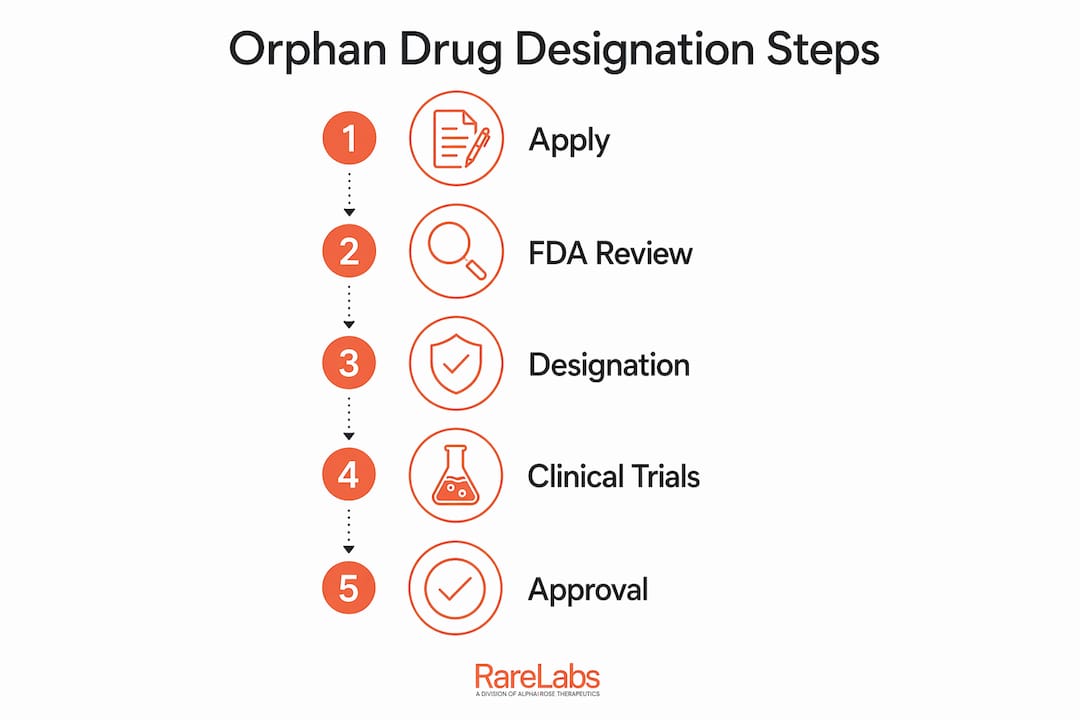
A deficiency letter is not a rejection. Treat it as a specific list of what the FDA needs. Address each point directly and resubmit with a cover letter that maps your responses to the original deficiency items.
All designated drugs are listed publicly in the FDA's orphan drug database. That public listing itself carries credibility for fundraising and partnership discussions, as early designation provides external validation that accelerates investor confidence.
Pro Tip: Submit your designation application at the preclinical stage. You do not need an approved IND or clinical data to apply. Early submission maximizes the time you benefit from incentives and gives investors a concrete regulatory milestone.
What strategies maximize success in orphan drug designation?
The strongest applications combine early regulatory engagement, real-world data, and patient community involvement. Each element addresses a different weakness in rare disease drug development.

Pre-IND meetings with the FDA are the single most underused tool in orphan drug development. These meetings let you clarify designation criteria before you invest in costly studies. They also signal to the FDA that you are a serious, organized sponsor.
Patient advocacy groups provide two things that no laboratory can generate: real-world patient data and direct testimony about disease burden. Collaboration with advocacy groups strengthens the scientific rationale by adding registry information, natural history data, and patient-reported outcomes. These are persuasive regulatory evidence, not just emotional support.
Adaptive clinical trial designs and real-world data are now recognized tools for rare disease drug development. The FDA has signaled acceptance of a single adequate trial with confirmatory evidence as the standard for rare disease approval, acknowledging that large multi-trial programs are often impossible with small patient populations.
Global regulatory alignment matters for multinational sponsors. The European Medicines Agency (EMA) runs a parallel orphan designation program. Aligning your US and EU applications from the start avoids contradictions in disease definitions and prevalence data that can undermine both submissions.
One procedural error derails more applications than any scientific gap: confusing OOPD with CDER/CBER. The OOPD grants designation based on rarity and plausibility. CDER and CBER review marketing applications based on full safety and efficacy data. These are separate processes with different evidence standards. Submitting marketing-level data to OOPD does not accelerate designation, and submitting only designation-level evidence to CDER will not support approval.
For researchers working on rare disease therapy acceleration, understanding this separation is the foundation of a sound regulatory plan.
What happens after designation: incentives, exclusivity, and obligations
Designation is a milestone, not a finish line. The benefits are real, but they come with ongoing obligations that sponsors must manage carefully.
The financial incentives activate immediately after designation. The Prescription Drug User Fee waiver saves approximately $3 million on a single New Drug Application (NDA) or Biologics License Application (BLA) filing. Federal tax credits apply to qualified clinical testing expenses incurred after designation. Seven years of market exclusivity begin at the time of FDA marketing approval, blocking competitors from gaining approval for the same drug in the same indication.
Annual status reports are required by the FDA to maintain designation. Lapses in reporting increase FDA scrutiny and can threaten designation status at a critical point in development. Set a calendar reminder for your annual report deadline the day you receive your designation letter.
Designation also functions as a fundraising tool. Investors and biopharma partners treat orphan designation as external validation of both the science and the regulatory strategy. Applying early, often at the preclinical stage, gives you this validation before you need to raise significant capital.
One point requires emphasis: designation does not guarantee marketing approval. The OOPD's decision is based on plausibility and rarity. CDER or CBER will independently evaluate safety and efficacy through the full NDA or BLA review. Sponsors who treat designation as approval create serious planning errors downstream.
Pro Tip: Track your annual report deadlines in a regulatory calendar shared across your team. A missed report is an avoidable risk that can complicate your marketing approval timeline.
Understanding FDA-approved drug pathways for rare diseases helps sponsors plan both designation and approval timelines without conflating the two.
Key Takeaways
Successful orphan drug designation requires meeting FDA rarity and plausibility criteria, submitting complete documentation, and maintaining active regulatory engagement from preclinical stages through marketing approval.
| Point | Details |
|---|---|
| Meet both FDA criteria | Demonstrate US prevalence under 200,000 and provide medical plausibility evidence from clinical, animal, or in vitro data. |
| Apply early | Submit at the preclinical stage to maximize incentive windows and give investors a concrete regulatory milestone. |
| Separate designation from approval | OOPD grants designation; CDER or CBER approves marketing. Treat these as distinct processes with different evidence standards. |
| Engage the FDA proactively | Use pre-IND meetings to clarify criteria and align your clinical study design before committing resources. |
| File annual reports on time | Missing annual status reports increases FDA scrutiny and can threaten designation status during development. |
What I have learned from watching sponsors navigate this process
The most consistent mistake I see is treating orphan drug designation as a box to check rather than a strategic tool. Sponsors rush the application to get the designation letter, then realize they built their entire development plan on a misreading of what designation actually provides.
The separation between OOPD and CDER or CBER is not a bureaucratic technicality. It reflects two genuinely different questions the FDA is asking. OOPD asks: "Is this drug plausibly useful for a rare disease?" CDER or CBER asks: "Is this drug safe and effective?" Answering the first question well does not prepare you for the second.
The evidence challenge in rare diseases is real. Small patient populations make traditional randomized controlled trials difficult or impossible. The FDA's 2026 shift toward accepting a single adequate trial with confirmatory evidence is a meaningful change. But sponsors still need to design that single trial rigorously. A poorly designed trial with confirmatory evidence still fails.
Patient advocacy groups are underutilized in ways that genuinely surprise me. Researchers often see them as communication channels rather than data sources. The registries, natural history studies, and patient-reported outcome measures that advocacy groups maintain are often the strongest prevalence and burden-of-disease evidence available. Build that relationship before you write your application, not after.
My practical advice: apply for designation at the preclinical stage, attend every FDA meeting you can request, and treat your annual reports as seriously as your clinical milestones. The sponsors who do all three consistently outperform those who treat regulatory compliance as an afterthought.
— John
Hopeatrarelabs and the path to orphan drug development
Families and researchers facing ultra-rare diseases rarely have the luxury of time. The orphan drug approval process is complex, and the cost of procedural errors is measured in years, not months.
Hopeatrarelabs works directly with patients, families, physicians, and biopharma partners to build patient-specific disease models using iPSC technology and CRISPR gene editing. These models support the scientific rationale that orphan drug designation applications require. Hopeatrarelabs also conducts parallel treatment screens across thousands of FDA-approved drugs and custom antisense oligonucleotides (ASOs), generating the kind of in vitro evidence that strengthens a plausibility argument. For researchers and families who need both the science and the regulatory clarity to move forward, Hopeatrarelabs provides a direct path from disease modeling to treatment discovery.
FAQ
What qualifies a disease for orphan drug designation?
A disease qualifies if it affects fewer than 200,000 people in the US, or if the drug cannot recover development costs through US sales. The sponsor must also demonstrate medical plausibility through clinical, animal, or in vitro evidence.
How long does the FDA take to review a designation application?
The OOPD targets a response to 100% of new designation requests within 90–150 days. The response will be a designation letter, a deficiency letter requesting more information, or a denial letter.
Does orphan drug designation mean the drug is approved?
No. Designation confirms rarity and plausibility only. Full marketing approval requires a separate safety and efficacy review by CDER or CBER through an NDA or BLA submission.
What financial benefits come with orphan drug designation?
Designated drugs receive a waiver of the Prescription Drug User Fee (approximately $3 million), federal tax credits for qualified clinical testing, and seven years of market exclusivity following FDA approval.
Can a foreign company apply for orphan drug designation?
Yes. Foreign sponsors must designate a US permanent resident agent to receive FDA correspondence. All other application requirements are the same as for domestic sponsors.