

Variant interpretation in genetics is the systematic process of classifying DNA sequence changes to determine their clinical significance, assigning each variant to one of five categories: pathogenic, likely pathogenic, variant of uncertain significance (VUS), likely benign, or benign. The standard framework for this process is the 2015 ACMG/AMP guidelines, which set the current benchmark for clinical laboratories and research teams worldwide. Defining variant interpretation in genetics correctly is not a formality. It directly shapes diagnostic conclusions, treatment decisions, and genetic counseling for patients with rare and undiagnosed diseases. Tools like MetaXVP and automated classifiers such as BIAS-2015 now assist this process, but expert judgment remains the irreplaceable final step.
What is variant interpretation in genetics?
Variant interpretation is defined as the structured evaluation of a DNA sequence change using multiple evidence types to determine whether that variant causes, contributes to, or is unrelated to a disease phenotype. The process sits at the intersection of population genetics, molecular biology, computational prediction, and clinical medicine. A single misclassification can send a diagnostic workup in the wrong direction for years.
The five classification categories established by the ACMG/AMP guidelines are not arbitrary tiers. They represent calibrated confidence levels built from evidence weight. Pathogenic and likely pathogenic variants carry sufficient evidence to inform clinical action. Benign and likely benign variants are deprioritized. VUS sits in the middle, requiring ongoing monitoring and reclassification as new data emerges.

Genetic variant classification applies to germline variants in inherited disease contexts and somatic variants in oncology, though the frameworks differ. For rare disease diagnosis, germline interpretation under ACMG/AMP guidelines is the dominant standard. Understanding genetic mutations in this context means moving beyond sequence detection to biological claim, a distinction that separates rigorous interpretation from raw sequencing output.
How do ACMG/AMP guidelines standardize variant classification?
The ACMG/AMP 28-criteria framework organizes evidence into five data domains: population frequency, computational prediction, functional data, segregation in families, and de novo occurrence. Each criterion carries a defined evidence weight, ranging from standalone pathogenic (PVS1) to supporting evidence levels. The combination of weighted criteria determines the final classification tier.
The practical value of this structure is reproducibility. Two laboratories applying the same criteria to the same variant should reach the same classification. In practice, they often do not, because variant interpretation software implements different subsets of the 28 criteria, and manual expert adjustments vary by institution. This inconsistency is one of the most persistent problems in clinical genetics today.
Key criteria categories within the ACMG/AMP framework include:
- Population data: Variant frequency in databases like gnomAD; high frequency in healthy populations supports benign classification
- Computational and predictive data: In silico tools predicting splicing, protein function, or conservation scores
- Functional data: Experimental evidence from cell lines, animal models, or biochemical assays
- Segregation data: Co-occurrence of the variant with disease in affected family members
- De novo data: Confirmed absence in parents, supporting pathogenicity in the proband
Pro Tip: When applying ACMG/AMP criteria, document which specific criteria codes (e.g., PS3, PM2, BP4) you applied and why. This creates an auditable trail and makes reclassification far easier when new evidence arrives.
The guidelines allow flexibility for disease-specific adaptations. Gene-specific variant curation expert panels, such as those coordinated through ClinGen, publish refined criteria for high-volume genes like BRCA1, BRCA2, and TP53. These adaptations improve precision beyond the generic framework.
How do computational tools like MetaXVP improve interpretation accuracy?
Machine learning has changed how to interpret genetic data at scale, particularly for VUS reclassification. MetaXVP achieved an AUROC of 0.991 for pathogenic versus benign variant prediction and 0.986 for VUS reclassification. An AUROC above 0.98 in this context means the model separates pathogenic from benign variants with near-clinical-grade accuracy, which is a meaningful advance over earlier ensemble tools.
What distinguishes MetaXVP from earlier predictors is interpretability. The model uses SHAP (SHapley Additive exPlanations) and LIME (Local Interpretable Model-agnostic Explanations) to surface which features drove each prediction. For a clinician reviewing a VUS in a rare disease patient, knowing that conservation score and splice site proximity were the top contributors to a pathogenic prediction is far more useful than a black-box score. This connects directly to genetic disease modeling approaches that require transparent, auditable reasoning.
The practical integration of tools like MetaXVP into clinical workflows follows a clear pattern:
- Triage layer: Computational scores filter the variant list before expert review
- Evidence aggregation: Model outputs feed into ACMG/AMP criteria as computational evidence (PP3 or BP4)
- Interpretability review: SHAP values flag which features need expert scrutiny
- Final classification: A trained curator or clinical geneticist makes the definitive call
The critical limit of any computational predictor is that it operates on features extracted from reference databases. Variants in understudied genes, ultra-rare populations, or novel functional contexts will have sparse training data. VUS classification remains the most labor-intensive step, and computational outputs are best treated as structured drafts that require expert review incorporating phenotypic context.
What are common challenges and nuances in variant interpretation?
The primary bottleneck in variants in genetic testing is not detection. It is the transition from a detected sequence change to a defensible biological claim. Claim inflation describes the tendency to overstate what limited evidence actually supports, and it is one of the most common errors in published variant reports. A single functional assay in a cell line does not establish pathogenicity. It contributes one piece of evidence toward a probabilistic conclusion.
A second underappreciated challenge is the inadequacy of simple mechanistic labels. Loss-of-function and gain-of-function are useful shorthand, but they obscure the biological reality of most variants. Context qualifiers such as tissue specificity, developmental timing, and pleiotropic effects dramatically change the clinical relevance of a variant classification. A variant that causes loss of function in hepatocytes may have no phenotypic consequence in lymphocytes, and reporting it without that qualifier misleads the clinician reading the report.
Common pitfalls that experienced curators encounter include:
- Overreliance on a single evidence type: Treating one strong functional study as sufficient for pathogenic classification without corroborating population or segregation data
- Ignoring cohort context: A variant found in a cancer cohort carries different prior probability than the same variant found in a cardiovascular cohort
- Premature reclassification: Upgrading a VUS based on a single new publication before that evidence has been independently replicated
- Underdocumented uncertainty: Reporting a VUS without specifying what additional evidence would change the classification
Pro Tip: Before writing a variant interpretation conclusion, state the evidence types you have in hand and their strength levels. This forces proportional claims and prevents the most common form of claim inflation.
The overcoming challenges in rare disease research context makes these nuances especially consequential. In ultra-rare diseases with fewer than 50 reported cases globally, segregation data may be impossible to obtain, and population frequency data is uninformative. Interpretation in these settings demands explicit acknowledgment of what is unknown.
How is variant interpretation applied in clinical and research settings?
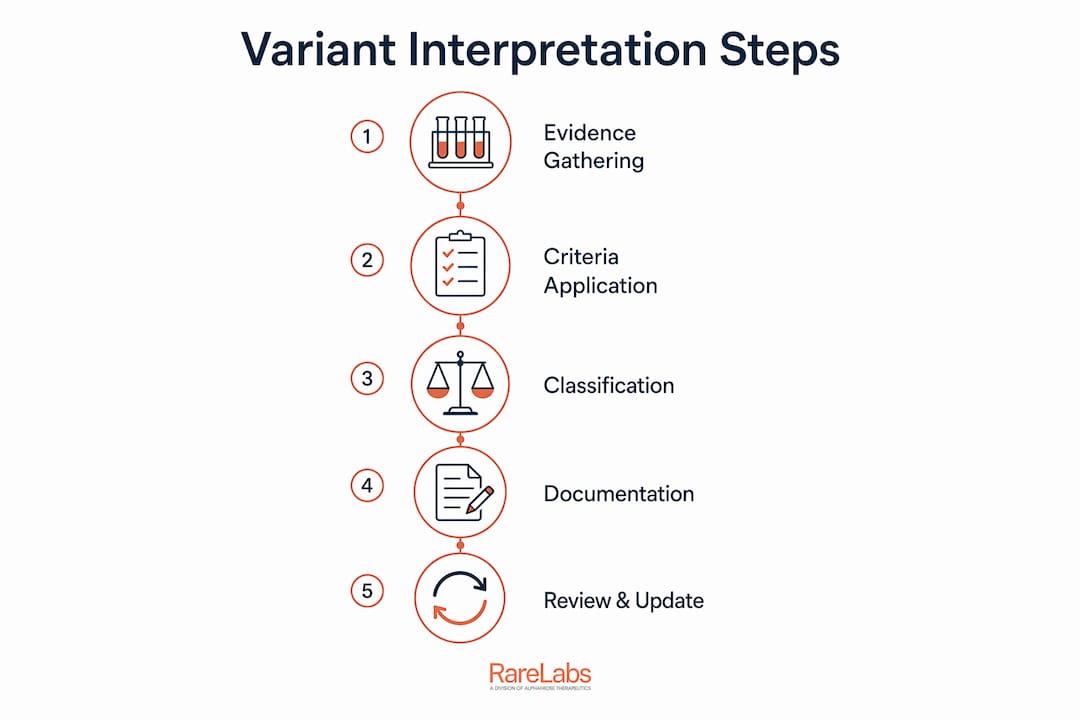
A rigorous interpretation workflow follows a defined sequence. Skipping steps or running them in parallel introduces errors that compound downstream. The process below reflects current best practice for diagnostic laboratories and research genetics teams.
- Technical confirmation: Confirm variant detection quality using read depth, mapping confidence, and allele balance metrics. Stable technical detection confirmed by quality metrics is the prerequisite for any biological claim. For critical findings, orthogonal confirmation by Sanger sequencing or an independent platform is standard.
- Genomic context annotation: Annotate the variant for gene function, transcript consequence, evolutionary conservation, and known disease associations using databases such as ClinVar, OMIM, and UniProt.
- Population frequency assessment: Query gnomAD, TOPMed, and disease-specific cohorts to establish allele frequency in relevant ancestral populations.
- Computational evidence integration: Apply in silico predictors and record their outputs as supporting evidence under the appropriate ACMG/AMP criteria codes.
- Orthogonal evidence review: Incorporate family segregation, functional assays, and expression data where available. Multiple independent evidence lines reduce misclassification risk.
- Classification and documentation: Assign the ACMG/AMP tier, document all applied criteria with justification, and specify what evidence would trigger reclassification.
- Reporting and next steps: Communicate classification with appropriate uncertainty language and recommend follow-up studies where the evidence is incomplete.
The table below summarizes the evidence types used at each workflow stage and their typical contribution to final classification:
| Workflow stage | Evidence type | Classification contribution |
|---|---|---|
| Technical confirmation | Read depth, Sanger sequencing | Validates variant existence before interpretation |
| Population frequency | gnomAD, TOPMed | Supports benign or pathogenic prior probability |
| Computational prediction | MetaXVP, SpliceAI, CADD | PP3 or BP4 criteria under ACMG/AMP |
| Functional data | Cell assays, animal models | PS3 or BS3 criteria; strongest experimental evidence |
| Segregation and de novo | Family studies, trio sequencing | PP1, PS2 criteria; high weight for pathogenicity |
Tools like BIAS-2015 support deterministic, reproducible workflows by applying ACMG criteria in a constrained, auditable manner. These tools do not replace expert judgment. They create a structured scaffold that makes expert review faster and more consistent.
Key takeaways
Variant interpretation in genetics requires a structured, evidence-graded workflow combining ACMG/AMP classification criteria, computational tools, and expert review to produce defensible, reproducible clinical conclusions.
| Point | Details |
|---|---|
| ACMG/AMP framework is the standard | Five-tier classification using 28 criteria across population, functional, and segregation data drives clinical consistency. |
| Computational tools assist but do not replace experts | MetaXVP's AUROC of 0.991 makes it a strong triage tool, but VUS calls still require expert phenotypic review. |
| Claim inflation is the most common error | State evidence types and strength levels before conclusions to keep claims proportional to available data. |
| Context qualifiers change clinical meaning | Tissue specificity and pleiotropic effects must be specified; loss-of-function labels alone are insufficient. |
| Workflow sequence matters | Technical confirmation must precede biological claims; skipping steps introduces compounding errors. |
Why the hardest part of variant interpretation is not the algorithm
The field has made genuine progress on the computational side. MetaXVP, SpliceAI, and BIAS-2015 have raised the floor for automated classification quality. What has not kept pace is the human infrastructure around those tools. Inconsistent professional competencies and the absence of clear career pathways for variant curators remain the most underaddressed problems in clinical genetics.
I have seen reports from well-resourced laboratories where a VUS was reclassified as likely pathogenic based on a single preprint. That is claim inflation in practice, and it has real consequences for patients who may undergo unnecessary interventions or, worse, be denied access to a clinical trial because their variant was prematurely upgraded. The algorithm did not cause that error. A person did, operating without a clear evidence-grading standard.
The solution is not more automation. It is better training, agreed-upon competency frameworks, and institutional cultures that reward epistemic discipline over diagnostic speed. The standardized training gap00031-5) in clinical variant interpretation is a workforce problem as much as a scientific one. Laboratories that invest in structured curation training and use tools like BIAS-2015 for auditable workflows consistently produce more reproducible classifications than those relying on individual curator experience alone.
Machine learning will continue to improve. AUROC scores will climb. But the judgment call on a VUS in a patient with a novel phenotype and no family history will always require a trained human who understands what the algorithm cannot see.
— John
Explore variant interpretation resources at Hopeatrarelabs

Hopeatrarelabs works directly with patients, families, and physicians navigating ultra-rare and undiagnosed genetic diseases, where variant interpretation is often the first and most consequential step. The RareLabs knowledge hub provides professional-grade resources covering genetic variant classification, rare disease research, and treatment search tools built for clinical and research use. Whether you are resolving a persistent VUS or evaluating gene therapy options for a patient with a confirmed pathogenic variant, Hopeatrarelabs offers the depth and specificity that generic databases do not. Explore the knowledge base to find evidence-graded information that supports real diagnostic decisions.
FAQ
What is the standard framework for genetic variant classification?
The 2015 ACMG/AMP guidelines are the current standard, classifying germline variants into five tiers using 28 criteria across population, computational, functional, segregation, and de novo data.
What does a variant of uncertain significance mean?
A VUS is a DNA change for which current evidence is insufficient to classify it as pathogenic or benign. It requires ongoing monitoring and reclassification as new functional, segregation, or population data becomes available.
How do computational tools support variant interpretation?
Tools like MetaXVP provide pathogenicity predictions with high accuracy, contributing computational evidence to ACMG/AMP criteria. Their outputs are structured drafts that require expert review, not standalone classifications.
What is claim inflation in variant interpretation?
Claim inflation is the practice of overstating what limited evidence supports, such as calling a variant likely pathogenic based on a single functional study. Stating evidence types and strength levels before conclusions prevents this error.
How does context affect the interpretation of genetic variants?
Tissue specificity, developmental timing, and pleiotropic effects change the clinical relevance of a variant classification. Reporting a variant as loss-of-function without specifying the biological context can mislead clinical decision-making.