

What are the leading alternatives to rarerising.org for rare disease biotech?
The strongest rarerising.org alternatives share one defining quality: they go beyond information directories and actually do something with patient biology. Here is a quick map of the field.
- RareLabs (Hopeatrarelabs): The most technically advanced option for patients and biopharma partners in the US. Builds patient-specific disease models using iPSCs and CRISPR, then runs parallel treatment screens across thousands of FDA-approved drugs and custom antisense oligonucleotides (ASOs).
- Multi-omics integrated research platforms: Organizations that combine genomics, transcriptomics, proteomics, and metabolomics to generate mechanistic hypotheses rather than static variant reports.
- Patient advocacy-enabled research hubs: Nonprofits and coalitions that connect patients to specialists, trials, and funding, with equity-focused outreach for underrepresented populations.
- End-to-end genetic testing and trial enrollment platforms: Services that cover the full arc from diagnosis to trial matching, reducing the fragmentation that stalls most rare disease journeys.
Scientific rigor, speed, and genuine collaboration separate the best options from the rest. The sections below break down what each category actually delivers.
Table of Contents
- What bottlenecks slow rare disease treatment development?
- Why does every rare disease patient need a dedicated support team?
- How does RareLabs approach personalized rare disease modeling?
- Why does RareLabs stand out among rarerising.org substitutes?
- How do alternative platforms compare on features and limitations?
- How do the best platforms integrate multi-omic data with patient-derived models?
- How should you evaluate and select an alternative biotech platform?
- What outcomes have patient-specific modeling approaches produced?
- What collaboration opportunities exist across platforms and stakeholders?
- Hopeatrarelabs: patient-specific rare disease research, built for urgency
- Key Takeaways
What bottlenecks slow rare disease treatment development?
The regulatory pathway for rare diseases has never been faster. The problem is everything that happens before and after the regulatory step.
Infrastructure fragmentation between genetic testing, patient screening, and trial enrollment is the primary structural bottleneck. A patient can receive a confirmed genetic diagnosis and still wait years for a matched trial because the systems connecting those steps do not talk to each other. Faster approvals do not fix disconnected pipelines.
More than 420,000 clinical trials are registered globally, yet rare disease patients routinely struggle to find eligible studies and meet complex enrollment criteria.
Key bottlenecks researchers and patients face:
- Limited genetic testing access: The Rare Disease Diversity Coalition identifies testing access as the most urgent gap for historically underrepresented populations.
- Data silos: Genomic, clinical, and phenotypic data sit in separate systems, preventing the integrated analysis that precision treatment requires.
- Complex trial navigation: With hundreds of eligibility criteria per study, patients without specialist support rarely find the right match.
- Equity gaps: Black, Latino, Asian, and Native American patients face compounding barriers to diagnosis, specialist access, and enrollment.
Overcoming these key challenges in rare disease research requires platforms that integrate all these steps, not just one of them.
Why does every rare disease patient need a dedicated support team?
Standard clinical trial listings are a starting point, not a solution. For ultra-rare diseases, submitting to registries like ClinicalTrials.gov is often the final step in a much longer navigation process, not the first.
A multidisciplinary support team dramatically improves a patient's ability to identify relevant studies and sustain the emotional and strategic demands of a long research journey. The roles that matter most:
- Patient advocates: Map the research landscape and connect families to disease-specific foundations and funding.
- Geneticists: Interpret variant data in the context of evolving multi-omic evidence.
- Clinical trial coordinators: Manage eligibility screening, documentation, and site communication.
- Rare disease specialists: Provide clinical context that general practitioners cannot.
- Biopharma liaisons: Open doors to compassionate use and expanded access programs.
Pro Tip: Tap into patient advocacy networks like NORD and the Rare Disease Diversity Coalition early. These organizations often know about pre-publication trials and compassionate access pathways that never appear on public registries.
How does RareLabs approach personalized rare disease modeling?
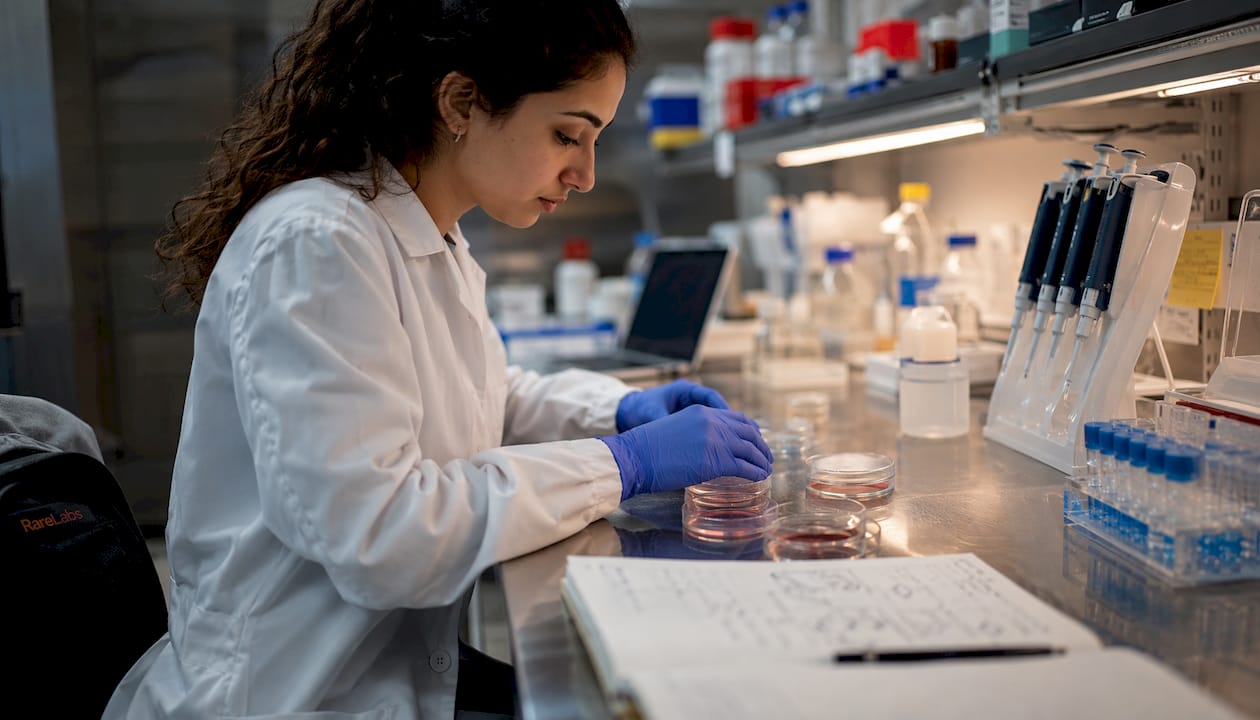
Most platforms analyze genetic data once and file the result. RareLabs treats genetic data as a dynamic manuscript requiring fresh analysis as new functional evidence emerges. That distinction drives every part of their methodology.
The core technology stack:
- iPSC-derived disease models: Patient cells are reprogrammed into induced pluripotent stem cells, then differentiated into the specific cell type affected by the disease. This gives researchers a living, patient-specific system to test against.
- CRISPR gene editing: Used to validate causal variants and model disease mechanisms with precision.
- Custom ASOs: Antisense oligonucleotides designed for the patient's specific genetic lesion, tested alongside FDA-approved drugs in parallel screens.
- Multi-omic data integration: Genomic, transcriptomic, and proteomic data are layered with functional AI to surface mechanistic treatment hypotheses.
| Technology | Function | Contribution to Treatment Discovery |
|---|---|---|
| iPSC disease models | Patient-specific cell systems | Enables functional drug testing in relevant tissue |
| CRISPR gene editing | Variant validation and modeling | Confirms disease mechanism before screening |
| Custom ASOs | Targeted gene silencing | Personalizes therapy to individual mutation |
| Parallel drug screens | FDA-approved drug testing at scale | Identifies repurposing candidates rapidly |
| Multi-omic AI integration | Cross-layer data analysis | Generates mechanistic hypotheses for novel therapies |
RareLabs' parallel treatment screening covers thousands of FDA-approved drugs and custom gene therapy options simultaneously, compressing a process that traditionally takes years into a far shorter window. Results are communicated directly to patients, families, and physicians with scientific transparency throughout.
Why does RareLabs stand out among rarerising.org substitutes?
The rare disease biotech field has no shortage of platforms that promise personalized medicine. Few deliver it at the mechanistic level RareLabs operates at.
Key differentiators:
- Patient-specific models, not population averages: Every screen runs on cells derived from the individual patient, not a disease-category proxy.
- Parallel screening at scale: Testing thousands of compounds simultaneously means no viable candidate is missed due to sequential testing timelines.
- Transparent scientific communication: Patients and physicians receive results with full methodological context, not just a ranked list.
- End-to-end integration: From disease modeling through treatment hypothesis to biopharma partnership, the workflow is continuous.
- Rapid timelines: The urgency of ultra-rare disease drives a pace that academic research programs rarely match.
For biopharma partners, RareLabs also offers a validated patient-derived model system that de-risks early-stage drug development. That dual utility, serving both individual patients and industry partners, is uncommon in this space.
How do alternative platforms compare on features and limitations?
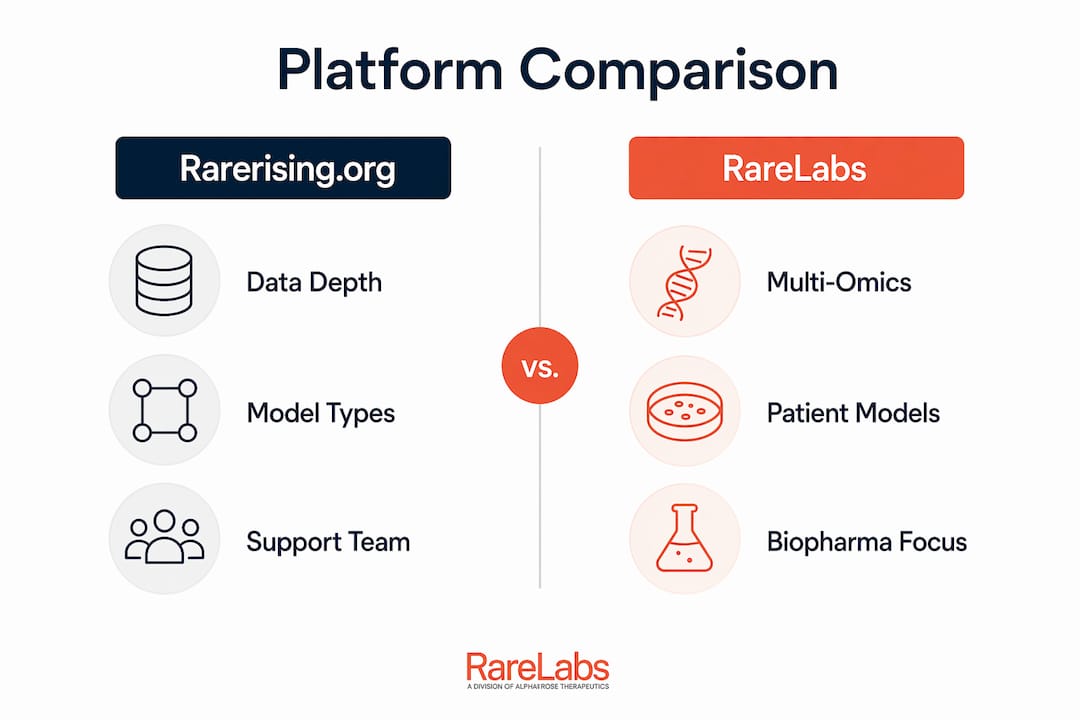
Platforms in the rare disease biotech space differ most sharply on three axes: data integration depth, patient-specificity of models, and collaboration infrastructure.
Multi-omics platforms that combine whole-exome sequencing with transcriptomics and proteomics can identify drug repurposing opportunities that single-layer genomic analysis misses entirely. Their limitation is typically the absence of functional validation: a computational hypothesis is not the same as a tested compound in a patient-derived cell line.
Patient advocacy hubs excel at navigation and emotional support but rarely generate original scientific data. They are essential partners, not standalone solutions. End-to-end enrollment platforms reduce friction but do not address the upstream problem of identifying which therapy to pursue in the first place.
RareLabs occupies the position where functional biology meets clinical urgency, which is where the field's hardest problems actually live.
How do the best platforms integrate multi-omic data with patient-derived models?
The most effective approach treats multi-omic data not as a diagnostic endpoint but as a hypothesis-generation engine. Genomic variants point to candidate pathways; transcriptomic data confirms whether those pathways are actually dysregulated in the patient's cells; proteomic and metabolomic layers reveal downstream functional consequences.
When that layered analysis feeds directly into a patient-derived iPSC model, the result is a testable biological system anchored in the patient's own molecular reality. Computational hypotheses become wet-lab experiments. Drug candidates get ranked by functional response, not predicted binding affinity alone. This is the integration model that [accelerates rare disease therapy](https://blog.hopeatrarelabs.com/blog/ways accelerate rare disease therapy) discovery most reliably.
How should you evaluate and select an alternative biotech platform?
Start with the disease mechanism, not the platform's marketing. The right questions:
- Does the platform build patient-specific functional models, or does it work from population-level data?
- Can it test compounds in the relevant cell type for your disease?
- Does it integrate multi-omic layers, or rely on genomics alone?
- How does it communicate results, and to whom?
- Does it have established pathways to biopharma partnership or compassionate access?
A [step-by-step approach to finding rare disease treatments](https://blog.hopeatrarelabs.com/blog/step by step guide to finding rare disease treatments) should always begin with confirming that the platform's biology matches the disease's biology.
What outcomes have patient-specific modeling approaches produced?
Patient-derived iPSC models have enabled identification of FDA-approved compounds with unexpected efficacy in rare metabolic and neurological diseases, cases where no approved therapy existed. CRISPR-validated disease models have confirmed causal variants that were previously classified as variants of uncertain significance, opening enrollment pathways for gene therapy trials. Custom ASO programs have moved from design to preclinical validation in months rather than years when built on a confirmed mechanistic foundation.
These outcomes share a common thread: functional biology, not computational prediction alone, drove the discovery.
What collaboration opportunities exist across platforms and stakeholders?
The most productive collaborations in rare disease research connect patient advocacy organizations, academic medical centers, biotech platforms, and biopharma partners around shared patient cohorts and data. [Collaborative rare disease trials](https://blog.hopeatrarelabs.com/blog/collaborative rare disease trials a practical guide) work best when each partner contributes what it does best: advocates bring patient voice and recruitment reach; academic centers provide clinical infrastructure; biotech platforms supply functional biology; biopharma partners provide development resources and regulatory expertise.
NORD's collaboration framework and the Haystack Project's health equity initiatives demonstrate what coordinated stakeholder engagement can accomplish at the policy and access level. At the scientific level, the same principle applies: no single platform has every capability, and the best outcomes come from structured partnerships.
Hopeatrarelabs: patient-specific rare disease research, built for urgency
For patients, families, and biopharma partners who need more than a database, Hopeatrarelabs delivers functional biology at the speed rare disease demands. Where other platforms stop at genetic analysis or trial matching, Hopeatrarelabs builds a living model of your disease from your own cells, screens thousands of compounds against it, and communicates results with full scientific transparency.
The concrete difference: you get a tested, patient-specific treatment hypothesis, not a ranked list of possibilities. That is what personalized rare disease research looks like when it is built around the individual, not the disease category.
Reach out to Hopeatrarelabs directly to discuss your case, your research program, or a potential biopharma partnership.
Key Takeaways
RareLabs (Hopeatrarelabs) is the strongest rarerising.org alternative for patients and biopharma partners who need functional, patient-specific disease modeling paired with parallel treatment screening.
| Point | Details |
|---|---|
| Infrastructure fragmentation is the core barrier | Disconnected testing, screening, and enrollment systems slow therapy access more than regulatory speed does. |
| Support teams are non-negotiable | Geneticists, advocates, and trial coordinators together improve trial identification and patient resilience. |
| Multi-omic integration drives discovery | Layering genomic, transcriptomic, and proteomic data generates mechanistic hypotheses that single-layer analysis cannot. |
| Functional models outperform computational prediction | iPSC-derived patient cell systems tested with real compounds produce more reliable treatment candidates than in silico ranking alone. |
| Hopeatrarelabs offers end-to-end patient-specific modeling | From iPSC disease models through parallel drug and ASO screens to transparent result communication, RareLabs covers the full discovery arc. |