

A rare nonprofit is a specialized organization that supports individuals and families affected by rare or undiagnosed genetic diseases through direct financial relief, research funding, and community connection. These organizations fill a critical gap: most rare diseases affect fewer than 200,000 people in the United States, which means mainstream health charities rarely prioritize them. Groups like the National Organization for Rare Disorders (NORD) and the Rare Genes Movement have proven that 501(c)(3) nonprofits built around rare diseases can deliver real, measurable impact. For families navigating a genetic diagnosis, knowing which organizations exist and what they offer is the fastest path to support.
What defines an impactful rare nonprofit?
The most effective rare disease nonprofits share a specific set of traits. They do not simply raise money. They build ecosystems that combine financial aid, research partnerships, and peer community in one place.
The defining criteria include:
- Direct financial assistance: Grants that cover medical travel, testing, and out-of-pocket treatment costs for families who cannot access mainstream funding.
- Research investment: Funding for scientists studying the specific genetic variant, including natural history studies and drug screening programs.
- Education and accessible resources: Webinars, guides, and expert panels that reduce the overwhelm families feel after a rare diagnosis.
- Policy advocacy: Active work to influence newborn screening standards and rare disease coding at the state and federal level. NORD ranks all 50 states on rare disease policies, making this data publicly visible and actionable.
- Community infrastructure: Discussion groups, family conferences, and connection programs that reduce isolation.
The strongest organizations grow from grassroots founder efforts into systemic advocacy bodies. Founders often evolve from seeking personal solutions for their own child to driving policy change across entire disease communities. That trajectory is a reliable signal of organizational depth.
Pro Tip: When evaluating a rare nonprofit, ask whether it funds research directly or only raises awareness. Organizations that award research grants create compounding value over time.

Top 10 rare nonprofits supporting genetic disease families
1. Rare Genes Movement
The Rare Genes Movement is a 501(c)(3) nonprofit built on the principle that rare should never mean alone. It provides direct financial relief, expert guidance, and community infrastructure for families navigating rare genetic diagnoses. Its programs include family grants, expert webinars, and peer discussion groups. The organization's philosophy drives every program it runs.
2. National Organization for Rare Disorders (NORD)
NORD is the most established rare disease advocacy organization in the United States. It operates patient assistance programs, funds research, and publishes the Rare Disease Database, which covers thousands of conditions. NORD's state policy rankings give families a clear picture of where their state stands on newborn screening and treatment access. For families newly diagnosed, NORD is the most practical first stop.
3. ARRE Foundation
The ARRE Foundation is one of the most research-focused unique nonprofit organizations in the rare genetic disease space. In 2026, it allocated $435,000 in research funding, including $75,000 for behavioral phenotyping and $60,000 for natural history studies. That level of targeted grant-making is rare among small nonprofits. The ARRE Foundation also partners with researchers and universities to accelerate the path from diagnosis to therapeutic development.
4. 16p11.2 Genetic Foundation
The 16p11.2 Genetic Foundation began as a parent-driven initiative and grew into a systemic advocacy organization. Its founder used personal investment and physician relationships to build early momentum before formal funding arrived. The foundation now focuses on genetic variance integration, clinical research coordination, and family support. It is a clear example of a small nonprofit success story built entirely on sweat equity and community trust.
5. Global Genes
Global Genes is one of the largest rare disease patient advocacy organizations in the world. It operates the RARE Patient Impact Survey and publishes resources that help families understand their rights and options. Its annual RARE Patient Advocacy Summit connects families, researchers, and policymakers in one place. For families who want to engage with the broader rare disease community, Global Genes provides the widest network.
6. EveryLife Foundation for Rare Diseases
The EveryLife Foundation focuses specifically on accelerating the development of treatments for rare diseases through science-driven public policy. It publishes the annual RARE Disease Impact Report, which quantifies the economic and social burden of rare conditions. The foundation works directly with the FDA and Congress to shape rare disease drug development policy. Families who want to understand the regulatory side of treatment access will find its resources particularly useful.
7. Undiagnosed Diseases Network (UDN)
The Undiagnosed Diseases Network is a federally funded program that connects patients with undiagnosed conditions to expert clinical teams across the United States. It operates through a consortium of academic medical centers and uses genomic sequencing as its primary diagnostic tool. For families who have spent years without a diagnosis, the UDN offers a structured, multi-center evaluation process. Getting a diagnosis is often the prerequisite for accessing any other nonprofit support.
"Rare should never mean alone. Families access expert webinars, discussion groups, and community-building programs that reduce isolation and build lasting connections."
8. Genetic Alliance
Genetic Alliance is a network of more than 10,000 organizations, companies, and government agencies working on genetics and health. It operates the Disease InfoSearch database and the Expecting Health program for families navigating prenatal genetic diagnoses. Its strength is in connecting families to condition-specific organizations they may not know exist. For families with newly identified genetic variants, Genetic Alliance is a practical directory of the entire rare disease nonprofit ecosystem.
9. National MPS Society
The National MPS Society supports families affected by mucopolysaccharidoses and related lysosomal storage diseases. It funds research, provides family grants, and operates a network of family support coordinators. The society's annual conference brings together families, researchers, and clinicians working on the same group of conditions. It is a strong model for condition-specific nonprofits that combine research funding with direct family services.
10. Rare Disease Legislative Advocates (RDLA)
RDLA trains rare disease patients and families to become effective advocates in Washington, D.C. It provides advocacy training, congressional meeting support, and policy education. Families who engage with RDLA learn to translate their personal experience into policy arguments that move legislation. For families who want to do more than receive support, RDLA offers a clear path to systemic change.
How rare nonprofits partner with researchers and healthcare systems
Nonprofits that fund research do not simply write checks. The most effective ones act as connectors between families, scientists, and clinical systems. That role accelerates research in ways that government grants alone cannot.
Key collaboration models include:
- Natural history studies: Nonprofits recruit patient cohorts and fund data collection that gives researchers the baseline information needed to design clinical trials.
- Multi-center research coordination: Organizations like the ARRE Foundation coordinate studies across multiple institutions, which increases statistical power and speeds publication.
- Clinical symposiums: Annual meetings that bring together researchers, clinicians, and families to share findings and align research priorities.
- Rare disease coding advocacy: Nonprofits push for accurate ICD codes for newly identified conditions, which is a prerequisite for insurance coverage and clinical trial enrollment.
Partnerships between nonprofits and researchers bridge the gap between a genetic diagnosis and a viable treatment option. That gap is often measured in years. Nonprofits that actively manage these relationships compress that timeline. Families can learn more about overcoming research challenges through coordinated nonprofit and research partnerships.
Pro Tip: Ask any rare disease nonprofit whether it has a scientific advisory board. A formal advisory board signals that the organization's research funding decisions are guided by experts, not just founder preferences.
What innovative fundraising approaches do rare nonprofits use?
Underfunded nonprofit sectors rarely attract corporate sponsorship. Rare disease organizations have responded by building fundraising models that rely on community creativity rather than institutional donors.
One of the most striking examples is "cow patty bingo," a community event where participants bet on which square a cow will use. Events like this net thousands of dollars and generate local media coverage that raises visibility for niche causes. The format works because it is memorable, low-cost to organize, and deeply tied to the community it serves.
Other effective approaches include:
- Founder-led personal fundraising: Many rare disease nonprofits begin with founders donating their own time and money before any external funding exists.
- Social media awareness campaigns: Condition-specific hashtag campaigns that combine fundraising with education reach audiences that traditional charity marketing misses.
- Research milestone events: Fundraising tied to specific research goals, such as funding a single natural history study, gives donors a concrete outcome to support.
"Unconventional fundraising approaches can create significant financial and visibility gains for rare nonprofits struggling with mainstream sponsorship."
Diversifying funding beyond corporate grants protects these organizations from budget shocks. The most resilient rare disease nonprofits combine individual donations, foundation grants, and community events into a stable funding base.
Key Takeaways
Rare disease nonprofits that combine direct financial aid, research grants, and community programs create the strongest long-term support for affected families.
| Point | Details |
|---|---|
| Rare nonprofits fill critical gaps | They provide financial aid, research funding, and community that mainstream health charities do not offer. |
| Research investment compounds over time | Nonprofits like ARRE Foundation awarded $435,000 in targeted research grants in 2026. |
| Founder-driven growth is a quality signal | Organizations built on personal investment, like the 16p11.2 Genetic Foundation, tend to develop deep community trust. |
| Policy advocacy expands treatment access | NORD's state rankings show families exactly where their state stands on newborn screening and care access. |
| Creative fundraising sustains small organizations | Community events and diversified funding protect rare nonprofits from dependence on a single donor source. |
What I've learned from watching rare nonprofits evolve
I have spent years watching families receive a rare genetic diagnosis and then spend months trying to figure out where to turn. The most consistent observation I have is this: the families who connect with a condition-specific nonprofit within the first six months of diagnosis navigate the experience measurably better than those who try to go it alone.
What strikes me most is the shift from isolation to organized advocacy. Ten years ago, a family with a child diagnosed with a rare genetic variant might never meet another family in the same situation. Today, nonprofits like the Rare Genes Movement and the 16p11.2 Genetic Foundation have built global networks where families connect within days of a diagnosis. That change is not incremental. It is structural.
The organizations I respect most are the ones that do not separate emotional support from scientific rigor. A nonprofit that funds a natural history study and also runs a peer support group understands that families need both. The ones that only do one or the other leave a gap that families feel acutely.
My honest prediction for 2030 is that the most effective rare disease nonprofits will be fully integrated into clinical care pathways. A physician diagnosing a rare genetic condition will refer the family to a nonprofit the same way they refer to a specialist. That integration is already happening in pockets. The organizations building those relationships now will define the standard of care for rare disease families in the next decade.
— John
Hopeatrarelabs: a practical next step alongside nonprofit support
Connecting with a rare nonprofit is a critical first step. The next step is understanding what treatment options exist for your specific condition.
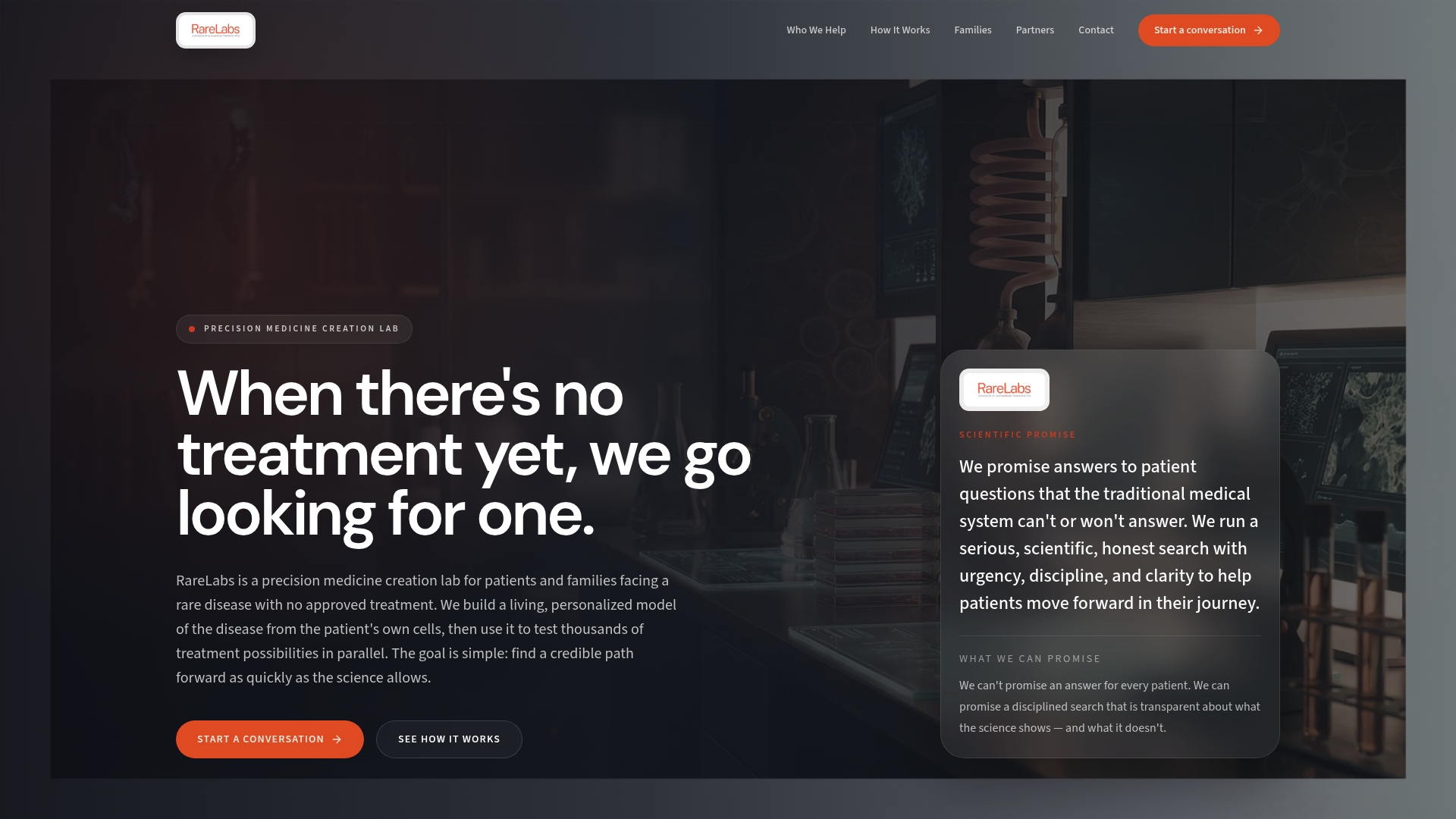
Hopeatrarelabs is a specialized biotech firm that builds patient-specific disease models using induced pluripotent stem cells (iPSCs) and CRISPR gene editing. It then screens thousands of FDA-approved drugs and evaluates gene therapy options to identify potential treatments for ultra-rare and undiagnosed genetic diseases. For families who have found their nonprofit community and are ready to ask harder questions about treatment, Hopeatrarelabs treatment search provides a scientifically rigorous path forward. You can also read the step-by-step treatment guide to understand how the process works before you begin.
FAQ
What does a rare nonprofit do for families?
A rare nonprofit provides direct financial assistance, research funding, and community connection for families affected by rare or undiagnosed genetic diseases. Organizations like NORD and the Rare Genes Movement also offer expert webinars, policy advocacy, and peer support programs.
How do I find a nonprofit for my specific rare disease?
Genetic Alliance's Disease InfoSearch database and NORD's Rare Disease Database both catalog condition-specific organizations. Searching by your diagnosis or genetic variant in either database will surface the most relevant nonprofits.
How do rare nonprofits fund research?
Many rare disease nonprofits award direct research grants to scientists studying specific genetic conditions. The ARRE Foundation, for example, allocated $435,000 in research funding in 2026, covering behavioral phenotyping and natural history studies.
Can a small nonprofit make a real difference in rare disease research?
Small nonprofits consistently drive research that larger institutions overlook. The 16p11.2 Genetic Foundation grew from a single parent's effort into a systemic research and advocacy organization, demonstrating that founder-driven organizations can achieve significant scientific and policy impact.
How can I support a rare disease nonprofit if I am not personally affected?
Donating to condition-specific organizations, volunteering for community fundraising events, and sharing awareness campaigns on social media all provide meaningful support. Nonprofits in underfunded sectors rely heavily on community engagement to sustain their programs.