

Choose the assay that measures the product's actual mechanism of action, not the one that's easiest to run. When mechanism of action is multifactorial, plan an assay matrix instead of forcing a single test to carry the whole burden, and expect the FDA and ICH frameworks to demand a quantitative, biologically relevant readout. Start by drafting an Ideal Assay Profile and running early feasibility experiments before committing resources to full development.
TL;DR:
- Selecting an assay should focus on the actual mechanism of action, with assay matrices used for complex or multifactorial processes, rather than relying on a single test.
- Cell-based functional assays provide the highest biological relevance but are slower and harder to validate, whereas biochemical and analytical assays are faster but need correlation to function.
- Building a stepwise workflow involves mapping MoA to measurable signals, drafting an Ideal Assay Profile, and screening candidates with scoring based on relevance, feasibility, and regulatory defensibility.
- Transitioning from qualification to validation requires increasing rigor, with full validation necessary for lot release and submission, and assay matrices are needed when a single test cannot capture all mechanisms.
- Regularly monitoring reagent stability, reference standard integrity, and employing orthogonal methods reduce common pitfalls like lot variability, standard drift, and vague MoA mapping.
Table of Contents
- What types of potency assays fit cell and gene therapy products?
- How do you build a stepwise potency assay selection workflow?
- How do QbD and DoE improve assay development?
- What's the difference between assay qualification and full validation?
- When do you need an assay matrix instead of one assay?
- How do reference standards and relative potency testing work?
- What acceptance criteria and statistics should you set?
- What are the most common potency assay pitfalls?
- How RareLabs applies assay correlation to patient-derived models
- What should teams starting assay selection do first?
- Where RareLabs fits in your assay selection process
- Where to go deeper on potency assay guidance
- Sources
What types of potency assays fit cell and gene therapy products?
The four core assay families each answer a different question, and picking the wrong one is the single most common reason teams end up redoing development a year in. Cell-based functional assays measure what the product actually does biologically, whether that's cytokine release from a CAR-T product, transduction efficiency followed by transgene expression, or a cytotoxicity readout against target cells. Biochemical and analytical assays quantify a molecular attribute, like protein concentration or enzymatic activity, that correlates with function but doesn't test it directly. Binding assays confirm a receptor or ligand interaction occurs, useful early on but rarely sufficient alone for a complex cell therapy. In vivo assays remain the gold standard for demonstrating whole-organism efficacy but are slow, expensive, and a poor fit for routine lot release.
Where analytical surrogates become acceptable is a judgment call that depends on correlation data, not convenience. A 2023 Frontiers review notes that quantitative, validated in vitro assays are necessary for timely lot release of advanced therapy medicinal products, and that regulators expect an assay matrix when the mechanism is complex enough that no single test captures it.
- Cell-based functional: best biological relevance, longest turnaround, hardest to validate for release.
- Biochemical/analytical: fast and reproducible, but only defensible once tied back to a functional correlate.
- Binding: cheap screening tool, weak stand-alone evidence for potency.
- In vivo: strongest efficacy signal, generally reserved for characterization rather than routine release.
Sample volume and patient-derived material constraints often decide the matter before biology does. Autologous products in particular force teams toward assays that work on small, variable input material. That's the practical reality Hopeatrarelabs's cell-based assay primer walks through in more depth.
How do you build a stepwise potency assay selection workflow?
A reproducible workflow beats ad hoc assay picking every time, and it starts with mapping mechanism of action to something you can actually measure. Vague MoA statements produce vague assays; specific ones produce testable readouts. From there, define an Ideal Assay Profile (IAP) that spells out target sensitivity, precision, dynamic range, and turnaround time before you run a single optimization experiment. The CIRM/Pharmaron potency assay guide frames this IAP step as the anchor for every downstream decision, and it's the single most skipped step in early-stage programs.
- Map MoA to a measurable biological or biochemical readout tied to the product's proposed clinical activity.
- Draft the IAP: acceptance criteria, required sensitivity, sample volume limits, and expected turnaround.
- Score candidate assays against biological relevance, technical feasibility, scalability, and regulatory defensibility.
- Run small-scale feasibility studies on the top two or three candidates before committing development resources.
- Set stage-appropriate deliverables: a qualified assay ahead of pivotal trials, a fully validated cGMP assay for BLA or MAA submission.
Pro Tip: Score every candidate assay on the same four criteria (biological relevance, feasibility, scalability, regulatory defensibility) using a simple 1 to 5 scale. It forces the team to argue with data instead of opinion, and it makes the eventual regulatory justification almost write itself.
The gene therapy modality itself shapes which mechanism you're mapping. Hopeatrarelabs's overview of gene therapy approaches for ultra-rare diseases is a useful reference when the MoA spans transduction, expression, and downstream functional correction.
How do QbD and DoE improve assay development?
Quality by Design treats the assay itself as a product with critical quality attributes, and Design of Experiments is how you find which variables actually move those attributes. Instead of changing one factor at a time, a DoE approach tests multiple variables (cell density, incubation time, reagent lot, detection reagent concentration) simultaneously to reveal interactions that one-factor-at-a-time testing would miss entirely. A 2024 review on QbD and DoE applied to assay development walks through practitioner case examples where this approach identified critical process parameters faster than traditional optimization.
Rockefeller University's assay development guidance sets a practical benchmark: aim for a Z' factor above 0.5 and a coefficient of variation under roughly 10% for screening-type assays. Biologically complex cell therapy assays often can't hit that CV target cleanly, and that's fine as long as the deviation is justified and documented rather than quietly ignored.
Core experiments worth running early:
- Titration curves to establish dynamic range and confirm the assay responds proportionally across expected potency levels.
- Signal-to-background ratio checks to confirm the readout isn't drowning in noise.
- Z' factor calculation across multiple plates and operators, not just one lucky run.
- CV monitoring across reagent lots, not just within a single lot.
- Orthogonal confirmation using a second, mechanistically distinct method to catch false positives.
Automation and synthetic reference standards earn their keep once manual variability starts eating into your CV budget, particularly for plate-based flow cytometry or luminescence readouts where operator handling introduces real noise. Hopeatrarelabs's drug screening optimization guide covers the practical side of introducing automation without losing biological signal.
What's the difference between assay qualification and full validation?
Qualification and validation aren't interchangeable, and regulators track the distinction closely. Qualification demonstrates an assay performs consistently enough for decision-making at a given development stage, using a defined but lighter set of parameters. Full validation, following the ICH Q2(R1) framework, requires formal evidence across accuracy, precision, specificity, linearity, range, and robustness, and it's what a cGMP release assay needs before a BLA or MAA filing.
The FDA's potency guidance for cellular and gene therapy products treats potency as a critical quality attribute and expects the rigor of your assay evidence to scale with trial phase:
- IND stage: exploratory assay acceptable, with a documented development plan toward qualification.
- Phase 2/3: assay should be qualified, with locked acceptance criteria and demonstrated reproducibility.
- BLA/MAA: fully validated, cGMP-compliant assay required for lot release.
- Any method change: a bridging study connecting old and new assay results, or you risk losing continuity of your potency dataset.
Waiting until Phase 3 to think about validation is the fastest way to blow a filing timeline.
When do you need an assay matrix instead of one assay?
An assay matrix becomes necessary when a single test can't capture a multi-mechanism product, when there are multiple active components, or when sample volume is too limited to run several independent full assays on the same material. FDA's own framing accepts this approach explicitly: pairing a transgene expression measurement with a downstream functional readout is a defensible way to cover a gene therapy's mechanism when no single assay does the whole job.
- Build the matrix around orthogonal methods that each capture a distinct piece of the MoA.
- Design a correlation study that statistically links the analytical surrogate to the functional readout across a meaningful range of samples.
- Present the correlation data, not just the surrogate result, when justifying the matrix to reviewers.
- Use the validated functional assay for characterization and the faster analytical method for routine lot release once correlation holds.
- Revisit the correlation periodically during stability testing, since drift between methods can appear over time even after initial validation.
Hopeatrarelabs's gene therapy screening guide shows how MoA mapping feeds directly into matrix design for complex modalities. A molecular diagnostics primer from EIV Diagnostics is a useful reference for teams evaluating whether a molecular readout can serve as one leg of that matrix.
How do reference standards and relative potency testing work?
Relative potency, comparing a test article against a qualified reference standard, is the practical backbone of most CGT release assays. Getting it right means treating the reference standard as a program asset with its own lifecycle, not a one-time purchase.
- Run system suitability checks (positive control, negative control, reference standard performance) on every plate before trusting sample data.
- Plan reference standard supply years ahead: production quantity, storage conditions, and a documented requalification protocol for when the current lot runs low.
- Build in a backup or bridging reference candidate before the primary standard is exhausted, not after.
- Confirm statistical parallelism between test article and reference dose-response curves before reporting a relative potency value.
Pro Tip: When parallelism fails, don't just rerun the assay hoping for a better day. Investigate dilution scheme, matrix effects, and reagent lot first. Failed parallelism repeated across multiple runs usually means the reference standard and test article are behaving through genuinely different mechanisms, which is a biology problem, not a technique problem. Reference material planning and parallelism documentation belong in the validation master plan from day one, since loss of parallelism can trigger a full assay revalidation if it isn't anticipated.
What acceptance criteria and statistics should you set?
Z' and CV aren't just screening metrics, they're the numbers that tell you whether your assay can actually distinguish a good lot from a bad one. A Z' factor above 0.5 paired with a CV under roughly 10% signals a robust screening assay, though biologically complex cell-based readouts routinely land higher on CV and still remain scientifically defensible.
Accuracy, precision, linearity, and range each need acceptance criteria set from real assay performance data, not copied from a template. Run enough replicates across enough operators and reagent lots to know your assay's actual variability before locking a criterion you can't consistently hit.
For autologous products where sample numbers are inherently small, a qualified assay used for release combined with a documented biological confirmation strategy can be an acceptable path, provided the approach is justified in the comparability protocol and discussed with regulators in advance. That's a narrower validation strategy than a standard allogeneic program would use, and it needs to be stated as such rather than presented as equivalent.
What are the most common potency assay pitfalls?
Most assay failures trace back to a handful of repeat offenders: reagent lot variability that wasn't caught before it hit a validation run, reference standard degradation nobody flagged until parallelism broke, insufficient replicates masking real assay noise, and an MoA mapping that was too vague to generate a testable readout in the first place.
- Reagent and cell-line lot changes without a bridging comparison.
- Reference standard drift caught too late in its lifecycle.
- Skipping orthogonal confirmation, so a single assay's blind spots go unnoticed.
- Locking acceptance criteria before enough data exists to justify them.
- Treating qualification data as validation data when a regulator will not.
When a functional assay stalls, running an orthogonal analytical method in parallel often isolates whether the problem is biological or technical faster than repeating the same failed run. If a method must change mid-program, a bridging study is the only way to keep your potency dataset continuous rather than starting over.
How RareLabs applies assay correlation to patient-derived models
Rare disease programs rarely get the luxury of an established cell line with a textbook MoA. Hopeatrarelabs builds disease models from a patient's own induced pluripotent stem cells, then uses CRISPR-edited isogenic controls to isolate exactly what the disease mutation changes functionally. That comparison, patient-derived cell against its own corrected counterpart, produces a biologically grounded readout that a generic cell line can't offer.
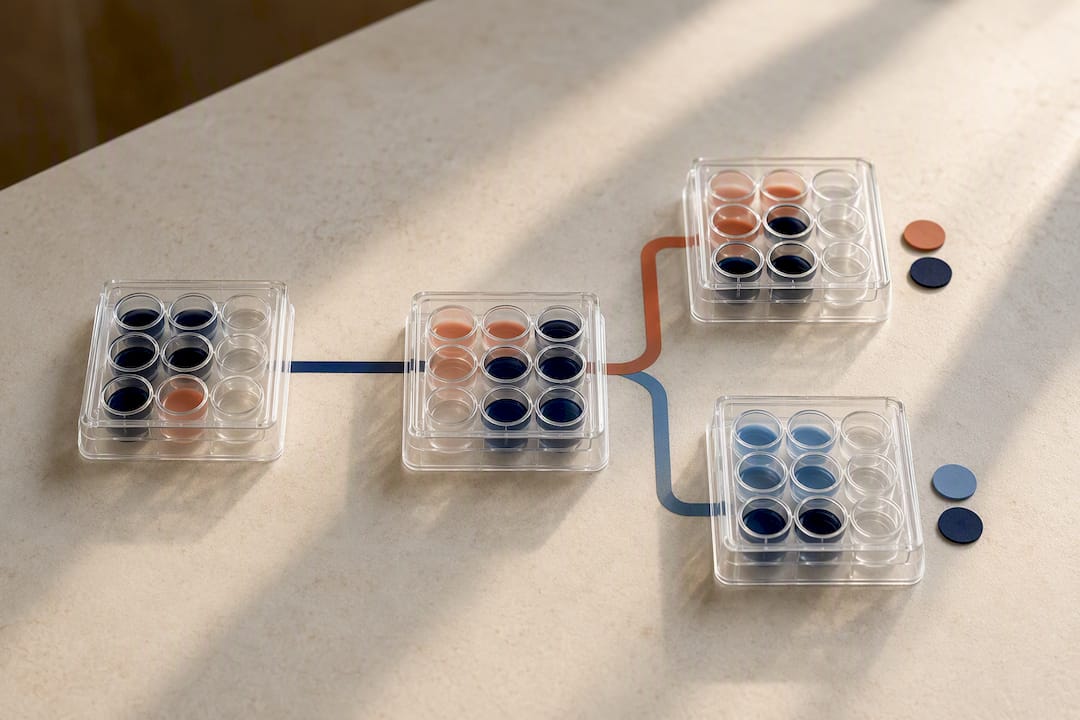
For gene therapy feasibility work, this often means building a small assay matrix: a molecular readout confirming vector transduction or ASO uptake, paired with a downstream functional assay measuring whether the corrected pathway actually behaves like the isogenic control. That correlation is what turns a screening result into a defensible potency signal, an approach detailed further in RareLabs Knowledge.
What should teams starting assay selection do first?
Spend the first 30 days mapping mechanism of action and drafting your IAP before running a single optimization experiment. By day 60, you should have feasibility data on your top two candidate assays. By day 90, a prioritization decision backed by that data, not a hunch. Build the core team early: a bench scientist, a statistician who understands parallelism and Z' calculations, and a regulatory or QA lead who can flag documentation gaps before they become filing delays. Engage your regulator early on assay strategy, and start reference material planning long before you think you need it.
— John
Where RareLabs fits in your assay selection process
If mapping mechanism of action to a biologically defensible readout is the hard part, Hopeatrarelabs built its entire platform around exactly that problem. Instead of guessing whether a generic cell line reflects your target biology, Hopeatrarelabs generates patient-derived iPSC models and CRISPR-edited isogenic controls that give you a direct functional comparison, correction versus disease state, to anchor your assay matrix in real biological signal rather than assumption.

For programs weighing high-throughput repurposed drug screening, custom ASO feasibility, or gene therapy correlation studies, that patient-specific foundation shortens the distance between a screening hit and a defensible potency readout. If your program is at the stage where mechanism mapping and assay correlation are the bottleneck, explore what a personalized modeling program could look like for your disease through RareLabs Knowledge.
Where to go deeper on potency assay guidance
The FDA's potency guidance sets the regulatory baseline. ICH Q2(R1) covers validation parameters. The Frontiers review addresses assay matrices for complex mechanisms. The CIRM/Pharmaron guide details the Ideal Assay Profile. The NIH Assay Guidance Manual offers hands-on development protocols.
Sources
- Potency Tests for Cellular and Gene Therapy Products | FDA
- Potency testing of cell and gene therapy products | Frontiers
- Potency Assay Guide (CIRM / Pharmaron)
- QbD and DoE for assay development | PMC (2024)
- Developing a robust assay | The Rockefeller University