
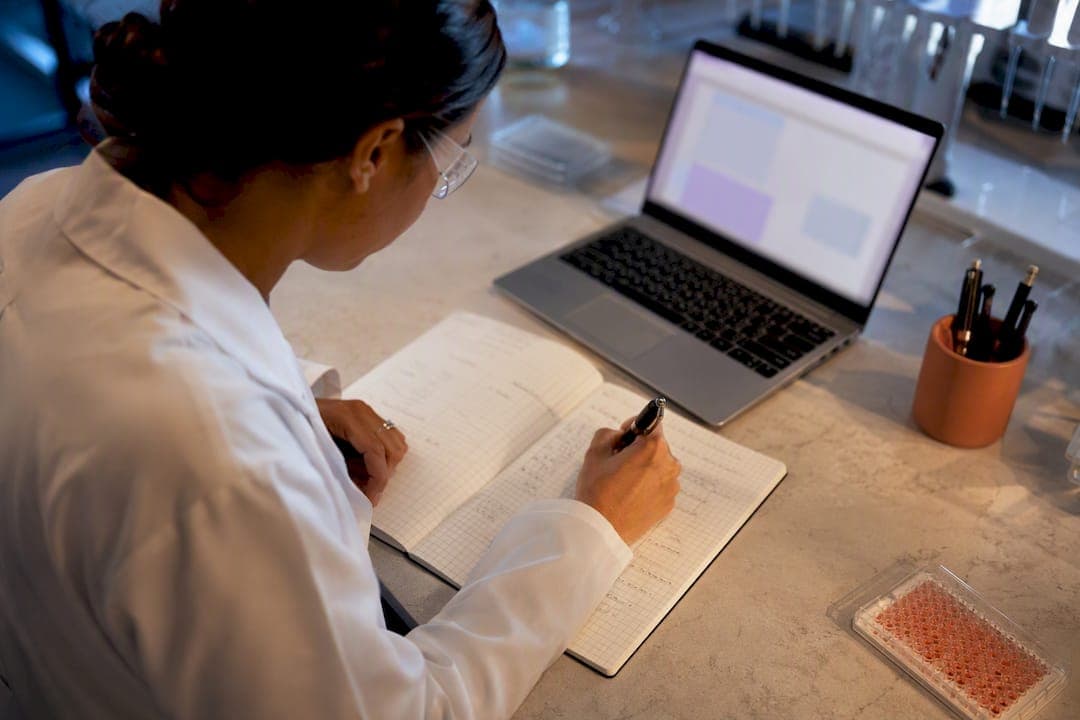
Open notebook science means putting the entire primary record of a research project online in real time, including raw data, protocols, and the failed experiments most labs never mention. Researchers who want faster feedback, tighter reproducibility, and broader collaboration should treat it as worth piloting now, especially in fields with small, urgent research communities like rare disease.
TL;DR:
- Timestamp and archive all research updates with a DOI to establish priority and minimize scooping risks in open notebook science.
- Use clear licensing like CC BY 4.0 and attach detailed metadata to maximize reuse and reproducibility of shared data.
- Maintain consistency through fixed templates, assign dedicated roles, and set a manageable posting cadence to prevent notebooks from becoming stale.
- Document failed experiments, negative results, and methodology openly to accelerate learning and collaboration in small or urgent research communities.
- Focus on transparency benefits for rare disease research, including faster funding, improved community engagement, and reducing redundant experiments.
Table of Contents
- What Is Open Notebook Science and Where Did It Start?
- What Are the Real Benefits of Sharing Research Live?
- What Are the Drawbacks of Publishing Research in Real Time?
- How Do You Start an Open Notebook Step by Step?
- How Do You Keep an Open Notebook From Going Stale?
- How Has Open Notebook Science Helped Rare Disease Research?
- Which Platforms and Standards Should You Actually Use?
- Why Transparency Is the Point, Not a Feature
- Sources
What Is Open Notebook Science and Where Did It Start?
The formal definition, drawn from Wikipedia's entry on the practice, is straightforward: making the complete primary record of a research project publicly available online as the work happens, not after publication. That includes the data everyone usually hides. Chemist Jean-Claude Bradley coined the term in the mid-2000s while running an open synthetic chemistry project at Drexel University, posting his lab's raw results, including dead-end reactions, for anyone to inspect.
Bradley's insight was that "dark data," the unpublished, negative, or inconclusive results that never make it into a journal, holds real scientific value. A failed reaction tells the next researcher what not to try. Early projects like LabScribbles extended this idea into a working example of a public notebook, and the community hub at openlabnotebooks.org grew out of the same push to standardize how researchers post live data. Over time, platforms matured from personal blogs into structured repositories with metadata standards, turning a niche habit into a repeatable practice.
What Are the Real Benefits of Sharing Research Live?
The upside is concrete, not theoretical. Open notebooks compress the feedback loop: instead of waiting a year for peer review, a flawed method or a promising lead gets flagged within days. Researchers using this model report several recurring gains:
- Fewer duplicated experiments across labs working on the same rare pathway or compound class
- More complete method reporting, since posting live forces you to document steps you'd otherwise skip
- Timestamped, DOI-linked credit for ideas and data, even before formal publication
- New collaborations that emerge from people finding your work mid-project, not after it's finished
- Outsized gains for small research communities, where every duplicated failed experiment wastes scarce time and funding
Open notebooks also function as an informal quality check. Peers can flag technical flaws early, before a shaky result gets formalized into a citable paper. That's a different kind of peer review, happening in public, in real time, rather than behind a closed editorial process.
Pro Tip: Post negative results with the same care you'd give a positive finding. A well-documented failure often earns more citations than a thin success, because it saves other labs the exact mistake.
What Are the Drawbacks of Publishing Research in Real Time?
The objections are real, and dismissing them does nobody a favor. Scooping fear tops the list: researchers worry that posting data live hands a competitor the finish line. Collaborator and intellectual property constraints come next, especially in biopharma partnerships where a sponsor's legal team has opinions about what goes public and when. Add in human-subjects privacy concerns and the sheer time cost of maintaining a notebook, and it's easy to see why many projects start strong and quietly stop updating.
Each barrier has a workable mitigation:
- Scooping risk shrinks once you timestamp entries and archive them with a DOI through a service like Zenodo. A dated, citable record establishes priority, arguably better than a manuscript stuck in review for months.
- IP and collaborator concerns are solvable with upfront language in project agreements specifying what stays internal versus what gets posted, reviewed before the notebook goes live.
- Privacy and human-subjects data need institutional review board sign-off before anything patient-specific gets shared; when in doubt, post the methodology and de-identified summary, not raw clinical data.
- Time burden is the quiet killer. A frequent pitfall in open-notebook projects is losing momentum once the initial novelty fades, which templates and assigned posting duties address directly.
How Do You Start an Open Notebook Step by Step?
Starting small beats starting perfectly. Decide your openness level first: full raw-data transparency, a curated subset, or a hybrid where sensitive material stays private while methods and negative results go public. Then build a lightweight entry template so posting doesn't require a decision every time.
A workable daily or weekly entry should include:
- Raw files from the day's runs, unedited
- Methods written plainly enough that someone outside your lab could repeat them
- Failed or inconclusive runs, labeled honestly rather than buried
- Analysis notes, even half-formed ones
- A short lay summary translating the entry for non-specialists, useful for patient advocacy groups and funders alike
Platform choice matters less than consistency, but the dominant combination pairs a narrative layer with an archival layer. Deep-dive workflows described in the rare disease ONS literature typically run a blog or GitHub Pages site for the readable narrative, then deposit the underlying data, code, and files to Zenodo or the Open Science Framework (OSF) for a permanent, citable DOI. GitHub itself handles versioned code and notebook history well, especially for computational work.
License everything under CC BY 4.0 unless you have a specific reason not to. Attach metadata that actually helps someone reuse your work: experiment date, contributor names with ORCID IDs, reagent catalog numbers, instrument settings, file checksums, and your code environment, following the minimal reproducible metadata set outlined by Nature Human Behaviour.
| Step | What to do | Where |
|---|---|---|
| Draft entry | Write raw notes, methods, failed runs | Blog or GitHub Pages |
| Archive | Deposit data, code, files for a DOI | Zenodo or OSF |
| License | Apply CC BY 4.0 | Attached to deposit |
| Link | Connect narrative post to archived DOI | Both platforms |
| Tag | Add ORCID, metadata, checksums | Deposit record |
How Do You Keep an Open Notebook From Going Stale?
Sustainability comes down to reducing friction, not willpower. A fixed template cuts the "what do I even write" hesitation that kills momentum. Assign roles explicitly: one person posts entries, another handles Zenodo deposits, a third curates outbound links and keeps the lay summaries current.
- Set a realistic cadence (weekly beats daily for most labs) and defend it
- Write lay summaries every few entries to pull in non-specialist readers, including patient communities
- Link every deposit to contributor ORCID IDs and a persistent project DOI for discoverability
- Track downloads, citation counts, and unsolicited collaboration inquiries as your actual success metrics, not vanity page views
Pro Tip: Review your notebook's traffic and inbound questions quarterly. A spike in downloads from an unfamiliar institution is often the first sign of a collaboration forming before anyone emails you.
How Has Open Notebook Science Helped Rare Disease Research?
Rare disease research is arguably the best-fit use case for this entire model. Communities are small, funding is thin, and duplicated failed experiments cost more than most fields can absorb. Published analysis of open notebook science applied to rare disease projects found it increases engagement with patient groups, cuts down on redundant experiments, and speeds progress precisely because the audience following along is motivated and specific.
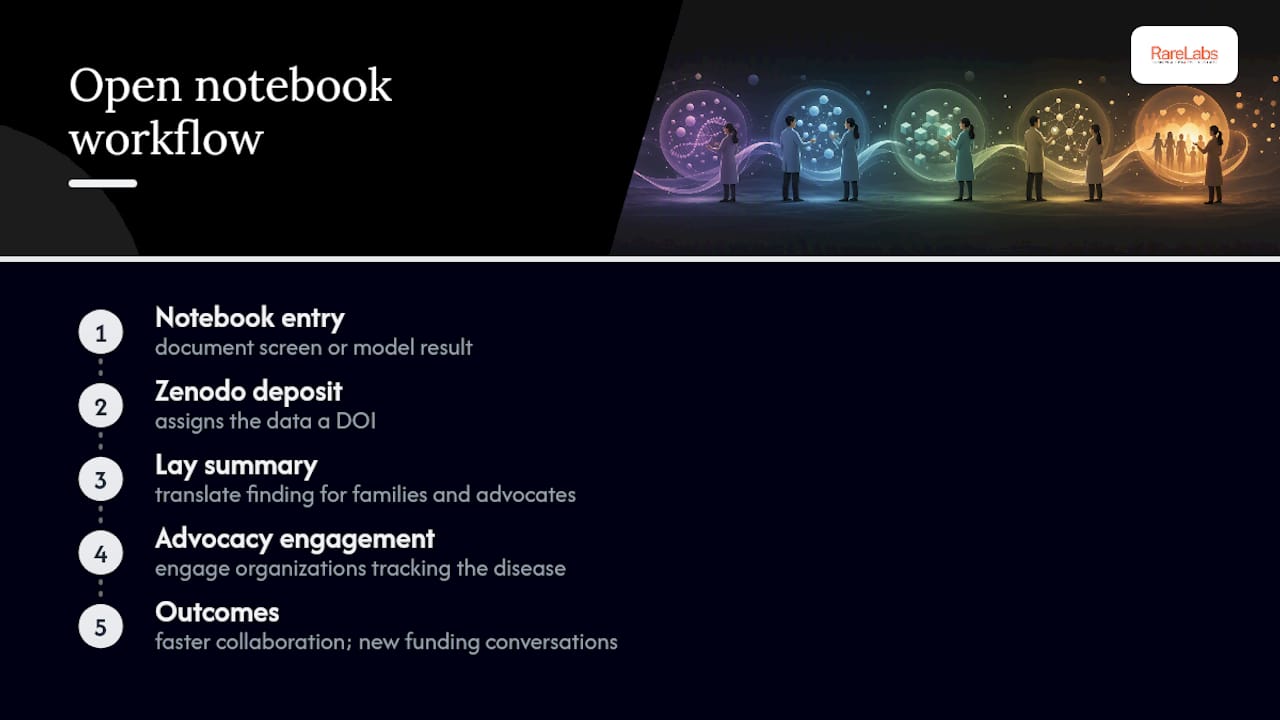
The pipeline that works looks consistent across projects: a notebook entry documenting a screen or model result, a Zenodo deposit that assigns the data a DOI, a lay summary translating the finding for families and advocates, and direct engagement with the advocacy organizations already tracking that disease. Reported outcomes include faster collaboration formation and new funding conversations that started because a foundation found the work mid-project rather than after publication, an outcome consistent with how rapid therapy discovery accelerates translational progress in personalized disease modeling.
Hopeatrarelabs runs on a version of this transparency ethic internally, treating rapid, documented iteration across personalized drug screening pipelines as core to how ultra-rare disease programs move quickly without cutting scientific corners.
Which Platforms and Standards Should You Actually Use?
Four resources cover almost everything a new open notebook needs. The community hub at openlabnotebooks.org collects example projects, including LabScribbles, as working templates rather than abstract advice. For archiving, Zenodo and OSF both issue DOIs and handle project registration, with Zenodo favored for dataset-plus-code deposits and OSF favored for full project-level organization including preregistration.
- openlabnotebooks.org for community examples and onboarding
- Zenodo for dataset and file archiving with DOI assignment
- OSF for project registration and broader study organization
- GitHub / GitHub Pages for versioned code and the narrative notebook layer
- TOP Guidelines and the Transparency Checklist for structured reporting standards that make your notebook verifiable rather than just visible
The TOP Guidelines give tiered implementation levels, so you can start at a basic transparency tier and move up as your workflow matures, rather than treating full openness as all-or-nothing. Common barriers to sustained transparency, including collaboration friction and funding uncertainty, are covered in more depth in Hopeatrarelabs' overview of rare disease research challenges.
Why Transparency Is the Point, Not a Feature
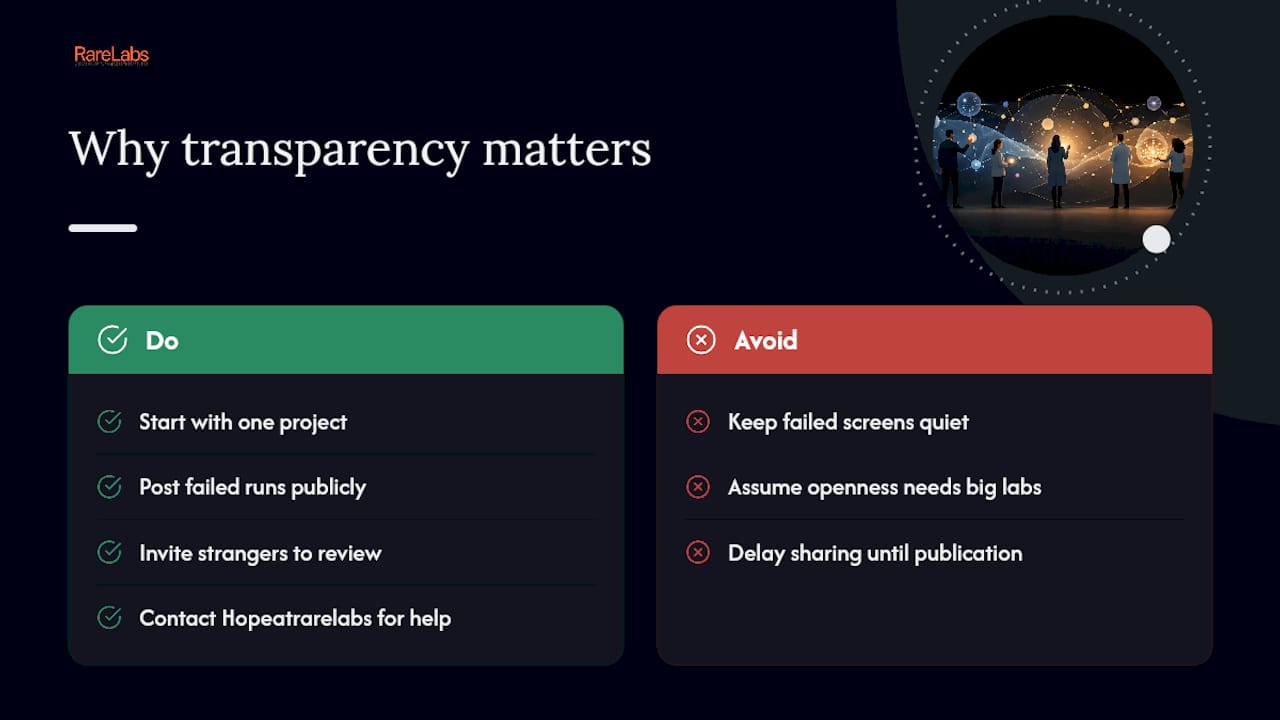
The rare disease field taught me that secrecy usually protects nothing except a false sense of control. A failed screen kept quiet doesn't stop being a failed screen; it just gets rediscovered by someone else, months later, at someone else's expense. Open notebook science forces a kind of honesty that formal publication delays for years, and in ultra-rare disease work, years are the one resource nobody has.
I'd push back on one common assumption: that openness only pays off for well-funded, well-staffed labs with time to spare. The opposite is closer to true. Small teams and family-driven research efforts, the ones Hopeatrarelabs works alongside most often, have the most to gain from a stranger finding their notebook and offering a lead they'd never have found alone. Start with one project. Post the failed run you'd normally leave out. See who shows up. If you're working on a specific rare or undiagnosed condition and want to see how personalized disease modeling fits alongside a transparent research approach, Hopeatrarelabs is a reasonable place to start that conversation.
— John
Sources
The Wikipedia entry on open-notebook science is the clearest starting definition and history. The PLOS Biology analysis of rare disease ONS projects documents concrete outcomes in patient-community engagement. The Structural Genomics Consortium's open notebook community writeup covers governance lessons from pilots that struggled with momentum. The TOP Guidelines paper lays out the transparency framework referenced throughout this guide, and the Nature Human Behaviour transparency checklist gives the metadata standard worth adopting from day one.
- Open-notebook science — Wikipedia
- Open notebook science can maximize impact for rare disease projects — PLOS Biology