
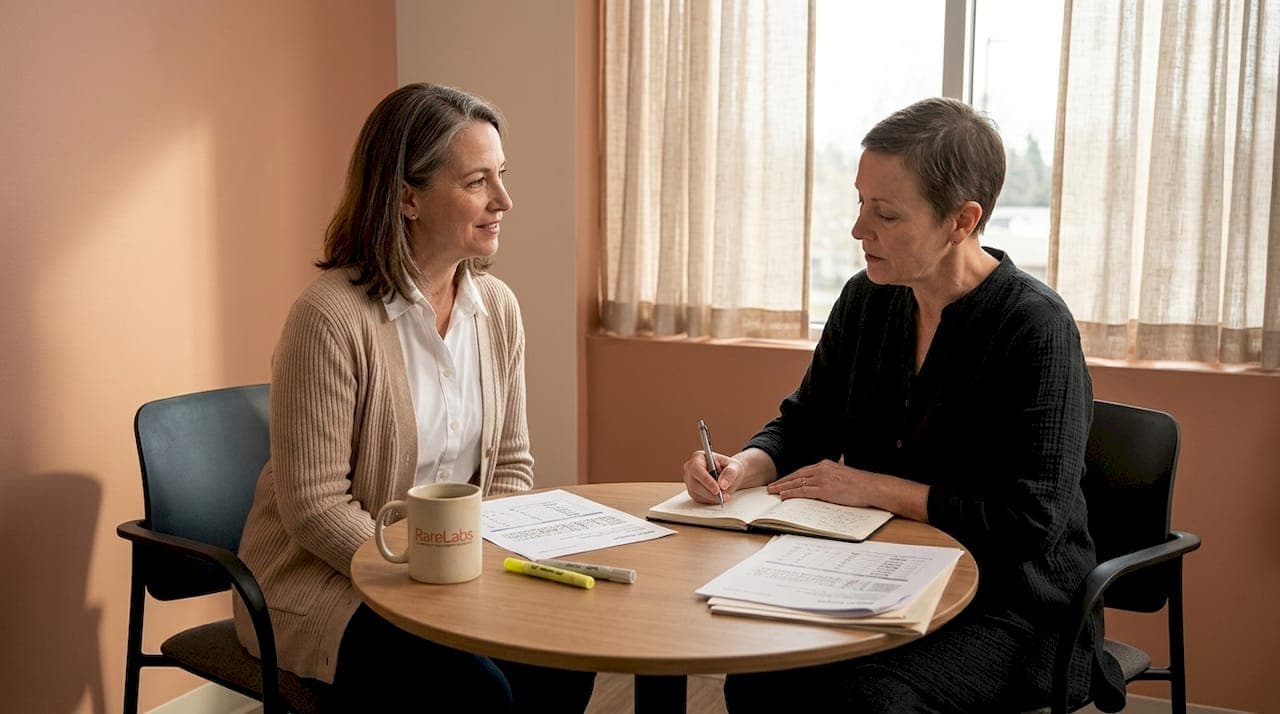
Receiving a rare disease diagnosis is one of the most disorienting experiences a family can face. Knowing how to discuss rare disease findings clearly and compassionately, whether with family members, friends, or your care team, can feel just as overwhelming as the diagnosis itself. The words you choose, the timing you pick, and the emotional preparation you do beforehand all shape how these conversations land. This guide walks you through every stage of that process: understanding what your findings actually mean, preparing for the conversation, communicating with clarity, and managing the emotional responses that follow.
Table of Contents
- Key Takeaways
- How to Discuss Rare Disease Findings: Know What You're Sharing
- Preparing for the conversation
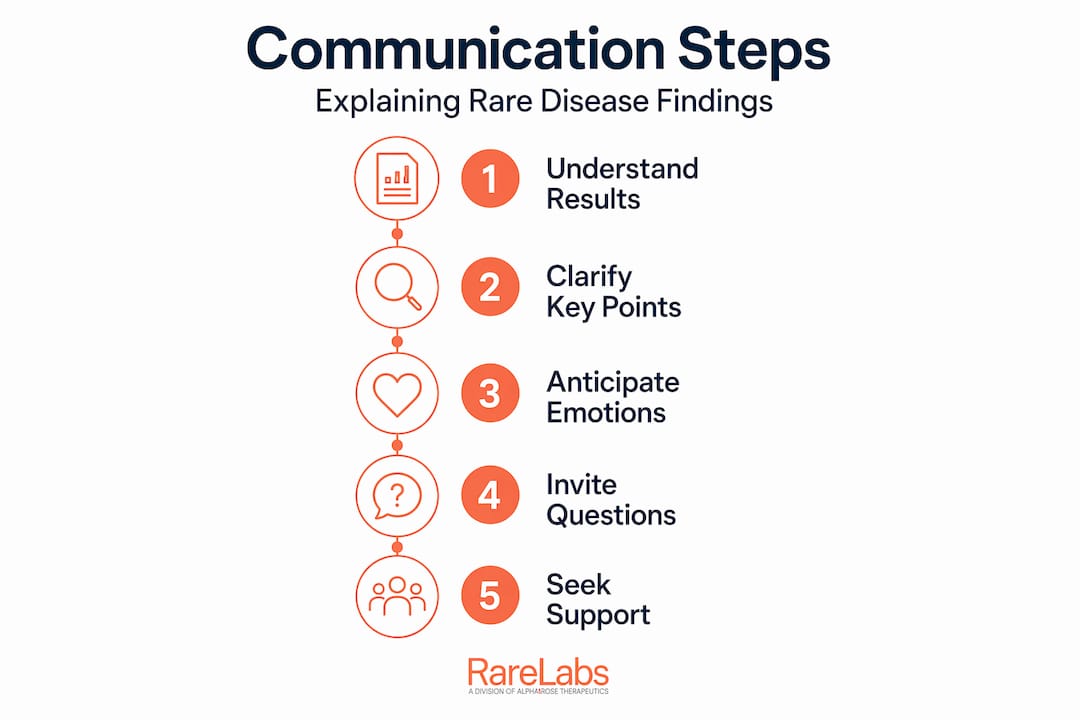
- Effective strategies for explaining rare disease findings
- Navigating emotional responses and communication barriers
- My perspective on why communication matters as much as diagnosis
- How Hopeatrarelabs can support your rare disease communication
- FAQ
Key Takeaways
| Point | Details |
|---|---|
| Understand your findings first | Know what your genetic results mean medically before trying to explain them to others. |
| Prepare emotionally before talking | Process your own feelings with a trusted non-family confidant before approaching relatives. |
| Use plain, empowering language | Replace clinical jargon with clear terms that frame genetic risk as something manageable. |
| Bring in professional support | Genetic counselors can lead or support conversations that feel too complex to handle alone. |
| Stay open over time | Rare disease understanding evolves, so communication should be ongoing rather than a one-time event. |
How to Discuss Rare Disease Findings: Know What You're Sharing
Before you can explain your findings to anyone else, you need to understand them yourself. Rare genetic diseases are defined, in the United States, as conditions affecting fewer than 200,000 people. Many are caused by mutations in a single gene, though the resulting symptoms can vary dramatically from person to person, even within the same family.
Typical diagnostic results include variant classifications ranging from "pathogenic" (confirmed disease-causing) to "variants of uncertain significance," which are among the most confusing results to communicate. Knowing which category your findings fall into changes what you should say and how.
What makes rare disease findings particularly complex is this: they carry both medical and deeply personal weight. A finding does not just describe your health. It potentially implicates blood relatives who have never been tested. Approximately 13% of seemingly healthy adults carry significant genetic risk requiring ongoing attention, meaning the conversation you start today may be life-changing for a sibling or parent tomorrow.
Consider Plasminogen Deficiency as one example: a condition affecting roughly 1.6 per million people worldwide, often missed because its symptoms overlap with more common conditions. Families dealing with ultra-rare conditions like this frequently discover the diagnosis only after years of searching. The diagnostic journey averages 5 to 7 years for rare disease patients, and that delay adds layers of grief, confusion, and relief to the communication challenge.
Here is what to clarify for yourself before any conversation:
- What specific gene or variant was identified, and what does it mean clinically?
- Is the finding confirmed pathogenic, or is more testing needed?
- What are the inheritance patterns, and who else in the family might be affected?
- Are there established treatments, or is this an area where research is still developing?
- What does this mean for your day-to-day life right now?
Pro Tip: Ask your physician to provide a written summary of your findings in plain language. Having something in writing gives you a reference point when memory fails in an emotional moment, and it gives family members something concrete to review later.
For a deeper look at interpreting genetic results, the genetic diagnosis guide at Hopeatrarelabs offers a practical breakdown by finding type.
Preparing for the conversation
Most people jump too quickly into telling others their news before they have had time to sit with it themselves. That rush often leads to emotionally charged conversations that leave everyone more confused and frightened than before.
Here is a step-by-step approach to preparing well:
-
Process your own response first. Denial, anger, guilt, and grief are all normal reactions to a rare disease finding. Give yourself time before attempting to explain anything to others. You do not owe anyone an immediate explanation.
-
Talk to a trusted, non-biological confidant first. Discussing findings first with a trusted non-family person helps you process the emotional weight and practice the words before you speak with relatives who may also be personally affected. A close friend, therapist, or patient advocate works well for this role.
-
Gather accurate, current information. Misinformation spreads fast when people fill in gaps on their own. Print out credible resources from your medical team. Explore genetic disease education resources that are designed specifically for families, not clinicians.
-
Choose the right setting and timing. A noisy family gathering is not the place for this conversation. Choose a calm, private setting with enough time for questions and emotions to surface. Avoid delivering major news right before someone has to leave for work or school.
-
Prepare for grief, not just information transfer. The person you are telling may respond with fear, tears, or silence. Your job is not just to inform. It is to be present. Prepare for their emotional reaction as much as you prepare the content itself.
Only 50% of families with rare genetic conditions are referred to genetic counselors. If you have not been offered this referral, ask for one explicitly. A genetic counselor can help you prepare for these conversations and can sometimes be present during family discussions.
Pro Tip: Write down two or three key points you want each family member to walk away with. Clarity of intent prevents the conversation from spiraling into tangential fears before the core message lands.
Effective strategies for explaining rare disease findings
Knowing what to say is one thing. Knowing how to say it is what actually changes outcomes.
Here are the communication strategies that matter most:
- Drop the jargon. Replace "autosomal dominant inheritance" with "this type of gene change can be passed from a parent to a child, with about a 50% chance." Clear, direct language reduces the chance of misinterpretation.
- Frame risk as empowering, not fatalistic. Reframing genetic risk as actionable allows relatives to see testing as a tool for proactive care rather than a verdict. Saying "knowing this gives us options we wouldn't have otherwise" changes the entire emotional register of the conversation.
- Balance honesty with hope. You do not have to share every worst-case scenario upfront. Be truthful about what is known and honest about what is still uncertain, without catastrophizing.
- Actively listen and validate emotions. Empathy, clarity, and active listening are not soft skills in this context. They are clinical tools that shape how information is actually received and retained.
- Use visual aids when possible. A simple family tree diagram showing inheritance patterns, or a printed one-page summary of the condition, can make abstract concepts concrete.
- Involve professionals in the room when needed. Your physician or genetic counselor can join a family meeting either in person or via video call. Their presence adds authority and helps field questions you may not be equipped to answer.
Here is a quick comparison of two communication approaches:
| Approach | What it sounds like | Likely outcome |
|---|---|---|
| Unstructured, emotional | "I have this gene thing and it's bad and you might have it too" | Confusion, panic, unresolved questions |
| Structured, empowering | "Here's what we found, what it means, and what we can do about it" | Better understanding, calmer response, action steps |
High-stakes medical conversations require recognizing both emotional and cognitive processing. Giving people a moment to absorb before asking if they have questions makes a significant difference in comprehension. See how genetic counseling supports these conversations throughout the rare disease journey.

Navigating emotional responses and communication barriers
Even the most carefully prepared conversation can go sideways. Family members may deny the risk, dismiss genetic testing as unnecessary, or react with anger that is really about fear.
Here is how to navigate those moments:
- Recognize denial for what it is. When a sibling says "I don't want to know," that is a valid choice but also a protective response. You can share information without demanding a reaction. Plant the seed and give it time.
- Address misinformation directly but gently. If a family member comes back with something they read online that contradicts your findings, acknowledge their concern and redirect them to your medical team for clarification rather than arguing the point yourself.
- Know when to bring in a mediator. Genetic counselors and rare disease patient advocates are trained for exactly these conversations. If your family is in conflict or someone is deeply distressed, professional mediation is not a failure. It is the smart choice.
- Expect the conversation to continue. One talk is rarely enough. As science evolves and understanding deepens, new information will emerge. Keep the door open rather than treating this as a single event.
"Negative or dismissive communication by healthcare professionals impacts families more than the diagnosis itself." This finding, from research on rare disease communication, is a reminder that you have the right to advocate for better support. If your medical team is not communicating clearly or respectfully, you can request a different specialist or care coordinator.
Many families also discover that support groups post-diagnosis are not proactively offered. Seek them out. Connecting with others who have the same condition often does more for communication confidence than any article or handbook.
My perspective on why communication matters as much as diagnosis
I have seen families receive a precise, scientifically significant diagnosis and then watch it dissolve into confusion and inaction because no one knew how to talk about it. The diagnosis sat in a folder. The relatives were never told. Years passed.
In my experience, the conversation around a rare disease finding is not secondary to the medical process. It is part of the medical process. When families communicate findings clearly, relatives get tested earlier, treatment decisions get made faster, and patients stop feeling alone in their experience. The science matters enormously. But without clear, empathetic communication, even the best findings can fail to produce any real change in people's lives.
What I have learned from working closely with families in this space is that most people are not afraid of the information itself. They are afraid of doing it wrong. Of saying too much or not enough. Of being the messenger of bad news. That fear is completely understandable, and it is also something you can move through with the right preparation. The families I have seen communicate most effectively are not the ones with the most medical knowledge. They are the ones who gave themselves permission to feel uncertain, prepared anyway, and reached out for help when the conversation got hard.
— John
How Hopeatrarelabs can support your rare disease communication
When you are trying to explain findings to your family, having the right information at your fingertips changes everything. Hopeatrarelabs is built to put that information in your hands quickly and clearly.
The RareLabs Knowledge platform gives patients, families, and physicians access to current rare disease research and treatment information organized in a way that supports real conversations, not just clinical summaries. Whether you are preparing for a family discussion or trying to understand what a new finding means for your treatment options, this resource is designed to help you move faster and communicate with more confidence. You can also explore personalized rare disease support that connects your specific genetic findings to active research pathways. Because knowing what to say starts with knowing what you are dealing with, and you should not have to figure that out alone.
FAQ
What does it mean to discuss rare disease findings?
Discussing rare disease findings means sharing and explaining your genetic diagnosis results with family members, healthcare providers, or support networks in a clear, compassionate way that supports understanding and informed decision-making.
Who should be told about a rare genetic finding first?
Start with a trusted non-biological confidant to process your emotions before telling family members who may also be genetically at risk. A therapist, close friend, or genetic counselor works well for this first conversation.
How do I explain a genetic finding without causing panic?
Use plain language, focus on what actions are available rather than worst-case outcomes, and frame the information as empowering. Saying "knowing this gives us options" shifts the tone from fear to agency.
When should I involve a genetic counselor in a family conversation?
Involve a genetic counselor whenever the findings are complex, when family members are in conflict, or when you feel unable to answer the medical questions that arise. Only half of families with rare genetic conditions receive this referral, so ask for it proactively if needed.
What if a family member refuses to engage with the information?
Respect their choice while leaving the door open. You can share written resources they can return to later, and recognize that denial is often a protective, temporary response rather than a permanent decision.