

Most families who receive a genetic diagnosis assume that identifying the mutation is the hardest part, and that a targeted treatment must follow naturally. The reality of mutation-specific therapy is more complicated and, in some ways, more promising than that assumption. Understanding what mutation-specific therapy actually is, how it works, and where it has genuine limits can change how you navigate your treatment search. This guide breaks down the science in plain language, with real examples from cancer and ultra-rare genetic diseases, so you can ask better questions and make more informed decisions.
Table of Contents
- Understanding mutation-specific therapy and precision medicine
- How mutation-specific therapy works in practice
- The limits and nuances of mutation-specific therapy effectiveness
- Applying mutation-specific therapy in ultra-rare and undiagnosed genetic diseases
- Why mutation-specific therapy still requires careful navigation beyond the mutation
- Find personalized support and rare disease treatment options at RareLabs
- Frequently asked questions
Understanding mutation-specific therapy and precision medicine
Mutation-specific therapy is a form of precision medicine where treatment is chosen based on a particular genetic mutation or variant found in a patient, rather than the organ or tissue where the disease appears. Instead of treating "lung cancer" or "a rare enzyme disorder" as broad categories, this approach asks: what is the exact genetic change driving this disease, and can we target it directly?
In cancer, this often means blocking the abnormal proteins that mutated genes produce. A mutated gene may instruct a cell to make a protein that triggers uncontrolled growth. A mutation-targeted treatment is designed to block that specific protein, interrupting the signal that tells the cell to keep dividing. This is fundamentally different from chemotherapy, which broadly attacks dividing cells regardless of why they are dividing.
For rare genetic diseases, the concept goes even further. Rather than blocking a protein, some mutation-specific treatments aim to correct or compensate for the genetic error itself. This is where gene editing options like CRISPR, base editing, and antisense oligonucleotides (ASOs, which are short synthetic molecules that can modify how a gene is read) come into the picture.
There are two broad categories worth understanding:
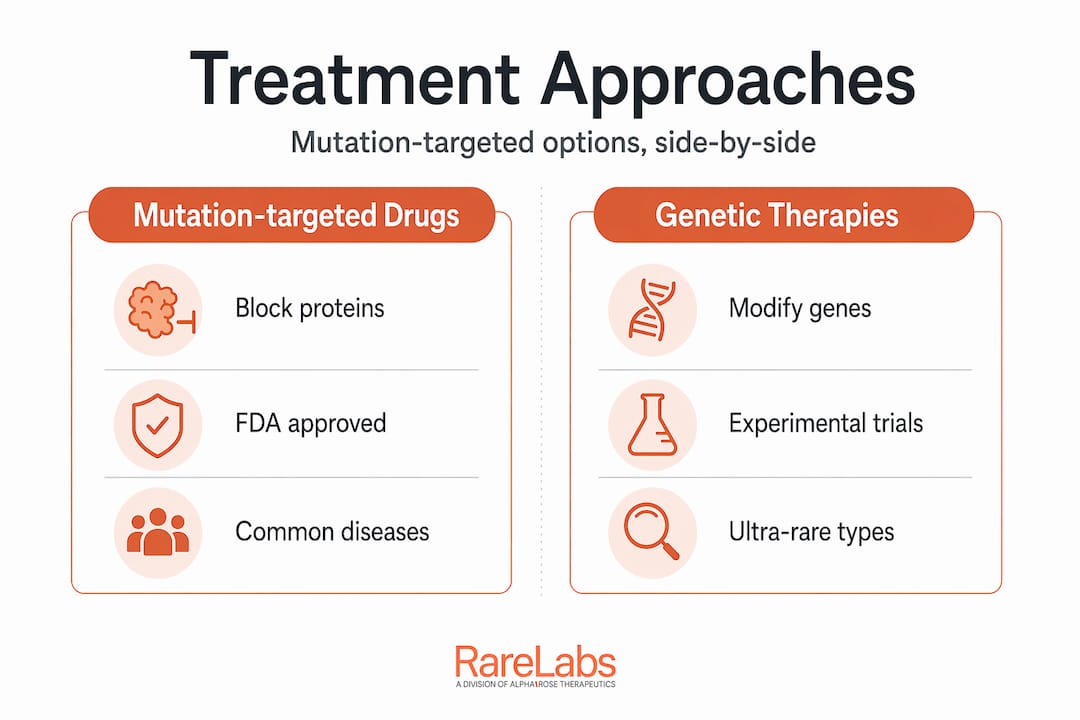
- Mutation-targeted drugs: Small molecule drugs or antibodies that block the abnormal protein a mutation produces, without changing the DNA itself
- Mutation-correcting therapies: Gene editing or gene therapy tools that fix, silence, or replace the faulty gene at the source
- ASOs: Molecules that alter how a gene's instructions are processed, often used when a full gene replacement is not yet feasible
- Tumor-agnostic therapies: FDA-approved drugs that target a specific mutation regardless of which organ the cancer started in
The core logic of mutation-specific therapy is that the mutation is the disease driver, and treating the mutation treats the disease. But that logic only holds when the therapy has been validated for the patient's specific disease context, not just for the mutation in isolation.
Understanding this distinction upfront will save you from chasing therapies that look relevant on paper but were validated in a completely different disease.
How mutation-specific therapy works in practice
Now that we know what mutation-specific therapy is, let's explore the practical steps involved in getting matched to these therapies.
The process is not as simple as "run a test, get a drug." It involves multiple decision points where evidence, access, and biology all intersect.
-
Molecular or genetic testing identifies the specific mutation or alteration driving the disease. In cancer, this might be a panel test like MSK-IMPACT that scans hundreds of genes simultaneously. In rare genetic diseases, whole exome or whole genome sequencing is often needed to find a previously unidentified variant. Patients are matched to therapies only after this step confirms an actionable mutation.
-
Actionability analysis determines whether the identified mutation has a therapy or clinical trial behind it. Not every mutation that shows up on a test has an approved drug or validated evidence pathway. A mutation may be detected but currently have no known therapy. This is where the difference between "detected" and "actionable" becomes critical.
-
Therapy matching connects the patient to the right treatment. This may be an FDA-approved drug, a compassionate use request, or enrollment in a clinical trial. FDA-approved tumor-agnostic therapies can treat any cancer type that carries the same actionable mutation, which is a significant shift in how regulators think about cancer treatment. NTRK inhibitors like larotrectinib are a clear example: they work in thyroid cancer, lung cancer, and sarcoma alike, as long as the NTRK fusion mutation is present.
-
Custom therapy development is becoming possible even for the rarest cases. In a landmark 2025 case, an experimental base-editing therapy was designed, approved by regulators, and administered to an infant with a severe genetic disorder within months of diagnosis. That is the frontier of what mutation-specific therapy can look like for ultra-rare conditions.
Pro Tip: Broad molecular profiling tests increase your chances of finding a match significantly. Narrow gene panels designed for common cancers will often miss variants relevant to rare diseases. Ask your physician specifically about whole genome or whole exome sequencing if you have an undiagnosed or ultra-rare condition.
Understanding genetic therapies options and knowing how to ask about gene therapy screening for applicable trials can open doors that a standard referral pathway misses entirely.

The limits and nuances of mutation-specific therapy effectiveness
Understanding how mutation-specific therapy works is vital, but it's equally important to recognize its limitations and what that means for you.
The most common misconception is that finding a mutation automatically means there is an effective therapy waiting. The harder truth is that having an actionable mutation is necessary but not sufficient. The therapy must be validated specifically for your disease type, not just for any disease where that mutation appears.
A 2026 Australian analysis found that survival improved only when mutations were treated with therapies that had clinical validation in that patient's specific cancer histology. When patients received mutation-matched therapies that were only validated in different cancer types, survival benefit disappeared. This is a critical finding for anyone exploring off-label mutation-specific treatments.
Here is a practical comparison of when mutation-specific therapy tends to work versus when it falls short:
| Scenario | Likely outcome | Key factor |
|---|---|---|
| Mutation validated in your disease type | Strong evidence of benefit | Histology-matched evidence |
| Mutation validated only in different cancer/disease | Uncertain benefit, variable results | Off-label use without direct evidence |
| Mutation detected but no approved therapy exists | Clinical trial may be needed | Actionability gap |
| Multiple co-occurring mutations | Treatment response may vary | Genomic complexity |
| Mutation found but therapy access is limited | Compassionate use or trial needed | Access barriers |
Co-occurring genetic alterations add another layer of complexity. A tumor or disease-causing gene rarely changes in just one place. Secondary mutations can block the drug from working, create alternate pathways for disease progression, or trigger resistance. This is why gene therapy approaches for rare diseases are often evaluated within the full context of a patient's genomic profile, not as a single-mutation fix.
Pro Tip: When evaluating any mutation-specific therapy, ask your care team specifically: "Has this therapy shown benefit in patients with my exact disease type, or was it validated in a different condition?" That one question can prevent a treatment course that looks promising but lacks the right evidence foundation.
Applying mutation-specific therapy in ultra-rare and undiagnosed genetic diseases
Let's look at how these principles and methods translate specifically to ultra-rare and undiagnosed genetic diseases, where personalized options can be life-changing.
The same logic that drives mutation-specific therapy in cancer applies directly to rare genetic disease, but the landscape is different. There are fewer approved therapies, far smaller patient populations, and often no disease-specific clinical trial to join. That does not mean there are no options. It means the search has to be more systematic.
Key strategies for patients and families navigating this space:
- Start with comprehensive genetic testing. Whole genome sequencing is increasingly accessible and gives the broadest possible picture of what mutations are present and potentially driving the disease.
- Identify whether your mutation is actionable. This requires expert interpretation, not just a lab report. Some mutations are well-characterized in the literature; others are variants of uncertain significance that need additional functional testing.
- Look beyond disease-specific trials. Platforms like NCI MATCH match patients to treatment trials based on the molecular profile of the disease rather than the tissue type or diagnosis. This matters enormously if your disease is unnamed or has no dedicated trial.
- Consider disease modeling. Building a model of your disease from your own cells, using iPSC or CRISPR technology, allows researchers to test how different therapies actually affect your specific biology before you take them.
Here is a practical comparison of the two main mutation-specific treatment approaches relevant to rare disease patients:
| Approach | How it works | Best suited for | Example |
|---|---|---|---|
| Mutation-targeted drugs | Block abnormal proteins produced by the mutation | Conditions with known druggable protein targets | Enzyme replacement in lysosomal storage diseases |
| Gene editing therapy | Correct, silence, or replace the faulty gene | Conditions where the gene defect itself can be addressed | Base editing for rare metabolic disorders |
| ASO therapy | Alter how the gene's instructions are processed | Single-gene disorders with specific splicing or expression errors | Spinal muscular atrophy (SMA) treatment |
| Drug repurposing screens | Test approved drugs against patient-derived disease models | Conditions with no approved therapy | Broad FDA-drug screening in iPSC models |
Connecting with resources on therapeutic targets for rare diseases, understanding genetic disease modeling, and accessing gene therapy evaluation guides can accelerate this process significantly.
Why mutation-specific therapy still requires careful navigation beyond the mutation
There is an understandable temptation, when you finally have a genetic diagnosis or an identified mutation, to treat that answer as the finish line. It is not. In our experience working at the intersection of genomics and rare disease, the mutation is better understood as the starting point of a more demanding investigation.
Mutation detection quality matters enormously and is rarely discussed openly with families. Not all sequencing labs report mutations with the same sensitivity or accuracy. A variant can be called incorrectly, missed, or reported without sufficient evidence to support clinical action. The chain from "mutation identified" to "therapy matched" involves test quality, interpretation expertise, evidence review, and disease context alignment. Any weak link in that chain can lead to a treatment decision that looks scientifically grounded but is not.
Resistance is the other reality that standard articles on precision medicine tend to understate. Tumors evolve. In genetic diseases, compensatory changes can emerge. Resistance develops as biology shifts, meaning that a therapy working today may not work in 12 months without adjustments. Repeated molecular testing and expert interpretation are not optional follow-up steps. They are part of the treatment itself.
The families who navigate mutation-specific therapy most effectively are those who build a multidisciplinary team early: a molecular geneticist, a disease specialist familiar with precision medicine, and, ideally, access to a research program that can model the disease and test therapies in a controlled setting. Exploring gene editing insights alongside clinical options gives families the full picture they need to ask sharper questions and avoid therapy decisions based on incomplete evidence.
Mutation-specific therapy is genuinely one of the most powerful developments in modern medicine. But its power is fully realized only when the therapy, the evidence, and the patient's specific biology are aligned. Getting that alignment right is where expertise makes all the difference.
Find personalized support and rare disease treatment options at RareLabs
For more tailored resources and to begin your personalized treatment search, RareLabs offers tools and information designed for patients like you.
At RareLabs, we work specifically with patients and families navigating ultra-rare and undiagnosed genetic diseases who need more than general information. We build patient-specific disease models from your own cells, run parallel treatment screens across thousands of FDA-approved drugs and custom therapies, and evaluate gene therapy options when no approved treatment exists.
If you are ready to move from research to action, RareLabs Knowledge gives you access to curated, science-backed resources on rare disease research and personalized treatment strategies. When you are ready to search for mutation-specific therapies or gene therapy opportunities relevant to your condition, the RareLabs treatment search helps you find options matched to your molecular profile. You do not have to navigate this alone.
Frequently asked questions
What does mutation-specific therapy mean for patients with ultra-rare genetic diseases?
It means treatments are designed around the exact genetic mutation found in your disease, which can include targeted drugs, ASO therapy, or patient-specific gene editing. In rare cases, base-editing therapies have been custom-built for a single patient's mutation profile.
How do doctors determine if mutation-specific therapy is right for me?
They use molecular testing to identify mutations in your disease-causing genes, then evaluate whether validated therapies or eligible clinical trials exist for that mutation in your disease type. Patients are selected for mutation-specific therapies only after this matching process is complete.
Are mutation-specific therapies always effective?
No. Effectiveness depends heavily on whether the therapy has been validated specifically for your disease type. Research shows survival improvement occurred only when mutation-matched therapies had direct clinical evidence in the patient's specific disease histology, not just in other conditions with the same mutation.
What steps can families take to explore mutation-specific therapy options?
Start with comprehensive whole genome or whole exome sequencing, then consult with specialists experienced in precision medicine and rare disease. NCI MATCH matches patients to treatment trials based on molecular data rather than diagnosis alone, which makes it relevant even for patients with unnamed or undiagnosed conditions.