

For a defensible clinical comparison of gene-editing and gene-therapy options, you need three things working together: a phenotype-guided variant prioritizer, a curated treatment compendium, and a clinical trial registry lookup, all feeding into a patient-specific translational workflow. No single database covers the full picture. The gap between what in-silico tools can tell you and what a patient's cells will actually do is where most comparisons break down.
The minimal toolset that holds up under clinical scrutiny combines:
- Variant prioritizer (Exomiser, LIRICAL, or PhenIX): ranks candidate genes from a VCF using HPO phenotype terms, ideally in trio mode
- Treatment compendium (Rx-Genes): maps confirmed diagnoses to curated therapy options and links directly to active trials
- Trial registry (ClinicalTrials.gov): locates interventional studies for gene therapy and gene editing by condition, gene, or intervention type
- Knowledgebases (ClinVar, ClinGen, OMIM/GeneReviews): provide variant pathogenicity, gene-disease validity, and clinical management context
- Functional translational testing (Hopeatrarelabs): patient-derived iPSC models and high-throughput screens to validate what the databases cannot tell you
The one-line workflow: variant interpretation → treatment mapping → risk and feasibility filtering → translational functional testing.
Pro Tip: Run your prioritizer in trio mode whenever parental samples are available. Benchmarking data shows optimized parameter settings and trio inputs substantially improve the fraction of causal genes captured in the top ten candidates, which is the list that actually drives clinical decisions.
Table of Contents
- What types of genetic disease treatment comparison tools exist?
- Key resources clinicians use for genetic disorder treatment options
- How do you combine these tools into a clinical comparison workflow?
- How do you evaluate which tool is right for your comparison work?
- What are the limitations and ethical risks of using these tools?
- When does Hopeatrarelabs fill the gap these tools leave?
- Key Takeaways
- The tools are only as good as the judgment behind them
- Hopeatrarelabs offers patient-specific feasibility testing when databases reach their limit
- Useful sources and where to go next
What types of genetic disease treatment comparison tools exist?
Before you open a single database, knowing which category of tool you need saves hours of misdirected effort. These are the main types, with their clinical versus research orientation and access constraints:
- AI and machine-learning prioritization aids: emerging tools that integrate multi-omic data to rank therapeutic candidates. Primarily research. Validation status varies widely, and recent benchmarking shows current large language models underperform specialized bioinformatics tools for causal gene identification.
Key resources clinicians use for genetic disorder treatment options
Each resource below has a distinct job in the comparison workflow. Using them interchangeably is one of the most common mistakes in clinical genomics practice.
Rx-Genes
A searchable treatment compendium for genetic conditions that maps Mendelian diagnoses to curated therapy options, evidence levels, and direct links to ClinicalTrials.gov entries. Clinicians use it as the first stop after a molecular diagnosis to see what approved, investigational, or off-label options exist for a given gene or condition. Fully open access; machine-readable exports support documentation for clinical records or regulatory submissions.
PanelAppRex
A harmonized gene-panel resource that integrates more than 58,000 curated gene-panel associations, including NHS-approved diagnostic panels. It supports structured exports and programmatic queries, making it useful for labs that need to confirm which genes are covered by a validated diagnostic panel before ordering sequencing or interpreting results. Open access; API available.
Exomiser (and the PhenIX/LIRICAL family)
The most widely benchmarked phenotype-driven variant prioritizer in clinical genomics. Exomiser scores variants from a VCF against HPO terms and ranks candidate genes by a combined pathogenicity and phenotype-match score. When configured with trio data and optimized parameters, published benchmarking places causal genes within the top ten candidates for 83–92% of cases across validation cohorts. Open source; Java-based local installation or REST API. A community benchmarking repository on GitHub provides reproducible pipelines for comparing Exomiser against LIRICAL, PhenIX, and other prioritizers.
ClinVar
The primary public archive for variant-level pathogenicity interpretations, submitted by clinical labs and research groups across the US and internationally. ClinVar is the first place to check whether a variant of interest has been classified as pathogenic, likely pathogenic, or of uncertain significance by another submitter. Free, web-based, and downloadable in bulk via FTP. FDA references ClinVar in its guidance on genomic test interpretation.
ClinGen
Where ClinVar handles individual variants, ClinGen evaluates the overall validity of gene-disease relationships using a structured evidence framework. Its curated gene-disease validity classifications (Definitive, Strong, Moderate, Limited, Disputed) are the standard clinicians should use when deciding whether a gene is a credible therapeutic target. Free; integrates with ClinVar and OMIM.
OMIM and GeneReviews
OMIM (Online Mendelian Inheritance in Man) provides the canonical catalog of Mendelian phenotypes and their molecular basis. GeneReviews, hosted by NCBI, offers peer-reviewed, clinician-authored summaries of diagnosis, management, and genetic counseling for specific conditions. Together they are the reference layer every other tool builds on. Both are free and web-based.
DECIPHER
A genotype-phenotype database built from patient cohort data submitted by clinical genetics centers worldwide. DECIPHER is particularly useful for ultra-rare variants where population databases offer no frequency data: finding even one or two patients with the same variant and overlapping phenotype can shift a VUS toward pathogenic. Access requires registration; patient-level data sharing follows a data access agreement.
CIViC (Clinical Interpretation of Variants in Cancer)
CIViC focuses on somatic variants in cancer but is increasingly relevant for germline cancer predisposition genes. It provides structured, evidence-graded interpretations of clinical significance and therapeutic relevance, with explicit citation links to primary literature. Open access; API available. Clinicians working on hereditary cancer syndromes should cross-reference CIViC alongside ClinVar.
ClinicalTrials.gov
The mandatory US registry for interventional clinical studies. For gene therapy and gene editing, ClinicalTrials.gov is the definitive source for locating active trials by condition, gene target, intervention type, and phase. FDA-approved gene therapies currently cover conditions including spinal muscular atrophy, hemophilia, and retinal dystrophy; for most other genetic diseases, a trial is the primary access route. Filter by "gene therapy" or "gene editing" under intervention type and cross-reference with Rx-Genes entries.
gnomAD
The Genome Aggregation Database from the Broad Institute provides allele frequencies and gene constraint metrics across more than 125,000 exomes and 76,000 genomes. A variant absent from gnomAD in a gene with high constraint (pLI > 0.9) is a strong signal for pathogenicity and a practical indicator that the gene may be a viable editing target. Free; downloadable and queryable via browser or API.
| Resource | Type | Evidence model | Clinical vs. research | API/export | Access |
|---|---|---|---|---|---|
| Rx-Genes | Treatment compendium | Curated, evidence-graded | Clinical | Machine-readable export | Open |
| PanelAppRex | Panel registry | Curated (NHS + academic) | Clinical | API, structured export | Open |
| Exomiser/LIRICAL | Variant prioritizer | Benchmarked, HPO-driven | Both | REST API, local install | Open source |
| ClinVar | Variant knowledgebase | Submitter-curated | Both | FTP bulk download, API | Open |
| ClinGen | Gene-disease validity | Expert panel, structured | Clinical | API | Open |
| OMIM/GeneReviews | Disease knowledgebase | Peer-reviewed | Clinical | Web; OMIM API | Open (OMIM API key) |
| DECIPHER | Patient cohort DB | Curated, cohort-based | Research/clinical | Data access agreement | Registration |
| CIViC | Variant knowledgebase | Evidence-graded, cited | Clinical/research | API | Open |
| ClinicalTrials.gov | Trial registry | Regulatory (FDA-linked) | Clinical | API, bulk download | Open |
| gnomAD | Population frequency | Aggregated sequencing | Research/clinical | Browser, API, download | Open |
How do you combine these tools into a clinical comparison workflow?
Gene editing and gene therapy are not interchangeable strategies. Gene editing (CRISPR-Cas9 and related approaches) modifies the patient's own genomic sequence, typically targeting a specific pathogenic variant. Gene therapy delivers a functional gene copy or regulatory sequence, usually via a viral vector, without necessarily correcting the underlying mutation. That distinction matters at step one of any comparison: the mutation type, zygosity, and tissue target determine which approach is even mechanistically feasible before you evaluate safety or access.
Here is the stepwise workflow:
-
Gather primary data. Collect the patient's VCF (whole-exome or whole-genome), HPO phenotype terms, family structure (trio preferred), prior functional data if available, and consent status for data sharing with external tools.
-
Run a phenotype-guided variant prioritizer. Load the VCF and HPO terms into Exomiser or LIRICAL. Use trio mode when parental samples exist. Review the top-ranked candidates and note the pathogenicity score, inheritance model, and phenotype match.
-
Cross-reference candidate genes in ClinVar and ClinGen. Confirm variant pathogenicity classification and gene-disease validity. A gene with a ClinGen "Definitive" rating and a ClinVar "Pathogenic" variant is a credible therapeutic target. A gene with "Limited" validity or a VUS requires additional evidence before treatment planning.
-
Map the confirmed or high-confidence diagnosis to treatment options. Search Rx-Genes for the gene or condition. Review approved therapies, investigational options, and off-label approaches. Note evidence levels and any direct links to active trials. For hereditary cancer genes, add a CIViC lookup.
-
Search ClinicalTrials.gov for active trials. Filter by condition, gene, and intervention type. Identify trials the patient may qualify for and note phase, enrollment status, and site locations. Cross-reference with Rx-Genes entries to confirm alignment.
-
Apply feasibility filters. For each candidate therapeutic approach, evaluate: mutation type compatibility (gain-of-function vs. loss-of-function), tissue targeting feasibility, delivery vector options, immune profile risk, and regulatory status. Gene therapy carries real risks including immune responses and hepatotoxicity that must be weighed against potential benefit. Established therapies such as bone marrow transplantation remain the standard of care for many inborn errors of metabolism and must be included in the comparison, not treated as fallback options.
-
Request functional translational testing for high-value candidates. When a gene-editing or gene-therapy candidate clears the feasibility filter but lacks patient-specific safety data, in-silico tools cannot resolve the remaining uncertainty. This is the step where patient-derived iPSC models and functional assays become necessary.
-
Formulate a clinical action plan. Summarize the comparison across therapeutic modalities, document the evidence sources and their curation dates, and identify the next concrete step: trial referral, compassionate use inquiry, or initiation of a translational research program.
Pro Tip: Engage your institution's IRB and, where applicable, FDA regulatory counsel before initiating any off-label or investigational therapeutic pathway. For gene therapy specifically, early regulatory engagement can determine whether an IND or IDE is required and prevents delays that cost patients time they do not have. See Hopeatrarelabs's gene therapy screening guide for a practical walkthrough of trial entry criteria.
Pro Tip: Document every tool you use, including its version or data release date, in the clinical record. Curation states change: a variant classified as uncertain today may be reclassified as pathogenic in the next ClinVar release, and your documentation needs to reflect the state of evidence at the time of the decision.
How do you evaluate which tool is right for your comparison work?
Not all tools are equal, and the wrong choice at the prioritization step can send a clinical workup in the wrong direction for weeks. Score each tool against these dimensions before committing it to your workflow.
Curation model and evidence grading. Does the resource use a structured, transparent evidence framework (like ClinGen's gene validity classifications or CIViC's evidence levels), or is it community-submitted without expert review? Submitter-curated resources like ClinVar require you to assess submitter quality yourself.
Update frequency and maintenance. Academic bioinformatics tools are frequently abandoned when grant funding ends. Prefer platforms with documented release cycles and active maintenance. Check the tool's GitHub commit history or changelog before adopting it. A tool last updated three years ago may have annotation gaps that silently bias your results.
Clinical validation and benchmarking. For variant prioritizers, published performance data matters. Exomiser's benchmarking across validation cohorts is publicly documented and reproducible via the community benchmarking repository. When evaluating a less-established prioritizer, look for peer-reviewed performance papers and check whether the validation cohort resembles your patient population.
API and EHR integration. A tool you cannot query programmatically or export from in a structured format creates documentation bottlenecks. Rx-Genes, ClinVar, ClinGen, gnomAD, and ClinicalTrials.gov all offer APIs or bulk downloads. Request machine-readable exports and confirm evidence traceability before using a compendium for regulatory submissions.
Cost and access model. Most of the core resources are open access. DECIPHER requires a data access agreement. Commercial platforms vary. For US clinical workflows, confirm that any cloud-based tool your institution uses meets HIPAA requirements before uploading patient-identifiable data.
US clinical applicability. Does the resource reflect FDA-referenced classifications? Is it used by US clinical labs and cited in US professional society guidelines? ClinVar, ClinGen, and OMIM are embedded in US clinical practice. Some international resources (NHS panels in PanelAppRex, for example) require interpretation in the US regulatory context.
| Evaluation dimension | Question to answer |
|---|---|
| Evidence grading | Is the curation model transparent and structured, or community-submitted? |
| Update frequency | When was the last data release? Is the tool actively maintained? |
| Clinical validation | Are there published benchmarks for this tool in a relevant cohort? |
| API/EHR integration | Can you export structured, traceable data for clinical records? |
| Cost/access | Is it open access? Does it require a data agreement or institutional license? |
| US clinical applicability | Is it FDA-referenced or cited in US clinical guidelines? |
| HIPAA compliance | Can patient data be uploaded without violating privacy requirements? |
One concrete example: when selecting between Exomiser and a newer AI-based prioritizer, the choice is not close for most clinical settings. Recent research confirms that large language models currently underperform specialized tools like Exomiser for causal gene identification. Exomiser has peer-reviewed benchmarking, an active development team, and documented performance across diverse cohorts. An LLM-based approach may be useful for literature synthesis but should not replace a validated prioritizer in a diagnostic workflow.
What are the limitations and ethical risks of using these tools?
The tools described here are powerful, but each carries failure modes that can mislead clinical decisions if you do not account for them.
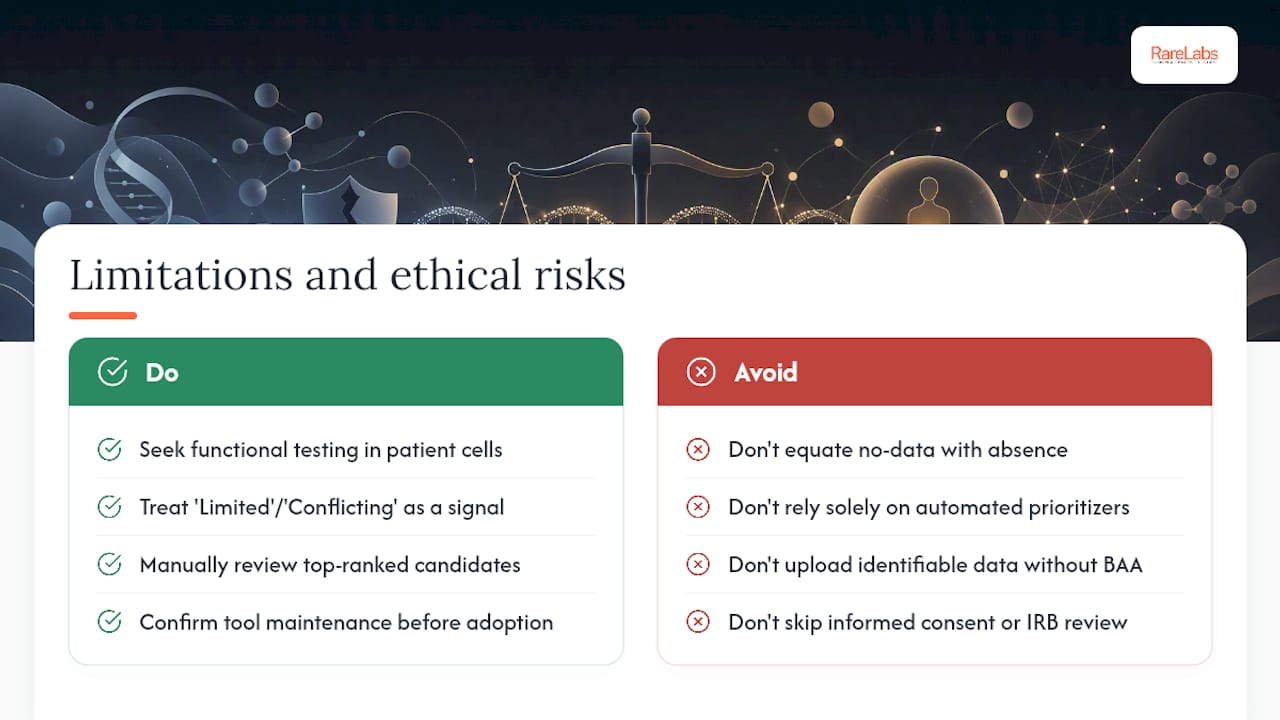
Evidence gaps for ultra-rare variants. For conditions with fewer than a few hundred documented cases globally, ClinVar may have no submissions for the specific variant, gnomAD may show zero allele count, and Rx-Genes may list no approved therapy. The absence of data is not evidence of absence. Ultra-rare variants require functional evidence that databases cannot supply.
Small sample sizes and annotation inconsistencies. Pathogenicity classifications can conflict between submitters in ClinVar, and gene-disease validity ratings in ClinGen may be based on fewer than ten published cases. Treat "Limited" or "Conflicting" classifications as a signal to seek additional evidence, not a reason to abandon the candidate.
Overreliance on automated prioritizers. A variant prioritizer ranks candidates; it does not diagnose. False positives are common, particularly when HPO terms are imprecise or the VCF contains many rare variants. Always review the biological plausibility of top-ranked candidates manually.
Abandoned tools and software decay. Many academic prioritization tools are no longer maintained. A tool that was state-of-the-art in 2020 may have annotation databases that are years out of date. Check maintenance status before adopting any tool into a clinical pipeline.
HIPAA and data sharing. Uploading patient-identifiable genomic data to external web tools without a Business Associate Agreement (BAA) is a HIPAA violation. Use de-identified data or confirm BAA status with any cloud-based tool before submission.
Informed consent for off-label and experimental interventions. Any therapeutic recommendation derived from this workflow that involves off-label use, compassionate use, or an investigational product requires explicit informed consent that covers the experimental nature of the intervention, known risks, and alternatives. IRB review is required for research use.
Regulatory pathways. Gene therapies in the US are regulated as biologics by FDA's Center for Biologics Evaluation and Research (CBER). Gene-editing approaches may require an Investigational New Drug (IND) application. Combination products (gene therapy plus a device delivery system) involve additional regulatory complexity. Early engagement with regulatory counsel is not optional for novel approaches.
Pro Tip: Before sharing any patient data with an external tool or registry, confirm whether the platform has executed a BAA with your institution. For gene therapy clinical hurdles including immune responses and delivery challenges, functional testing in patient-derived cells is the only way to generate patient-specific safety data that a database cannot provide.
When does Hopeatrarelabs fill the gap these tools leave?
In-silico tools can tell you what is plausible. They cannot tell you what will happen in your patient's cells. That gap is where Hopeatrarelabs operates.
Hopeatrarelabs builds patient-derived iPSC disease models from a patient's own cells, generates CRISPR-edited isogenic controls to isolate the effect of the pathogenic variant, and runs high-throughput screens across FDA-approved drugs, custom antisense oligonucleotides (ASOs), and gene therapy constructs. The result is patient-specific functional data, not population-level inference.
When Hopeatrarelabs adds value in the workflow:
- A gene-editing candidate has cleared the in-silico prioritization and ClinGen validity check, but the specific mutation type and patient immune profile make delivery toxicity uncertain. Patient-derived cells are the only way to test this.
- No approved therapy exists for the condition, and Rx-Genes shows only investigational options. A high-throughput repurposed drug screen across thousands of FDA-approved compounds can identify candidates that databases would never surface.
- A gene therapy vector has been identified as mechanistically appropriate, but tissue targeting and off-target risk in the patient's specific genetic background need functional validation before a trial referral or regulatory conversation.
- A custom ASO is being considered for a splice-site or nonsense variant. ASO design and efficacy testing in patient-derived cells requires wet-lab work that no knowledgebase can substitute.
- A data package is needed for a compassionate use request, trial entry, or IND-enabling study. Hopeatrarelabs produces assay readouts, feasibility notes, and prioritized therapeutic lists formatted for regulatory and clinical use.
What to send to Hopeatrarelabs to get started:
- VCF file (whole-exome or whole-genome preferred) or a variant summary with HGVS nomenclature
- HPO phenotype terms or a clinical summary
- Family structure and available parental samples
- Prior functional data, if any exists
- Consent status and any relevant IRB documentation
- Specific question: drug screen, ASO feasibility, gene therapy vector assessment, or full translational program
Expected deliverables include assay readouts from iPSC-based functional screens, CRISPR isogenic control data, ASO efficacy and toxicity profiles, gene therapy feasibility notes, and a prioritized therapeutic list with supporting evidence. For a detailed overview of how genetic disease modeling translates in-silico findings into patient-specific data, Hopeatrarelabs's published resources walk through the full process.
Key Takeaways
The most defensible clinical comparison of gene-editing and gene-therapy options combines a phenotype-guided variant prioritizer, a curated treatment compendium, a trial registry lookup, and patient-specific functional testing in a single reproducible workflow.
| Point | Details |
|---|---|
| Start with a validated prioritizer | Run Exomiser or LIRICAL in trio mode; benchmarked tools place causal genes in the top ten candidates for 83–92% of cases. |
| Cross-check in Rx-Genes and CIViC | Map confirmed diagnoses to curated therapy options and evidence-graded variant interpretations before evaluating any intervention. |
| Filter for delivery and immune risk | Gene therapy carries real risks including immune responses and hepatotoxicity; feasibility filtering must precede any therapeutic recommendation. |
| Document every tool and data release | Curation states change; record tool version and data release date in the clinical record for reproducibility and regulatory defensibility. |
| Hopeatrarelabs for functional validation | When in-silico tools reach their limit, Hopeatrarelabs provides patient-derived iPSC models, drug screens, ASO testing, and gene therapy feasibility data. |
The tools are only as good as the judgment behind them
The field has more databases than it has clinicians who know how to use them together. That is the actual problem. A researcher who runs Exomiser, finds a top-ranked candidate, looks it up in ClinVar, sees "Pathogenic," and concludes the treatment question is answered has skipped the three steps that matter most: feasibility filtering, functional validation, and regulatory reality-checking.
What gets underestimated, consistently, is how much the comparison between gene editing and gene therapy depends on patient-specific biology that no database captures. The mutation type matters. The patient's immune history matters. The tissue you need to reach matters. A tool that ranks a gene as a credible target is giving you a hypothesis, not a treatment plan.
The resources in this article are genuinely useful, and the workflow above is the right structure. But the clinicians and researchers who get the best outcomes are the ones who treat in-silico results as the beginning of the comparison, not the end. Functional testing in patient-derived cells is not a luxury for ultra-rare disease cases. It is the step that converts a plausible candidate into something you can actually act on, defend to a regulatory body, and present to a family with confidence.
Hopeatrarelabs exists precisely because that step is where most programs stall. The knowledgebases are free and excellent. The gap they leave is expensive and consequential.
Hopeatrarelabs offers patient-specific feasibility testing when databases reach their limit
When the in-silico workflow points to a credible therapeutic candidate but patient-specific safety and efficacy data are missing, that is the moment to move from databases to a functional model. Hopeatrarelabs builds disease models from a patient's own cells, tests therapeutic candidates directly in those cells, and delivers a prioritized, evidence-backed therapeutic list with the supporting data needed for clinical decisions, trial referrals, or regulatory conversations.

The submission package is straightforward: a VCF or variant summary, HPO terms or a clinical summary, family structure, and consent status. Hopeatrarelabs operates under HIPAA-compliant data handling protocols, and all patient data is treated with strict confidentiality throughout the program.
For families, physicians, and foundations who have exhausted what the databases can offer, the next step is a feasibility evaluation. Submit your case through Hopeatrarelabs to receive a program overview, expected deliverables, and a timeline. For a practical orientation to personalized treatment pathways for ultra-rare genetic diseases, Hopeatrarelabs's published guides cover the full scope of what a translational program involves.
Useful sources and where to go next
The sources below are the primary references behind this article. Each entry notes the best follow-up use case.
-
Rx-Genes treatment compendium — First stop after a molecular diagnosis. Search by gene or condition to map approved, investigational, and off-label therapy options with evidence levels and trial links.
-
ClinicalTrials.gov — Use for every trial lookup and referral step. Filter by gene, condition, intervention type, and phase. Required for any clinical action plan involving investigational therapies.
-
PanelAppRex (medRxiv preprint) — Consult for panel selection and gene-panel harmonization. Particularly useful when confirming diagnostic panel coverage before ordering sequencing.
-
Exomiser benchmarking (Scientific Reports) — Read before configuring any phenotype-guided prioritizer. Covers parameter optimization, trio-mode advantages, and performance across validation cohorts.
-
Community benchmarking repository for germline variant prioritizers (GitHub) — Use to compare Exomiser, LIRICAL, PhenIX, and other tools using reproducible pipelines before committing to a prioritizer for your workflow.
-
Gene Therapy for Genetic Syndromes (PMC) — Consult for a thorough review of gene therapy risks, delivery challenges, immune responses, and feasibility considerations. Essential reading before the feasibility filtering step.
-
Gene therapy overview, Mayo Clinic — Accessible summary of approved gene therapy products, vectors, and clinical limitations. Useful for patient-facing communication and for confirming which conditions have FDA-approved options.
-
LLMs vs. specialized bioinformatics tools in genomic diagnosis (Nature, 2026) — Consult when evaluating AI-based prioritization aids. Confirms that current LLMs underperform validated tools like Exomiser for causal gene identification.
-
Genetic diseases treatment options, UCSF Benioff Children's Hospital — Reference for established treatment standards including bone marrow transplantation for inborn errors of metabolism. Use when building the comparator arm of a feasibility analysis.
| Source | Best use case |
|---|---|
| Rx-Genes | Therapy mapping after molecular diagnosis |
| ClinicalTrials.gov | Trial lookup and referral planning |
| PanelAppRex preprint | Panel selection and gene-panel harmonization |
| Exomiser benchmarking paper | Prioritizer configuration and performance validation |
| GitHub benchmarking repo | Reproducible tool comparison pipelines |
| PMC gene therapy review | Feasibility filtering and risk assessment |
| Mayo Clinic gene therapy | Patient communication and approved product reference |
| Nature LLM benchmarking | AI tool evaluation and caution |
| UCSF treatment options | Established therapy comparators |