

Precision drug matching uses a patient's genetic makeup, clinical history, and biological markers to select the right medication at the right dose for that specific person, replacing the traditional trial-and-error approach with targeted, evidence-based prescribing. According to MedlinePlus, this approach replaces one-size-fits-all care by accounting for an individual's genetic, environmental, and lifestyle factors. The practical payoff is real:
- Fewer adverse drug reactions — genetic variants that cause dangerous drug buildup or hypersensitivity are identified before prescribing, not after a crisis.
- Better efficacy — drugs are matched to patients whose biology is likely to respond, rather than prescribed on population averages.
- Reduced trial-and-error — clinicians get actionable guidance from programs like CPIC (Clinical Pharmacogenetics Implementation Consortium), the FDA's pharmacogenetic resources, UCSF's Clinical Pharmacogenomics Program, and the NIH All of Us Research Program.
- Personalized dosing — the same drug at the same dose can be therapeutic for one patient and toxic for another, depending on how their genes process it.
The formal term for the genetics-driven branch of this field is pharmacogenomics: the study of how inherited DNA variants shape drug response. Precision drug matching draws on pharmacogenomics plus non-genetic factors like kidney function, age, and comorbidities to build a complete prescribing picture.
Key Takeaways
| Point | Details |
|---|---|
| Core definition | Precision drug matching tailors drug choice and dose to an individual's genetics, organ function, and clinical history. |
| Actionable variants are common | UCSF found every patient in a large cohort carried at least one relevant genetic variant. |
| Key gene-drug pairs | CYP2C9/warfarin, CYP2D6/opioids and antidepressants, TPMT/thiopurines, and HLA-B*57:01/abacavir are the most established examples. |
| Evidence and limits | Benefits are strongest in oncology, cardiology, and HIV; psychiatry evidence is growing; variant databases remain skewed toward European ancestry. |
| Hopeatrarelabs | For ultra-rare cases where standard pharmacogenomics offers no guidance, Hopeatrarelabs provides patient-specific iPSC modeling and high-throughput drug screening. |
Table of Contents
- How precision drug matching works in clinical practice
- Pharmacogenomics: which genes matter and what they mean for your medications
- What types of diagnostic tests are used in precision drug matching?
- Real clinical situations where precision drug matching changes care
- What the clinical evidence shows about benefits and its limits
- Costs, insurance coverage, and how to access testing in the U.S.
- Limitations, privacy concerns, and red flags to watch for
- How to request testing and what to do with the results
- Regulatory and guideline context: FDA, CPIC, and NIH All of Us
- When standard pharmacogenomics is not enough: patient-specific modeling for ultra-rare cases
- Hopeatrarelabs offers patient-specific modeling when standard testing has no answer
- Sources
How precision drug matching works in clinical practice
The process moves from sample to prescription in a series of steps that most patients can navigate in a few weeks. Here is the practical flow: a clinician orders a test, a certified lab analyzes your sample, the results are loaded into your electronic health record (EHR), and automated alerts guide prescribing decisions going forward.
Step 1: Clinical data collection. Before any test is ordered, your clinician reviews your medication list, organ function (kidney and liver), age, weight, and relevant diagnoses. These non-genetic factors already narrow the field of safe options.
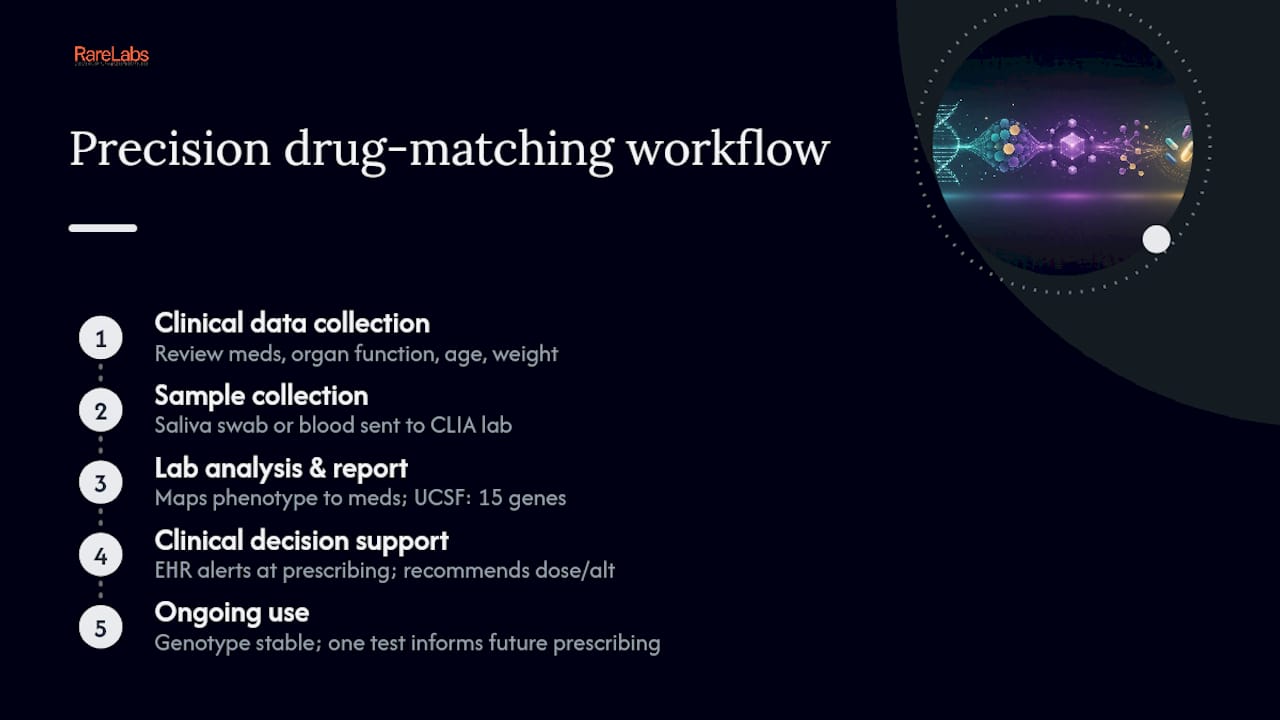
Step 2: Sample collection. Most pharmacogenomic panels use a saliva swab or a standard blood draw. The sample goes to a CLIA-certified laboratory, where DNA is extracted and analyzed for variants in genes known to affect drug metabolism or drug-specific risk.
Step 3: Lab analysis and report. The lab generates a report that translates raw genotype data into clinical phenotypes — for example, "CYP2D6 poor metabolizer" — and maps those phenotypes to specific medications. UCSF's Clinical Pharmacogenomics Program tests 15 genes covering approximately 56 medications and integrates results directly into the EHR.
Step 4: Clinical decision support at the point of prescribing. Once results are in the EHR, automated alerts fire whenever a clinician attempts to prescribe a drug flagged by the patient's genotype. UCSF has delivered tens of thousands of such alerts, catching potential mismatches before the prescription is written. The alerts reference CPIC guidelines and FDA pharmacogenetic guidance, so the clinician sees not just a warning but a recommended alternative or dose adjustment.
Step 5: Ongoing use. Unlike most lab results, pharmacogenomic data does not expire. Your genotype is stable across your lifetime, so a single test can inform prescribing decisions for years.
Pro Tip: Ask your clinician whether the pharmacogenomic results will be stored in your EHR and whether the system generates automatic prescribing alerts. Programs that integrate results into clinical decision support — rather than just mailing you a PDF — deliver the most consistent safety benefit.
Pharmacogenomics: which genes matter and what they mean for your medications
Pharmacogenomics predicts how you will respond to a drug based on inherited DNA variants that affect how your body absorbs, metabolizes, or reacts to specific medications. The core concept is the metabolizer phenotype: depending on which variants you carry, you may be a poor, intermediate, normal, or rapid/ultrarapid metabolizer of a given drug. Poor metabolizers accumulate a drug to toxic levels; ultrarapid metabolizers clear it so fast it never reaches a therapeutic concentration. Both extremes cause harm.

Advances in pharmacogenomics now include polygenic pharmacogenomic scoring and AI-assisted prediction of drug-gene interactions, expanding clinical uptake across psychiatry, cardiology, and oncology. CPIC publishes peer-reviewed, freely available guidelines that translate genotype results into specific prescribing recommendations, and the FDA maintains a Table of Pharmacogenetic Associations to document the strength of evidence for each gene-drug pair.
The table below maps the four most clinically important gene-drug relationships you are likely to encounter:
| Gene | Common Drugs Affected | Clinical Implication |
|---|---|---|
| CYP2C9 | Warfarin, NSAIDs, phenytoin | Poor metabolizers need lower warfarin doses; standard doses risk serious bleeding |
| CYP2D6 | Opioids (codeine, tramadol), antidepressants (SSRIs, TCAs) | Ultrarapid metabolizers convert codeine to toxic morphine levels; poor metabolizers get no analgesia |
| TPMT | Thiopurines (azathioprine, 6-mercaptopurine) | Low TPMT activity causes severe bone marrow suppression at standard doses |
| HLA-B*57:01 | Abacavir (HIV treatment) | Carriers face a severe, potentially fatal hypersensitivity reaction; pre-screening is now standard of care |
CPIC guidelines for each of these gene-drug pairs are freely available and are the primary reference clinicians use to act on results. The FDA's companion diagnostic approvals for several oncology biomarkers follow the same logic: identify the molecular subgroup, then prescribe accordingly.
What types of diagnostic tests are used in precision drug matching?
The practical distinction is this: a pharmacogenomic panel tests multiple genes at once to guide a broad range of prescribing decisions, while a companion diagnostic is a single FDA-approved test required before prescribing one specific drug. Knowing which type you need determines who orders it, how long it takes, and what it costs.
| Feature | Pharmacogenomic Panel | Companion Diagnostic | Single-Gene Test |
|---|---|---|---|
| Purpose | Broad prescribing guidance across drug classes | Required or recommended before one specific drug | Targeted risk or metabolism check |
| Typical use case | Psychiatry, primary care, pain management | Oncology (e.g., HER2 before trastuzumab), HIV (HLA-B*57:01) | Warfarin dosing (CYP2C9/VKORC1), TPMT before thiopurines |
| Who orders it | Any clinician; pharmacist in some states | Oncologist or specialist | Any clinician |
| Turnaround time | 1–3 weeks (most clinical labs) | 1–2 weeks; rapid options exist in some cancer centers | 1–2 weeks |
| Clinical actionability | Broad, multi-drug guidance | Narrow, drug-specific; FDA-linked | Narrow, drug-specific |
Most clinical pharmacogenomic panels are processed in CLIA-certified laboratories, a federal certification that sets minimum standards for accuracy and quality. CLIA certification matters because it is the baseline that makes results legally reportable and clinically actionable. Direct-to-consumer (DTC) genetic tests, such as those from ancestry services, are generally not CLIA-certified for clinical use and should not be used to make prescribing decisions without clinical validation.
The FDA's precision medicine framework supports companion diagnostics as a regulatory tool that links drug approval to a validated biomarker test, so the drug and the test are co-developed and co-approved.
Real clinical situations where precision drug matching changes care
Precision drug matching is not a theoretical benefit. It changes specific prescribing decisions in ways that prevent harm or improve outcomes. Here are four situations where the test result directly altered therapy:
-
Oncology: biomarker-directed therapy. A patient with non-small-cell lung cancer is tested for EGFR mutations before treatment begins. A positive result means an EGFR-targeted therapy is likely to work; a negative result means it will not. Without the test, the patient might receive an ineffective drug for months. Precision medicine has enabled smaller, molecularly targeted trials and, in some cases, single-patient therapeutics for conditions with no approved treatment.
-
Warfarin dosing guided by CYP2C9 and VKORC1. Warfarin has one of the narrowest therapeutic windows in medicine. A patient who is a CYP2C9 poor metabolizer and carries a VKORC1 variant that increases sensitivity to the drug needs a substantially lower starting dose than population averages suggest. Without genotyping, clinicians rely on INR monitoring alone, which catches the problem only after the patient has already been over-anticoagulated.
-
Psychiatry: choosing an antidepressant. A patient with major depression who is a CYP2D6 poor metabolizer will accumulate standard doses of certain SSRIs and tricyclics to levels that cause side effects without additional benefit. A pharmacogenomic panel flags this before the first prescription, allowing the clinician to choose a drug metabolized through a different pathway or to start at a lower dose.
-
HLA-B*57:01 screening before abacavir. Abacavir, a cornerstone HIV antiretroviral, causes a severe and potentially fatal hypersensitivity reaction in patients who carry the HLA-B*57:01 allele. Pre-screening is now standard of care. The test is a textbook companion diagnostic: one gene, one drug, one binary result that determines whether the drug can be used at all.
What the clinical evidence shows about benefits and its limits
Pharmacogenomic-guided prescribing can meaningfully reduce clinically important adverse drug reactions. Pooled analyses and programmatic reports associate this approach with reductions in adverse drug reactions, with some analyses reporting notable reductions across multiple medication classes. That figure comes from programs where testing was systematically implemented and results were integrated into clinical workflows, not from isolated single-gene studies.
On the strength of the evidence: The 30% adverse drug reaction reduction figure reflects pooled findings from programs with EHR-integrated clinical decision support. Evidence is strongest in oncology (biomarker-directed therapy), cardiology (warfarin, clopidogrel), and selected psychiatry use cases. For many gene-drug pairs, the evidence base is still maturing, and clinician judgment remains central to interpreting results in context.
The evidence is not uniform across specialties. Oncology has the most robust data, driven by companion diagnostic approvals and targeted trial designs. Cardiology and HIV medicine have well-established single-gene tests (CYP2C9/VKORC1 for warfarin, HLA-B*57:01 for abacavir) with clear clinical benefit. Psychiatry pharmacogenomics is growing but more contested: the gene-drug relationships are real, but the clinical benefit of broad panel testing in depression and anxiety is still being studied in randomized trials.
A key operational finding from UCSF's program shows that actionable genetic variants are common in patients. A large U.K. cohort similarly found that nearly all patients carried at least one actionable pharmacogenetic variant. The implication is that actionable variants are not rare edge cases. They are the norm.
Costs, insurance coverage, and how to access testing in the U.S.
Coverage varies widely, and cost is one of the most common barriers patients face. Here is a practical checklist for navigating the process:
- Who can order the test: Any licensed clinician can order a pharmacogenomic panel. In many states, pharmacists can also order or co-manage testing. Genetic counselors can help interpret results but typically do not order tests independently.
- Sample type: Most panels use a saliva swab (mailed kit or in-office collection) or a standard blood draw. No fasting or special preparation is required.
- Typical cost range for clinical panels: Out-of-pocket costs for a multi-gene pharmacogenomic panel at a CLIA-certified lab range from roughly $100 to $500 depending on the panel size and lab. Companion diagnostics ordered in oncology are often covered by insurance when they are required for a specific drug approval.
- Insurance coverage: Medicare covers some pharmacogenomic tests under specific conditions (e.g., CYP2C19 testing for clopidogrel in certain cardiac patients). Commercial insurers vary; prior authorization is often required. Coverage is expanding but inconsistent.
- Documentation to bring: Bring your current medication list, relevant diagnoses, and any prior genetic test results. If your clinician is requesting prior authorization, a letter of medical necessity citing CPIC guidelines or FDA labeling language strengthens the case.
Questions worth asking your lab or clinician:
- Which specific genes and variants are included in this panel?
- Will results be integrated into my EHR and trigger prescribing alerts?
- Is genetic counseling available if I have questions about the results?
- Is the lab CLIA-certified?
Limitations, privacy concerns, and red flags to watch for
The major limits of precision drug matching are variant interpretation uncertainty, incomplete gene coverage, and unequal access across populations. Not every genetic variant has a clear clinical meaning, and labs differ in which variants they report and how they classify them.
Patient privacy protections and their limits. The Genetic Information Nondiscrimination Act (GINA) prohibits discrimination based on genetic information in health insurance and employment. GINA does not cover life insurance, disability insurance, or long-term care insurance. Patients considering DTC testing should review the company's data-sharing policies carefully, as some share de-identified data with third parties.
Red flags to watch for:
- Labs that are not CLIA-certified for clinical reporting
- Tests marketed with no reference to CPIC guidelines or FDA pharmacogenetic labeling
- Vendors that promise guaranteed treatment outcomes based on a genetic test
- Surprise billing for panels ordered without prior cost discussion
- DTC reports that recommend specific prescription changes without clinician involvement
The NIH All of Us Research Program is actively working to expand genomic reference data across diverse ancestral populations, which matters because many existing variant databases are skewed toward European ancestry. Variants common in other populations may be misclassified or underreported, a real equity gap in current clinical pharmacogenomics.
How to request testing and what to do with the results
A short, direct script works better than a lengthy explanation when raising this topic with a clinician. Try: "I've read that pharmacogenomic testing can help identify whether my current medications are a good match for my genetics. Given my medication list, would a panel be appropriate for me?"
Once testing is ordered, here is what to request in the lab report:
- Phenotype interpretation for each gene tested — not just the raw genotype, but the clinical classification (e.g., "CYP2D6 poor metabolizer").
- Actionable recommendations — specific guidance on which drugs to avoid, which to use at adjusted doses, and which are unaffected.
- References to CPIC guidelines or FDA pharmacogenetic labeling — this confirms the recommendations are grounded in peer-reviewed clinical evidence.
- EHR integration confirmation — ask whether results will be stored in your health record and whether your clinical system will generate prescribing alerts.
- A summary you can share with other providers — a portable one-page summary ensures that a specialist who has not seen your record can still act on the findings.
For complex results or variants of uncertain significance, ask for a consultation with a clinical pharmacist, a genetic counselor, or a clinical pharmacogenomics program. UCSF and several academic medical centers run dedicated programs. A pharmacist with pharmacogenomics training is often the most accessible resource for medication-specific interpretation.
Regulatory and guideline context: FDA, CPIC, and NIH All of Us
The FDA and CPIC are the two primary governance and guidance sources shaping how pharmacogenomic results are used in U.S. clinical practice. They operate differently but are complementary.
- FDA companion diagnostic approvals link a specific drug's approval to a validated biomarker test. When the FDA approves a companion diagnostic, it means the test has been analytically validated and the clinical evidence supports using the result to guide that drug's use. The FDA also publishes a Table of Pharmacogenetic Associations, which categorizes gene-drug pairs by the strength and type of evidence.
- CPIC guidelines translate genotype results into prescribing recommendations for clinicians. CPIC does not regulate; it synthesizes peer-reviewed evidence into free, actionable clinical guidance. Guidelines are updated as new evidence emerges and are the primary reference for clinical decision-support systems.
- NIH All of Us Research Program is a large-scale effort to build a genomic and health data resource that reflects the full diversity of the U.S. population. Its goal is to reduce the ancestry bias in existing variant databases and generate population-level data that improves the accuracy of pharmacogenomic interpretation across all patients.
The FDA's individualized therapeutics framework also supports tools like precisionFDA, a community platform for validating next-generation sequencing bioinformatics pipelines, which underpins the analytical reliability of clinical genomic testing.
When standard pharmacogenomics is not enough: patient-specific modeling for ultra-rare cases
Most patients benefit from standard pharmacogenomic testing. For patients with ultra-rare or undiagnosed genetic diseases, however, the standard panel may offer no guidance at all because the disease itself has no established treatment pathway and no validated gene-drug pairs to test.
This is where patient-specific disease modeling becomes relevant. The distinction matters:
- Standard pharmacogenomics addresses common gene-drug interactions across a broad population. It works well when the drug exists and the question is whether your metabolism fits it.
- Patient-specific iPSC modeling builds a living cellular model of your disease from your own cells, then screens hundreds or thousands of compounds against that model to find candidates. It is used when no approved treatment exists and standard testing has been exhausted.
Hopeatrarelabs conducts this intensive form of precision drug matching for ultra-rare and undiagnosed genetic diseases. Their process includes:
- Deriving induced pluripotent stem cell (iPSC) models from patient-donated cells, creating a biological replica of the disease in the lab
- Using CRISPR-edited isogenic controls to isolate the specific genetic variant's effect
- Running high-throughput screens across FDA-approved drugs, custom antisense oligonucleotides (ASOs), and gene therapy candidates
- Providing translational support to help clinicians and families interpret and act on findings
This pathway is resource-intensive and is typically pursued when a patient has an ultra-rare single-gene condition, a disease affecting only a handful of known patients worldwide, or a situation where standard diagnostics have returned no actionable result. Families, foundations, physician-scientists, and biopharma partners can initiate a program through Hopeatrarelabs. A personalized treatment guide for ultra-rare genetic diseases outlines what that process looks like in practice.
What precision drug matching gets right, and where the field still has work to do
Precision drug matching is one of the most practically useful advances in modern prescribing. The gene-drug evidence for warfarin, abacavir, thiopurines, and codeine is solid enough that testing before prescribing should be standard, not optional. The UCSF finding that every patient in their cohort carried at least one actionable variant is the clearest argument for preemptive testing: you are not screening for a rare edge case; you are finding something clinically relevant in nearly everyone.
Where the field still has genuine gaps: variant databases remain skewed toward European ancestry, which means patients from other backgrounds may receive less accurate interpretations. DTC testing has outpaced clinical infrastructure, leaving patients with results they cannot get interpreted. And for ultra-rare diseases, the entire pharmacogenomics framework simply does not apply because there are no population-level data to draw from.
The most underappreciated aspect of precision drug matching is that it requires a team to work. A genetic test result sitting in a PDF, unread by a pharmacist or genetic counselor, does almost nothing. The clinical benefit comes from integration: results in the EHR, alerts at the point of prescribing, and a clinician who knows how to act on them. That infrastructure exists at academic medical centers and is slowly spreading to community practice. If your current provider cannot integrate results into your care workflow, asking for a referral to a program that can is a reasonable next step.
Hopeatrarelabs offers patient-specific modeling when standard testing has no answer
For patients whose conditions fall outside the reach of standard pharmacogenomics, Hopeatrarelabs provides a specialized alternative: patient-specific iPSC disease modeling paired with high-throughput drug screening across FDA-approved compounds, custom ASOs, and gene therapy candidates. This is not a panel test. It is a full translational research program built around one patient's biology, designed for ultra-rare and undiagnosed genetic diseases where no approved treatment exists.
If you or a family member has exhausted standard diagnostic and treatment pathways, consider asking your clinician whether patient-specific modeling could be appropriate for your situation. The RareLabs Knowledge hub provides detailed information on how the process works, who it is designed for, and what families and physicians can expect at each stage. It is a practical starting point for any conversation about next steps.
Sources
- What is precision medicine? - Genetics — MedlinePlus
- Understanding precision medicine — FDA
- Are Your Meds and DNA a Bad Match? This Test Alerts Clinicians | UC San Francisco
- Integration of pharmacogenomics into precision medicine: transforming healthcare for the next generation - PMC
- Precision Medicine Explained: How It’s Changing Drug Development | UF Medical Physiology Online
This article is general information, not a substitute for advice from a qualified doctor. Consult a qualified healthcare professional about your own circumstances before acting on anything here.