

Custom treatment models consistently outperform standardized care in mental health and addiction recovery. A 2023 meta-analysis of personalized psychological treatments found a statistically significant effect size of d = 0.22 in favor of personalized approaches, translating to roughly 1 in 8.5 patients achieving meaningfully better outcomes than they would under a standard protocol. That number is small by conventional standards, but applied across a large clinical population, it represents thousands of people who recover when they otherwise would not.
The core benefits of custom treatment models include:
- Improved symptom reduction, particularly for depression, where personalized approaches show measurable gains over standardized care
- Higher treatment adherence because patients engage more consistently when the plan reflects their actual life, values, and preferences
- Lower dropout rates driven by culturally sensitive, individualized care that keeps patients invested in the process
- Better handling of co-occurring conditions, since modular frameworks can address multiple diagnoses simultaneously rather than sequentially
- Stronger therapeutic alliances, which research identifies as a primary predictor of treatment success
Standardized protocols work. The evidence for cognitive behavioral therapy, medication-assisted treatment, and other established approaches is solid. But they treat the average patient, and most patients are not average.
Why does personalized mental health treatment matter?
Every patient walks into treatment carrying a different combination of history, biology, culture, and circumstance. A 28-year-old with opioid use disorder and childhood trauma needs something different from a 55-year-old with alcohol dependence and a recent divorce, even if both technically qualify for the same diagnosis.
Standardized protocols are built around what works for the most people in a controlled trial. That is genuinely useful, but it leaves a gap. Personalized medicine shifts care from reactive symptom management toward proactive prevention, using genomic, lifestyle, and clinical data to predict which treatments will actually work for a specific individual. In mental health and addiction, the equivalent shift means moving from "here is the protocol for your diagnosis" to "here is a plan built around you."

The practical consequence of ignoring individual differences is trial-and-error prescribing: a patient tries one medication, it fails, they try another, and weeks or months pass while their condition worsens. That cycle erodes trust, increases dropout, and delays recovery. Personalized models are designed to interrupt that cycle early.
What exactly is a custom treatment model?
The term "custom treatment model" is used loosely in clinical settings, so the distinction between related concepts matters. A personalized treatment adjusts an existing evidence-based protocol to fit a specific patient. A modular treatment lets clinicians mix and match intervention components from validated protocols without building something entirely new. A custom treatment, in the strictest sense, designs novel elements for a patient whose needs fall outside existing frameworks entirely.
In practice, most clinical settings use modular and personalized interventions rather than fully custom designs, because building from scratch is expensive and time-consuming. The MATCH-ADTC program is a good example: it combines modules for anxiety, depression, trauma, and conduct problems in children, allowing a therapist to address co-occurring difficulties within one coherent framework rather than switching between separate protocols.
The core components of any well-designed personalized model include:
- Comprehensive initial assessment covering diagnosis, history, cultural background, and patient goals
- Modular intervention selection based on clinical data and patient preference
- Ongoing feedback loops using tools like Routine Outcome Monitoring (ROM) to track progress session by session
- Therapist adaptability, meaning the clinician adjusts communication style, pacing, and technique based on real-time patient response
That last point is often underestimated. Therapist relational adaptability is a critical driver of outcomes in personalized psychotherapy, separate from whatever specific technique is being used. You can have the right modules and still lose a patient if the therapeutic relationship breaks down.
Pro Tip: Ask any treatment program how they use patient feedback between sessions. Programs using Feedback-Informed Treatment (FIT), which collects structured patient input every session, tend to catch early signs of disengagement before dropout happens.
How do custom treatment models improve therapeutic outcomes?
The 2023 meta-analysis covering 17 randomized controlled trials and 7,617 patients found that personalized psychological treatment produced significantly better outcomes than standardized care, with an NNT of 8.5. For every 8–9 patients who receive personalized rather than standardized treatment, one additional person achieves a meaningfully better result. Across a population of 1,000 patients, that translates to roughly 118 additional people recovering.
Statistic to know: Component-level matching, where specific treatment techniques are tailored to the individual rather than just the intensity or package, produced an effect size of d = 0.37 in the same meta-analysis. That is nearly double the overall effect, suggesting that the how of personalization matters as much as the whether.
Depression outcomes show the clearest gains. Formally structured personalization, where matching decisions follow a data-driven process rather than clinical intuition alone, consistently outperforms informal or artisanal approaches. This finding has direct implications for addiction recovery programs, where relapse risk is high and the cost of a poorly matched treatment plan is measured in real harm.
Treatment adherence is the other major lever. Patients who feel their plan reflects their actual situation stay in treatment longer. Longer treatment duration correlates with better outcomes across virtually every mental health and addiction condition studied.

How does family involvement strengthen personalized treatment?
Family and support systems are not optional add-ons in effective personalized care. They are part of the treatment architecture. Culturally sensitive, individualized approaches that incorporate a patient's social environment consistently show better engagement and lower dropout rates than those that treat the patient in isolation.
Ways that personalized models integrate support systems:
- Family psychoeducation modules that teach loved ones about the patient's specific condition, triggers, and recovery goals
- Culturally adapted communication so that family involvement respects the patient's background rather than imposing a generic model of "family support"
- Defined roles for support persons in relapse prevention planning, particularly in addiction recovery where environmental cues are a major risk factor
- Flexible scheduling and format to accommodate family members who work irregular hours or live at a distance
Cultural considerations deserve particular attention. A treatment plan that asks a patient to set firm boundaries with family members may be clinically appropriate in one cultural context and deeply counterproductive in another. Personalized models account for this; standardized ones often do not. For families navigating rare or complex conditions, the personalized therapy discovery process offers a practical framework for understanding how individualized care gets built around a patient's full context.
How do personalized models handle co-occurring conditions?
Co-occurring mental health and substance use disorders are the rule in clinical practice, not the exception. A patient presenting with opioid dependence frequently also carries depression, anxiety, or PTSD. Standardized protocols, designed around single diagnoses, struggle with this reality.
Modular treatment frameworks solve this by allowing clinicians to address multiple conditions within one coordinated plan rather than running parallel, disconnected treatments. The flexibility benefits for complex cases are concrete:
- A single assessment captures all presenting conditions rather than siloing them
- Module selection can prioritize the condition most likely to destabilize recovery first
- Treatment intensity can be adjusted up or down based on real-time outcome data
- Gaps in care, where one condition goes unaddressed because it falls outside the primary protocol, are reduced
Feedback-Informed Treatment is especially valuable here. When a patient's session-by-session data shows deterioration in one area while another improves, the clinician can shift module emphasis without starting over. That kind of real-time adjustment is simply not possible within a fixed, standardized protocol. Understanding why custom therapeutics matter for patients with layered diagnoses helps clarify why flexibility is not a luxury but a clinical necessity.
What does the future of personalized treatment look like?
The next phase of personalized mental health and addiction care will be shaped by three converging forces: artificial intelligence, genomic data, and real-time digital monitoring. AI tools are already being used to analyze large patient datasets and identify which treatment components are most likely to work for a given profile. Genomic data, long used in oncology, is beginning to inform psychiatric medication selection, reducing the trial-and-error cycle in prescribing antidepressants and mood stabilizers.
Personalized medicine's evolution toward proactive, prevention-focused care requires collaboration among patients, clinicians, technologists, and policymakers. That collaboration is happening, but unevenly. Wearable devices and smartphone-based monitoring tools now allow clinicians to track mood, sleep, and activity patterns between sessions, feeding real-time data into treatment decisions rather than relying solely on weekly self-report.
The barriers are real. Initial implementation costs for personalized diagnostics and clinician training are high, and the infrastructure required for genomic-informed psychiatry does not yet exist at scale in most American healthcare systems. Expanding access to customized healthcare approaches will require both policy investment and a shift in how treatment programs are funded and evaluated.
Feedback-Informed Treatment will continue to expand as the evidence base grows. The combination of FIT with AI-assisted module selection represents the most promising near-term path to making personalized care accessible at population scale, not just in well-resourced specialty clinics.
What does the research actually say about personalized psychological treatments?
The evidence base for personalized psychological treatment has strengthened considerably. The 2023 systematic review and meta-analysis of 17 RCTs is the most rigorous summary available. Key findings:
- Effect size d = 0.22 in favor of personalized over standardized treatment, statistically significant at p = 0.011
- When high-bias studies were removed, the effect size dropped to d = 0.14 but remained statistically significant (p < 0.001)
- Individually tailored approaches produced an effect size of d = 0.37, the strongest subgroup result
- Formal or semi-formal personalization structures outperformed informal approaches (d = 0.26 vs. d = 0.06)
What the NNT means in practice: An NNT of 8.5 means that for every 8–9 patients treated with a personalized rather than standardized approach, one additional patient achieves a better outcome. At a population level, that is a large number of people.
Routine Outcome Monitoring drives much of this improvement. ROM techniques detect early signs of treatment failure before they become dropout, allowing course corrections that standardized protocols cannot accommodate. The evidence also points to a specific vulnerability: when the therapeutic alliance breaks down, custom models fail not because the methodology is wrong but because the relational foundation collapsed. That finding reinforces why therapist training in adaptive communication is as important as the treatment design itself.
Real-world examples of personalized treatment in practice
The MATCH-ADTC program, developed for children and adolescents with anxiety, depression, trauma, or conduct problems, is one of the most studied examples of modular personalized treatment. Rather than assigning a child to a single-diagnosis protocol, clinicians use weekly symptom scores and a decision algorithm to select and sequence modules. Studies of MATCH-ADTC show it performs at least as well as single-diagnosis protocols and handles co-occurring presentations more effectively.
In addiction recovery, tailored recovery planning that accounts for a patient's specific substances, trauma history, social supports, and readiness to change consistently outperforms generic 12-step or single-modality programs for patients with complex presentations. Programs that integrate motivational interviewing, contingency management, and trauma-focused cognitive behavioral therapy within a single personalized framework show stronger retention than those that offer each modality as a standalone option.
In oncology, a meta-analysis of 50 Phase II clinical trials covering 6,536 patients found that genomics-based personalization produced significantly higher response rates and better progression-free survival compared to non-personalized arms. While oncology and psychiatry use different personalization mechanisms, the underlying principle translates: matching treatment to the individual's specific biology and circumstances improves outcomes across disease categories.
Custom treatment models versus standardized approaches
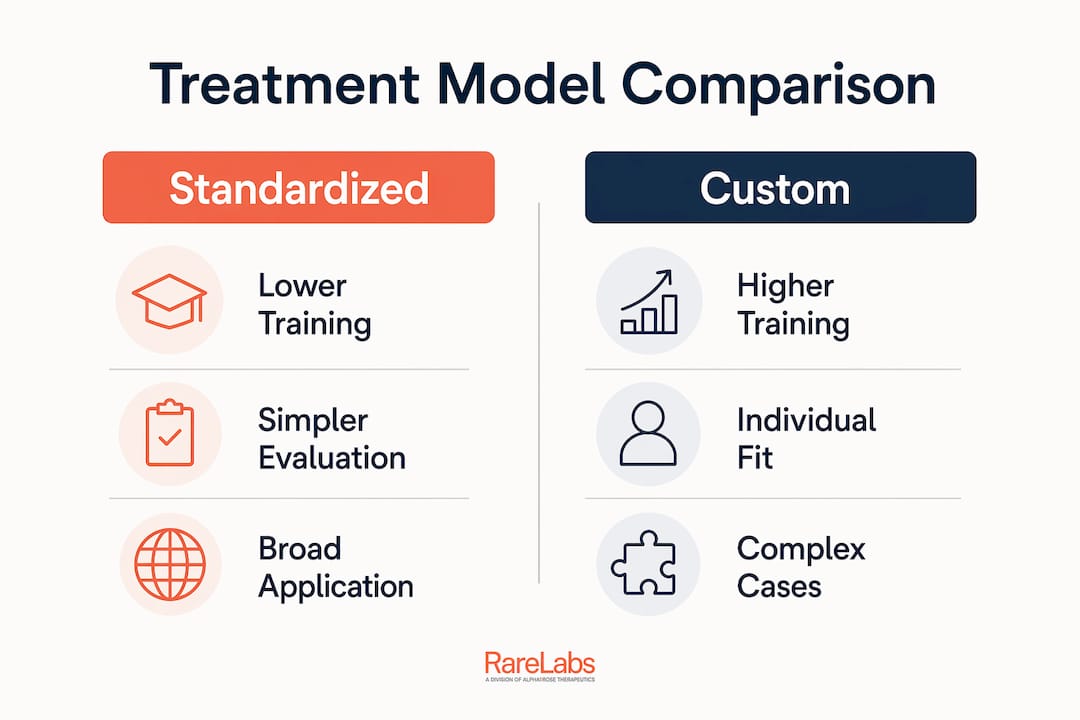
Standardized treatments offer real advantages. They are easier to train clinicians in, simpler to evaluate in trials, and more consistent in delivery. For patients with straightforward presentations and no significant comorbidities, a well-implemented standardized protocol often works well.
The gap opens with complexity. Patients with co-occurring conditions, cultural factors that affect engagement, or prior treatment failures are systematically underserved by one-size-fits-all designs. Standardized interventions remain effective but personalized adaptations enhance acceptability, adherence, and outcomes, particularly for these harder-to-treat populations.
The practical tradeoff looks like this:
| Dimension | Standardized treatment | Personalized treatment |
|---|---|---|
| Clinician training burden | Lower | Higher |
| Effectiveness for simple cases | High | High |
| Effectiveness for complex cases | Moderate | Higher |
| Treatment adherence | Moderate | Higher |
| Cost at initial implementation | Lower | Higher |
| Long-term cost efficiency | Lower | Higher (fewer failed trials) |
The cost argument for personalization is often framed as a barrier, but the long-term picture is different. Minimizing trial-and-error treatment cycles reduces total cost per recovered patient, even when upfront diagnostic and training costs are higher. For patients and families navigating personalized treatment options, understanding this tradeoff helps set realistic expectations about what personalized care requires and what it delivers.
Key Takeaways
Personalized psychological treatment produces significantly better outcomes than standardized care, with an NNT of 8.5 meaning roughly 1 in 8.5 patients achieves a better result under a personalized approach.
| Point | Details |
|---|---|
| Effect size advantage | Personalized treatment yields d = 0.22 over standardized care; component-level matching reaches d = 0.37. |
| Adherence and dropout | Culturally sensitive, individualized care reduces dropout and improves patient engagement throughout treatment. |
| Co-occurring conditions | Modular frameworks address multiple diagnoses simultaneously, reducing gaps that standardized protocols leave. |
| Therapeutic alliance | Alliance breakdown, not methodology failure, is the primary reason custom models underperform; therapist adaptability is critical. |
| Cost tradeoff | Higher upfront implementation costs are offset by fewer failed treatment trials and better long-term outcomes. |