

Custom therapy development is the process of designing tailored treatment strategies for individual patients with rare genetic conditions by integrating multidisciplinary research, regulatory frameworks, and clinical protocols. For researchers, clinicians, and families facing ultra-rare or undiagnosed genetic diseases, this custom therapy development guide covers the tools, stepwise methods, and regulatory resources that move a therapy from concept to clinic. The Co-Develop-IT guideline, PaVe-GT regulatory templates, and the ERDERA Innovation Management Toolbox are the three foundational resources shaping personalized therapy design in 2026. Following this guide, you will understand how to build a therapy program that is scientifically grounded, regulatory-ready, and clinically translatable.
What foundational tools and resources do you need for custom therapy development?
The right toolkit determines whether a therapy program advances or stalls. Three categories of resources matter most: methodological frameworks, regulatory templates, and integrated project management tools.
The Co-Develop-IT guideline, published in may 2026, specifies 8 iterative phases in custom health technology development, with 5 preparatory contextual research phases that must be completed before any generative co-development begins. That sequencing matters because teams that skip preparatory phases routinely discover critical gaps during clinical design, which forces expensive restarts. The guideline gives researchers and clinicians a shared language for planning therapy programs across disciplines.

The PaVe-GT program provides free regulatory templates, including INTERACT packages and pre-IND meeting request documents. These templates have already helped advance four rare disease gene therapies to regulatory review. Starting from a validated template rather than a blank document cuts weeks from regulatory preparation and reduces the risk of incomplete submissions.
The ERDERA Innovation Management Toolbox, updated in november 2025, aligns research, regulatory science, and project management into a single staged framework. Integrated toolkits that combine these three functions prevent the costly development gaps that arise when scientific teams and regulatory teams work in silos.
| Tool | Type | Primary Use |
|---|---|---|
| Co-Develop-IT guideline | Methodological framework | Phase-by-phase therapy development planning |
| PaVe-GT templates | Regulatory resource | INTERACT, pre-IND, and Type C meeting preparation |
| ERDERA IMT toolbox | Project management | Aligning research, regulatory, and operational activities |
| Rare Diseases Clinical Trials Toolbox | Clinical research resource | Trial design, recruitment, and knowledge sharing |
Pro Tip: Use PaVe-GT's example INTERACT packages as a checklist against your own submission drafts before sending anything to the FDA. Gaps become obvious when you compare side by side.
How do you design and validate effective custom therapies step by step?
Therapy design for rare genetic diseases follows a defined sequence. Skipping steps does not save time. It creates regulatory objections and safety gaps that cost far more to fix later.
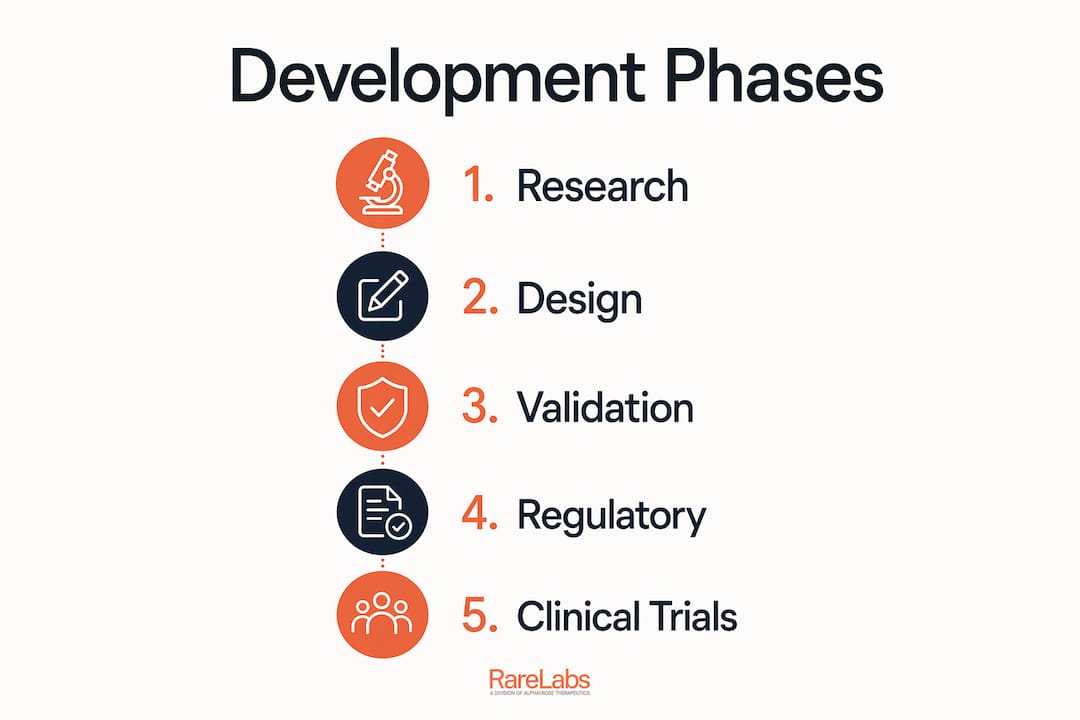
Phase-by-phase development
The Co-Develop-IT 8-phase model structures development from initial context-setting through iterative validation. The first five phases are preparatory: they establish scientific rationale, map the patient population, define unmet need, and set measurable endpoints. Only after completing these phases does the generative work of therapy design begin.
- Define the disease context. Document the genetic mechanism, patient phenotype, and existing treatment landscape. This phase produces the scientific rationale that anchors every downstream decision.
- Establish the target product profile. Specify what the therapy must achieve clinically, what safety profile is acceptable, and what regulatory pathway applies.
- Design nonclinical studies. Nonclinical studies for advanced therapies should be built around the specific biological risks of the therapy, not standard templates. Use tailored model systems and assays that reflect the actual human disease mechanism.
- Develop potency assays and biodistribution studies. These generate the data regulators require to assess whether the therapy behaves as intended in a biological system.
- Build the CMC roadmap. Early Chemistry, Manufacturing, and Controls planning is critical. It must integrate with the development plan to support scalability, traceability, and process comparability across clinical stages.
- Design the clinical dose strategy. Use nonclinical data to justify starting dose, escalation rules, and stopping criteria.
- Prepare regulatory submissions. Use validated templates from PaVe-GT to structure INTERACT and pre-IND meeting requests.
- Iterate based on feedback. Regulatory and clinical feedback loops back into earlier phases. Build this iteration into your project timeline from the start.
Risk-based validation
A risk-based mindset accelerates clinical translation and builds development confidence. The alternative, applying rigid template-driven pathways to biologically unique therapies, produces studies that answer the wrong questions. Risk-based assessment means identifying the specific unknowns for your therapy and designing studies that directly address them.
Moving beyond pure predictive metrics to a multidimensional benchmarking rubric that includes algorithmic rigor, clinical relevance, validation depth, and explainability is essential for clinical adoption of personalized treatment systems. A survey of 60 peer-reviewed studies between 2019 and 2024 supports this approach. That means your validation plan must answer not just "does this work?" but "can a clinician trust and act on this result?"
Pro Tip: Build your Product Development Plan before seeking any funding. Sponsors who arrive at regulatory meetings with a documented PDP that covers scientific rationale, CMC roadmap, and clinical design receive faster, more productive feedback.
Common mistakes to avoid
Failing to complete preparatory research phases before designing studies is the most common and costly error. Treating regulatory templates as rigid scripts rather than starting points leads to submissions that do not reflect the therapy's actual risk profile. Separating CMC planning from clinical planning creates comparability gaps that delay IND approval.
What regulatory considerations guide custom therapy approval?
Regulatory preparation is not a final step. It runs in parallel with scientific development from the earliest phases.
The PaVe-GT program's free templates cover three critical meeting types with the FDA: INTERACT meetings, pre-IND meetings, and Type C meetings. Leveraging existing regulatory templates rather than building submissions from scratch significantly accelerates FDA feedback and advances gene therapies through review. Each template type serves a different purpose, and using the wrong format for a meeting type signals to reviewers that the sponsor lacks regulatory experience.
Key regulatory strategies for rare disease therapy programs include:
- Orphan Drug Designation (ODD): Apply early. ODD provides seven years of market exclusivity, fee waivers, and eligibility for tax credits on clinical trial costs. The application requires a prevalence estimate below 200,000 affected individuals in the United States.
- Rare Pediatric Disease Designation: Applicable when the disease primarily affects patients under 18. Successful approval can generate a Priority Review Voucher, which has significant commercial value.
- INTERACT meetings: Use these before pre-IND to get early FDA input on nonclinical study design. The PaVe-GT INTERACT package template structures this request clearly.
- Risk-based regulatory strategy: A risk-based framework tailored to the biological characteristics of advanced therapies outperforms rigid template-driven pathways. Regulators respond better to submissions that demonstrate the sponsor understands the specific risks of their therapy.
Integrating regulatory science with project management prevents the most common delay: discovering a regulatory gap after a study is already complete. The ERDERA IMT toolbox structures this integration explicitly.
Pro Tip: Request an INTERACT meeting before finalizing your nonclinical study design. FDA feedback at that stage costs nothing to implement. Feedback after studies are complete can require repeating them entirely.
How can you overcome limited experts and small patient populations?
The scarcity of clinical research experts and patient participants is a major barrier in rare disease trials, requiring collaborative knowledge sharing and use of prior project outputs to avoid duplicating work. This is not a problem individual teams can solve alone. It requires structural solutions.
Practical strategies that work include:
- Adaptive trial designs. Adaptive designs allow protocol modifications based on interim data without invalidating the trial. For rare diseases with small populations, this flexibility is not optional. It is the difference between a trial that completes and one that stalls.
- Collaborative infrastructure. Clinical trialists for rare diseases benefit from shared infrastructures that enable knowledge sharing to mitigate low patient availability and expert scarcity. Patient registries, natural history studies, and shared biobanks all reduce the burden on individual programs.
- Leveraging prior outputs. The ERDERA Rare Diseases Clinical Trials Toolbox explicitly recommends using outputs from previous projects rather than starting from scratch. Published nonclinical data, existing patient cohorts, and prior regulatory correspondence are all reusable assets.
- Multidisciplinary team building. Rare disease programs need geneticists, clinical pharmacologists, regulatory scientists, and patient advocates working together from phase one. Bringing these experts in late creates misalignment that delays every subsequent phase.
Families and patient advocacy groups are an underused resource for overcoming recruitment barriers. They maintain direct connections to patient communities and can accelerate enrollment in ways that clinical sites cannot. Engaging them as partners, not just participants, changes the dynamic of a trial program. For teams building collaborative rare disease trials, structured partnership models with advocacy groups have consistently shortened recruitment timelines.
Key Takeaways
Personalized therapy development for rare genetic diseases succeeds when scientific rigor, regulatory preparation, and collaborative clinical design are integrated from the first phase, not assembled at the end.
| Point | Details |
|---|---|
| Start with preparatory phases | Complete all 5 Co-Develop-IT contextual research phases before designing any therapy. |
| Use free regulatory templates | PaVe-GT INTERACT and pre-IND templates have advanced four rare disease gene therapies to regulatory review. |
| Apply risk-based validation | Design nonclinical studies around your therapy's specific biological risks, not standard templates. |
| Integrate CMC planning early | Early Chemistry, Manufacturing, and Controls planning prevents comparability gaps that delay IND approval. |
| Build collaborative infrastructure | Adaptive trial designs and shared patient registries are the most effective tools for small patient populations. |
What I've learned about building therapy programs that actually move forward
The teams I've seen succeed in rare disease therapy development share one habit: they treat regulatory preparation as a scientific activity, not an administrative one. They bring their regulatory scientist into nonclinical study design meetings. They draft their INTERACT package before they finalize their animal model selection. That integration is not common, but it is the single biggest predictor of whether a program reaches the clinic.
The other pattern I've noticed is that families and patient advocates who engage directly in the development process change the quality of the science. They surface natural history data that researchers didn't know existed. They identify outcome measures that matter to patients but that clinical teams would never have chosen. The translational spectrum from discovery to clinic moves faster when patient perspective is built into the design, not added as a consultation at the end.
The emerging role of AI in personalized therapy design is real, but it is not a shortcut. Model interpretability and clinical context are prerequisites for clinical adoption. A model that predicts a therapeutic response but cannot explain the mechanism will not change clinical practice. The evaluation frameworks for AI-augmented treatment systems must go beyond predictive accuracy to include explainability and clinical relevance. That is where the field is heading, and programs that build interpretability into their validation plans now will be ahead of the regulatory curve when guidance catches up.
My honest advice to families reading this: do not wait for a specialist to hand you a plan. The tools described in this guide are publicly available. The PaVe-GT templates are free. The ERDERA toolboxes are open access. You have more agency in this process than the system typically communicates.
— John
How Hopeatrarelabs supports your therapy development program
Researchers, clinicians, and families navigating rare and undiagnosed genetic diseases need more than a roadmap. They need a partner who can execute the science.
Hopeatrarelabs builds patient-specific disease models using induced pluripotent stem cells and CRISPR gene editing, then runs parallel treatment screens across thousands of FDA-approved drugs, custom antisense oligonucleotides, and gene therapy candidates. The process is designed for diseases that have no approved treatment and no established development pathway. Every program at Hopeatrarelabs is built around the patient's own biology, not a generalized disease model. Families, physicians, and research foundations can access personalized therapy resources and connect with the Hopeatrarelabs team directly at hopeatrarelabs.com to discuss how a patient-specific program could apply to their case.
FAQ
What is custom therapy development for rare diseases?
Custom therapy development is the process of designing patient-specific treatments for rare or undiagnosed genetic conditions using tools like iPSCs, CRISPR, and parallel drug screening. It integrates scientific, regulatory, and clinical planning into a single coordinated program.
What are the Co-Develop-IT phases in therapy development?
The Co-Develop-IT guideline defines 8 iterative phases, with 5 preparatory contextual research phases that must be completed before generative therapy design begins. Skipping these phases is the most common cause of costly program restarts.
How do PaVe-GT templates help with FDA submissions?
PaVe-GT provides free INTERACT, pre-IND, and Type C meeting templates that have already advanced four rare disease gene therapies to regulatory review. Using these templates reduces preparation time and improves submission quality.
How do small patient populations affect rare disease trial design?
Small patient populations require adaptive trial designs and collaborative infrastructure, including shared registries and prior project outputs, to generate statistically meaningful results. The ERDERA Rare Diseases Clinical Trials Toolbox provides practical frameworks for these situations.
When should families get involved in therapy development?
Families should engage from the earliest preparatory phases. Patient advocates provide natural history data, identify clinically meaningful endpoints, and accelerate recruitment in ways that clinical sites alone cannot achieve.