

A sponsored research agreement (SRA) is a legally binding contract between a sponsor and an institution that funds a defined research project and sets terms for scope, intellectual property, publications, reporting, and payment. The institution, not the principal investigator, is the contracting party, though the PI signs to confirm they'll deliver the work. Every functional SRA addresses six things: the statement of work, the payment structure, IP ownership and licensing, publication rights, reporting obligations, and compliance flags tied to federal funding rules.
TL;DR:
- A sponsored research agreement must include clear scope, payment, intellectual property, publication rights, reporting, and compliance details, to avoid contract delays or disputes.
- Crafting a detailed statement of work with specific tasks and acceptance criteria is crucial to prevent disagreements over project completion or deliverables.
- Funding type influences risk and compliance; fixed-price models shift risk to the institution, while cost-reimbursement carries more federal and audit obligations.
- Federal regulations like Bayh‑Dole and NIH guidance impose strict reporting, invention, and compliance requirements that escalate review for large or long-term federal-funded projects.
- Negotiation red flags include broad IP rights, unfettered sponsor veto over publications, uncapped indemnity, and overly extended license options, requiring careful scope and risk management.
Table of Contents
- What Every Sponsored Research Agreement Must Include
- Writing the Statement of Work, Deliverables, and Reporting Terms
- Cost-Reimbursement vs. Fixed-Price: Choosing the Payment Model
- How Sponsors and Institutions Typically Handle IP Rights
- Balancing Sponsor Confidentiality with the Right to Publish
- Bayh‑Dole, NIH Guidance, and Federal Compliance Triggers
- Who Signs What: OSP Authority and Internal Routing
- Finding and Adapting SRA Templates
- Negotiation Red Flags and Practical Tactics
- Conflict of Interest Policies in Sponsored Research
- Data Management and Sharing Requirements
- Insurance Requirements Tied to Sponsored Projects
- Publisher Perspective: Contracting for Translational Rare Disease Work
- How RareLabs Supports Contract-Ready Translational Projects
- Sources
What Every Sponsored Research Agreement Must Include
Before negotiating anything, confirm the draft actually covers the load-bearing pieces. A sponsored research agreement missing any of these is a draft, not a contract ready for signature.
- Parties and signatories: the institution as legal party, the sponsor, and the PI's acknowledgment signature.
- Statement of work (SOW): tasks, timeline, and who does what.
- Deliverables and milestones: what gets produced, and when.
- Budget and payment schedule: total funding and disbursement triggers.
- IP and licensing terms: ownership defaults and sponsor options.
- Publication and review windows: how long the sponsor gets to review before you publish.
- Reporting and audit rights: financial and technical reporting cadence.
- Confidentiality obligations: what stays private and for how long.
- Indemnification and insurance: who bears liability for what.
- Term and termination: how either party exits early.
- Regulatory flags: human subjects research, export controls, or federal flow-through funds.
Route the draft to your office of sponsored programs (OSP) immediately if the IP terms, publication restrictions, or indemnity language look nonstandard. Those three clauses cause more failed negotiations than everything else combined.
Writing the Statement of Work, Deliverables, and Reporting Terms
The SOW is where most SRAs quietly fall apart, usually months after signing, when the sponsor and the lab disagree about what "complete" means. Structure it around discrete tasks, each with a start condition, an end condition, and a named responsible party. Vague language like "conduct exploratory analysis" invites dispute the moment a sponsor wants their money back. Specific language like "screen 2,000 FDA-approved compounds against the patient-derived cell line and report hit-rate data within 90 days" gives both sides something to check against.
Deliverables and progress reports are not the same thing, and treating them as interchangeable causes real confusion. A deliverable is a defined product: a dataset, a validated assay, a written protocol. A progress report is a status update, usually required quarterly or at defined milestones, that doesn't trigger payment on its own. Manuscripts sit in a third category entirely, governed by the publication clause rather than the deliverables schedule. Set acceptance criteria for each deliverable up front, in writing, so a sponsor can't reject a completed task on subjective grounds after the fact.
Financial reporting deserves its own scrutiny. Cost-reimbursement agreements typically require detailed expense reports tied to the approved budget, plus records retention for a set period, often several years past project close, in case of audit. Fixed-price agreements usually don't require financial reporting to the sponsor at all, since the sponsor is paying for outcomes, not tracking your internal costs. Institutions should require audit rights regardless of payment model. A sponsor who insists on auditing your lab's books without limits on scope or frequency is asking for more control than the funding justifies, and that's a fair thing to push back on during redlines.
Cost-Reimbursement vs. Fixed-Price: Choosing the Payment Model
Cost-reimbursement pays actual allowable costs up to a capped maximum, and it's the standard model when the scope carries real uncertainty, which describes most exploratory research. Fixed-price pays a set amount for defined deliverables regardless of what it actually costs to produce them.
The risk allocation is the whole story here. Under fixed-price terms, the institution keeps leftover funds if the work comes in under budget, but absorbs any overrun entirely. That only works if the SOW is airtight and the internal budget includes contingency, typically 10 to 15 percent, before you agree to a number. Standard invoicing often runs net 30 from invoice date, with milestone-based payments common on both models and indirect cost recovery calculated on the negotiated federally approved rate rather than the sponsor's initial proposal.
How Sponsors and Institutions Typically Handle IP Rights
Most institutional templates default to institutional ownership of inventions created under the SRA, with the sponsor receiving a time-limited option to negotiate a license rather than an automatic grant. That option window is usually a few months after disclosure, giving the sponsor first right of refusal without locking up IP indefinitely.
Pre-negotiating exact license terms, royalty rates, and field restrictions before an invention even exists is generally avoided, because nobody can value IP that doesn't exist yet. Acceptable middle ground includes field-of-use limits, non-exclusive licenses for background technology, and exclusivity carve-outs restricted to the sponsor's specific commercial area.
Penn State's guidance notes institutions frequently decline to grant up-front exclusive licenses in human health fields specifically, reserving flexibility for future public-benefit considerations. Faculty and student consent forms, plus significant financial interest (SFI) disclosures, protect junior researchers from being pressured into signing away rights they don't fully understand.
Balancing Sponsor Confidentiality with the Right to Publish
Sponsors reasonably want a window to review manuscripts before they go public, mainly to catch confidential information or file patent applications before disclosure kills patentability. Reasonable review windows run a few weeks to a couple of months. Anything longer starts to look like a delay tactic rather than a protection mechanism.
What's not negotiable: a clause giving the sponsor veto power over content, findings, or conclusions. Review for confidential information and patent protection is standard. Review for whether the sponsor likes the results is not, and that distinction belongs in every redline conversation. Student theses complicate this further, since graduate programs often have their own publication timelines that predate and outlast any sponsor's confidentiality preference. Build explicit carve-outs for thesis and dissertation requirements into the confidentiality clause itself, and address data-sharing obligations, including any funder mandates for public deposit, separately from the sponsor review window.
Bayh‑Dole, NIH Guidance, and Federal Compliance Triggers
Bayh‑Dole governs invention rights when federal funds are involved, giving institutions the right to elect ownership of inventions while the government retains a non-exclusive license and certain march-in rights. Invention reporting to the funding agency is mandatory under these terms, and missing that deadline can jeopardize the institution's ownership election entirely.
NIH guidance flags specific thresholds that demand heightened scrutiny: sponsor funding of $5 million or more in a single year, sponsor funding exceeding 20 percent of the institution's total research budget, licensing terms covering a broad swath of institutional output, or agreement terms running five years or longer. Hit any of those markers, and the deal needs review beyond standard OSP sign-off. Escalate to institutional counsel or the federal-award compliance office before executing anything that trips these flags, especially when NIH or other federal funds overlap with the sponsored project.
Who Signs What: OSP Authority and Internal Routing
The OSP or contracts office negotiates and executes the SRA on the institution's behalf. That's non-negotiable delegated authority, not a formality. The PI acknowledges the SOW and accepts responsibility for executing the science, but doesn't have signature authority to bind the institution to financial or legal terms.
Internal approvals typically run through the department chair, compliance office, and conflict-of-interest committee before OSP finalizes anything, adding one to three weeks depending on complexity. When you submit to OSP, attach the draft SRA, a detailed budget, sponsor contact information, and the full SOW. Missing any of these routinely bounces the submission back and adds another review cycle you didn't need.
Finding and Adapting SRA Templates
Reliable starting points exist. UGA's sponsored research agreement template shows the standard clause structure: scope, payment schedule, PI designation, term, and budget appendices, laid out in a format most institutions will recognize.
Common template sections worth knowing:
- Payment schedule appendix: itemized milestones tied to invoice triggers.
- IP option clause: sponsor's negotiation window after invention disclosure.
- Publication review clause: defined day count, usually 30 to 60 days.
- Termination for convenience: either party's right to exit with notice, typically 30 to 90 days.
When a sponsor sends their own redlined template instead of using yours, read it against your institution's standard terms line by line rather than assuming boilerplate is neutral. Check the document's version date and any limitation-of-use notes before treating a downloaded template as current. Penn State and similar research offices maintain multiple template versions by payment type, since a fixed-price template and a cost-reimbursement template shouldn't share identical financial-reporting language.
Negotiation Red Flags and Practical Tactics
Some terms deserve an automatic no, or at minimum a hard escalation, before anyone signs.
- Broad IP grabs covering inventions unrelated to the funded project.
- Publication delay with no defined cap, or any sponsor veto over content.
- Unlimited or uncapped indemnification obligations for the institution.
- Exclusive license options extending years beyond a reasonable evaluation window.
Effective levers include narrowing the SOW's scope until it's unambiguous, capping option windows at a fixed number of months, setting insurance and liability ceilings tied to actual project risk, and structuring payment around verifiable milestones rather than calendar dates alone.
Pro Tip: Write acceptance criteria into the SOW before you negotiate price. A sponsor can't argue over a milestone payment if the deliverable's definition of "done" was agreed on in writing months earlier, and fixed-price contingency language protects you when scope creep inevitably shows up.
Conflict of Interest Policies in Sponsored Research
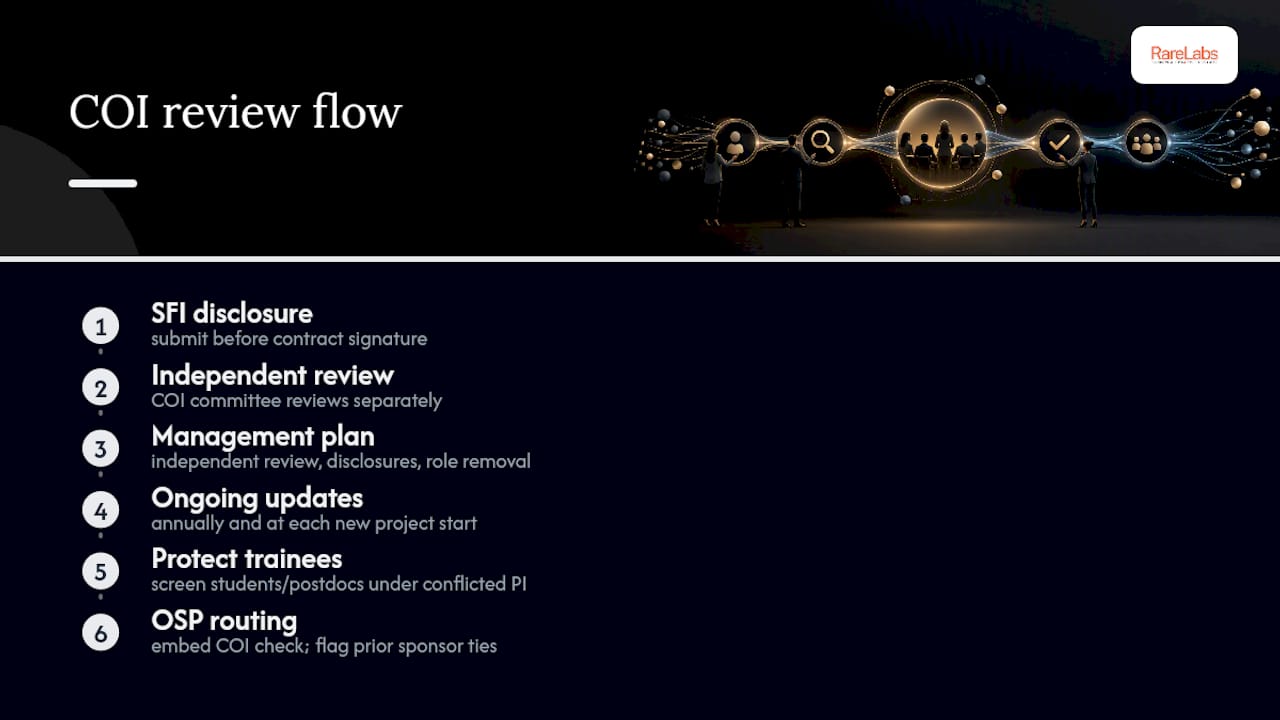
Every SRA touching outside funding raises a basic question: does anyone involved have a financial stake in the outcome? Significant financial interest (SFI) disclosure forms exist to surface that before the contract gets signed, not after a paper gets published and someone notices the PI holds equity in the sponsoring company.
Institutional conflict-of-interest committees typically review disclosures separately from the OSP's contract negotiation, and for good reason. A financial relationship between a PI and a sponsor doesn't automatically disqualify a project, but it does require a management plan, which might include independent data review, disclosure in resulting publications, or removal of the conflicted individual from specific decision points like data analysis or interpretation.
Institutional policy generally requires disclosure updates annually and at the start of any new sponsored project, since financial relationships change and a clean disclosure from two years ago doesn't cover a new equity grant. Students and postdocs working under a conflicted PI deserve particular attention here. They're often the least equipped to push back if a sponsor's interests start shaping how data gets interpreted or which results get emphasized. Build COI review into the standard OSP routing checklist rather than treating it as a separate, optional step, and flag any project where the sponsor and a co-investigator share a prior financial relationship before the SRA reaches final signature. Catching this early avoids a retraction or federal audit finding later.
Data Management and Sharing Requirements
Every SRA needs an explicit data management clause, and leaving it vague is one of the more common drafting failures in practice. Define who owns the raw data generated under the project, who can access it during the project term, and what happens to it after the agreement ends.
Federal funders increasingly require data-sharing plans as a condition of the award itself, separate from whatever the sponsor's own confidentiality preferences might be. When a project involves both federal and sponsor funding, those two sets of obligations need explicit reconciliation in the contract, because a sponsor's confidentiality clause and a federal deposit mandate can genuinely conflict without careful drafting.
Address retention periods directly. Most institutions require primary research data retained for a minimum period after project completion, commonly several years, regardless of what the sponsor wants. Specify format and storage requirements too. A sponsor expecting raw sequencing files versus processed summary statistics is a different deliverable entirely, and that distinction belongs in the SOW, not left to be argued about at project close. For projects involving patient-derived materials or genetic data specifically, tie the data management clause to your institution's human subjects protections and any applicable consent language, since the two documents need to stay consistent with each other.
Insurance Requirements Tied to Sponsored Projects
Insurance clauses protect against the specific liability the research actually creates, and matching coverage to risk matters more than defaulting to a standard number. A behavioral survey study and a Phase 1 clinical trial carry radically different exposure, and the insurance clause should reflect that gap rather than using boilerplate limits.
General liability coverage is standard baseline protection in most SRAs. Projects involving human subjects, particularly anything with an investigational drug or device, typically require additional clinical trial or product liability coverage, often with specific per-occurrence and aggregate limits the sponsor will want stated explicitly in the contract. Confirm whether your institution's existing policy covers sponsor-funded work automatically or whether the specific project needs a rider, since assuming coverage that isn't actually in force is a real and common gap.
Indemnification and insurance clauses should carry matching caps. A sponsor asking for uncapped indemnification while offering only minimum statutory insurance coverage is asking the institution to absorb risk the sponsor isn't actually backing financially, and that imbalance deserves pushback during negotiation, not acceptance because it appeared in a standard template. Review insurance requirements alongside indemnification language as a matched pair rather than two separate clauses, since a mismatch between the two often reveals the actual gap in a sponsor's risk-sharing position.
Publisher Perspective: Contracting for Translational Rare Disease Work
Some organizations scope sponsored projects around measurable deliverables from day one. When a family or foundation contracts a personalized disease-modeling program, the SOW defines specific milestones: cell line validation, screen completion against a defined compound library, a translational report with findings. That structure keeps academic rigor intact while giving contract terms something concrete to attach to.
Practical compromises matter more than perfect terms. A limited-term option window on any resulting IP, paired with a clearly defined deliverable schedule, tends to satisfy both a family's urgency and an institution's need for defensible terms. The projects that stall are usually the ones where nobody defined "done" before signing.
— John
How RareLabs Supports Contract-Ready Translational Projects
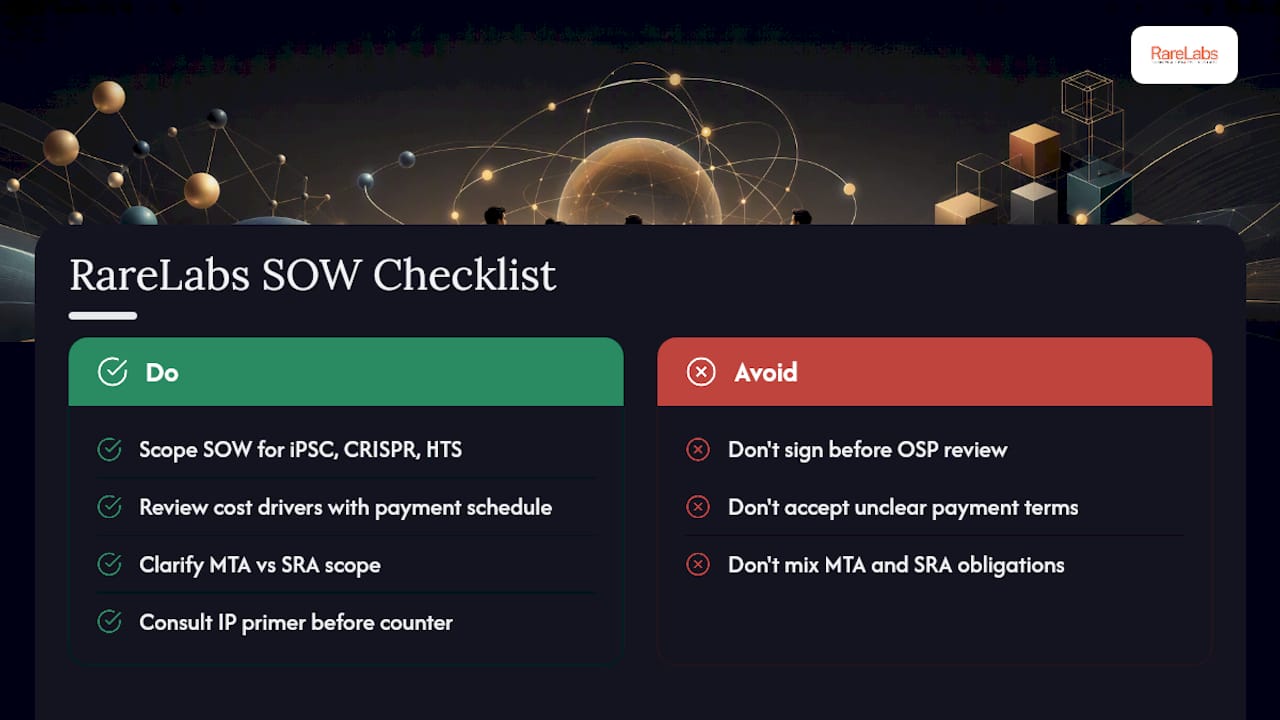
If your foundation, family, or biopharma partner needs a sponsored research program scoped the way an institution can actually sign off on, RareLabs builds SOWs around iPSC disease modeling, CRISPR-edited isogenic controls, and high-throughput drug screening with milestones defined before the contract goes to redline, not after.
Personalized programs for ultra-rare and undiagnosed genetic disease work often require budget clarity before an office of sponsored programs will move a draft forward. Reviewing typical cost drivers for custom iPSC work alongside a sponsor's proposed payment schedule helps set realistic fixed-price contingency before anyone signs. When a sponsor's draft SRA includes materials transfer alongside the research scope, understanding material transfer agreement basics prevents boundary confusion between what the MTA covers and what the SRA covers. For IP terms specifically, a primer on protecting intellectual property rights is a useful reference before your institution counters a sponsor's licensing ask.
If you're evaluating whether a contracted disease-modeling program fits your family's or foundation's situation, start a scoping conversation with RareLabs to define a SOW your institution's OSP can actually review and sign.
This article is general information, not a substitute for advice from a qualified lawyer. Consult a qualified legal professional about your own circumstances before acting on anything here.
Sources
- Sponsored Research Agreements (SRAs) | Research Support
- Cost Reimbursement and Fixed-Price | Penn State Research Support
- Developing sponsored research agreements: considerations for recipients of NIH research grants and contracts
- Sponsored Research Agreement (template) | UGA SPA