

A material transfer agreement (MTA) is a legally binding contract that governs how tangible research materials, things like iPSCs, cell lines, plasmids, and reagents, move between institutions. It sets rules for permitted use, ownership of progeny and derivatives, publication rights, and intellectual property boundaries. You need one whenever a lab sends or receives physical material, not just data or ideas, and no funding or deliverables are attached. If money, milestones, or planned joint experiments are involved, you likely need a sponsored research agreement instead.
Before you draft anything, do three things:
- Contact your authorized institutional official (tech transfer office or sponsored research office) rather than signing anything yourself.
- Gather the protocol, quality control data, and shipping specifics the provider or recipient will need.
- Confirm biosafety classification and carrier constraints under DOT and IATA rules before you promise a ship date.
Key Takeaways
A material transfer agreement succeeds when institutions align contract signature, ethical clearance, and shipping logistics as parallel tracks instead of sequential steps.
| Point | Details |
|---|---|
| Define the transaction first | Confirm it's a true material transfer, not a funded collaboration, before drafting anything. |
| Route signature correctly | Only an authorized official in the tech transfer or sponsored research office can sign an MTA. |
| Scrutinize five clauses | Ownership, permitted use, publication windows, IP/reach-through claims, and liability decide most disputes. |
| Sync ethics, QC, and shipping | Start IRB/SCRO review and QC prep the same day you start the MTA, not after. |
| Flag cross-border shipments early | Loop in your export control officer before signing, since EAR/ITAR review happens separately from MTA review. |
| Get logistics support for iPSC transfers | Hopeatrarelabs coordinates MTA timing, QC release, and shipping windows for patient-derived material programs. |
Table of Contents
- What a Material Transfer Contract Actually Covers
- The Clauses That Actually Decide Whether You Should Sign
- Who Signs and How Long Institutional Review Actually Takes
- When You Need a Different Agreement Entirely
- Shipping and Biosafety Requirements You Cannot Skip
- Where to Find Model MTAs and What to Attach
- How a Provider Coordinates MTAs for Patient-Derived Material
- What Happens When an MTA Dispute Actually Arises
- What Happens to the Material After the Project Ends
- Export Controls and International Transfer Rules You Cannot Ignore
- How an MTA Shapes What You Can Publish and Share
- Why Most MTA Delays Are Self-Inflicted
- Getting Help Coordinating an MTA for Patient-Derived Material
- Frequently Asked Questions
- Sources
What a Material Transfer Contract Actually Covers
An MTA is narrower than most researchers assume. It covers the specific material listed, plus anything derived from it, such as cell lines expanded from a donor sample, subclones, or modified plasmids. It does not automatically cover new inventions made using that material, which is where IP clauses matter.
Common material types you'll see in an MTA:
- Patient-derived iPSC lines and CRISPR-edited isogenic controls
- Plasmids, vectors, and antisense oligonucleotide constructs
- Reagents, antibodies, and chemical compounds
- Animal models and tissue samples
Academic-to-academic transfers usually run on a standard template with minimal negotiation. Academic-to-industry transfers, or any deal where a for-profit entity gets the material, tend to trigger extra scrutiny, licensing terms, and sometimes a reach-through royalty clause. Many institutions keep a stack of pre-signed "implementing letters" for high-volume, low-risk transfers like common plasmids, and reserve full bespoke MTA drafting for anything proprietary, patient-derived, or headed to a commercial partner.
The Clauses That Actually Decide Whether You Should Sign
Most MTA disputes trace back to five clauses. Read these first, every time.
- Ownership vs. license. The provider almost always retains title to the original material. What you're negotiating is the license terms for derivatives and progeny, not ownership of the sample itself.
- Permitted use and redistribution. Look for language restricting use to the named research purpose and barring transfer to third parties without written consent. Confidentiality obligations often ride along here too.
- Publication rights. Most templates give the provider a review window, typically 30 to 60 days, to check for inadvertent disclosure of confidential information before you publish, not to block your results.
- IP allocation and reach-through claims. This is where academic-industry transfers get contentious. Watch for language granting the provider rights to inventions made using the material, sometimes called reach-through claims, and understand what triggers a commercialization obligation.
- Liability and indemnity. The NIH's Public Health Service model MTA disclaims warranties on the material and limits provider liability. Industry-originated MTAs sometimes ask the recipient institution for indemnification, which your sponsored research office will want to negotiate down.
Pro Tip: Flag reach-through IP language and indemnity clauses to your tech transfer office before you invest time on the science. Those two items cause more stalled negotiations than any other part of the contract.
Who Signs and How Long Institutional Review Actually Takes
Researchers rarely have legal authority to bind their institution, so an authorized official in the tech transfer or sponsored research office signs every MTA. If you sign one yourself as a principal investigator, it may not be enforceable, and your institution may not honor the liability protections inside it.
For human-derived materials, expect an additional gate: IRB or SCRO (stem cell research oversight) review confirming the material was obtained and will be used under appropriate consent and ethical standards. This approval has to be in place, or at least clearly underway, before the MTA can be finalized.
On timeline, plan for weeks, not days. Standard template MTAs between two academic institutions often clear review in about one to two weeks. Bespoke negotiations, especially those involving reach-through IP, can take several weeks to months. Separately, preparing a cell shipment for QC release commonly takes several weeks, so align your MTA signature timing with that lab schedule rather than assuming the contract will be the bottleneck.
- Draft/template MTA, academic to academic: one to two weeks
- Bespoke MTA with industry partner or reach-through IP: several weeks to months
- IRB/SCRO clearance for human-derived material: run in parallel, not after
When You Need a Different Agreement Entirely
An MTA is the wrong document if the transfer includes funding, defined deliverables, or a joint research plan. A common pre-check institutions recommend is confirming the transaction is genuinely limited to material transfer before anyone drafts an MTA at all.
Red flags that you need something else:
- The other party is paying for the material, reagents, or associated services.
- There's a defined scope of work or specific experiments the provider expects performed.
- Either side expects co-authorship, shared IP on new findings, or milestone reporting.
Sign an MTA when one of those applies and you risk mischaracterizing a funded collaboration as a simple material handoff, which creates real IP and compliance exposure later. Request a sponsored research agreement or a collaboration agreement instead, and route it through your sponsored research office, not tech transfer.
Shipping and Biosafety Requirements You Cannot Skip
Contract terms mean nothing if the shipment doesn't clear the carrier's rules. Biological materials shipped domestically fall under DOT regulations, and international or air shipments fall under IATA rules, which require secondary containment, absorbent material, and visible hazard labeling, including a dry ice sticker when applicable.
- Use secondary packaging (poly seal bag with absorbent material) inside the outer shipping container.
- Label dry ice shipments and biological hazard markings clearly and correctly, per IATA/DOT specs.
- Confirm who pays: shipping costs and distribution fees are commonly charged to the recipient, and for-profit recipients may owe additional licensing fees.
- Time MTA execution to land right before QC release and the carrier's pickup window, not after.
Improper packaging isn't just a compliance footnote. Georgetown's environmental health and safety guidance notes it can create real civil or criminal liability for the shipper. Our partner guidance on dry ice transport walks through packaging and labeling rules in more operational detail if you're setting up a shipping protocol from scratch.
Where to Find Model MTAs and What to Attach
Don't draft from a blank page. The Uniform Biological Material Transfer Agreement (UBMTA) and the NIH PHS model MTA are the two most widely adopted templates, and AUTM's toolkit collects both along with implementing letters.
Attach these when you submit an MTA request to speed review:
- Research protocol and relevant SOPs
- QC reports for the material
- Biosafety data sheet and containment level
- Shipping instructions and any required import/export permits
Using standard model language rather than a fully bespoke contract can cut weeks off negotiation, particularly for common academic materials.
How a Provider Coordinates MTAs for Patient-Derived Material
Coordinating an MTA for patient-derived iPSCs adds layers a standard reagent transfer doesn't have. Hopeatrarelabs treats the legal, ethical, and logistics tracks as parallel work, not sequential steps.
- Confirm the authorized institutional signatory early, before scientific planning locks in a timeline.
- Verify IRB/SCRO clearance for the specific donor material and use case.
- Assemble QC documentation and biosafety data before requesting MTA review.
- Schedule the shipping window against QC release, not against the contract's expected signature date.
Aligning MTA signature with QC release, rather than treating them as separate milestones, is usually what determines whether a transfer ships on time. Details on how personalized modeling programs handle oversight documentation for patient-derived iPSCs apply directly to this coordination problem.
What Happens When an MTA Dispute Actually Arises
Most MTA disputes never reach litigation, and that's by design. The agreements themselves usually specify how disagreements get resolved, and the mechanism differs from what you'd see in a commercial supply contract.
The first line of defense is almost always informal: a conversation between the two institutions' tech transfer or sponsored research offices, often before either party's legal counsel gets involved. Because MTAs are frequently governed by PHS model language that construes terms under federal law for federal grantees, disputes involving NIH-funded material often default to a specific governing law clause rather than open negotiation over jurisdiction.
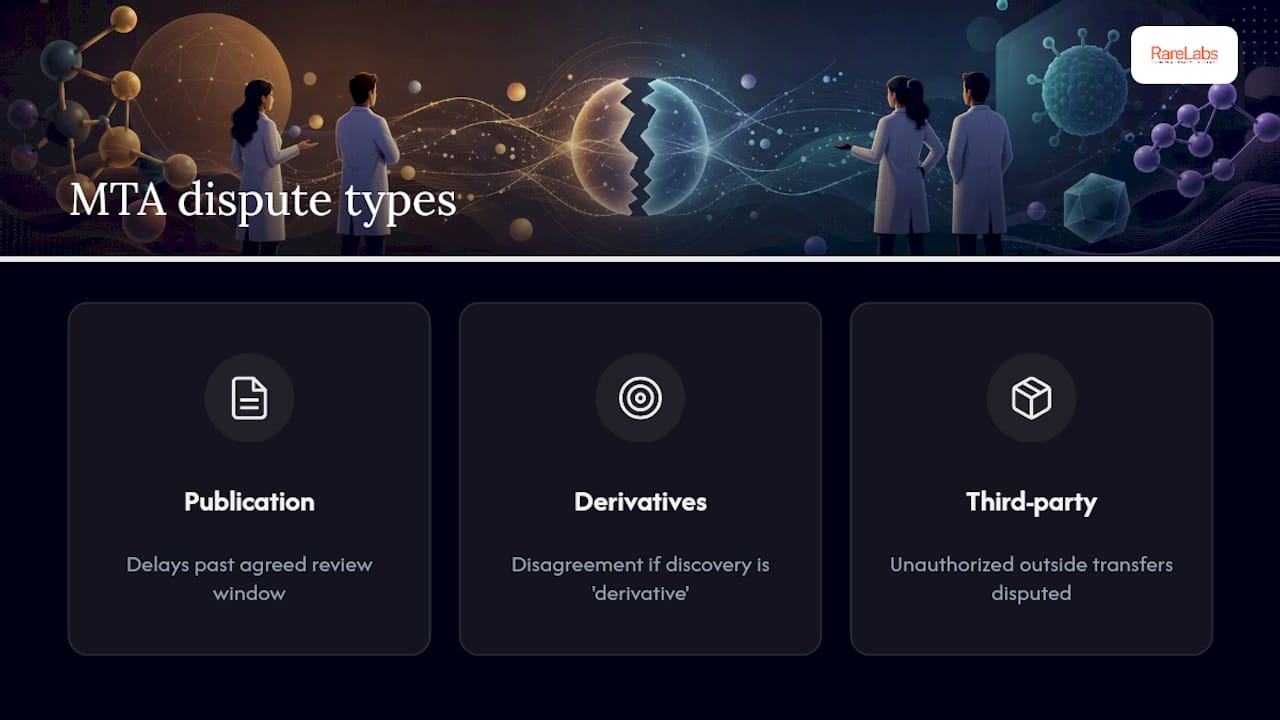
Where disputes actually surface, three areas dominate: publication delays past the agreed review window, disagreement over whether a downstream discovery counts as a "derivative" subject to reach-through claims, and disputes over unauthorized third-party transfer. Each of those maps directly back to a clause you should have scrutinized before signing, which is why the clause-by-clause review earlier in this piece matters more than any dispute clause itself.
Formal arbitration or mediation clauses do appear in bespoke, industry-facing MTAs, especially where a for-profit recipient has negotiated custom terms. Academic-to-academic MTAs using UBMTA or PHS language rarely include binding arbitration, relying instead on the two institutions' good-faith obligation to resolve issues administratively. If a dispute can't be resolved between offices, escalate through your sponsored research office rather than reaching out to opposing counsel directly. That office knows the governing law clause and the institutional relationship history that outside counsel won't.
What Happens to the Material After the Project Ends
An MTA doesn't expire quietly when the study wraps. Most templates specify what happens to the remaining material, and skipping this clause creates real liability if you're still holding cell lines, reagents, or patient-derived samples a year after the grant closed.
Three outcomes typically show up in the contract: return the unused material to the provider, destroy it and certify destruction in writing, or retain it under continuing terms if the agreement allows extended use. The PHS model MTA and most UBMTA-based agreements default to one of the first two unless the parties negotiate a retention clause specifically.
For patient-derived material, retention terms deserve extra scrutiny. If the original consent didn't anticipate indefinite storage, or the IRB approval was scoped to a defined study period, holding onto iPSC lines past that window can violate both the MTA and the ethical approval that made the transfer possible in the first place. Check the SCRO or IRB documentation against the MTA's retention clause before you assume you can keep material "just in case" for a future project.
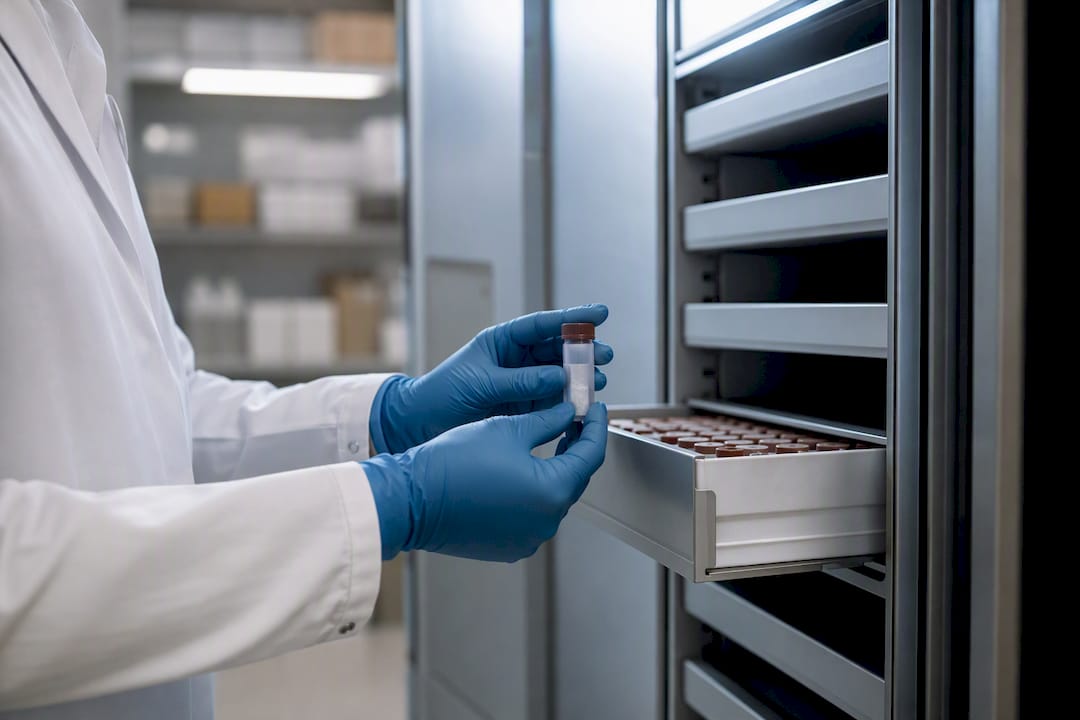
Practical advice: build a project close-out step into your lab's MTA tracking process. When a study ends, someone, usually a lab manager or the PI, should confirm whether the contract requires certified destruction, and if so, complete it and file the certification with your institution's records. Providers increasingly ask for that documentation before they'll consider a follow-up transfer request from the same lab.
Export Controls and International Transfer Rules You Cannot Ignore
Shipping research material across a border adds a compliance layer that has nothing to do with the MTA's clauses and everything to do with federal export control law. The Export Administration Regulations (EAR) and, for certain biological agents, International Traffic in Arms Regulations (ITAR) can apply even to academic material transfers, depending on what the material is and where it's going.
The trigger isn't always obvious. A cell line itself might not be controlled, but the technical data accompanying it, protocols, characterization data, sequence information, sometimes is. Transfers to certain countries, or to specific foreign nationals regardless of location, can also require a license even when the material itself seems benign. This is a separate review from your MTA approval, and it needs to happen before, not after, you finalize shipping logistics.
Most research institutions have an export control officer, often housed in the same office as sponsored research or research compliance, who reviews international MTAs specifically for these triggers. Loop them in as soon as you know a transfer is crossing a border, particularly if the recipient is in a country subject to additional restrictions or if the material has any dual-use potential.
Practical checklist for international transfers:
- Flag any cross-border shipment to your export control officer before shipping, not after the MTA is signed.
- Confirm whether the material or accompanying technical data falls under EAR or ITAR classification.
- Check for restricted-party or restricted-country issues tied to the specific recipient.
- Build extra review time into your timeline. International MTAs routinely take longer than domestic ones because of this added layer.
How an MTA Shapes What You Can Publish and Share
The publication clause in an MTA is where a lot of researchers get an unwelcome surprise. Most templates, including the PHS model agreement, grant the provider a review window before publication, but the purpose is narrower than people assume: checking for inadvertent disclosure of confidential information, not vetoing your conclusions.
That said, the practical effect on data sharing policies can be real. If your funder requires open data deposition, say, an NIH data management and sharing plan, and your MTA restricts redistribution of the material or associated data to third parties, you need to reconcile those two obligations before you submit anything. A well-drafted MTA should explicitly carve out an exception for data deposited to meet funder mandates. A poorly drafted one won't, and you'll be negotiating an amendment mid-study.
Confidentiality clauses compound this. If the material came with proprietary characterization data or a provider-specific protocol marked confidential, you may be barred from including that detail in a methods section without separate written permission. This is one more reason to read the confidentiality clause before you assume your entire dataset is yours to publish freely. Coordinating what actually gets disclosed, and to whom, is exactly the kind of provision covered under transparency practices in biotech research relationships.
Practical fix: when your protocol involves an MTA and you anticipate a data-sharing mandate from your funder, ask your tech transfer office to negotiate the publication and data-sharing clauses simultaneously, not sequentially. Retrofitting a signed MTA to accommodate a funder mandate discovered later is slower and harder than getting it right at signature.
Why Most MTA Delays Are Self-Inflicted
The conventional advice on MTAs treats them as a legal bottleneck you wait out. That framing is backwards. The clauses themselves, ownership, publication windows, liability, are largely settled territory; UBMTA and PHS language covers the vast majority of academic transfers without real controversy. The actual delay almost always comes from sequencing, not law: labs start MTA negotiation without confirming IRB/SCRO status, or without lining up QC timing, and then blame the contract when the real holdup is a missing ethics approval or an unprepared shipment.
The fix isn't a better lawyer. It's parallel processing. Start your ethical review, your QC prep, and your MTA request at the same time, not in sequence, and loop in your export control officer immediately if any cross-border element exists. Institutions that operationalize patient-derived material transfers well treat the contract as one track among several running simultaneously, not the first domino.
If there's one habit worth adopting from this whole process, it's this: never let the MTA be the thing you start last. Start it the same day you start assembling protocol and QC documentation, and you'll cut weeks off a process that most labs treat as sequential when it doesn't need to be.
Getting Help Coordinating an MTA for Patient-Derived Material
Patient-derived iPSC transfers carry more moving parts than a standard reagent MTA, ethics clearance, QC documentation, and shipping windows all have to land in sync, and Hopeatrarelabs runs personalized disease modeling programs where that coordination is part of the daily work, not a one-off exception.

Hopeatrarelabs builds patient-specific iPSC models and runs parallel drug repurposing and ASO screens for ultra-rare and undiagnosed genetic diseases, and the same team that designs those screens also manages the QC and shipment scheduling that keeps an MTA-driven transfer on track. If you're a family, foundation, or physician-scientist facing a complex MTA negotiation, an IRB/SCRO alignment question, or a shipment that needs to hit a narrow QC release window, that's exactly the kind of logistics problem this team handles routinely. Visit the RareLabs knowledge page to see how a personalized disease modeling program gets structured from first contact through material transfer, and to start a conversation about your specific case.
Frequently Asked Questions
What is the difference between a material transfer agreement and a sponsored research agreement? An MTA covers the transfer of physical material for a defined research use with no funding attached. A sponsored research agreement involves payment, deliverables, or a defined scope of work, and it requires a different review process through your sponsored research office.
Who has authority to sign a material transfer agreement? An authorized institutional official, typically in the tech transfer office or sponsored research office, signs on behalf of the institution. Principal investigators generally lack the legal authority to bind their institution and should not sign directly.
Does an MTA cover materials derived from the original sample? Most templates, including the NIH PHS model MTA, extend coverage to progeny, derivatives, and modifications of the original material, which is why the ownership and permitted-use clauses matter more than they first appear to.
How long does MTA review typically take? Standard academic-to-academic MTAs using UBMTA or PHS language often clear in one to two weeks. Bespoke negotiations involving industry partners or reach-through IP claims can take several weeks to months.
Who pays for shipping costs under an MTA? Shipping costs and distribution fees are commonly charged to the recipient, and for-profit recipients may face additional licensing fees on top of shipping.
This article is general information, not a substitute for advice from a qualified lawyer. Consult a qualified legal professional about your own circumstances before acting on anything here.
Sources
- Material Transfer Agreements (MTA) — Northwestern University
- IATA / DOT shipping guidance — Georgetown EHS
- Public Health Service Material Transfer Agreement (model) — NIH / Tech Transfer
- Distribution services FAQ and signing authority — HSCI / Harvard