
Partnerships exist to solve five problems no biotech can solve alone: they accelerate clinical development, supply funding and non-dilutive resources, unlock outside technology and data, add manufacturing scale, and spread scientific and commercial risk across more than one balance sheet. Assets that move through a partnership reach launch at a meaningfully higher rate than those developed in-house, according to McKinsey's analysis of biopharma dealmaking. That single fact reframes how a biotech should think about partnering: not as a fallback when internal resources run short, but as a deliberate lever for de-risking a pipeline.
The pattern shows up in a few consistent ways:
- Partnered programs get faster access to clinical operations infrastructure, regulatory expertise, and centralized CRO networks.
- Deal structures increasingly protect a smaller biotech's upside through milestones and options rather than forcing an early sale.
- A well-defined Target Product Profile going into partner discussions correlates with smoother diligence and faster deal closes.
Key Takeaways
Partnerships improve a biotech's odds of reaching launch by combining external capability, shared risk, and disciplined governance rather than simply adding headcount or cash.
| Point | Details |
|---|---|
| Partnered assets launch more often | Programs developed through partnerships show a success rate from Phase I to launch substantially higher than internal programs. |
| Match structure to strategic need | Licensing, co-development, and platform deals carry different risk and control tradeoffs; pick deliberately, not by default. |
| Define milestones precisely | Vague milestone language and overbroad exclusivity clauses cause most later disputes. |
| Governance requires active management | Dedicated alliance managers who chase blockers weekly outperform passive steering committees. |
| Build a TPP before negotiating | Early Target Product Profile alignment speeds diligence and clarifies milestone design for both sides. |
Table of Contents
- The Role of Partnerships in Biotech Starts With Choosing the Right Structure
- Why Partnering Improves R&D Odds, Not Just R&D Speed
- Deal Structures Determine Who Carries the Risk
- The Governance Habits That Separate Good Partnerships From Bad Ones
- Finding and Vetting a Partner Before You Sign Anything
- Where Deal Value Is Concentrating and What That Means for Timing
- What a Specialty Partner Contributes in Rare-Disease Programs
- The Part of the Partnership Playbook Most Guides Skip
- Frequently Asked Questions
- Sources
The Role of Partnerships in Biotech Starts With Choosing the Right Structure
Not every collaboration should look the same, and picking the wrong structure for the moment is one of the most common strategic mistakes in the sector. Here's how the major categories break down.
Research collaborations are early, often pre-competitive arrangements between a biotech and an academic lab or another company to explore a target or mechanism. They typically initiate from the academic or scientific side, cost little upfront, and rarely bind either party to future obligations. The downside: unclear IP ownership if the scope isn't nailed down at the start.
Strategic alliances go further, pairing two organizations around a shared program or platform without a full merger. Big pharma and mid-cap biotechs often initiate these when they want long-term access to a technology without owning it outright. They demand real governance investment to function.
Licensing (in and out) remains the workhorse deal type in the industry. A licensor keeps some ownership through royalties while transferring development or commercialization rights. More than 70 percent of new drugs are developed externally and later acquired by a pharmaceutical company(https://www.cbinsights.com/research/pharmaceutical-companies-business-relationships/), which tells you how central licensing has become to how new medicines actually reach patients. The tradeoff is straightforward: cash and speed now, in exchange for smaller economics later.
Co-development agreements split cost and risk on a shared asset, usually between two companies with complementary capabilities such as a discovery-stage biotech and a partner with clinical operations muscle. These require the most operational coordination of any structure and the most careful upfront agreement on decision rights.
Joint ventures create a new, separately governed entity, usually reserved for large, capital-intensive programs where neither party wants full balance-sheet exposure. They're rare in early biotech and more common once a program has late-stage validation.
Manufacturing and CMO agreements are less glamorous but often make or break a program's timeline. A biotech usually initiates these once it has a candidate worth scaling; the leverage typically sits with whichever party controls capacity.
Option-to-acquire and equity investment structures let a larger company buy time and information before committing to a full acquisition. For the smaller partner, this preserves independence longer while still bringing in capital.
M&A is the terminal structure. It resolves risk-sharing permanently by removing one party from the equation entirely.
A platform deal, where a company licenses an entire discovery engine rather than one molecule, tends to carry more total value than a string of single-asset licenses, according to trade coverage from Labiotech's overview of biotech partnership types. If your technology can generate more than one asset, negotiate the platform conversation before you get boxed into a single-product deal.
Why Partnering Improves R&D Odds, Not Just R&D Speed
The mechanism matters more than the marketing language around it. Partnerships don't just add resources. They change the probability that a program survives contact with the FDA and the market.
A partnered asset moving from Phase I to launch succeeds at roughly double the rate of an internally developed one, based on McKinsey's review of dealmaking's effect on R&D productivity between 2016 and 2020. That gap isn't explained by better molecules. It's explained by better execution: partners bring clinical operations experience that shortens enrollment timelines, regulatory teams that have already navigated the specific pathway a program needs, and manufacturing scale-up expertise that a ten-person biotech simply doesn't have in-house.
A few concrete effects show up repeatedly:
- IND-enabling studies move faster when a partner's CRO relationships are already established rather than built from scratch.
- Access to centralized data infrastructure and AI-assisted target validation tools cuts down the guesswork in early discovery.
- Credibility transfer matters more than people admit. A partnership with an established name can unlock investor and regulatory attention a standalone biotech would otherwise spend years earning.
Modality hotspots reflect where this dynamic is strongest right now. Oncology programs, platform technologies, and AI-driven discovery tools are absorbing a disproportionate share of partnering activity, largely because they benefit most from the validation and infrastructure a partner provides. The CB Insights review of pharma partnership activity points to deals like the BioNTech and Pfizer collaboration as evidence that external partnering, not internal R&D alone, increasingly produces the industry's biggest wins.
Deal Structures Determine Who Carries the Risk
Every deal structure is really a negotiation over who absorbs risk and when. Understanding the economics before you sit down at the table changes what you ask for.
Licensing deals split payment into upfronts, milestones, and royalties. Upfront cash is shrinking as a share of total deal value industrywide, with licensors increasingly accepting milestone-heavy structures in exchange for larger totals if the program succeeds, per McKinsey's analysis of innovation sourcing practices. That shift rewards biotechs with strong conviction in their own data and punishes those who need cash now more than upside later.
Co-development and profit-sharing structures split both cost and reward, which sounds fairer but demands far more operational trust between parties. If your partner controls the trial design and you're only entitled to a profit share, you've effectively handed over strategic control while keeping financial exposure.
Options and equity investments let a bigger partner buy the right to acquire later, often at a pre-agreed valuation formula. This preserves your independence in the near term but caps your negotiating leverage if the program performs unexpectedly well.
M&A eliminates the risk-sharing question entirely by ending it.
A few negotiation levers matter more than most term sheets suggest:
- Define milestones around specific, measurable clinical or regulatory events, not vague development stages that invite dispute later.
- Watch for overbroad exclusivity clauses that lock you out of adjacent indications or geographies you never intended to license away.
- Check for IP reversion gaps: what happens to your intellectual property if the partner walks away mid-program.
- If you run a platform, negotiate to keep rights to future assets rather than granting exclusivity across your entire pipeline for one program's sake.
The Governance Habits That Separate Good Partnerships From Bad Ones
Most partnership failures trace back to governance, not science. A joint steering committee with a vague remit and no real decision rights is worse than no committee at all, because it creates the illusion of alignment while nothing actually gets resolved.
- Define the joint steering committee's authority explicitly. Spell out what it can decide unilaterally, what requires both parties' sign-off, and how ties get broken.
- Assign a dedicated alliance manager on each side. This is not an administrative role. High-performing organizations use alliance managers to proactively unblock bottlenecks by pulling in regulatory, clinical operations, or CMC support the moment a program stalls, according to McKinsey's research on dealmaking productivity.
- Set a review cadence and stick to it. Monthly or quarterly JSC meetings, tracked against milestone progress, enrollment rates, and issue-resolution time, catch drift before it becomes a crisis.
- Build an escalation pathway before you need one. Waiting until a dispute erupts to figure out who has final say is how partnerships quietly die.
Pro Tip: Treat alliance management as an operating function, not a legal formality. The partnerships that generate the most value are run by teams who chase down blockers weekly, not the ones who wait for the next scheduled call to notice something's off track.
Finding and Vetting a Partner Before You Sign Anything
Due diligence in biotech partnering fails most often when it skips the boring parts. Technical review of the science matters, but so does a clear-eyed look at whether the two organizations can actually work together operationally.
Before any serious conversation, run through:
- IP review: who owns background IP, foreground IP, and improvements made jointly, and whether any prior grants or academic obligations create encumbrances.
- Capability mapping: does the prospective partner actually have the manufacturing or clinical operations capacity they claim, or is it aspirational.
- Cultural and operational fit: how fast does the other side make decisions, and does that pace match your program's timeline.
- Early TPP alignment: building a Target Product Profile before deep negotiations gives both sides a shared reference point for what success looks like, which makes milestone design far less contentious later.
On sourcing itself, the strongest channels tend to be translational programs modeled on the SPARK approach, which pair academic teams with hands-on mentorship and weekly review cycles to get them partner-ready, partnering conferences and BD-specific forums, direct business development outreach, and venture investor networks who often see deal flow before it becomes public. Academic-industry collaboration has expanded steadily since the Bayh-Dole framework took hold, and Tufts CSDD's review of academic-industry partnerships notes that a large share of biotech founders originate from university labs, which makes academic sourcing channels worth taking seriously rather than treating as a formality.
Where Deal Value Is Concentrating and What That Means for Timing
Deal activity isn't spreading evenly across the industry. It's piling up in a few specific places, and knowing where changes how you should time your own partnering strategy.
Oncology, platform technologies, and AI-driven discovery are absorbing a disproportionate share of partnership value right now. Organizations that McKinsey classifies as external-innovation outperformers are three to eight times more productive with their external assets than peers, driven by four specific practices: AI-enabled scouting, faster internal decision-making, deeper ecosystem collaboration, and therapeutic-area focus rather than opportunistic breadth.
The economics have shifted alongside the concentration. Upfront payments have shrunk as a share of total deal value since 2010, with the difference shifted into milestone payments tied to clinical and regulatory events. That trend favors biotechs with strong data and patience over those needing cash immediately, and it means competition for the best assets in hot categories is intensifying even as headline deal values look more conservative on paper. If your program sits in a crowded modality, expect diligence to move faster and expect partners to negotiate harder on milestone definitions, since that's where they're now taking on more of the shared risk.
What a Specialty Partner Contributes in Rare-Disease Programs
Rare-disease programs face a specific version of the partnering problem: there's often no existing playbook, no large patient population to validate a hypothesis against, and no time to spare. Hopeatrarelabs works this problem directly by building patient-derived iPSC models paired with CRISPR-edited isogenic controls, then running parallel screens across thousands of FDA-approved drugs alongside custom ASO and gene therapy feasibility testing.
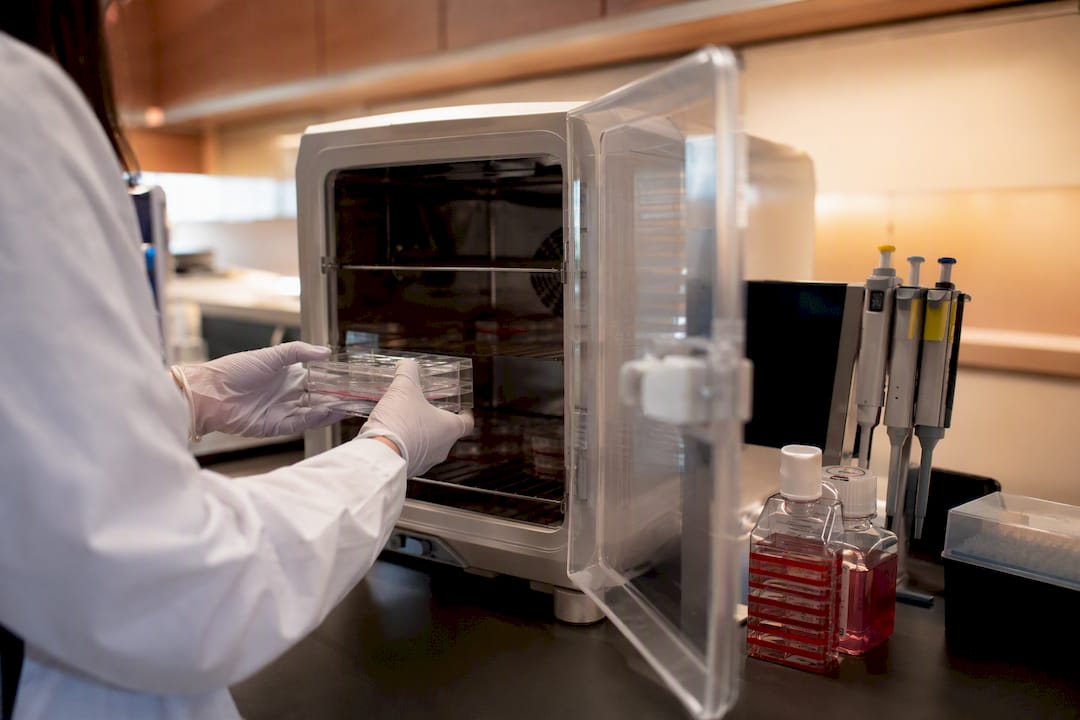
That combination compresses the hypothesis-to-action loop that would otherwise take a foundation or family months of searching to assemble on their own. A biopharma or foundation partner evaluating a specialty lab should expect the same governance rigor covered earlier: clear reporting cadence, defined decision points, and a shared understanding upfront of what a successful screen actually looks like. The same evaluation checklist that applies to larger partnerships, capability mapping, IP clarity, and early alignment on target outcomes, applies here too, just compressed into a much shorter timeline.
The Part of the Partnership Playbook Most Guides Skip
Most advice on biotech partnering treats deal structure as the whole game: get the milestones right, protect your IP, negotiate a fair royalty. That's necessary but not sufficient. The evidence on partnered-asset success rates points somewhere else: execution discipline, particularly active alliance management, explains more of the outcome gap than deal terms alone.
The conventional wisdom underrates how much a Target Product Profile does before a term sheet even exists. Biotechs that walk into partner conversations with a TPP already drafted move faster through diligence and negotiate milestones with far less friction, because both sides are arguing from the same definition of success.
If you take one thing from this, prioritize governance readiness over deal-term perfection. A slightly worse royalty split with an actively managed alliance beats a slightly better one that nobody's minding week to week.
Frequently Asked Questions
What is the primary role of partnerships in biotech?
Partnerships primarily accelerate R&D by adding clinical operations expertise, regulatory experience, manufacturing scale, and capital that a biotech typically lacks alone, which improves the odds a program reaches launch.
How do biopharma partnerships differ from academic collaborations?
Biopharma partnerships usually involve formal deal economics like milestones and royalties, while academic collaborations often start pre-competitively and focus on early validation, frequently evolving into licensing deals once a target shows promise.
What makes a partnership fail in biotech?
Most failures trace back to weak governance: undefined decision rights, passive alliance management, and vague milestone language that creates disputes once a program hits a rough patch.
Should an early-stage biotech license out or seek a co-development deal?
It depends on how much operational control you want to retain. Licensing gives up more control for immediate cash and speed; co-development keeps you closer to the program but demands far more coordination and shared risk.
How important is a Target Product Profile before partnering discussions?
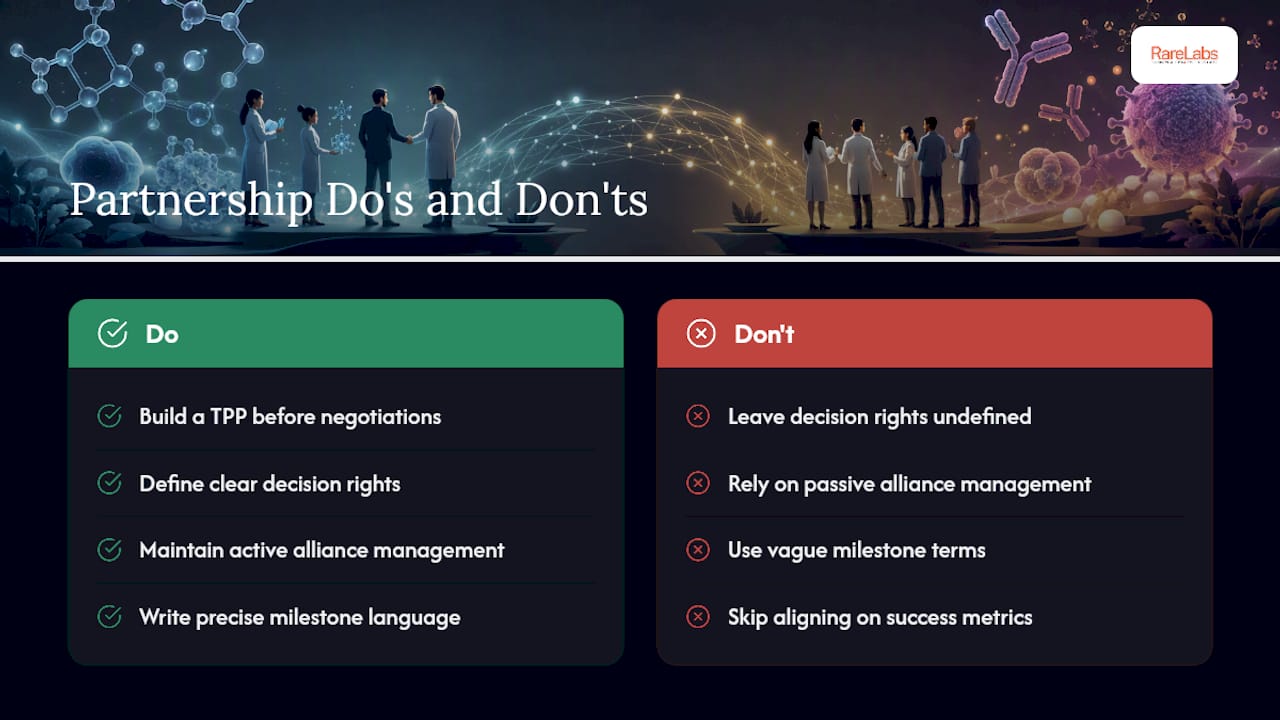
Very. A TPP built before negotiations gives both parties a shared definition of success, which speeds diligence and makes milestone design significantly less contentious.
Sources
- Biopharma dealmaking to boost R&D productivity | McKinsey
- The future of academia–pharma partnerships for novel drug discovery: a better path to success? | Journal article
- Academic–Industry Partnerships for Biopharmaceutical R&D | Tufts CSDD
- From vaccines to cancer treatments, how pharma partnerships drive drug innovation | CB Insights
- The ABC of biotech partnerships | Labiotech