

A biotech collaboration workflow is defined as an integrated, orchestrated system that aligns multidisciplinary teams, data exchange, and quality milestones across the full drug development lifecycle. When executed well, these workflows compress timelines dramatically. Orchestrated collaboration frameworks reduce drug development timelines to approximately 8.5 months from DNA stage through GMP production, with cell line yields of 8–12 g/L achieved early in the process. For project managers and researchers working on drug development or genetic disease therapies, that kind of compression is not incremental. It is the difference between a therapy reaching patients or stalling in development limbo.
What are the essential components of a biotech collaboration workflow?
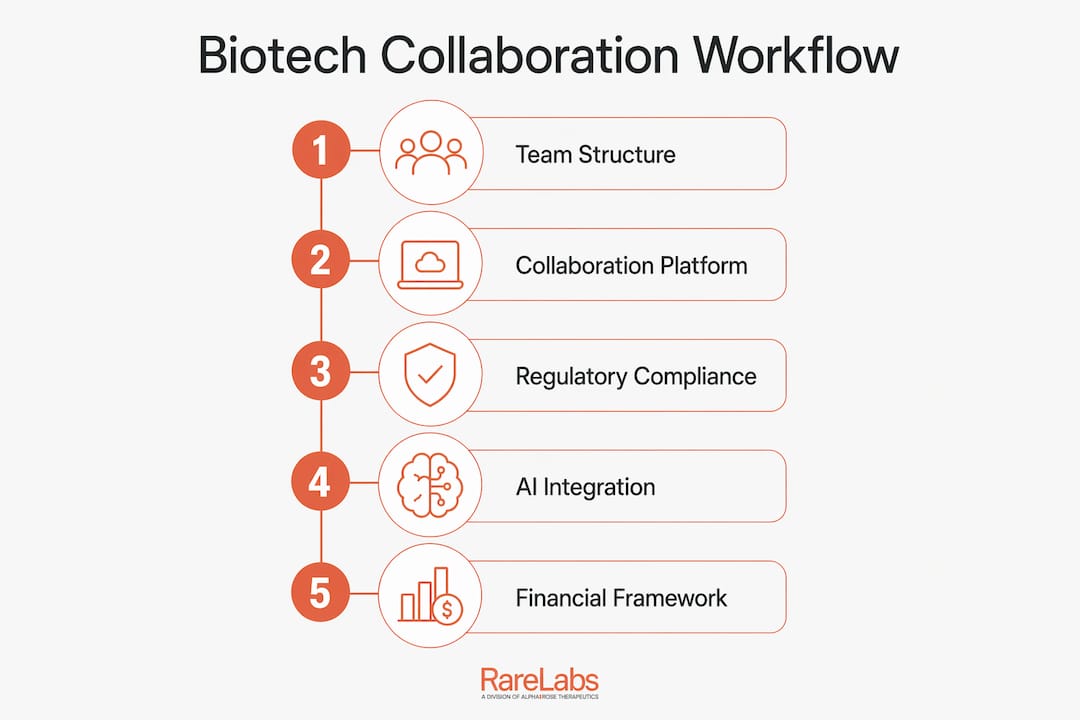
A successful biotech collaboration workflow requires five foundational elements working in parallel, not in sequence. Missing any one of them creates bottlenecks that compound over time.
Multidisciplinary team structure is the first requirement. Biology, bioinformatics, process development, and manufacturing teams must operate under a shared project plan from day one. Siloed handoffs between these groups are the primary cause of rework and schedule slippage.

Workflow-native collaboration platforms replace fragmented email chains and disconnected portals. High-performing biotech teams use platforms that integrate ordering, experiment tracking, and data return directly into electronic lab notebooks. That integration eliminates manual data re-entry and the errors that come with it.
Regulatory traceability and quality risk management must be embedded in the workflow architecture, not added at the end. ISPE recommends governance frameworks that span from conceptual design through commercialization. Traceability built in from the start satisfies regulatory requirements without creating separate documentation burdens.
AI-enabled scientific workflows with human oversight are now a practical requirement for competitive programs. Expert scientific methods can be codified into AI-executed processes with human-in-the-loop checkpoints, reducing variability in target assessments and dossier generation. Human oversight at defined checkpoints keeps the science governed.
Financial and contractual structures complete the foundation. Strategic R&D collaborations routinely involve upfront payments near $40 million and milestone potentials exceeding $1.4 billion. Those figures reflect how seriously leading organizations treat the contractual scaffolding around collaboration.
| Component | Function | Risk if absent |
|---|---|---|
| Multidisciplinary team structure | Aligns biology, bioinformatics, manufacturing | Siloed handoffs, rework |
| Workflow-native platform | Integrates ordering, tracking, lab notebooks | Data errors, communication gaps |
| Regulatory traceability | Embeds quality milestones in workflow | Compliance failures, audit risk |
| AI with human oversight | Standardizes repeatable scientific processes | Inconsistent outputs, variability |
| Financial/contractual framework | Governs milestones and partner obligations | Misaligned incentives, delays |
Pro Tip: Before selecting a collaboration platform, map every data handoff point in your current workflow. Any platform that cannot automate those handoffs natively will recreate the same fragmentation you are trying to eliminate.
How to operationalize an orchestrated biotech collaboration workflow
Translating a high-level scientific contract into daily executable tasks is where most programs fail. Biotech project management requires converting ambiguous statements of work into granular operational plans that every team member can act on. Abstract milestones do not drive delivery. Precise task assignments with owners and deadlines do.
Follow these steps to build an orchestrated workflow from contract to GMP production:
-
Decompose the SOW into operational tasks. Take each scientific deliverable in the statement of work and break it into daily or weekly tasks with named owners. A milestone labeled "cell line development complete" becomes a sequence of specific assays, passage schedules, and data review gates.
-
Build a joint milestone plan spanning all teams. Map cell line development, process development, analytical method qualification, and GMP production onto a single shared timeline. Every team sees every dependency. No team operates in isolation.
-
Run parallel workflows to compress time. The Pool-to-Tox and Tox-to-GMP workflow model runs manufacturing preparation activities in parallel with toxicology studies rather than waiting for tox completion. Moving beyond sequential handoff models to integrated orchestrated teams minimizes rework and cuts schedule time significantly.
-
Conduct mock technology transfers early. Technology transfer is the riskiest phase for data integrity and timeline delays. Early mock transfers and integrated quality systems applied before the actual transfer reduce costly rework and protect schedule integrity. Run a mock transfer at 60% completion, not at 95%.
-
Integrate quality systems across all teams. Quality risk management cannot live in a separate QA silo. Embed quality checkpoints into the shared project plan so that process development and manufacturing teams are reviewing quality data in real time, not after the fact.
-
Deploy AI-driven agentic workflows for repeatable processes. Target assessment, literature review, and dossier generation are repeatable processes that benefit from AI execution. Human experts define the method once, and the system executes it consistently across programs. This is how life sciences collaboration scales without proportional headcount growth.
The comparison below shows the difference between a traditional sequential model and an orchestrated parallel model:
| Dimension | Sequential model | Orchestrated parallel model |
|---|---|---|
| Team structure | Siloed by function | Integrated across functions |
| Milestone visibility | Function-level only | Shared across all teams |
| Technology transfer | Planned at end of development | Mock transfers run at midpoint |
| Quality integration | Separate QA review cycle | Embedded in shared project plan |
| Timeline | 14–18 months typical | Approximately 8.5 months achievable |
Pro Tip: Schedule a cross-functional milestone review every two weeks from day one. Teams that wait for monthly reviews discover dependency conflicts too late to recover the schedule.
What challenges commonly arise in biotech collaboration workflows?
The most damaging problems in cross-disciplinary biotech partnerships are not scientific. They are organizational. Communication fragmentation, data integrity gaps, and misaligned partner milestones cause more program failures than failed experiments.
Key challenges and their mitigations:
- Technology transfer failures. Data packages that are incomplete or formatted inconsistently cause receiving teams to repeat work already done. Early mock transfers and standardized data templates prevent this.
- Fragmented communication. Email threads and disconnected portals create version control problems and decision delays. Workflow-native platforms that unify ordering, experiment tracking, and data linkage directly in scientific workflows eliminate this fragmentation.
- Governance gaps. Without centralized project governance, partner milestones drift and resource conflicts go unresolved. Integrated project management with a single source of truth for all teams is the fix.
- AI workflow risks. Automated agentic workflows can propagate errors at scale if human checkpoints are absent. Governing AI outputs at defined review gates keeps scientific quality intact.
- Resource dependency mismanagement. When one team's output is another team's input, unplanned delays cascade. Proactive resource mapping and weekly dependency reviews catch these conflicts before they become critical path issues.
"Successful regulated pharmaceutical project management integrates scheduling with quality risk management and traceability from early phases through commercialization." — ISPE
Continuous risk assessment is not a project close-out activity. It belongs in every sprint review and milestone gate. Teams that treat risk management as a periodic audit rather than a daily practice consistently miss their schedules. For teams working on collaborative rare disease trials, where patient urgency is highest, this discipline is non-negotiable.
Pro Tip: Maintain a live risk register shared across all partner teams. Any team member should be able to log a risk in under two minutes. Friction in risk reporting means risks go unreported until they become crises.
What tools and technologies best support biotech collaboration workflows?
The right technology stack for biotechnology workflow optimization has three layers: orchestration, integration, and automation. Each layer serves a distinct function.
Orchestration platforms manage multi-agent AI workflows with governed human oversight. They allow scientific teams to define expert methods once and execute them consistently across programs. This is the layer where AI and robotic automation accelerate drug discovery by enabling systematic target prioritization and candidate optimization. Combining AI-powered discovery with clinical domain expertise allows development of therapies for complex diseases more efficiently than traditional methods.
Integration platforms connect electronic lab notebooks, ordering systems, and experiment tracking into a single data environment. Researchers working on drug screening workflows benefit directly from platforms where a single click triggers ordering, logs the request in the lab notebook, and links results back to the originating experiment automatically.
Visualization and project mapping tools give project managers real-time visibility into milestone status and team dependencies. Without this layer, project managers are managing from memory and status emails rather than live data.
| Technology layer | Primary function | Key capability |
|---|---|---|
| Orchestration platform | Governs AI and human workflows | Codifies expert methods into repeatable processes |
| Integration platform | Unifies lab notebooks, ordering, tracking | Eliminates manual data re-entry |
| Visualization tools | Maps milestones and dependencies | Provides real-time schedule visibility |
| AI discovery engine | Accelerates target and candidate identification | Combines domain expertise with machine learning |
| Quality management system | Embeds traceability in workflow | Supports regulatory compliance from day one |
Emerging AI-driven clinical integration tools are beginning to connect discovery-phase data with clinical decision support, shortening the gap between preclinical findings and trial design. For genetic disease therapy programs, that connection is particularly valuable because patient populations are small and every data point carries more weight.
Platforms that cannot integrate across all three layers force teams to manage data manually between systems. That manual work is where errors enter and timelines slip. The standard for 2026 is full integration, not best-of-breed tools that do not communicate.
Key takeaways
An orchestrated biotech collaboration workflow is the single most effective way to compress drug development timelines and reduce rework across multidisciplinary teams.
| Point | Details |
|---|---|
| Orchestrated workflows compress timelines | Integrated team models reduce DNA-to-GMP timelines to approximately 8.5 months. |
| Workflow-native platforms eliminate fragmentation | Platforms unifying ordering, tracking, and lab notebooks remove manual data errors. |
| Mock technology transfers prevent rework | Running mock transfers at midpoint catches data integrity issues before they cascade. |
| AI workflows require human checkpoints | Governed AI execution with expert review gates maintains scientific quality at scale. |
| Governance must be embedded, not added | Quality risk management and traceability built into the workflow from day one prevent compliance failures. |
What I have learned from watching orchestrated workflows succeed and fail
The most common mistake I see biotech project managers make is treating the collaboration workflow as a project management problem rather than a scientific governance problem. They build beautiful Gantt charts and then watch them collapse at the first technology transfer because the quality systems were never integrated into the plan.
The teams that consistently hit their milestones share one habit: they treat the workflow as a living document that every team member owns, not a plan that the project manager maintains alone. When a process development scientist can see that their cell line yield data feeds directly into the manufacturing team's GMP readiness gate, they understand the stakes of their own timeline. That visibility changes behavior.
I am genuinely optimistic about agentic AI in scientific workflows, but I am cautious about teams that deploy it without defining the human review gates first. The efficiency gains are real. The risk of propagating a systematic error across hundreds of automated analyses is equally real. The organizations getting this right are the ones that codify their best scientists' methods before automating them, not after.
The shift from siloed stages to fully integrated team models is the most significant structural change in life sciences collaboration I have observed in the past decade. It is not a technology change. It is a governance change that technology enables. Teams that understand that distinction build workflows that last. Teams that treat it as a software procurement decision rebuild their workflows every two years.
— John
Hopeatrarelabs and the science of working together
Hopeatrarelabs operates at the intersection of patient urgency and scientific rigor, where collaboration workflows are not abstract best practices. They are the mechanism by which a child with an undiagnosed genetic disease gets a treatment option faster.
The RareLabs Knowledge platform supports researchers and project managers working on rare disease programs by centralizing curated research, treatment data, and disease modeling insights in one accessible environment. For teams coordinating iPSC modeling, CRISPR gene editing, and parallel drug screens across FDA-approved compounds and custom ASOs, having a unified knowledge resource reduces the time spent searching and increases the time spent deciding. Hopeatrarelabs also provides quality assurance guidance relevant to teams managing compliance across development and manufacturing phases.
FAQ
What is a biotech collaboration workflow?
A biotech collaboration workflow is an integrated system that coordinates multidisciplinary teams, data exchange, and quality milestones across the full drug development lifecycle. Orchestrated frameworks using this approach have reduced DNA-to-GMP timelines to approximately 8.5 months.
How does AI fit into a biotech collaboration workflow?
AI executes repeatable scientific processes such as target assessment and literature review, while human experts define the methods and review outputs at governed checkpoints. This combination reduces variability without removing scientific oversight.
What is the biggest risk in cross-disciplinary biotech partnerships?
Technology transfer is the riskiest phase for data integrity and timeline delays. Running mock technology transfers at the midpoint of development, rather than at the end, is the most effective way to prevent costly rework.
Why do sequential handoff models fail in drug development?
Sequential models create delays because each team waits for the previous team to finish before starting. Integrated orchestrated models run parallel workflows, share milestones across all teams, and catch dependency conflicts before they become critical path problems.
How does Hopeatrarelabs support biotech collaboration for rare disease programs?
Hopeatrarelabs provides patient-specific disease modeling using iPSCs and CRISPR gene editing, combined with parallel treatment screens across thousands of compounds. The RareLabs Knowledge platform centralizes research and treatment data to support coordinated decision-making across research teams.