

To cure a disease means to permanently or durably resolve its underlying cause or clinically relevant effects so the condition no longer requires ongoing therapy. That is the clinical definition, and it is narrower than most people expect.
Here is the short version of what separates a cure from related terms:
- Cure: The disease cause is eliminated or controlled so completely that no further treatment is needed and the condition does not return.
- Treatment: Manages symptoms or slows progression but does not resolve the underlying cause. Most therapies fall here.
- Remission: Disease activity drops to undetectable or clinically insignificant levels, but the underlying cause may still be present and monitoring continues.
- Recovery: The patient returns to normal function, which can happen with or without a true cure (a broken bone heals; the flu resolves).
Three examples that illustrate the range: smallpox was eradicated globally through vaccination, meaning the pathogen no longer exists in nature. Hepatitis C can now be eliminated from the body in most patients using direct-acting antivirals, a genuine sterilizing cure for the virus. Sickle cell disease has been functionally cured in individual patients through gene-edited autologous stem cell transplants, where the patient's own cells are corrected and returned.
Table of Contents
- What does "cured" actually mean in clinical terms?
- How do sterilizing, functional, and partial cures differ?
- What diseases have been cured or functionally cured?
- How does a potential cure go from lab to approved therapy?
- Why do so many diseases remain incurable?
- How can you tell if a "cure" claim is real?
- Where does cure research stand right now?
- How Hopeatrarelabs approaches curative strategies for ultra-rare diseases
- Key Takeaways
- Why cure-focused research is the only honest priority for rare diseases
- Hopeatrarelabs: personalized disease modeling for ultra-rare conditions
- Useful sources
What does "cured" actually mean in clinical terms?
The word "cure" carries more precision in medicine than it does in everyday speech. According to Wikipedia's clinical overview, a cure resolves a medical condition so it is gone and will not return, while a functional cure reduces disease to undetectable levels and permits immune control without lifelong therapy. Those two definitions do a lot of work in research papers and press releases, and conflating them is one of the most common ways patients and journalists misread trial results.
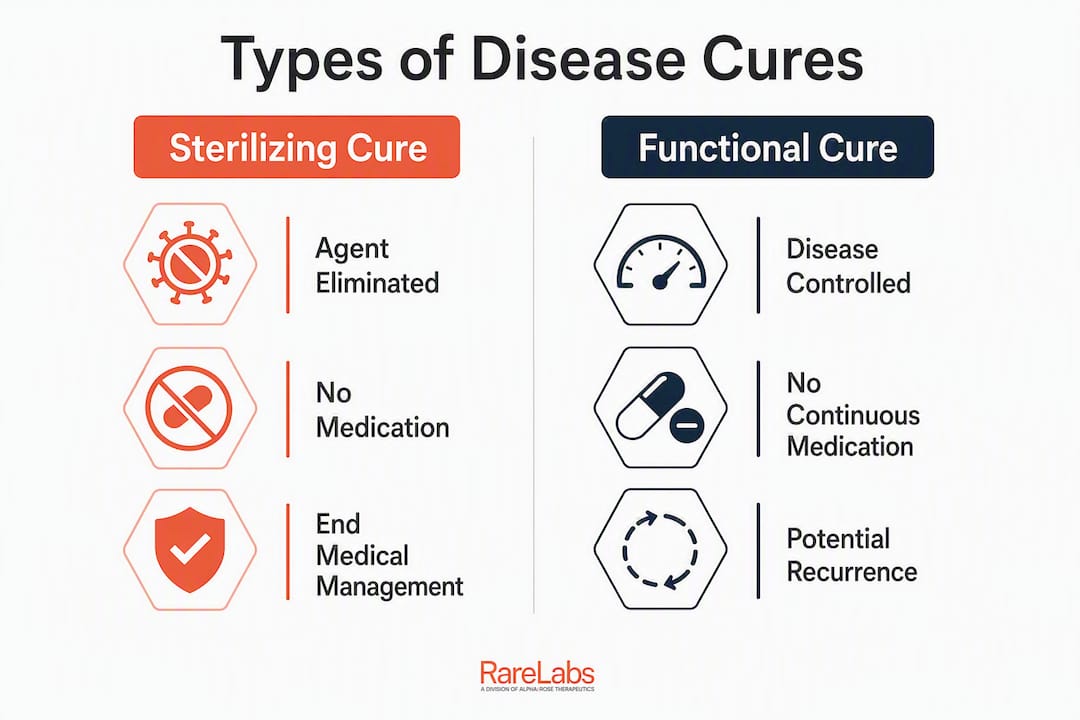
Sterilizing cure means the causative agent or pathological process is completely eliminated. No virus, no mutant cells, no ongoing pathology. Hepatitis C treated with direct-acting antivirals is the clearest modern example.
Functional cure means the disease is controlled to a clinically meaningful degree without continuous medication, but the underlying cause may still be present at low levels. The immune system, or the therapy's lasting effect, keeps it in check. Periodic monitoring is still required because rebound is possible.
Cure fraction (cure rate) is a statistical concept. It refers to the proportion of a treated population that achieves long-term disease-free survival, typically modeled using Kaplan–Meier survival curves and mixture-cure models. A study might report a 60% cure fraction, meaning 60% of patients show no evidence of disease at the end of a defined follow-up period.
Durable response is a softer term used when sustained benefit is observed but the follow-up period is not yet long enough to claim cure confidently.
Disease-free survival (DFS) is the endpoint most commonly used to operationalize cure in oncology trials. It measures the time from treatment to disease recurrence or death. The longer the DFS plateau on a Kaplan–Meier curve, the stronger the argument that a cure fraction exists.
"Cure is often misused; effective permanent benefit for a subset of patients can qualify a therapy as curative, which is why distinctions like sterilizing versus functional cures are critical." — Synthesized from clinical cure literature
At the population level, the World Health Organization uses a different standard entirely. WHO defines eradication as the permanent worldwide reduction of a disease's incidence to zero through deliberate efforts, with no further control measures required. Smallpox met that bar in 1980. Individual clinical cure and population-level eradication are related concepts but require completely different evidence and infrastructure.
How do sterilizing, functional, and partial cures differ?
Understanding the biological meaning behind each cure type changes how you read a headline.
- Sterilizing cure: The pathogen or pathological agent is completely eliminated from the body. No residual disease, no ongoing immune surveillance required beyond standard follow-up. Hepatitis C treated with direct-acting antivirals achieves this for the virus itself in the majority of treated patients.
- Functional cure: The disease is controlled durably without continuous therapy, but the causal agent may persist at very low levels. The patient's immune system or the therapy's lasting effect maintains that control. Hepatitis B functional cure is the active research target here. A functional cure does not eliminate the need for periodic monitoring because rebound remains possible.
- Partial or conditional cure: A meaningful, durable benefit is achieved in a defined subgroup, typically patients who meet specific biomarker criteria at baseline. The therapy works as a cure for that subgroup but not across the full disease population. This is common in oncology, where a subset of patients with a specific mutation achieves long-term disease-free survival while others do not.
- Durable remission (sometimes called a practical cure): Disease activity is undetectable and the patient is off therapy, but the scientific community has not yet accumulated enough follow-up data to formally claim cure. Many early gene-therapy results sit in this category.
The clinical consequences differ sharply. A sterilizing cure ends medical management for that condition. A functional cure replaces daily medication with periodic monitoring. A partial cure demands careful patient selection and honest communication about who benefits. Conflating these categories is how a 26% response rate in a biomarker-selected subgroup becomes a misleading "breakthrough cure" headline.
What diseases have been cured or functionally cured?
Smallpox: the only human disease fully eradicated
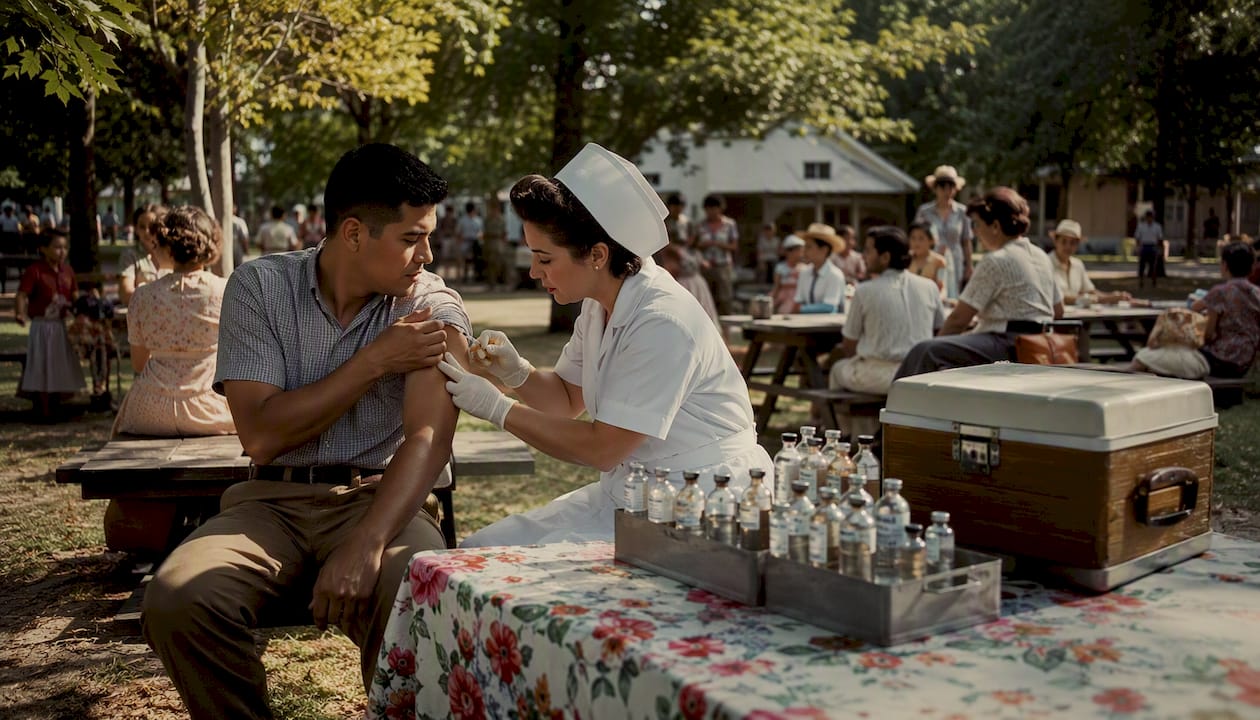
Smallpox is the benchmark. The WHO declared its eradication in 1980 after a coordinated global vaccination campaign. No natural cases have occurred since. Eradication required a vaccine that produced sterilizing immunity, a pathogen with no animal reservoir, and decades of public health infrastructure. The bar it set has not been cleared by any other human disease since, though polio is close.
Hepatitis C: a model for antiviral curative therapy
Direct-acting antivirals transformed hepatitis C from a chronic, progressive liver disease into a curable infection for most patients. Sustained virologic response at 12 weeks post-treatment (SVR12) is the accepted endpoint for cure, meaning the virus is undetectable 12 weeks after stopping therapy. SVR12 rates above 95% are now routine across major genotypes. This is the clearest modern example of a sterilizing cure achieved through pharmacological intervention rather than surgery or gene editing.
Hepatitis B: functional cure as the active frontier
Hepatitis B is harder. The virus integrates into host DNA, which means complete elimination is not yet achievable with current tools. The research target is a functional cure: loss of hepatitis B surface antigen (HBsAg) and sustained immune control off therapy. A Phase III trial of bepirovirsen added to standard therapy achieved a functional cure rate of approximately 19% overall, and about 26% in the subgroup with the lowest baseline surface antigen levels. These rates are based on a large international trial of 1,838 adults. Baseline biomarker status predicts who benefits most, a pattern that appears across many curative trials.
"A new breakthrough offers hope for a functional cure of hepatitis B — but the results show that who you are at baseline shapes whether you respond." — National Geographic Health
Sickle cell disease: gene therapy producing functional cure
A patient treated at Tulane Medical Center became one of the first in the Gulf South to achieve a functional cure for sickle cell disease through autologous gene-edited stem cell transplantation. The process involved extracting the patient's own stem cells, shipping them to Scotland for CRISPR-based editing, returning them after conditioning chemotherapy, and monitoring for engraftment and functional correction. The complexity of that workflow illustrates why personalized gene therapies are both promising and logistically demanding.

Huntington's disease: early gene therapy results
UniQure's gene therapy for Huntington's disease reported slowing disease progression in early trial data covering 29 patients, using a viral vector delivered through targeted neurosurgery. The BBC's reporting on the trial noted that the procedure is invasive and that long-term durability data are still accumulating. This is not yet a cure, but it represents the first time a therapy has meaningfully altered Huntington's trajectory. The distinction between a dramatic early result and a confirmed durable cure is exactly where patients and families need to be careful.
Regulators at the FDA and WHO do not accept curative labeling based on short-term data alone. Long-term follow-up, population-level evidence, and validated endpoints are required before a therapy earns that designation in approved labeling.
How does a potential cure go from lab to approved therapy?
The path from a promising laboratory finding to a therapy that carries regulatory approval and a curative claim is long, expensive, and attrition-heavy. Understanding each stage helps you judge where a reported "breakthrough" actually sits.
The development pipeline
- Discovery and target identification: Researchers identify a biological target (a gene, protein, or pathway) whose modification could resolve the disease. Most candidates fail here.
- Preclinical studies: The candidate is tested in cell models and animal models. Efficacy, safety, and dosing are characterized. Induced pluripotent stem cell (iPSC) models and CRISPR-edited isogenic controls are increasingly used at this stage to create more accurate human disease models.
- IND-enabling studies: An Investigational New Drug application is submitted to the FDA. This requires toxicology, pharmacokinetics, and manufacturing data sufficient to justify first-in-human testing.
- Phase 1 clinical trial: Safety and dosing in a small number of patients (typically 20–80). Not designed to prove efficacy.
- Phase 2 clinical trial: Efficacy signals and dose optimization in a larger cohort (typically 100–300 patients). Endpoints begin to include disease-relevant biomarkers.
- Phase 3 clinical trial: Definitive efficacy and safety in a large, randomized controlled trial. This is where cure-relevant endpoints (DFS, SVR12, HBsAg loss) are formally tested.
- Regulatory review and approval: The FDA reviews the full data package. For curative claims, long-term follow-up data and validated endpoints are required. Breakthrough Therapy and Accelerated Approval designations can shorten this timeline for serious conditions with unmet need.
- Post-approval surveillance: Phase 4 studies and registry data confirm that the therapy's curative effect holds in the broader real-world population, not just the trial cohort.
Clinical trial phases and what they tell you about cure potential
| Phase | Primary question | Typical size | Cure-relevant signal |
|---|---|---|---|
| Phase 1 | Is it safe? | 20–80 patients | Minimal — safety and dosing only |
| Phase 2 | Does it work? | 100–300 patients | Early efficacy; biomarker endpoints |
| Phase 3 | How well does it work vs. standard care? | 100–300 patients | Definitive cure endpoints (DFS, SVR12, antigen loss) |
| Phase 4 | Does it hold in the real world? | Thousands | Durability and long-term follow-up |
Pro Tip: When you read about a "cure" in a press release, check which phase the trial was in. A Phase 1 safety result with a few patients showing biomarker improvement is not evidence of a cure. A Phase 3 result with validated endpoints and 12+ months of follow-up is.
The genetic disease research process for ultra-rare conditions often diverges from this standard pipeline because the patient populations are too small for conventional Phase 3 trials. Adaptive trial designs, natural history studies, and n-of-1 approaches are increasingly used to generate the evidence regulators need.
Baseline biomarker status shapes outcomes in ways that aggregate trial results can obscure. Functional-cure trials commonly enroll patients based on biomarker baselines, and the reported cure rate in the full trial population may be substantially lower than the rate in the biomarker-favorable subgroup. Always ask which population the reported percentage applies to.
Why do so many diseases remain incurable?
The honest answer is that curing a disease is harder than treating it, and the gap between those two goals is wider than most people realize.
Scientific complexity
Many diseases do not have a single, fixed target. Cancer is not one disease. Alzheimer's involves multiple interacting pathologies. HIV integrates into resting T cells where the immune system cannot see it. Latent viral reservoirs, genetic heterogeneity across patients, and the ability of some pathogens to mutate faster than therapies can track them all create fundamental scientific barriers that no amount of funding alone resolves.
"The shift from broad, non-targeted treatments to targeted therapies — monoclonal antibodies or gene editing — represents a major frontier for converting previously incurable diseases into potentially curable ones." — New Scientist
Delivery and manufacturing
Getting a therapeutic payload to the right cells is often the hardest engineering problem in medicine. The blood–brain barrier blocks most large molecules from reaching the central nervous system, which is why Huntington's gene therapy required direct neurosurgical injection. Targeted delivery for liver diseases is comparatively easier, which partly explains why hepatitis C and B have seen more curative progress than neurological diseases. For rare genetic diseases, manufacturing patient-specific products at scale adds another layer of complexity. Each patient's cells must be harvested, modified, quality-tested, and returned, a process that currently takes months and costs millions.
Economic and access barriers
The MIT NEWDIGS program has analyzed the financing challenge of curative gene therapies, noting that one-time high-cost treatments create payment model mismatches that current insurance structures were not designed to handle. A therapy that cures a disease in a single administration may cost more upfront than years of chronic disease management, even if it is cost-effective over a lifetime. For ultra-rare diseases affecting hundreds or thousands of patients globally, the commercial market is too small to recover development costs through standard pricing, which is why most ultra-rare disease programs depend on foundation funding, advocacy groups, or academic-industry partnerships to reach patients at all.
Regulatory and evidence requirements
Proving durability takes time. A therapy that looks curative at 12 months may show recurrence at 36 months. Regulators require follow-up periods that match the biology of the disease, and for conditions where natural history data are sparse (as in ultra-rare genetic diseases), even defining what "cured" looks like is a scientific challenge before it becomes a regulatory one.
How can you tell if a "cure" claim is real?
Media coverage of disease cures is often premature. Here is what to look for before accepting a claim at face value.
Evidence to seek:
- Peer-reviewed publication: Has the data been published in a journal with independent peer review? A press release is not evidence.
- Trial phase and size: Phase 3 trials with hundreds of patients carry far more weight than Phase 1 or 2 results with dozens.
- Follow-up duration: Twelve months of follow-up is a minimum for most curative claims. Neurological and genetic diseases often require three to five years.
- Validated endpoints: Disease-free survival, sustained virologic response, and antigen loss are validated. "Improvement in biomarker X" is not the same as cure.
- Independent replication: Has another research group confirmed the result in a separate cohort?
- Regulatory submission or approval: Has the FDA reviewed the data? Approved labeling with curative language is the highest bar.
Red flags:
- A single press release with no accompanying data or preprint.
- Surrogate endpoints (a lab value improved) presented as proof of cure without clinical outcome data.
- A cohort of fewer than 20 patients with short follow-up.
- No mention of which patients were eligible for the trial (biomarker selection can inflate reported rates dramatically).
- Claims of "100% response" in very small, highly selected groups.
Where to verify:
- PubMed/NCBI for peer-reviewed publications on specific diseases and therapies.
- ClinicalTrials.gov for trial registration, phase, endpoints, and enrollment criteria.
- The FDA's public database for approved indications and label language.
- The WHO's disease elimination and eradication tracking for population-level claims.
Where does cure research stand right now?
The most realistic near-term prospects for new disease cures fall into three areas.
Infectious disease functional cures are the most advanced. Hepatitis B is the primary target, with multiple antisense oligonucleotide and RNA interference programs in late-stage trials alongside bepirovirsen. The goal is durable HBsAg loss off therapy. HIV functional cure research is active but further behind, complicated by the latent reservoir problem.
Gene therapies for select genetic diseases are moving from early proof-of-concept to broader access. Sickle cell disease now has FDA-approved gene therapies. Beta-thalassemia, certain forms of inherited blindness, and some lysosomal storage disorders have approved or late-stage gene therapies. The gene therapy options for ultra-rare diseases are expanding, but delivery, manufacturing, and cost remain the primary constraints on how quickly these reach patients.
Targeted immune modulation is producing results in previously untreatable conditions. A monoclonal antibody called tanruprubart, which targets the complement protein C1q, showed clinically meaningful reductions in ventilation time and ICU stay in a late-stage trial for Guillain–Barré syndrome. This is not a cure in the strict sense, but it represents the kind of targeted mechanistic intervention that, in other diseases, has eventually led to curative approaches.
"The decade of disease elimination is underway — but the gap between population-level ambition and individual patient access remains the defining challenge." — World Health Organization
The realistic timeline from a late-stage positive trial to real-world patient access in the United States is typically three to seven years for standard diseases, longer for ultra-rare conditions where manufacturing scale-up and payer negotiations add time. Rare-disease pathways under FDA's Orphan Drug designation can compress regulatory review, but the manufacturing and access challenges do not compress proportionally.
Near-term research trends that are likely to shape the next generation of curative therapies include combination approaches (pairing antiviral agents with immune modulators), biomarker-driven patient selection to concentrate curative benefit in the patients most likely to respond, improved lipid nanoparticle and viral vector delivery technologies, and expanded use of patient-specific disease modeling to identify candidates before expensive clinical trials.
How Hopeatrarelabs approaches curative strategies for ultra-rare diseases
For the vast majority of ultra-rare and undiagnosed genetic diseases, no approved therapy exists. The standard clinical pipeline was not designed for conditions affecting hundreds or thousands of patients globally. Hopeatrarelabs works in exactly that gap, using patient-specific disease models to identify potential curative strategies before committing to expensive clinical programs.
The process works like this:
- Patient sample to iPSC model: A patient's own cells are reprogrammed into induced pluripotent stem cells, which are then differentiated into the disease-relevant cell type. This creates a living model of the patient's specific disease, not a generic approximation.
- CRISPR isogenic controls: Gene-edited versions of the same cell line, with the mutation corrected, serve as controls. This isolates the effect of the specific mutation from background genetic variation.
- High-throughput repurposing screens: Thousands of FDA-approved drugs are tested against the patient's disease model. Repurposed drugs can reach patients faster because their safety profiles are already established.
- Custom ASO and gene therapy feasibility: Where repurposed drugs do not produce a meaningful signal, Hopeatrarelabs evaluates custom antisense oligonucleotides and gene therapy approaches for feasibility, including delivery mechanism and manufacturing considerations.
What families and clinicians can expect from a Hopeatrarelabs program: a detailed disease model, a ranked list of candidate therapies with supporting data, and translational support for the next steps, whether that means working with a treating physician to access a repurposed drug off-label, connecting with a gene therapy program, or generating data for a regulatory submission. Timelines vary by disease complexity, but most programs produce initial screening results within months rather than years.
Personalized research accelerates cures for rare diseases precisely because it de-risks the translational steps that most programs fail at: identifying the right target, in the right cell type, for the right patient.
The honest limits: patient-specific modeling identifies candidates, it does not guarantee clinical success. Manufacturing, regulatory, and access challenges remain real even when a strong candidate is found. Hopeatrarelabs is transparent about this from the first conversation.
Key Takeaways
Curing a disease requires permanently or durably resolving its underlying cause, a standard that most therapies do not meet, but that gene editing, targeted antivirals, and immune modulation are increasingly achieving for specific conditions.
| Point | Details |
|---|---|
| Cure vs. treatment | A cure resolves the disease cause durably; treatment manages symptoms without resolving the underlying pathology. |
| Two main cure types | Sterilizing cures eliminate the pathogen entirely; functional cures achieve durable control without ongoing therapy but require monitoring. |
| Evaluating claims | Look for Phase 3 peer-reviewed data, validated endpoints, and at least 12 months of follow-up before accepting a curative claim. |
| Development timeline | Standard therapies take years from late-stage trial to patient access; rare-disease pathways often take longer due to manufacturing and payer challenges. |
| Hopeatrarelabs | Offers patient-specific iPSC disease modeling, drug repurposing screens, and ASO/gene therapy feasibility assessment for ultra-rare diseases with no approved treatment. |
Why cure-focused research is the only honest priority for rare diseases
The conventional wisdom in rare disease medicine is that management is the goal and cure is the aspiration. That framing has done real harm. It has kept research programs focused on symptom control for conditions where the biology of a curative approach is actually within reach, if someone is willing to do the harder translational work.
What most people underestimate about disease curing is how much of the gap between "promising preclinical result" and "patient with a functioning therapy" is not scientific. It is logistical, financial, and organizational. The science of gene editing, antisense oligonucleotides, and iPSC modeling has moved faster than the infrastructure to deploy it. Families with children who have ultra-rare diseases are not waiting for a discovery. They are waiting for someone to do the work of translating a discovery that already exists into something their child's physician can actually use.
The other thing worth saying plainly: functional cure is not a consolation prize. For a patient with a progressive, fatal genetic disease, durable control without daily medication and without disease progression is a profound clinical outcome. The distinction between sterilizing and functional cure matters for scientific accuracy, but it should not be used to dismiss results that genuinely change lives.
The urgency is real. For many ultra-rare diseases, the window for intervention is narrow, and the number of patients is too small to wait for a conventional clinical trial to run its course. Patient-specific modeling, done rigorously and transparently, is the most direct path from a genetic diagnosis to a testable therapeutic hypothesis. That is not a marketing claim. It is what the biology of these diseases demands.
Hopeatrarelabs: personalized disease modeling for ultra-rare conditions
For families and clinicians facing an ultra-rare genetic disease with no approved treatment, the standard research pipeline offers little. Hopeatrarelabs provides a direct alternative: a contracted disease modeling and treatment discovery program built around the patient's own cells.
Services include iPSC-based disease modeling, CRISPR isogenic controls, high-throughput repurposed drug screening across thousands of FDA-approved compounds, custom ASO development, and gene therapy feasibility assessment. Programs are contracted by patients, families, foundations, advocacy groups, and biopharma partners. The starting point is a conversation about the specific disease, the genetic diagnosis, and what data already exists.
Outcomes are honest: not every program produces a curative candidate, but every program produces data. Initial screening results typically arrive within months. Translational support continues through the next steps, whether that means a physician-guided off-label trial, a connection to a gene therapy program, or data for a regulatory pathway.
Explore the RareLabs knowledge hub to search existing research, find relevant trials, and understand what a personalized program involves before committing. If your situation calls for a direct conversation, the contact path starts there.
Useful sources
- Assessing potential cures: distinctive elements of curative therapies (PMC/NCBI) — Peer-reviewed framework for what distinguishes a curative therapy from a disease-modifying one; supports the definition and evaluation sections.
- Cure — Wikipedia — Definitional overview of cure, cure fraction, disease-free survival, and statistical cure models; used in the definition section.
- Hepatitis B functional cure breakthrough — National Geographic — Phase III bepirovirsen data: 19% overall functional cure rate, 26% in lowest-antigen subgroup.
- Sickle cell gene therapy in the Gulf South — Tulane University — Case report of autologous gene-edited stem cell functional cure; illustrates the translational pipeline.
- Huntington's gene therapy results — BBC — UniQure trial data showing approximately 75% slowing of progression in 29 patients; supports the gene therapy examples section.
- Guillain–Barré targeted therapy — New Scientist — Late-stage trial results for tanruprubart; illustrates targeted immune modulation as a frontier for curative approaches.
- MIT NEWDIGS gene therapy financing brief — Analysis of payment model challenges for one-time curative gene therapies; supports the economic barriers section.
- WHO disease elimination decade — WHO framing of population-level disease elimination goals; supports the eradication context.
- PubMed — Journal of Comparative Effectiveness Research — Peer-reviewed source for clinical evidence standards; supports the how-to-evaluate-claims section.
- RareLabs knowledge hub — Starting point for families and clinicians seeking research, trial matches, and information about personalized rare disease programs.
This article provides general scientific and medical information for educational purposes. It is not a substitute for professional medical advice. Consult a qualified clinician or genetic specialist to evaluate specific therapeutic options for your situation.