
Authenticate every human cell line with short tandem repeat (STR) profiling covering at least 13 loci plus amelogenin, matched against a reference database at roughly an 80% threshold. Pair that with routine mycoplasma screening. Test new cultures on receipt, retest periodically during extended passage, and confirm identity again before you submit for publication. Skip any leg of that cycle and you're gambling with months of experimental work.
TL;DR:
- Authenticating human cell lines involves STR profiling of at least 13 loci and regular mycoplasma screening to prevent unnoticed contamination.
- Misidentified or contaminated cell lines occur in up to 36% of cases and can invalidate published research or mislead drug development.
- For accurate verification, send samples for external testing when laboratories lack in-house capabilities, especially for high-throughput or rare samples.
- Routine retesting after extended culture, prior to experiments, and before publication reduces genetic drift and contamination-related errors.
- Accurate records and immediate testing of new or recovered lines can prevent years of resource waste and publication retractions.
Table of Contents
- What Is Cell Line Authentication and Why Does It Matter?
- Which Tests Should You Run on a New Cell Line?
- How Does STR Profiling Actually Verify Cell Identity?
- What Are the Best Mycoplasma Detection Methods?
- When Should You Authenticate a Cell Line?
- How Do You Compare STR Results Against Reference Databases?
- What Belongs in a Credible Authentication Report?
- How RareLabs Builds Authentication Into Patient-Derived Models
- What Causes Cell Line Misidentification and What Does It Cost?
- What Are the Alternatives to STR Profiling?
- How Can Labs Prevent Cross-Contamination?
- What Do Journals and Funders Require for Authentication?
- What Have Real Authentication Failures Cost Research Labs?
- Three Things Every Lab Should Do This Week
- Consider RareLabs When Verified Modeling Is the Bottleneck
- Sources
What Is Cell Line Authentication and Why Does It Matter?
Cell line authentication is the process of confirming that the cells in your flask are genuinely what your records say they are, and that they're free of the microbial contamination that quietly corrupts experiments. It sounds like a formality until you look at the numbers: independent estimates put the rate of misidentified or cross-contaminated cell lines somewhere between 17% and 36%, and misidentified lines have been linked to invalidating a meaningful share of published findings in affected fields.
The practice rests on two pillars. First, cell line verification through STR profiling, which acts as a genetic fingerprint unique to the donor. Second, mycoplasma detection, since mycoplasma contamination is invisible under a standard microscope and can silently reshape everything from growth rate to gene expression. Neither check substitutes for the other. A line can be genetically authentic and still be mycoplasma-positive, or mycoplasma-free and still be the wrong cell line entirely. Treat them as two separate, mandatory gates.
Which Tests Should You Run on a New Cell Line?
Before you commit weeks of culture time to a line, run through a short sequence of checks. Some take five minutes under a scope; others require sending samples out.
- Morphology and growth-curve review: Compare cell shape, doubling time, and confluence behavior against the line's published profile. A line growing twice as fast as expected is a red flag before you even run a genetic test.
- Species verification: If a line has passed through multiple hands or institutions, confirm species origin via species-specific PCR or isoenzyme analysis. Cross-species contamination happens more often than most labs assume, especially in shared incubators.
- Mycoplasma screening: PCR or qPCR-based assays are the preferred routine method for sensitivity and turnaround speed, and should be run before any other authentication step proceeds.
- STR profiling: The definitive identity check for human cell lines, required for publication and accession purposes.
For labs without in-house capillary electrophoresis equipment, in-house kits handle basic screening, but STR profiling and multiplexed mycoplasma panels are typically better sent to accredited external providers who carry CLIA or equivalent certification. That tradeoff usually comes down to volume: a lab running one or two new lines a year rarely justifies the equipment cost, while a core facility processing dozens benefits from bringing it in-house.
How Does STR Profiling Actually Verify Cell Identity?
STR profiling works by amplifying short repeating DNA sequences at specific chromosomal locations, then measuring how many repeats occur at each locus. Because the repeat count at each site varies between individuals almost like a barcode, comparing enough loci produces a profile specific enough to distinguish one donor's cells from another's with extremely high confidence.
The ANSI/ATCC ASN-0002 standard sets the reference benchmark: a minimum of 13 STR loci plus the amelogenin locus, which also confirms sex. This loci count isn't arbitrary. Fewer markers increase the odds that two unrelated lines coincidentally share a profile; 13 loci push that probability down to a level the field treats as reliable evidence of identity.
Matching a query profile against a reference typically produces a percentage score, and the field commonly treats an 80% or higher match as evidence the line is authentic. That threshold exists because biological drift over many passages can shift a handful of alleles without changing the underlying identity.
- Full matches (near 100%) confirm the reference is essentially the same cell population.
- Partial matches (roughly 80% to 99%) usually reflect a genuine match with some drift.
- Anything meaningfully below 80% signals possible misidentification, mixed populations, or cross-contamination.
Cancer cell lines complicate this picture. Microsatellite instability and loss of heterozygosity can alter allele counts at specific loci over time, sometimes producing ambiguous partial matches that aren't the result of contamination at all. When a report shows scattered locus-level discrepancies rather than a uniform mismatch, that pattern usually calls for a trained eye rather than an automated pass/fail flag.
Pro Tip: Never accept an automated STR report at face value when a cancer line shows a borderline match. Pull the raw electropherogram and check whether the mismatched loci cluster in regions known for instability in that lineage before assuming contamination.
What Are the Best Mycoplasma Detection Methods?
Mycoplasma bacteria lack a cell wall, sit below the resolution of routine microscopy, and can persist in a culture for months while quietly altering proliferation rates, metabolism, and even transfection efficiency. That invisibility is exactly why a testing routine matters more than a one-time check.
- Direct culture: Highly sensitive but slow, often taking weeks, and impractical for routine screening in most labs.
- DNA staining (Hoechst or DAPI): Fast and inexpensive, but less sensitive at low contamination levels and prone to false negatives.
- ELISA-based kits: Reasonably quick, detects specific mycoplasma antigens, though sensitivity varies by kit and contaminating species.
- PCR and qPCR: The preferred routine method for most labs today, combining strong sensitivity with same-day or next-day turnaround; qPCR results generally warrant a melting-curve or gel confirmation step to rule out false positives.
Quarantine every incoming line in a dedicated hood or incubator until it clears mycoplasma testing, and screen it again at intervals during extended culture rather than assuming a clean initial result holds indefinitely. If contamination turns up before a sensitive downstream workflow like sequencing library prep, escalating to PCR-based screening before you commit reagents is worth the delay.
Eradication kits exist, and some labs successfully clear contamination with antibiotic treatment protocols. But eradication attempts to don't always work, and treated cultures can carry lingering effects on cell behavior. For irreplaceable lines, attempt clearance. For anything replaceable from a verified stock, discarding and reordering is usually the faster, safer call.
When Should You Authenticate a Cell Line?
Authentication isn't a one-time checkbox. The International Cell Line Authentication Committee frames it as a continuous process, and that framing should shape your lab's actual workflow rather than sit in a policy document nobody reads.
- Test immediately on receipt of any new line, whether from a repository, a collaborator, or a commercial vendor.
- Retest after extended culture, generally past four months or many passages, since genetic drift and contamination risk both climb over time.
- Retest before starting a major experimental series and again before submitting results for publication.
- Confirm identity after any thaw or expansion event that introduces a new working stock.
STR testing accepts several sample types: a cryopreserved vial, actively growing cells, or extracted genomic DNA. If you're submitting DNA directly, confirm concentration and purity meet the provider's minimums, since degraded or low-yield DNA produces unreliable locus calls. Freeze and archive several vials from each verified batch, and track passage number and freeze date for every one. That record is what lets you trace a problem back to its source months later.
How Do You Compare STR Results Against Reference Databases?
Once you have a profile in hand, the comparison step is what turns raw allele data into an actual identity confirmation. Cellosaurus, its CLASTR search tool, and repository databases maintained by ATCC and DSMZ are the standard reference points most labs use. Submit your locus-by-locus profile and the tool returns candidate matches ranked by percentage identity.
Reading the output takes more than glancing at the top-line score. The first pattern can indicate a mixed culture; the second is more consistent with expected biological variation over passages.
- Run the comparison against Cellosaurus first, since it aggregates known misidentified lines flagged by ICLAC.
- Cross-check against the specific repository (ATCC or DSMZ) that originally supplied the line when available.
- If the line matches a name on the ICLAC misidentified-line register, stop using it for publication-track work immediately.
If you detect contamination or a clear mismatch, quarantine the affected stock, trace which other cultures or shared equipment might have been exposed, and consider notifying collaborators who received material from the same source. Whether you attempt to rescue the line or discard it depends on how replaceable it is and how far the contamination has spread through your freezer stocks.
What Belongs in a Credible Authentication Report?
A report worth trusting, whether generated in-house or by an outside lab, shows its work rather than just delivering a verdict. Look for the actual electropherogram traces, not just a summary table, since peak shape and height tell you whether a call is confident or borderline. The report should include a full allele table by locus, a clear percentage comparison against the reference profile, and a statement of the lab's accreditation status.
Sample prep metadata matters more than researchers often realize. Extraction method, DNA concentration, purity ratios, and the specific kit and reagent lot used all affect result reliability, and a report that omits them is harder to troubleshoot if something looks off later.
- Electropherograms and raw peak data, not just a pass/fail summary.
- Complete allele calls across every tested locus, including amelogenin.
- Positive and negative controls run alongside your sample.
- Time-stamped records tying results to a specific passage and date.
Pro Tip: If an external provider's report skips positive and negative controls, ask for them before trusting the result. A clean-looking profile with no controls run alongside it tells you nothing about whether the assay itself worked that day. Labs building out their own model validation workflows should treat this checklist as a baseline, not a ceiling.
How RareLabs Builds Authentication Into Patient-Derived Models
Working with patient-derived induced pluripotent stem cell lines raises the stakes on authentication considerably, since the source material is often irreplaceable. Hopeatrarelabs embeds identity and mycoplasma checks at each handoff point in its modeling pipeline, before CRISPR-edited isogenic controls move into drug screening and before any downstream assay consumes precious material. Catching a contamination or identity issue early preserves cells that, in an ultra-rare disease program, may not exist in a second vial anywhere else.
What Causes Cell Line Misidentification and What Does It Cost?
Misidentification usually traces back to a handful of recurring failures rather than any single dramatic event. Two culture flasks getting swapped during a busy passage day, a mislabeled cryovial pulled from a shared liquid nitrogen tank, or cross-contamination from an aerosolized line grown nearby in the same biosafety cabinet all show up repeatedly in retrospective investigations. HeLa cells, notoriously aggressive and prolific, have contaminated other lines in laboratories worldwide for decades, sometimes replacing the intended line entirely without anyone noticing for years.
The consequences compound the longer a misidentified line goes undetected. A published study built on the wrong cell line can misattribute a drug response, a genetic phenotype, or a disease mechanism to cells that never actually exhibited it. Other labs then attempt to replicate or build on that finding, wasting resources chasing a result rooted in contaminated material. Retractions tied to cell line misidentification have hit journals across oncology, pharmacology, and cell biology, and the retraction itself often lands years after the original publication, by which point dozens of downstream papers may have cited the flawed work.
Grant funding and clinical translation efforts carry their own version of this risk. A promising preclinical result built on a misidentified line can send a drug development program down a dead end before anyone catches the error, burning both time and capital that rare disease research in particular can't easily absorb.
What Are the Alternatives to STR Profiling?
STR profiling remains the field's reference standard for a reason, but it isn't the only genetic identity tool available, and some situations call for a supplementary method.
Single nucleotide polymorphism (SNP) profiling examines variation at individual base pairs across the genome rather than repeat counts at a handful of loci. It scales well for high-throughput panels and can be layered onto existing genotyping arrays some labs already run for other purposes, making it a practical add-on rather than a replacement in many workflows.
Karyotyping takes a different approach entirely, visualizing the full chromosome complement under a microscope to catch large-scale structural changes such as translocations, extra chromosomes, or major deletions. It won't distinguish two similar donor lines the way STR profiling does, but it catches chromosomal instability that a locus-based genetic test can miss entirely, which makes it a useful companion check for lines used in long-term culture or gene-editing work.
Isoenzyme analysis, once a mainstay for species verification before PCR became routine, still shows up occasionally as a quick species check when a full genetic panel isn't warranted. None of these methods displaces STR profiling as the primary identity check for human cell lines. They function best as targeted supplements when a specific question, chromosomal stability, species origin, or genome-wide variation, falls outside what STR loci alone can answer.
How Can Labs Prevent Cross-Contamination?
Most cross-contamination traces back to shared equipment and workflow habits rather than a single dramatic mistake, which means prevention comes down to discipline more than technology.
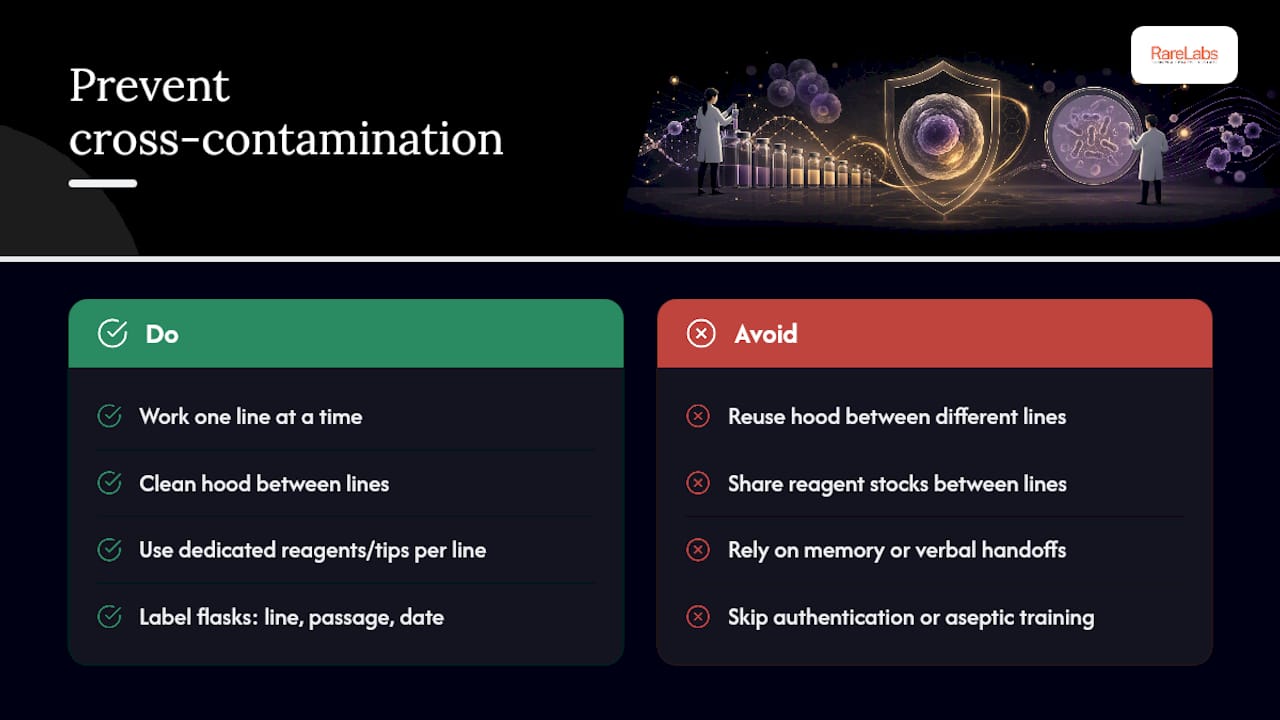
Work with one cell line at a time in a biosafety cabinet whenever the schedule allows, and clean the workspace thoroughly between lines when it doesn't. Aerosols generated during pipetting or media changes travel further than most researchers assume, and a shared hood used back-to-back for two different lines is a common contamination pathway. Dedicate separate reagent bottles, pipette tips, and media aliquots per line where feasible, since a single contaminated stock bottle can seed multiple cultures simultaneously without anyone noticing until an STR check flags it.
Labeling discipline matters as much as physical separation. Use a consistent labeling convention on every flask and cryovial that includes the line name, passage number, and date, and never rely on memory or verbal handoffs between lab members working the same incubator. Segregate new or unverified lines in their own incubator shelf or unit until they clear both mycoplasma screening and STR verification, rather than placing them alongside established, trusted stocks.
Training turnover is an underrated risk factor. New lab members who haven't internalized a lab's specific contamination-prevention habits are statistically more likely to introduce a mix-up, so build authentication and aseptic technique training into onboarding rather than treating it as something people pick up by osmosis.
What Do Journals and Funders Require for Authentication?
Publication standards around cell line authentication have tightened considerably. Many journals now request authentication documentation at manuscript submission and expect that documentation to be current, generally recommending records no older than three years given how much can change over extended culture periods.
Funding bodies have followed a similar trajectory, particularly for grants supporting preclinical and translational work where a misidentified line could derail an entire funded program. Reviewers increasingly ask applicants to describe their authentication protocol as part of the rigor and reproducibility sections that have become standard in grant applications.
This shift reflects a broader accountability push across biomedical research following well-documented cases of misidentified lines contaminating published literature for years before detection. Researchers who build authentication into their standard operating procedure rather than treating it as a submission-deadline scramble tend to avoid the last-minute crisis of discovering a core line failed verification just before a manuscript deadline. Keeping STR records current, dated, and tied to a specific passage number turns a potential publication delay into a non-issue.
What Have Real Authentication Failures Cost Research Labs?
The HeLa contamination saga remains the most cited cautionary tale in the field, and for good reason. HeLa cells' unusually aggressive growth allowed them to overtake other cultures in shared facilities across multiple decades, with researchers later discovering that lines they believed were breast, prostate, or other tissue types were in fact HeLa cells that had silently outcompeted the intended culture. Entire bodies of published work built on those lines required reassessment once the contamination came to light.
Beyond HeLa, misidentification cases have surfaced repeatedly in cancer research specifically, where lines with similar names or shared laboratory origins have been swapped or cross-contaminated without detection for years. Papers built on these compromised lines have required retraction, and downstream research citing those findings has had to grapple with results built on an unreliable foundation.
The pattern that emerges from these cases isn't that any one lab was careless. It's that authentication wasn't yet a routine, enforced step in most laboratory workflows during the decades these contaminations took root. That's precisely what current standards like ANSI/ATCC ASN-0002 and ICLAC's continuous-testing guidance aim to prevent going forward, by making STR verification and mycoplasma screening a routine checkpoint rather than an afterthought triggered only when something looks visibly wrong.
Three Things Every Lab Should Do This Week
Quarantine and STR-test every new line before it touches your main incubator, and put your most irreplaceable stocks through verification now if they haven't been checked recently. Schedule recurring mycoplasma checks on your calendar rather than relying on memory. Build a simple log tracking passage number, freeze date, and last authentication result for every critical line, and make checking it part of onboarding for new lab members. If you ever get an ambiguous or partial STR match, report it, since flagging a problematic line to the community through Cellosaurus or ICLAC prevents the next lab from repeating your mistake.
— John
Consider RareLabs When Verified Modeling Is the Bottleneck
Running STR profiling and mycoplasma screening in-house works when you have the equipment, the trained staff, and patient material to spare for retesting. Not every lab does, especially when working with ultra-rare disease samples where a single biopsy or reprogramming attempt may be the only material available for years. Hopeatrarelabs builds validated authentication directly into its patient-derived modeling pipeline, so families, physicians, and biopharma partners working on scarce genetic material get certified quality assurance without needing to build that infrastructure themselves.

Hopeatrarelabs uses patient-derived induced pluripotent stem cell models, CRISPR-edited isogenic controls, and high-throughput repurposed drug screening, all run through the same authentication discipline covered above, applied to programs where the source material can't simply be reordered from a repository. That matters most when timelines are urgent and the patient's own cells are the only starting point available. If your lab lacks certified QA capacity or is racing a diagnostic odyssey against the clock, explore how a contracted program works through RareLabs Knowledge. For readers who need external CLIA-certified testing without a full outsourced program, biospecimen and CRO testing services are another route worth checking against your specific timeline and budget.
Sources
- Authentication of human cell lines: Standard and guidance (NCBI / NLM)
- Cell line authentication (University of Wisconsin research pathology)
- International Cell Line Authentication Committee (ICLAC)
- Prevention, diagnosis and eradication of Mycoplasma contamination in cell culture (PMC)
- Authentication of cell lines (DSMZ)